Sealed stages vs simultaneous worlds
Both artists re‑enchant vision by refusing naturalism, but they organize seeing in opposite ways. Rousseau halts the world so emblems can speak; Chagall overlaps times and devotions into a single field. This page traces their strongest shared thread—music, animal kinship, and symbolic clarity—and the decisive fork in how each builds a pictorial reality.
Comparison frame: How do Rousseau’s stage‑still dreams and Chagall’s memory‑montages each redefine what a painting lets us see?
Quick Comparison
| Topic | Henri Rousseau | Marc Chagall |
|---|---|---|
| How time works on the canvas | Single, arrested episode; cause and effect muted | Simultaneity; multiple moments coexist |
| Spatial construction | Shallow, stage‑like plane; crisp contour | Overlapping facets; Cubist‑aware montage |
| Imagery sources | Jardin des Plantes, museums, prints; never left France | Vitebsk memory fused with Paris modernism and theater |
| Human–animal relation | Charged nearness and paused threat (sniffing, stillness) | Reciprocal gaze and pact (eye‑to‑eye community) |
| Role of music | Instruments suspend danger and hold a truce | Violin animates, gathers, and carries a village |
| Color logic | Even lighting; enamel clarity; emblematic tone | Prismatic, non‑naturalist color as aura |
| Viewer’s task | Contemplate emblems inside a sealed scene | Navigate a montage of recollection and motifs |
| Avant‑garde position | Self‑taught “outsider,” honored by Picasso and peers | Independent of isms; absorbs but resists formal labels |
Shared Ground
Rousseau and Chagall both reject descriptive realism to re‑enchant what a picture can hold. Instead of optics, they trust symbolic clarity. Rousseau engineers dream stages where danger pauses and meaning gels into simple, legible forms: a lion that only sniffs; a moon that adjudicates. Chagall, arriving in Paris in 1910, adapts avant‑garde geometry to folk memory, layering vignettes until village life feels cosmic and continuous. In both, animals are not props but partners. Rousseau’s beasts approach with uncanny restraint; Chagall’s cow or goat meets a villager eye‑to‑eye, establishing reciprocity rather than spectacle.
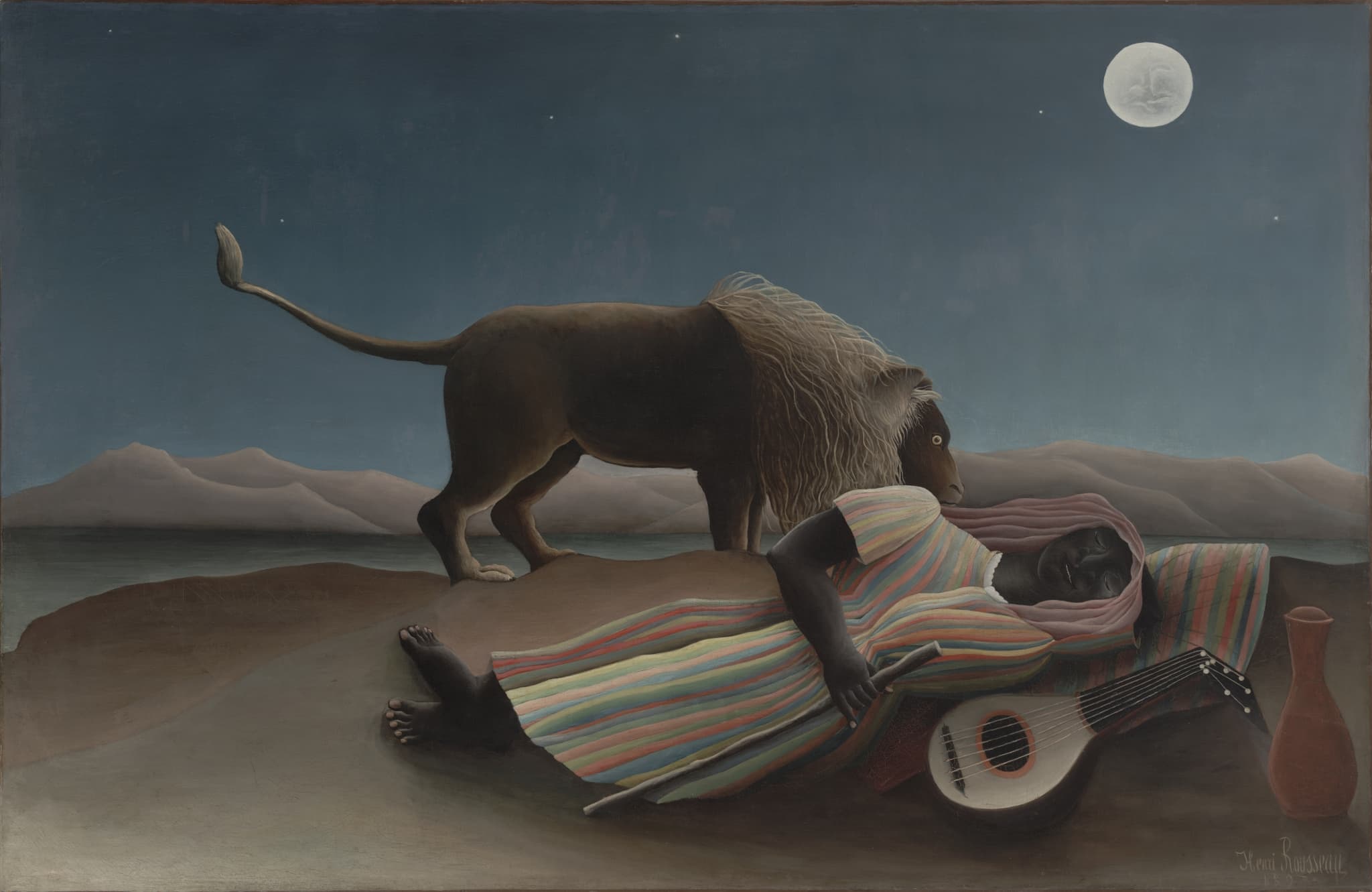
Music mediates their worlds. In Rousseau, a mandolin, pipe, or flute stills the night and suspends threat, as in The Sleeping Gypsy or the eerie calm of The Snake Charmer. In Chagall, the violin is agency itself: an overscaled fiddler strides roofs and binds a community’s time, distilled in The Green Violinist and rooted in stage work for the Moscow State Jewish Theater. Both were welcomed by the Paris avant‑garde despite outsider statuses—Rousseau a self‑taught customs clerk feted by Picasso; Chagall an independent who folded Cubist and Orphic lessons into his own language.
The deepest shared ground, then, is re‑enchantment through non‑naturalism. Each artist constructs a pictorial contract where inner life organizes the visible: culture’s instruments reorder nature; animals and people recognize one another; color signals belief and memory. This is not escape from reality but a bid to reframe it as a readable, ethical space.
Decisive Difference
The decisive difference lies in how each conceives the picture’s time and stage. For Rousseau, painting is a sealed theater of visionary stillness. He composes shallow, evenly lit scenes with crisp outlines and emblematic poses. Action halts at the brink—predators poise, charmed creatures freeze, a sleeper breathes under a white moon—so that forms can declare themselves with ceremonial clarity. Crucially, his jungles are constructed from mediated sources in Paris—the Jardin des Plantes, the Natural History Museum, illustrated prints—rather than travel. That distance produces an art of distilled tokens: leaves like cutouts, eyes like moons, instruments like shields. We “see” by accepting suspension, reading a simplified repertoire for symbolic truth.
Chagall treats the canvas as simultaneity: lived time folded into a montage. He overlays village episodes, floating lovers or fiddlers, inverted figures, and interlocking gazes within Cubist‑aware geometries. Color acts as aura, not atmosphere—greens and violets announce states of spirit and memory rather than light. I and the Village condenses a pact between human and animal, a milking scene nested inside a muzzle, an upside‑down passerby and a church dome—all at once. The Green Violinist magnifies the musician into a guardian whose bow literally spans the horizon. We “see” by traversing layers of recollection, linking motifs across planes and seasons.
Rousseau arrests the world so an emblem can be grasped; Chagall overlaps worlds so community can be imagined together. Stillness versus simultaneity—this is the hinge that reveals how each understands painting’s power.
Paired Works
Music: stillness versus agency
Focus question: When music enters the picture, why does Rousseau’s instrument still danger while Chagall’s violin sets a village in motion?
The Sleeping Gypsy vs The Green Violinist
Rousseau’s sleeper is guarded by culture’s quiet tools: a mandolin and a water jar sit intact at the body’s edge as a lion pauses to sniff. The scene’s hush is architectural—flat bands of sand, water, hills, and sky; a white moon like a seal. Music is present as potential and order, not sound; it suspends predation and locks the world into a temporary truce. In Chagall, music acts. The giant fiddler strides rooftops, bow stretched like a horizon, coloring the village with a green‑faced aura. Houses facet and tilt as if vibrating with the tune; one foot alights while the other hovers, refusing gravity. Where Rousseau posits art as a protective boundary that holds fear at bay, Chagall makes art the engine that carries communal time. Both images elevate instruments beyond entertainment, but their physics diverge: one composes silence to domesticate danger; the other releases rhythm to animate and bind a place.
Two models of dream‑logic
Focus question: What changes when a dream is staged as a single emblem versus braided as a living memory?
The Dream vs I and the Village
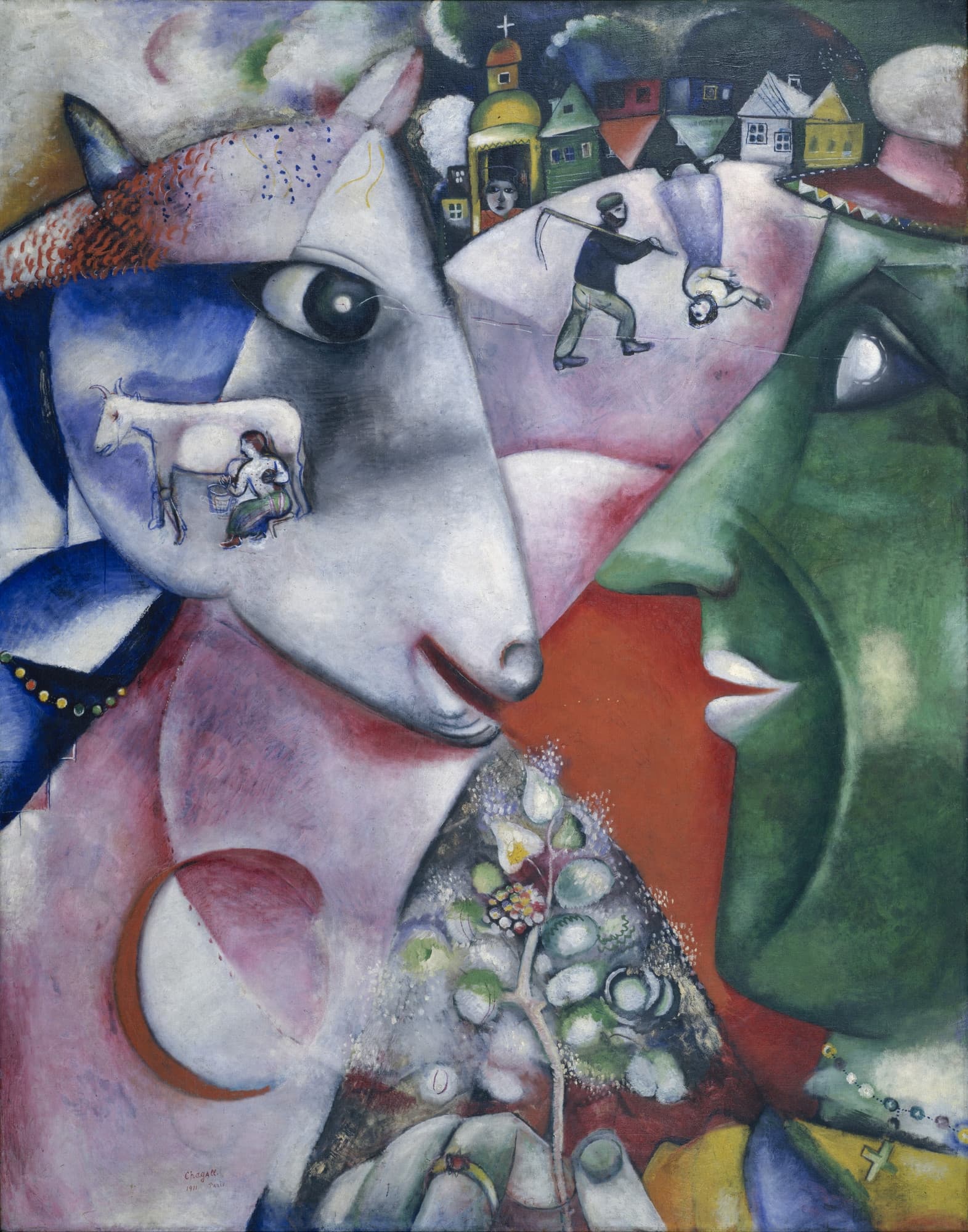
Rousseau’s The Dream presents a nude reclined on a sofa improbably set in a jungle meticulously compiled from Parisian sources. The plants and animals behave like actors under stage lights; a snake charmer’s music seems to hold the scene in suspended awe. Time is arrested so that symbols can be legible: the luxuriant leaves, the poised animals, the ornamental moonlight. By contrast, Chagall’s I and the Village refuses a single episode. A villager and an animal lock eyes across a red axis; inside the animal’s muzzle, a woman milks—memory within memory. Figures float and invert, a church dome glows, a scythe cuts across seasons. The picture’s grammar is simultaneity: Cubist‑aware planes serve mnemonic links rather than analysis. Rousseau uses dream to purify and stage a vision; Chagall uses dream to laminate experiences until a commons appears. Both deny ordinary gravity, but one clarifies an emblem while the other composes a community of moments.
Enchantment and control
Focus question: How do the artists picture culture’s power over fear and nature?
The Snake Charmer vs The Green Violinist
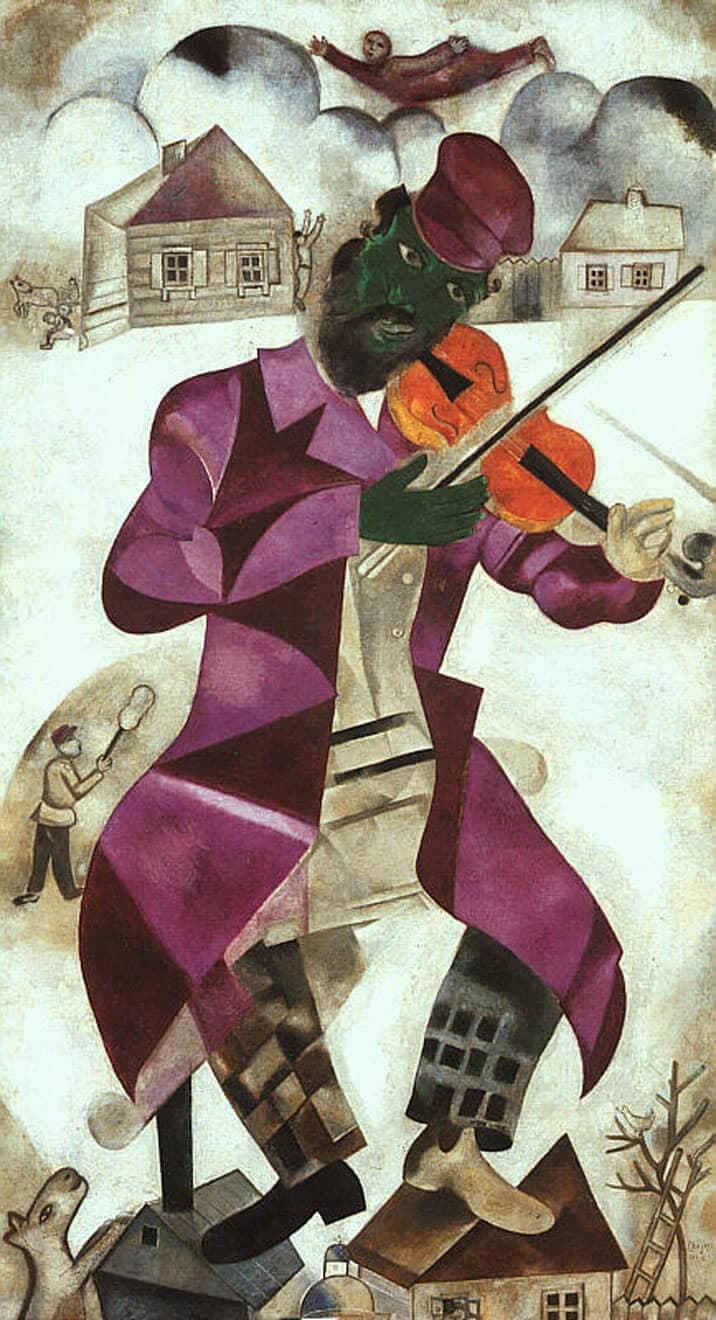
Rousseau’s charmer, silhouetted in moonlit black, pipes a line that freezes the jungle. Snakes rise in eerie unison; foliage becomes a patterned wall; sound translates into immobilization. It is enchantment as arrest: culture subdues the unknown by stilling it inside a shallow, legible stage. In Chagall’s Green Violinist, enchantment is kinetic. The fiddler is overscaled and otherworldly, yet careful—stepping across pitched roofs without crushing them. His bow unites sky and street; prismatic color reads as aura rather than description. Here music does not halt danger so much as sustain a dispersed community, improvising balance across rooftops and seasons. The comparison sharpens the artists’ ethics of culture: Rousseau proposes measure as a protective spell that contains fear; Chagall proposes song as a moving bond that carries the vulnerable. Both trust music to mediate between nature and human life, but one pictures control as stillness, the other as ongoing motion.
Why This Comparison Matters
This comparison clarifies two durable options for modern vision. Rousseau shows how simplification and suspension can grant symbolic force to ordinary things—a jar, a mandolin, a moon, a lion’s breath. He models a way of looking that halts the rush of events so meanings can settle. Chagall offers the complementary tool: a picture that behaves like memory, where places, rituals, and affections overlap until a living community emerges on one plane. He models how art can braid dispersed experience without flattening it.
Together they argue that painting is not bound to optics. It can regulate fear, honor reciprocity with the nonhuman, and transmit culture across distance and loss. For readers today, the fork—stillness versus simultaneity—maps onto how we process the world: either by clearing a stage for emblems or by composing montages of connection. Knowing the difference helps you see why a lion’s pause feels fateful in Rousseau, and why a green fiddler can carry an entire town in Chagall.
Related Links
Sources
- MoMA Collection: Henri Rousseau, The Sleeping Gypsy (1897)
- Musée d’Orsay: Douanier Rousseau—Archaic Candour (exhibition overview)
- Musée de l’Orangerie: Henri Rousseau—Painter’s Ambition (exhibition overview)
- National Gallery, London: Tiger in a Tropical Storm (Surprised!)
- MoMA Collection: Marc Chagall, I and the Village (1911)
- MoMA Collection: Henri Rousseau, The Dream (1910)
- Musée d’Orsay: La Charmeuse de serpents (The Snake Charmer)
- Musée Picasso–Paris (CEP): Picasso at the Bateau‑Lavoir
- MarcChagall.com: Themes—Music
- YIVO Encyclopedia: Chagall, Marc (GOSET and the violinist archetype)
- SFMOMA: Chagall’s independence from formal movements (press release)
- MoMA Collection: Robert Delaunay (context for chromatic simultaneity)