Rousseau vs Picasso
Both rebuild painting by constructing how we see, not by imitating the world. Rousseau engineers lucid, sealed stages where time seems paused; Picasso splinters form and space so the viewer must reassemble perception. Animals, masks, and lighting become thinking devices—calm witness versus eruptive exposure.
Comparison frame: How do Rousseau’s dream‑stage and Picasso’s fracture‑stage each change what looking in painting can do?
Quick Comparison
| Topic | Henri Rousseau | Pablo Picasso |
|---|---|---|
| Core view of painting | A stage for visionary stillness—images as clear emblems | An instrument of perceptual shock—forms to be reassembled |
| Space | Shallow, frontal bands; depth reduced to planes | Multiperspectival fracture; depth collapsed into shards |
| Light as meaning | Even moonlight that cools action into vigilance | Clashing bulb vs oil lamp—exposure, crisis, witness |
| Source material | Zoos, botanical gardens, world’s fairs, illustrated books | Iberian sculpture, African masks, photography’s rhetoric |
| Motifs as devices | Predators and patterned foliage as poised allegories | Bull/horse, mask physiognomies as unstable, public signs |
| Tempo of looking | Slow, sealed, contemplative | Accelerated, unsettled, reconstructive |
| Public address | Self‑contained icons (night scenes, jungles) | From studio shocks to mural‑scale civic indictments |
Shared Ground
Rousseau and Picasso meet on a crucial ground: both rebuild painting as a constructed way of seeing rather than a window onto reality. Each rejects deep, naturalistic space in favor of shallow, staged arenas where figures, animals, and props act like legible signs. Rousseau’s jungles, deserts, and moonlit banks read as frontal planes stacked like a collage; Picasso’s proto‑Cubist and Cubist rooms fracture perspective so that contour and plane do the work once done by recession. The result in both cases is not imitation but designed vision.
They also turn to non‑academic sources to remake the eye. Rousseau mined the Jardin des Plantes, world’s fairs, and illustrated books to synthesize “exotic” fauna and foliage into emblematic scenes; Picasso’s study of Iberian heads and African masks—encountered in Paris collections—helped him short‑circuit Western ideals of beauty and single‑point perspective. In their hands, animals, masks, and light become thinking devices: Rousseau’s watchful predators and moon witness poised danger; Picasso’s bull and horse, the harsh bulb and fragile lamp, stage arguments about modernity, violence, and human testimony.
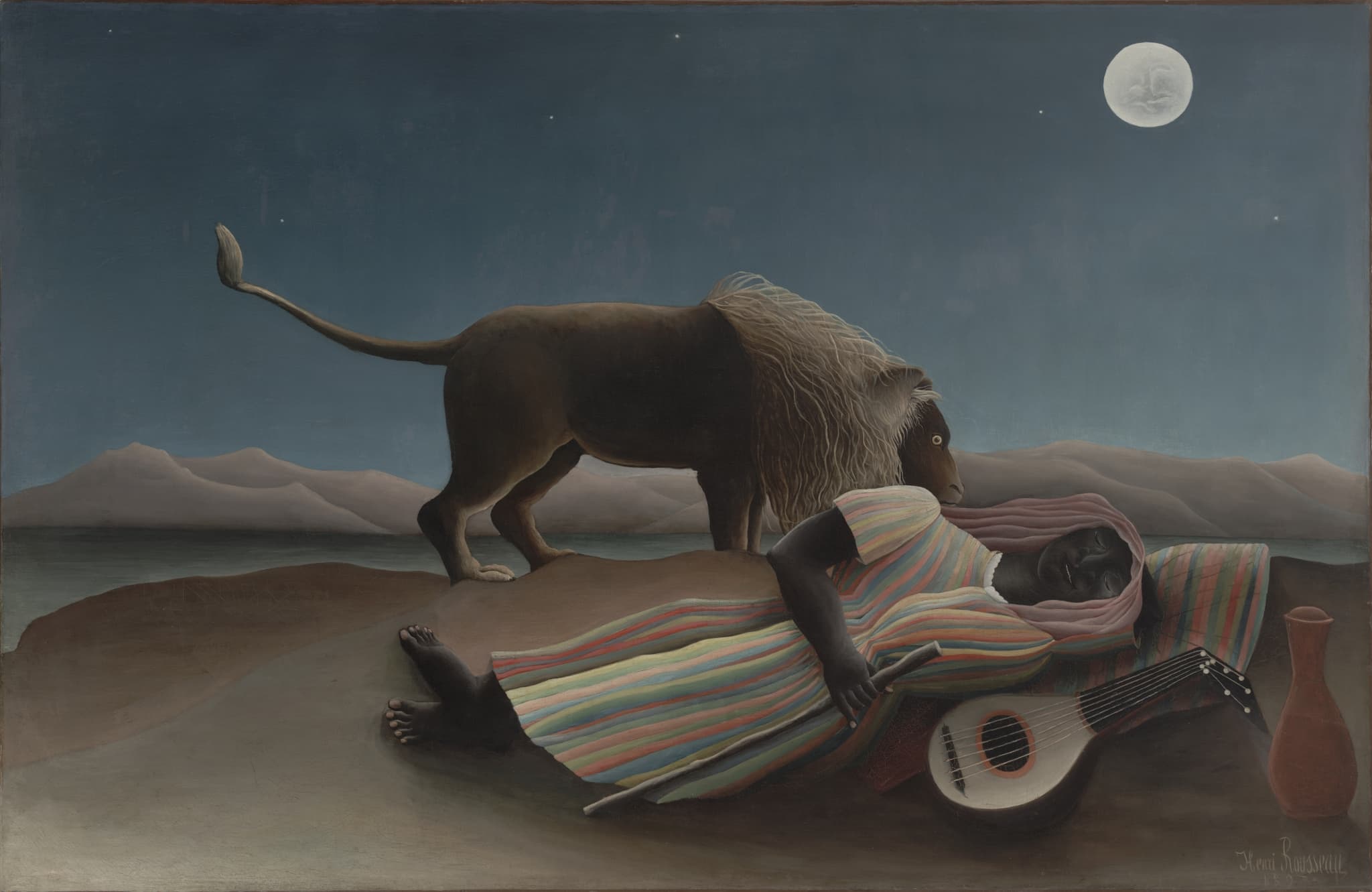
There is a concrete historical tie: Picasso publicly championed Rousseau, hosting the 1908 “Banquet Rousseau” at the Bateau‑Lavoir. That esteem signals a shared wager about the future of painting: pictures should be built, not copied; meaning should arise from structure. Whether in the suspended calm of The Sleeping Gypsy or the jagged urgency of Guernica, both artists use flattened space, emphatic contour, and emblematic props to reprogram how a painting asks us to look—and to think.
Decisive Difference
The decisive split is tempo and pressure. Rousseau slows and seals perception. He engineers lucid stages where time feels paused and danger is suspended: a lion sniffs but does not strike; rain falls as a rhythmic screen; moonlight levels textures into clarity. Because his jungles are compiled from Paris’s image banks, their inventedness is explicit and serene: outline governs, pattern repeats, and even predators become emblems inside a self‑contained world. The viewer’s task is contemplative decoding—reading relations held in calm equilibrium.
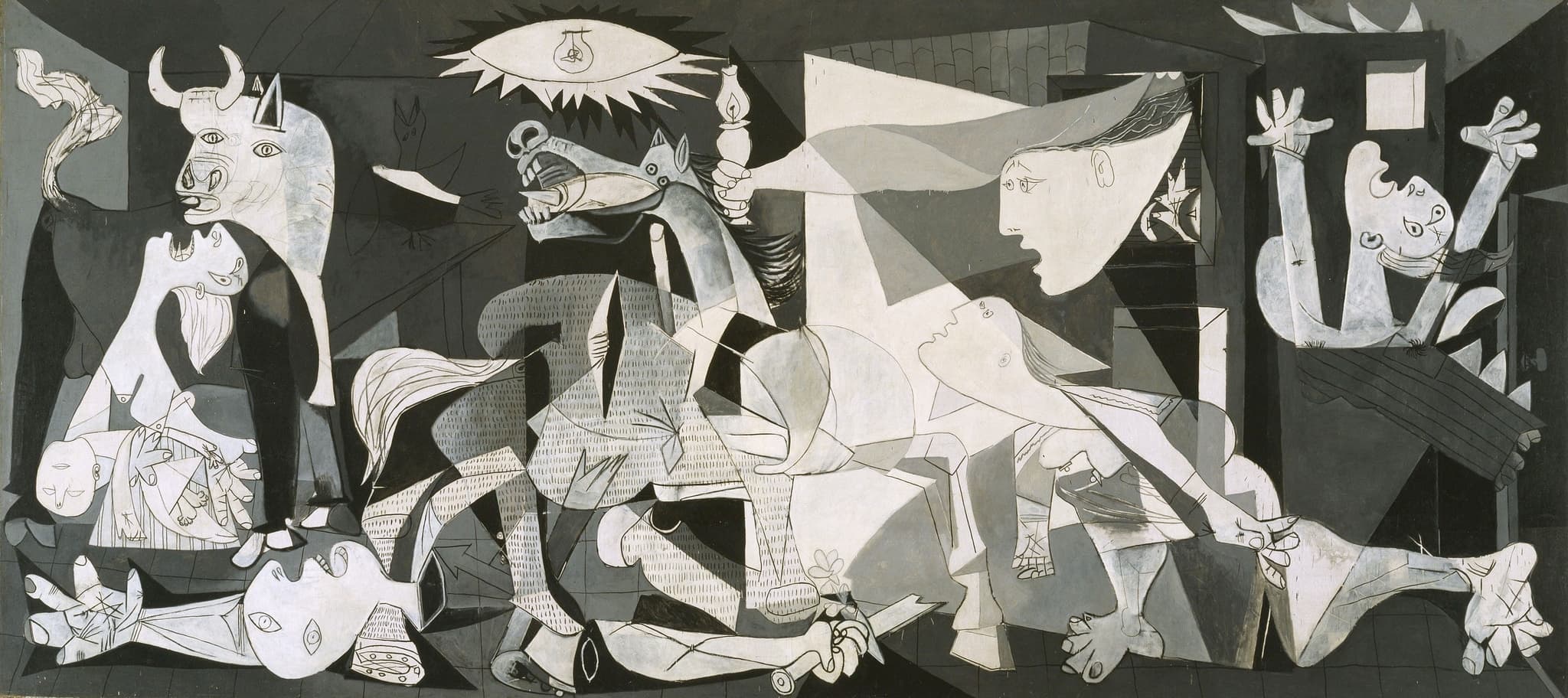
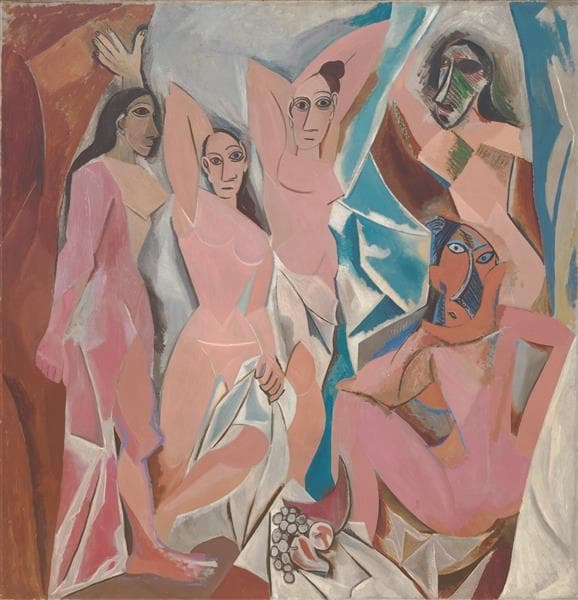
Picasso, by contrast, accelerates and unsettles perception. From Les Demoiselles d’Avignon onward he fuses multiple viewpoints and hard contours so the eye must build the image in real time; looking becomes labor. In Guernica he scales this syntax to public catastrophe, draining color to newsprint grisaille and setting an electric bulb against a hand‑held lamp so illumination itself becomes crisis and witness. Where Rousseau’s moon is a cool observer, Picasso’s bulb is a violent, all‑seeing glare; where Rousseau’s figures remain intact within ordered planes, Picasso’s bodies and faces splinter into shards that indict both atrocity and the complacencies of vision.
In short: Rousseau makes painting a sanctuary of visionary stillness; Picasso makes it a site of shock and accountability. Both construct images, but one seals the stage so symbols resonate in suspended time, while the other fractures the stage so meaning arrives through collision and reconstruction.
Paired Works
Suspension vs Eruption: Night and Light
Focus question: How do a moon and a bulb rewrite what a painting asks us to witness?
The Sleeping Gypsy vs Guernica
Re‑staging the Nude
Focus question: What happens when the nude becomes an icon built from planes instead of an illusionistic body?
The Dream vs Les Demoiselles d'Avignon
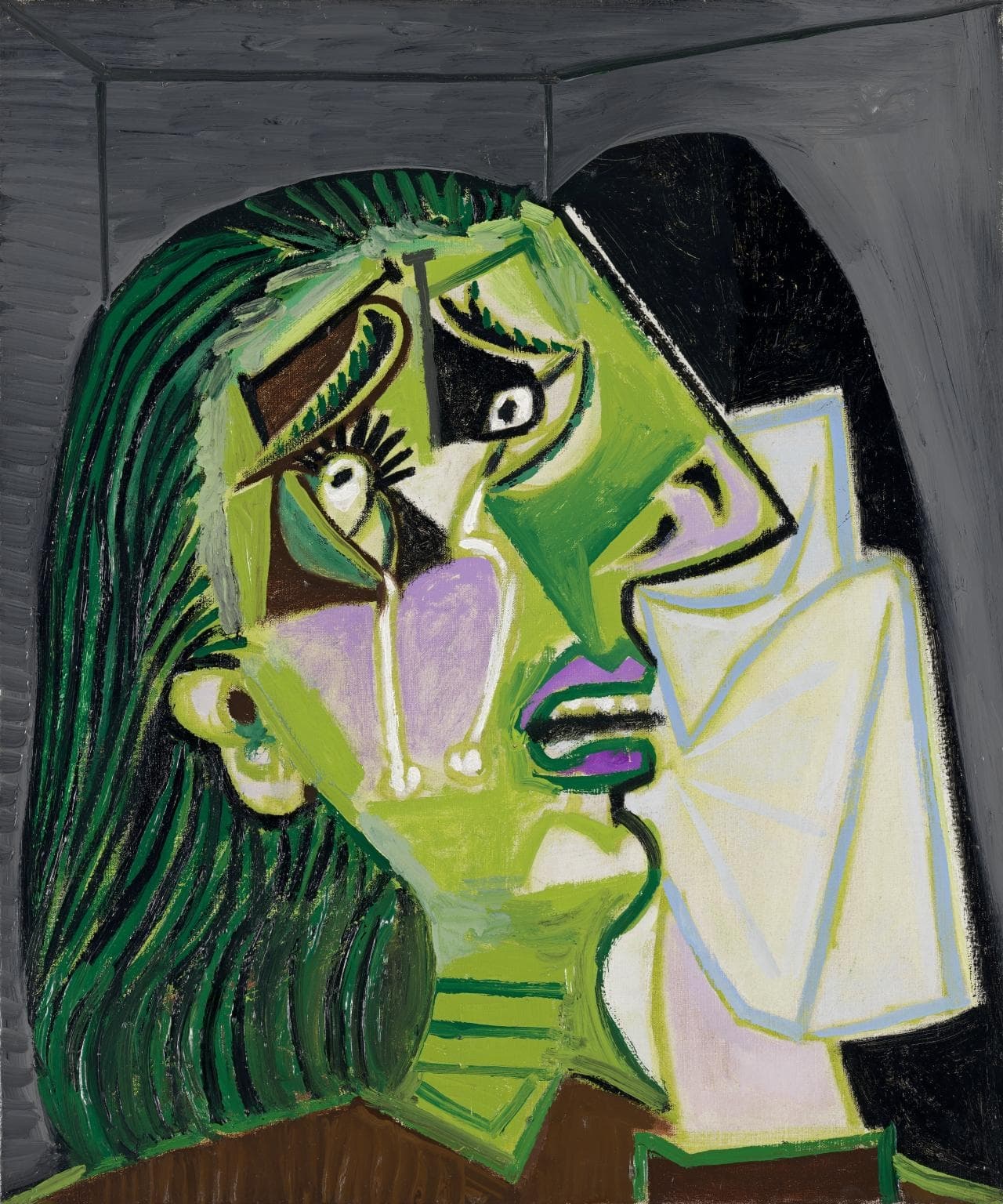
Patterned Menace vs Iconic Trauma
Focus question: How do contour and pattern externalize fear in a tableau versus a mask‑like head?
Tiger in a Tropical Storm (Surprised!) vs The Weeping Woman
Why This Comparison Matters
This pairing clarifies two durable programs for modern vision. Rousseau proves that radical simplification can carry metaphysical weight: by sealing space and equalizing light, he turns outline, pattern, and emblem into a language for inward balance—an approach that later nourished Surrealism’s suspended narratives. Picasso proves that the same tools—flattened space, hard contour, borrowed masks—can be sharpened into civic critique: perception itself becomes the drama, from the proto‑Cubist brothel to Guernica’s public lament in newsprint tones.
Seeing these logics together refines how we read modern art’s borrowings and its ethics. Both artists used non‑European or non‑academic sources encountered through Paris collections and displays; acknowledging those routes and their colonial entanglements helps us parse the power and the cost of “primitivism.” Above all, the comparison gives viewers a practical lens: ask whether a picture slows and seals looking into emblematic clarity, or accelerates and unsettles it into reconstruction. That simple test can unlock works far beyond Rousseau and Picasso.
Related Links
Sources
- MoMA: Henri Rousseau, The Sleeping Gypsy
- MoMA: Pablo Picasso, Les Demoiselles d’Avignon
- Museo Reina Sofía: Dora Maar’s photographs of Guernica’s making
- Smarthistory: Picasso, Guernica
- National Gallery (London): Henri Rousseau, Tiger in a Tropical Storm (Surprised!)
- Larousse Encyclopédie: Le Bateau‑Lavoir (Banquet Rousseau, 1908)
- MoMA: Henri Rousseau artist page
- Art Institute of Chicago: Picasso, Weeping Woman I (series context)
- Museo Reina Sofía: Rethinking Guernica (work history and itinerary)
- Musée d’Orsay: Douanier Rousseau—Archaic Candour