Event‑field or constructed image?
Both artists rebuild the task of looking. Each moves meaning from subject matter to procedure and makes the eye work across a constructed surface. Pollock turns painting into an event‑field you read bodily; Picasso builds images that analyze and re‑signify the world.
Comparison frame: How do Pollock’s all‑over fields and Picasso’s fractured figures ask us to see: as an immersive event or as an analytic construction?
Quick Comparison
| Topic | Jackson Pollock | Pablo Picasso |
|---|---|---|
| What a painting is | A performed event fixed as surface | A constructed image made of analytic parts |
| How vision is organized | Centerless, all‑over scan | Multi‑view, faceted relations |
| Composition and space | Even activation; shallow depth as field | Shallow, designed stage; edges articulate space |
| Where meaning resides | Procedure, tempo, layering of pours | Syntax of signs: planes, contours, collage emblems |
| Time in the picture | Legible passes; chronology of action | Simultaneous viewpoints; revisions collapsed |
| Role of subject matter | Minimized; process becomes subject | Central; figures and icons carry history |
| Viewer’s task | Bodily immersion; track rhythm and density | Decode relations; read symbols and structure |
| Emotional delivery | Atmospheric and rhythmic; nonfigurative | Iconic and emblematic; figure‑ or sign‑bound |
Shared Ground
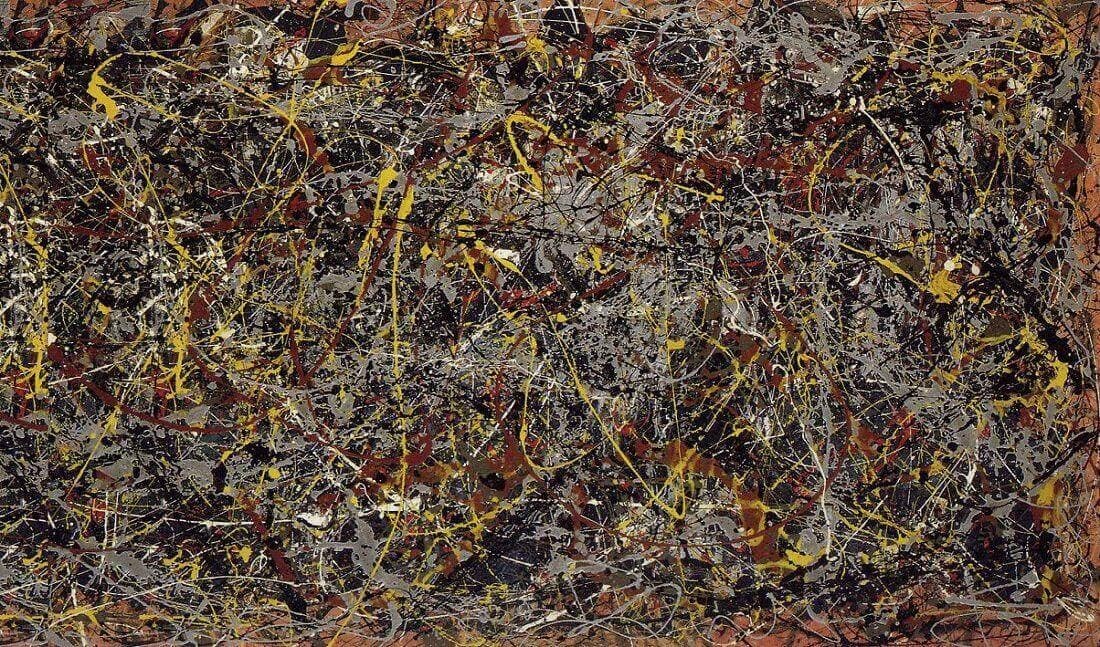
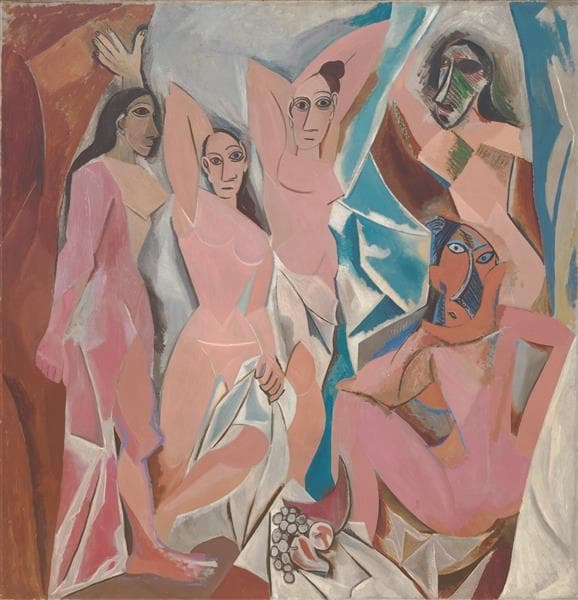
Pollock and Picasso remake what a painting asks the eye to do. The Renaissance single viewpoint gives way to a field of relations the viewer must build: Picasso by presenting facets and simultaneous views that deny a resting center; Pollock by saturating the surface so no inch is subordinate. In Les Demoiselles d’Avignon, room and bodies splinter into planes that force comparisons across angles and masks; in One: Number 31, 1950, the eye scans an evenly charged mesh. In both, sight becomes a task rather than a window.
Meaning relocates from depicted motifs to procedure. Pollock’s loops, pours, and layered passes make paint behavior itself the subject—an index of action legible as tempo and density; early poured works such as Full Fathom Five read like chronologies. Picasso constructs images from parts that declare their made‑ness—collage, cut contours, or the oilcloth and rope frame of Still Life with Chair Caning—so depiction and thingness meet. Both insert time into the picture: Picasso’s revisions and re‑sightings are collapsed onto a single surface, from the evolving figures of Guernica to the oscillations in late portraits; Pollock’s lattices remain legible as temporal strata, each pass a record of speed, height, and viscosity. The result is modern spectatorship keyed to tracking relations—facet to facet, strand to strand—rather than simply recognizing a scene.
Decisive Difference
The split begins with what a painting is. For Pollock, it is a performed event fixed as a surface. The drip does not abdicate control; studio films and fluid‑mechanics studies show he tuned viscosity, height, and tempo to keep strands coherent. In No. 5, 1948 and One: Number 31, 1950, the all‑over field suppresses hierarchy so action becomes content. The viewer’s task is kinesthetic and immersive: to pace the rhythms of the field, not to locate a center. Hence the image reads as a record you inhabit—an arena of decisions that the eye retraces.
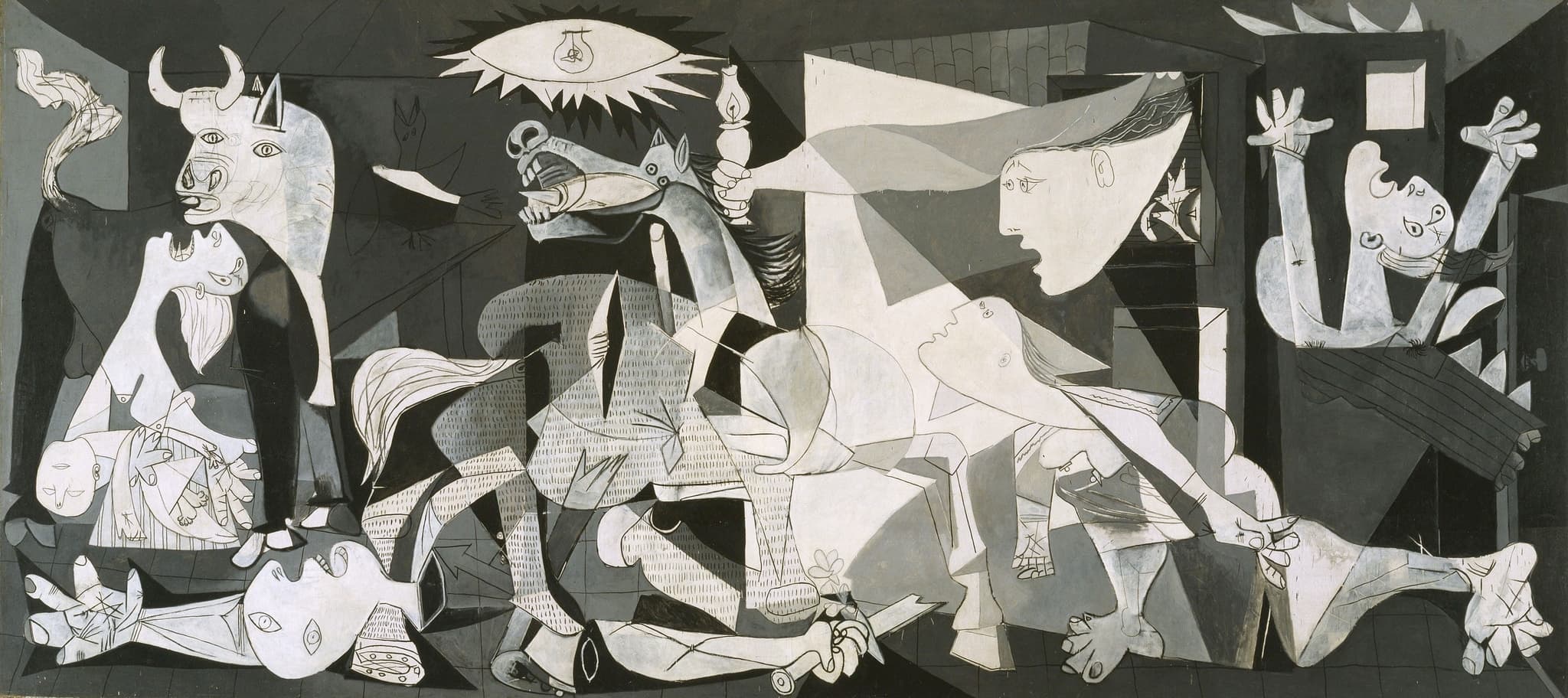
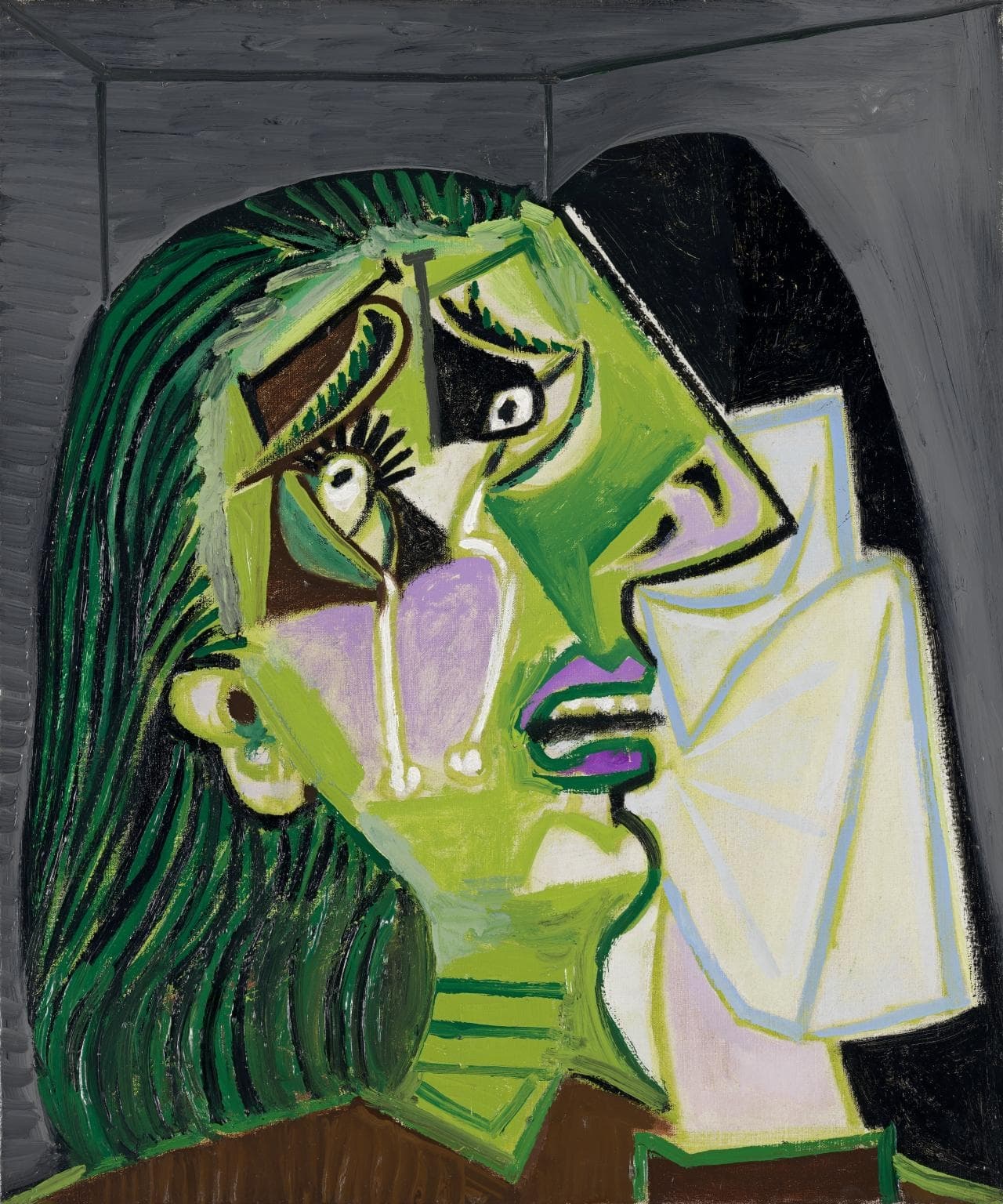
For Picasso, a painting is a constructed image that analyzes and re‑signifies the world. Cubist multiplicity and later emblematic figures keep representation operative, even when fractured. Guernica concentrates horror into readable signs—the horse, the weeping mother, the bulb versus the hand‑lamp—so the mural functions as civic language. The Weeping Woman distills grief into an icon; Still Life with Chair Caning folds real materials into pictorial syntax to test what counts as image. Perception here is analytic and symbolic: you parse a designed system of planes, contours, and inserted things tied to subjects and histories. The difference is not abstraction versus figuration but event‑field versus constructed allegory.
Paired Works
Mural shock: field vs emblem
Focus question: At mural scale, do we read or inhabit the surface?
Breaking the window
Focus question: What replaces the single viewpoint: a centerless scan or a suite of cuts?
One: Number 31, 1950 vs Les Demoiselles d'Avignon
Materials that mean
Focus question: How do materials themselves carry sense—by index or by insertion?
Full Fathom Five vs Still Life with Chair Caning
How painting carries feeling
Focus question: Is emotion delivered as ambient rhythm or as an icon to read?
Number 1, 1950 (Lavender Mist) vs The Weeping Woman
Why This Comparison Matters
Knowing whether a picture asks you to inhabit an event or to decode a construct changes how you see everything from abstraction to posters. Pollock set a template for artworks that mean through process—performance, installation, and many data‑dense paintings inherit his centerless, relational scan. Picasso secured the complementary branch: images as built languages tuned to history, where fragments, icons, or borrowed materials carry social argument. Once you recognize these logics, museum rooms reorganize. A monochrome field, a process video, or a dense network canvas can be read for tempo and layering; a collage, a political mural, or a sharply contoured portrait can be parsed for its syntax of signs. The comparison does not crown a winner. It supplies a durable lens—event‑field versus constructed image—that keeps looking active, lets pleasure and analysis coexist, and clarifies why two very different painters still orient how modern art asks us to see.
Related Links
Sources
- MoMA: Multiple Perspectives (Cubism)
- MoMA: One: Number 31, 1950
- MoMA: Action Painting (term)
- Physics Today: Painting with drops, jets, and sheets
- MoMA Pollock Interactive: 1947 Breakthrough (floor method)
- MoMA Pollock Interactive: Hans Namuth photographs/film
- Musée Picasso: Nature morte à la chaise cannée
- Museo Reina Sofía: Rethinking Guernica
- LIFE Magazine: Pollock at work (1949)
- Clement Greenberg: American-Type Painting (PDF)
- National Gallery of Art: Number 1, 1950 (Lavender Mist)