Action vs relation on a centerless field
Pollock and Mondrian both reinvent the canvas as a fully active field, not a window onto a scene. Pollock turns paint into a visible trace of motion; Mondrian turns color and interval into a calibrated code. Side by side, they show two rigorous ways to build meaning without images. This page isolates their strongest shared ground and the decisive difference that reshapes how we look.
Comparison frame: If both cancel the picture’s center, why does Pollock make us track time and touch while Mondrian makes us feel balance and beat?
Quick Comparison
| Topic | Jackson Pollock | Piet Mondrian |
|---|---|---|
| Field structure | All-over web: no focal point; figure/ground fuse | Non-hierarchical grid: balance via unequal parts |
| Rhythm | Continuous gestural flow read as time | Stepwise syncopation in colored units and white rests |
| Making method | Floor-based pours and throws; acted inscription | Iterative placement; taped tests; measured adjustment |
| Surface cues | Layered viscosities; matte/gloss shifts; aluminum flicker | Opaque planes; primaries plus neutrals; bars as planes |
| Color/line system | Lines are liquid tracks of motion | Lines and blocks are relational units; late works drop black |
| Viewer training | Track sequence, speed, and touch | Sense interval, equivalence, and pause |
| Role of chance | Controlled contingency within fluid dynamics | Minimized contingency; rule-bound calibration |
| What replaces subject matter | Action and time become content | Relations and harmony become content |
Shared Ground
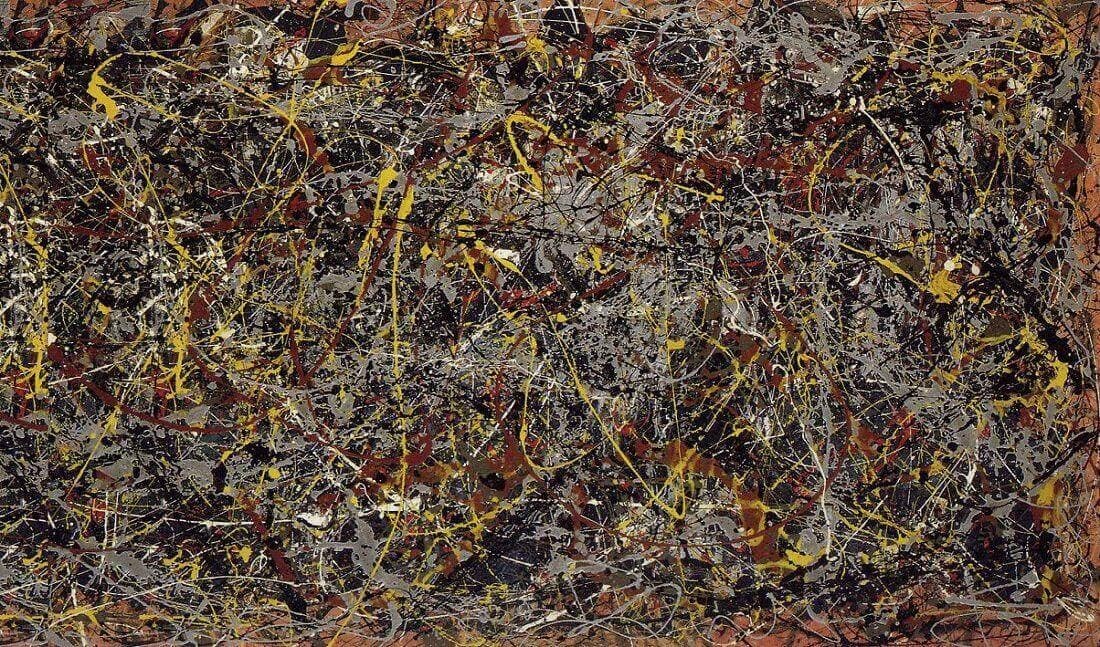
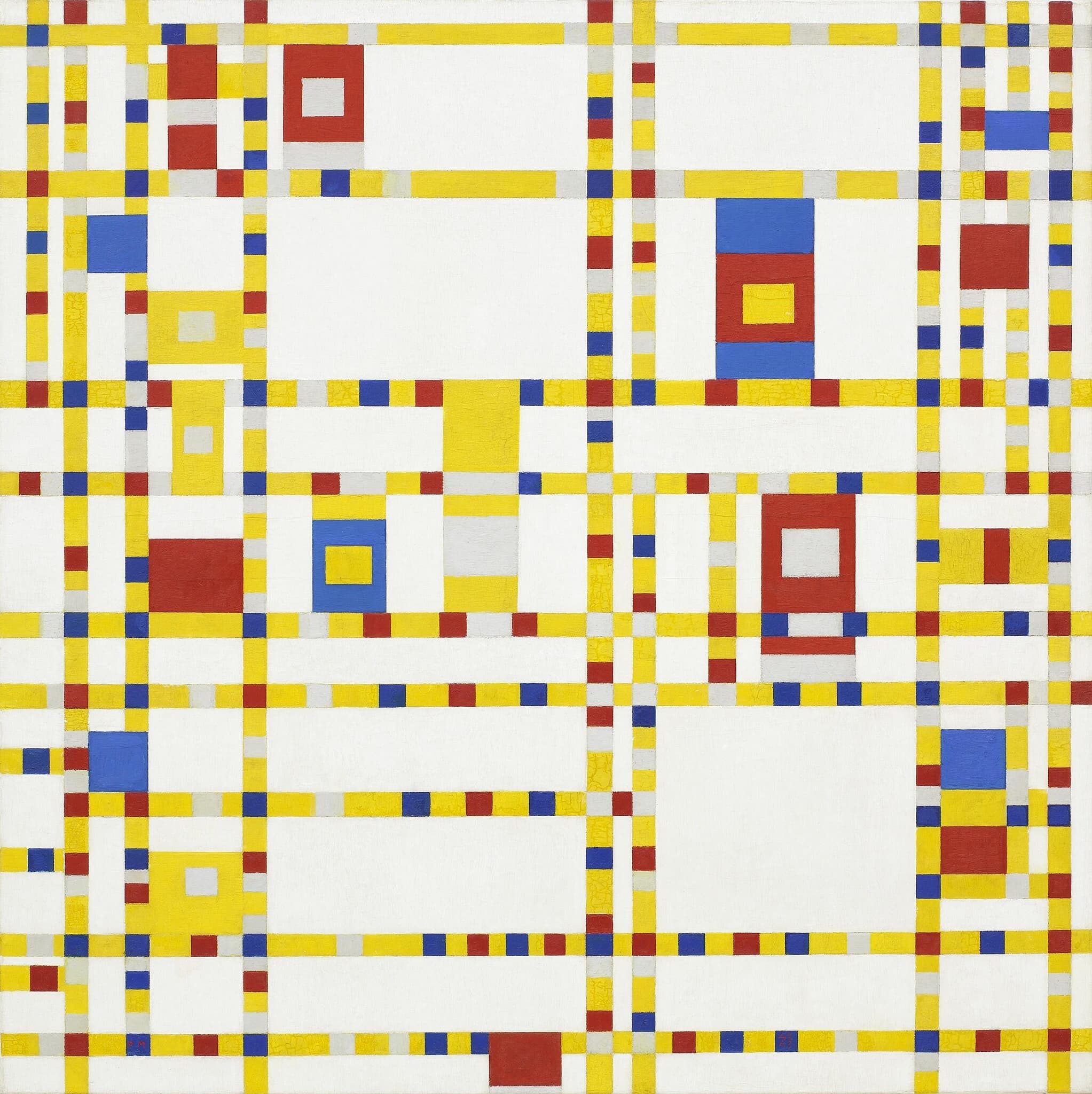
Both artists rebuild painting as a total field. Instead of organizing forms toward a privileged center, they activate every inch of the surface so the eye must scan laterally. Pollock’s One: Number 31, 1950 spreads poured enamel into a centerless fabric of lines; Mondrian’s Broadway Boogie Woogie distributes incident through yellow bands segmented by red, blue, and white tiles. In each case, composition happens as a rhythm distributed across the plane rather than as a figure placed against a ground.
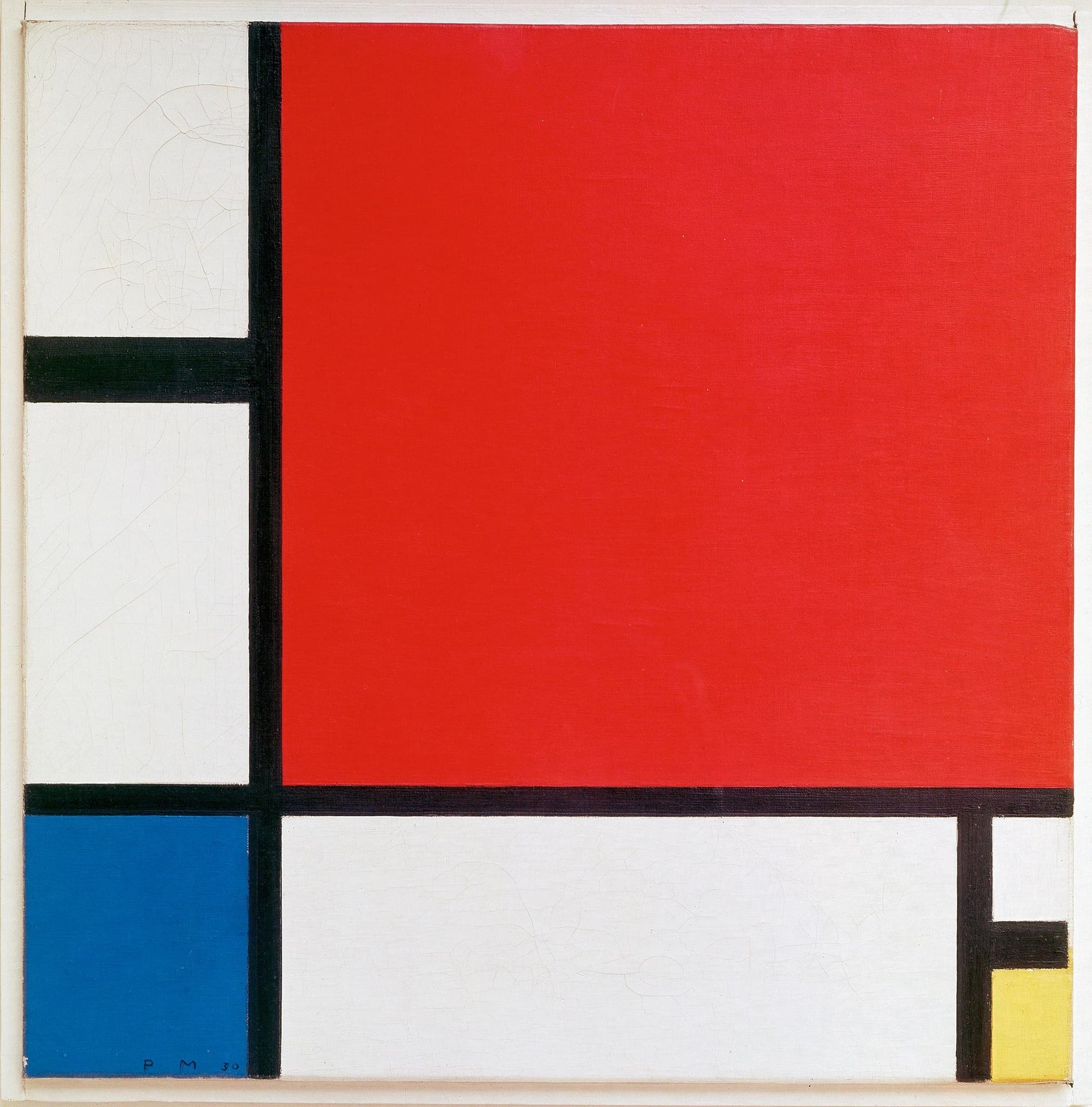
Flatness is not merely a stylistic preference but the source of meaning. Pollock lets industrial enamel sit openly on the surface; his lines are literal deposits that refuse illusionistic depth. Mondrian restricts himself to verticals and horizontals with primaries and neutrals; the black bars and the white rectangles function as active planes, not outlines or blankness. The result is that content moves from depiction to relations that the eye must follow. Pollock’s lines record bodily tempo and shifting viscosity; Mondrian’s intervals produce optical syncopation akin to musical phrasing. Their New York overlap is a telling hinge: in 1943 Mondrian urged jurors to pay attention to Pollock, recognizing a shared project to construct order from a fully activated, centerless field. Seen together, their paintings teach a new kind of looking in which scanning, recurrence, and interval displace traditional subject matter.
Decisive Difference
The decisive difference is how meaning gets inscribed. Pollock makes the canvas an index of action. His poured and flung lines carry the imprint of movement, proximity, and speed; a viewer can read sequence in the way thick, matted strands sit under taut, high-velocity filaments and scattered spatters. He insisted, “I can control the flow of the paint; there is no accident,” and close looking backs this up: filament coherence, changes in gloss, and the avoidance of large puddles mark decisions about height, viscosity, and tempo. We experience the picture as time made visible, a choreography distributed across a field.
Mondrian, by contrast, builds a code of relations. Meaning arises from measured intervals, the halting or continuation of bars, and the equivalence of chromatic units. In Broadway Boogie Woogie he eliminates black, letting chains of small colored squares carry structure; large white rectangles operate as pauses that reset the beat. Victory Boogie Woogie reveals an iterative process of placing, taping, and revising units until balance clicks into place. The viewer is trained not to track gesture but to sense balance through discrete counts and calibrated rests. Where Pollock shows an event unfolding in material time, Mondrian presents a clarified order whose vitality comes from relational tension held steadily in the present. Both are rigorous; one is inscribed as action, the other engineered as interval.
Paired Works
Eliminating the center two ways
Focus question: How does each create a balanced, centerless order without a focal motif?
No. 5, 1948 vs Composition with Red, Blue and Yellow
Rhythm engines: flow vs syncopation
Focus question: What kind of rhythm does each painting make you follow?
Autumn Rhythm (Number 30), 1950 vs Broadway Boogie Woogie
Process made visible: acted vs iterated
Focus question: How does each surface tell you how it was made?
Number 1A, 1948 vs Victory Boogie Woogie
Why This Comparison Matters
Putting Pollock beside Mondrian clarifies two credible blueprints for modern attention. Both reject the centered image and make relations themselves carry meaning, yet they train vision differently. Pollock’s best fields—Autumn Rhythm, One: Number 31, Number 1A—teach you to read a picture temporally: layer over layer, change of speed, wet crossing dry. Mondrian’s—Composition with Red, Blue and Yellow, Broadway Boogie Woogie, Victory Boogie Woogie—teach you to sense balance through intervals, rests, and equivalence.
Those models still shape how images work now. Process art and performance inherit Pollock’s acted surface; systems and information design echo Mondrian’s coded intervals. The comparison also grounds abstraction’s stakes: not escape from the world, but translation of lived forces into legible structure—New York’s grid and boogie-woogie in Mondrian; postwar urgency and bodily scale in Pollock. Learning to see these differences refines how we look at any centerless field, from data dashboards to city maps: do we follow a flow, or do we count relations?
Related Links
Sources
- MoMA, One: Number 31, 1950
- MoMA, Broadway Boogie Woogie
- E-RIHS, Victory Boogie Woogie: materials and methods
- The Met, Autumn Rhythm (Number 30), 1950
- Kunsthaus Zürich, Composition with Red, Blue and Yellow (1930) catalogue note
- MoMA Conservation, Number 1A, 1948
- Harold Rosenberg, The American Action Painters (1952)
- Fluid mechanics of Pollock’s drips
- MoMA Pollock Chronology (Mondrian’s 1943 endorsement)
- LIFE magazine, Pollock feature (Aug 8, 1949)