Two Florentine answers to disegno
Both Botticelli and Michelangelo treat drawing as the mind of painting and the human body as its argument. Each turns to antiquity and Scripture to model ideals for Medici and papal patrons, even sharing the Sistine stage. Yet they steer disegno toward different ends: Botticelli clarifies the world into readable, civilizing beauty; Michelangelo concentrates creation’s force into monumental anatomy.
Comparison frame: Two Florentine answers to disegno: how does Botticelli make thought visible through contour, and how does Michelangelo make origin tangible through the body?
Quick Comparison
| Topic | Michelangelo | Sandro Botticelli |
|---|---|---|
| Core aim | Poetic clarity that civilizes desire (Primavera, Birth of Venus). | Sculptural revelation of life and will (Creation of Adam, Doni Tondo). |
| How the eye learns | By reading contour, emblem, and rhythmic spacing. | By sensing weight, torsion, and charged instants. |
| Typical staging | Frieze-like, shallow stage; patterned grounds. | Monumental figures for an upward gaze; deep bodily volumes. |
| Time logic | Clear sequence and allegorical roles. | Condensed crises; one instant bears the story. |
| Signature domestic format | Tondi that spiral devotion (Madonna of the Magnificat). | A tondo made sculptural and muscular (Doni Tondo). |
| Classicism repurposed | Mythic pageantry for Medici humanism. | Antique anatomy and Laocoön-like torsions as theological engine. |
| Sistine Chapel solution | Episodic wall narratives with architectural separators. | Integrated ceiling field; figures fuse narrative and architecture. |
| Color’s job | Tempera clarity and decorative surface intelligence. | Saturated contrasts that sharpen mass. |
Shared Ground
Botticelli and Michelangelo meet on the Florentine ground of disegno—drawing as intellectual design. In that culture, the line is not a mere outline but the vehicle of thought. Botticelli’s linear grace comes through Lippi’s workshop and Florentine training; Michelangelo’s mastery of draftsmanship made him the era’s emblem of design as invention. For both, the idealized human figure is where meaning happens. Botticelli’s bodies argue for humane, tempered beauty; Michelangelo’s anatomies declare human dignity and dependence on origin. Each mines antiquity not as archaeology but as a toolbox for present ethics: Botticelli’s mythologies couch Medici ideals in classical allegory; Michelangelo’s classicizing nudes sharpen Christian claims about creation and agency.
They also share patrons, places, and formats. Both worked for Medici circles and for the papacy, leaving statements in the Sistine Chapel—Botticelli on the Quattrocento walls, Michelangelo on the High Renaissance ceiling. Both exploit the tondo, a Florentine domestic form: Botticelli orchestrates devotion into a spiral of faces and emblems; Michelangelo compacts a twisting triad into an almost sculptural dome. Across media and scale, each treats painting as more than depiction. It must carry ideas, educate the eye, and measure human life against larger orders—whether the garden of Venus or the spark between God and Adam. This is their deepest shared ground: using disegno and the ideal body to make thought visible.
Decisive Difference
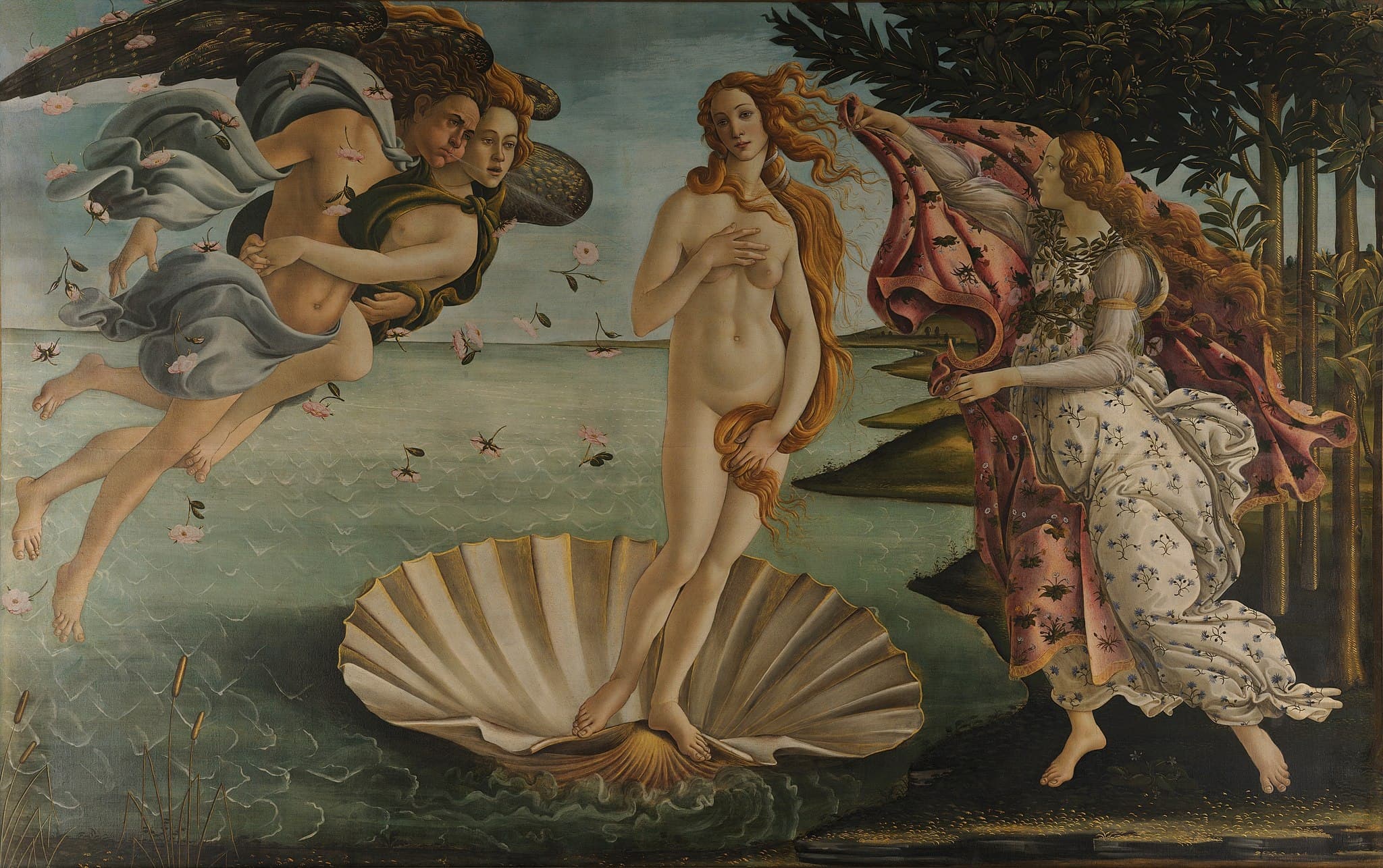
The decisive split is how each artist believes painting teaches us to see. Botticelli turns vision into poetic intelligibility. Line is his instrument of reason: a contour encloses virtue; a frieze arranges conduct. In the Birth of Venus, discrete actors and patterned sea-air clarify an ethic of civilized desire. In Primavera, allegorical roles read across a shallow stage like choreographed verse. Even his tondi—such as the Madonna of the Magnificat—make a circle think by spiraling signs (quill, crown, fruit) into a legible liturgy. Botticelli’s picture space is a grammar where emblem, posture, and costume translate beauty into social and moral order.
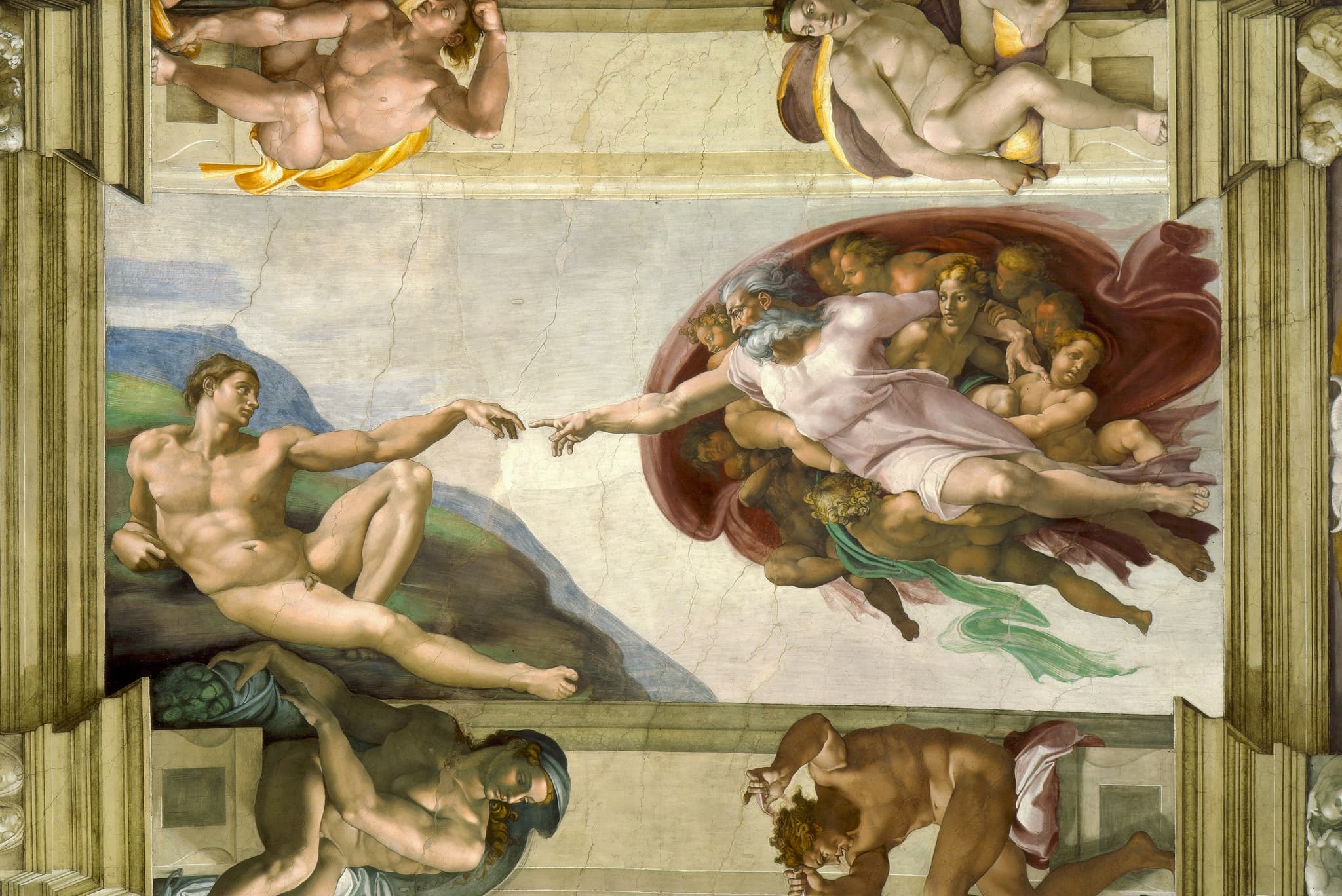
Michelangelo, by contrast, makes painting into sculptural revelation. Mass, torsion, and a compressed instant deliver experience as felt force. In the Creation of Adam, the micro-gap between fingertips and the opposition of slack and taut bodies concentrate Genesis into bodily voltage. The Doni Tondo compacts a twisting family like a living statue, with antique nudes beyond a low wall as a foil. On the Sistine ceiling, single figures can carry a program through sheer anatomical authority. Where Botticelli asks us to read line as idea, Michelangelo asks us to sense power in the body. One clarifies origins as arrival and order; the other renders origin as energy entering form.
Paired Works
Origins: arrival vs spark
Focus question: Which beginning does each image stage—appearance or animation?
The Birth of Venus vs The Creation of Adam
Both scenes are threshold images, but they define origin differently. Botticelli presents an arrival: Venus borne ashore reads as beauty entering the human realm. Contour is sovereign—crisp silhouettes, a patterned sea, and choreographed actors (winds, attendant) turn motion into legibility. The meanings are readable at a glance: roses and myrtle, modest pose, and a welcoming mantle civilize desire into ethical love. Space feels stage-front and continuous, so the viewer proceeds by scanning emblems and aligning them into sense.
Michelangelo stages animation: Adam is already formed yet inert, and the instant before contact becomes the entire drama. Force is the language—opposed body vectors (slack Adam, taut God), swelling volumes, and saturated color focus everything on the micro-gap between fingers. Rather than reading attributes, we register energy loading into a body. The panel condenses time into voltage, turning painting into an instrument for sensing causality rather than for parsing symbols. Arrival versus spark: Botticelli clarifies an ideal’s entry; Michelangelo reveals life about to begin.
How a circle thinks
Focus question: What does each tondo make the viewer do with eye and body?
Madonna of the Magnificat vs Holy Family (Doni Tondo)
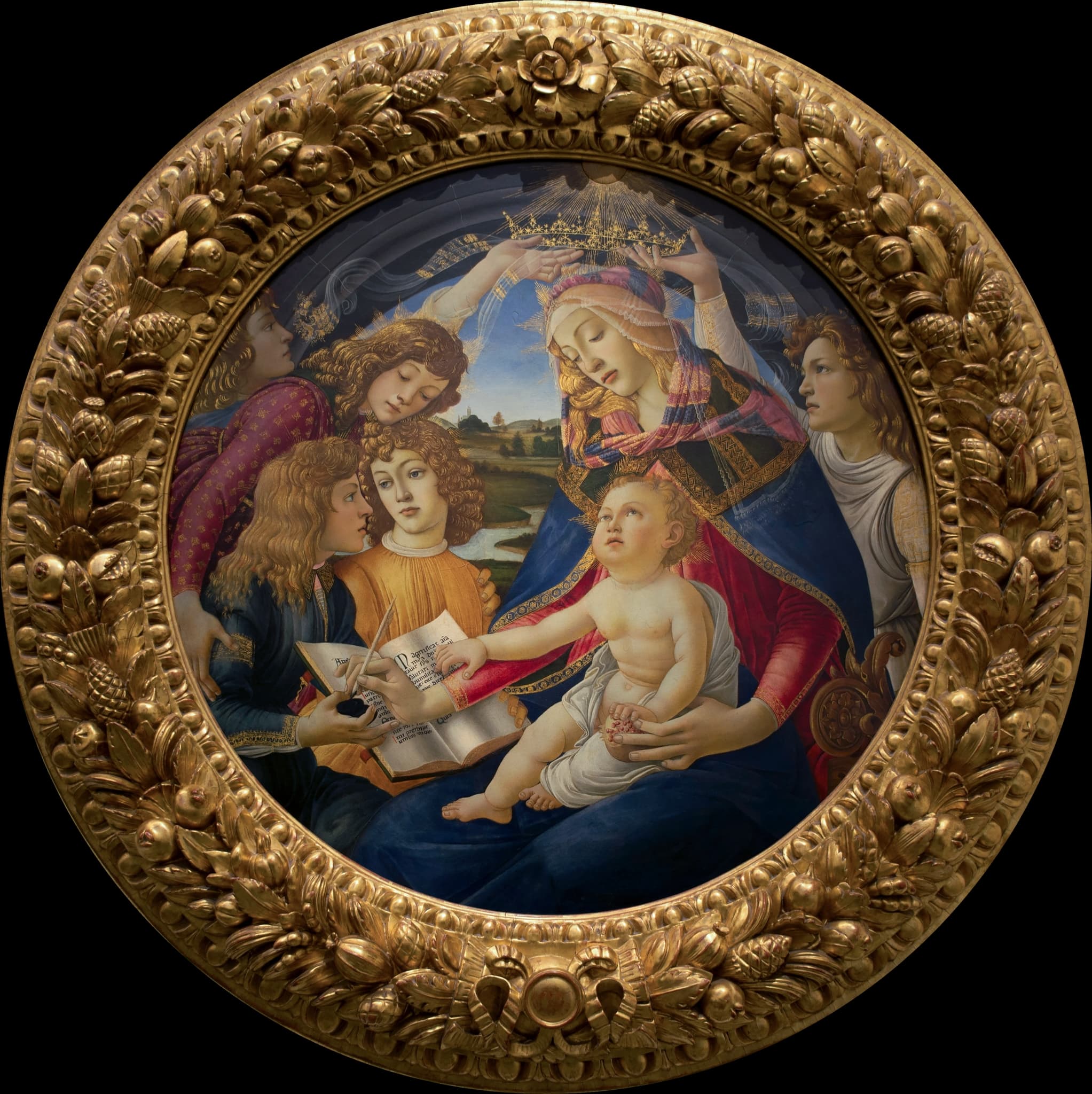
Botticelli treats the circle as a ceremony of reading. Faces, hands, and fabrics spiral into the hinge where Mary’s quill touches the page, the Christ Child guiding her wrist. Emblems—crown, book, pomegranate—are placed like clauses that the eye connects, turning devotion into a legible liturgy. The roundness secures continuity of praise; the figures’ gentle rhythms keep the surface planar so that meaning travels cleanly along contour and attribute.
Michelangelo uses the tondo as a pressure vessel. The Holy Family twists within a tight circumference as if carved in the round; Mary’s muscular swivel, Joseph’s counter-turn, and the Christ Child’s climb generate torque that holds the composition together. Behind a low wall, antique nudes set a classicizing register and a moral contrast. Color blocks and hard modeling make the circle feel like a dome of body and will. The viewer’s eye doesn’t read emblems so much as track weight shifts and pivots—experience is delivered as mass under tension. Two circles, two logics: Botticelli’s circle organizes signs; Michelangelo’s compacts force.
Telling Scripture: stage vs crisis
Focus question: How do architectural sequence and bodily compression shape meaning?
Temptations of Christ (Sistine Chapel) vs The Fall and Expulsion from the Garden
On the Sistine Chapel wall, Botticelli parcels the Temptations of Christ into discrete episodes mapped across an architectural stage. Clear separators and calibrated gestures produce a readable sequence: the viewer advances scene-by-scene, grasping moral tests through staging and emblem. It is narrative as pedagogy by design, suited to the large wall’s public clarity.
On the ceiling, Michelangelo fuses the Fall and Expulsion into a single, violently continuous field. The serpent coils around the central tree as Adam and Eve reach; the same bodies, abruptly transformed, are hurled out to the right. Architecture retreats; the story is carried by torsion, scale, and the shock of adjacent postures. One compressed crisis replaces staged sequence. The contrast is decisive: Botticelli clarifies Scripture through spatial organization and emblematic pacing; Michelangelo concentrates it into bodily drama where time snaps and consequence is felt in the muscles.
Why This Comparison Matters
Seeing Botticelli beside Michelangelo clarifies what disegno could do in Renaissance Florence. The same devotion to drawing yields two distinct kinds of knowledge: a grammar you can read and a force you can feel. That split helps decode not only these masters but whole traditions—panel allegories, domestic tondi, and courtly myth on one side; monumental fresco cycles and sculptural painting on the other. It also sharpens looking habits. With Botticelli, attention to contour, spacing, and emblem pays dividends; with Michelangelo, tracking torsion, weight, and the charged instant opens meaning.
The comparison reframes clichés. Line is not “mere decoration” in Botticelli; it is an ethics of clarity. Muscle is not “show” in Michelangelo; it is theology made tangible. Both artists ask painting to carry ideas, but they route that task through different senses—reading versus sensing. Learning to switch between those modes equips a viewer to navigate Renaissance art with greater precision and, by extension, to recognize today when images aim to instruct through legibility or to persuade through embodied impact.
Related Links
Sources
- Uffizi Galleries: The Birth of Venus
- Uffizi Galleries: Primavera (Spring)
- Uffizi Galleries: Madonna of the Magnificat
- Uffizi Galleries: Holy Family (Doni Tondo)
- Vatican Museums: The Creation of Adam
- Vatican Museums: Sistine Chapel – History
- The Met: Michelangelo—Divine Draftsman and Designer
- National Gallery (London): Disegno (glossary)
- Britannica: Sandro Botticelli – Secular patronage and works
- Wikipedia: Temptations of Christ (Botticelli)