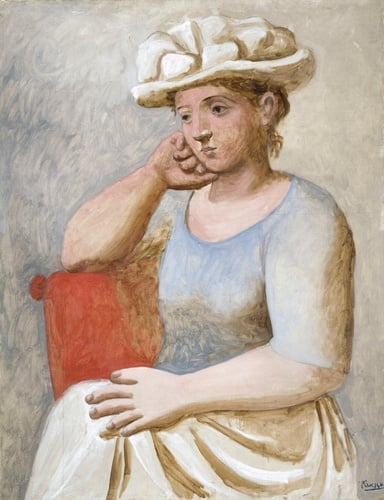
Chalky whites and pale blues Symbolism
Chalky whites and pale blues have long served artists as a cooling palette that communicates serenity, order, and restraint. In early twentieth‑century classicizing revivals, these subdued tones could signal calm permanence over formal experimentation, a balance made explicit in Pablo Picasso’s neoclassical work of the early 1920s.
Chalky whites and pale blues in Femme au chapeau blanc
In Femme au chapeau blanc (1921) by Pablo Picasso, the palette’s soft whites and pale blues structure a scene of poised stillness. The woman’s cheek‑in‑hand pose beneath a billowing white hat, set against the lone scarlet cushion, is rendered with muted coolness that reins in emotion and motion. The restrained chroma imposes order and quiet dignity, while the single red accent operates as a measured counterpoint that clarifies rather than disrupts the prevailing calm. Within Picasso’s postwar neoclassical turn, these hues function as a symbolic claim for stability and permanence over experiment and fracture.