Salvador Dali Paintings in New York — Where to See Them

New York displays approximately 3 of Salvador Dalí’s paintings on permanent view across two institutions: The Museum of Modern Art (MoMA) (1 painting) and The Metropolitan Museum of Art (2 paintings). Seeing Dalí here matters because MoMA places his work amid key modernist and Surrealist dialogues while the Met situates his paintings within broader art-historical and cultural contexts, letting you compare how his signature imagery reads in both a modernist museum and an encyclopedic collection.

At a Glance

Museums
MoMA, The Met
Highlight
See Dalí's surreal masterpieces at MoMA
Best For
Fans of surrealism and modern art

The Museum of Modern Art (MoMA)

MoMA matters for experiencing Dalí because it anchors his reputation within the history of Surrealism in a modern-art context: the museum’s display places Dalí’s most immediately recognizable works beside other key Surrealist and modernist pieces, emphasizing how his imagery reshaped 20th‑century visual culture. Seeing his painting(s) here highlights the theatricality and precision of his technique while allowing direct comparison with contemporaries and later artists who responded to his iconography.
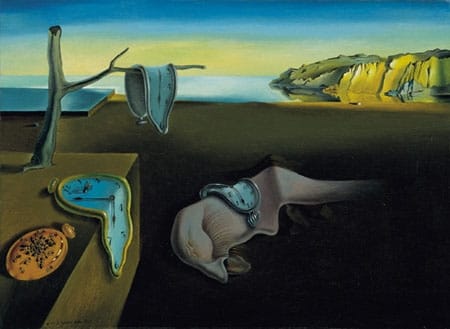
Address: 11 West 53 Street, New York, NY 10019
Hours: Monday–Thursday, Saturday, Sunday 10:30 a.m.–5:30 p.m.; Friday 10:30 a.m.–8:30 p.m.
Admission: Adults $30; Seniors (65+) $22; Students (full-time with ID) $17; Children 16 and under free; Members free
Tip: Head straight to the gallery that houses Dalí’s work on arrival — it’s often a small, high‑traffic room where the scale and detail are best appreciated before crowds form; check the museum map for temporary rotations because MoMA sometimes loans this work to special exhibitions.

The Metropolitan Museum of Art

The Met matters for Dalí because it situates his paintings within a much broader historical and decorative-arts narrative, letting you see how his classical draftsmanship and interest in Old Master techniques intersect with Surrealist invention. The Met’s installations frequently display Dalí alongside earlier European painting and applied arts, which reveals how he borrowed, transformed, and parodied traditional pictorial motifs rather than working only as an eccentric outsider.
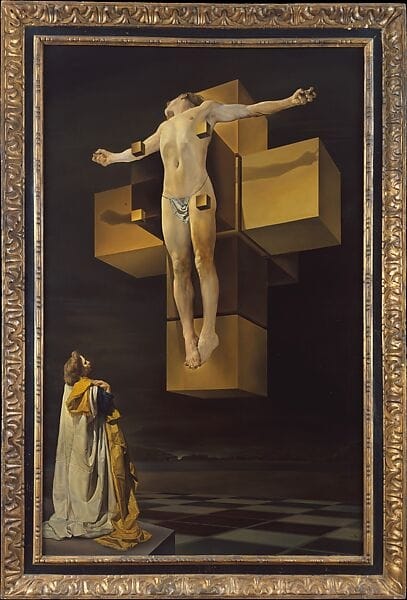
Crucifixion (Corpus Hypercubus)

Crucifixion (Corpus Hypercubus)

1954

Dali depicts a monumental, serene Christ suspended before the unfolded net of a hypercube (a geometric ‘‘cross’’) set in a luminous, barren landscape, blending classical figuration with mathematical structure. The work marks Dali’s ‘‘nuclear mysticism’’ phase—combining Catholic iconography, Renaissance technique, and modern scientific ideas—and is significant for rethinking the crucifixion as a geometric and metaphysical event. Viewers should look for the hypercube net that replaces the traditional cross, the calm, idealized body of Christ (without visible torment), and the theatrical Caravaggesque lighting and precise draughtsmanship that contrast with the surreal context. ([metmuseum.org](https://www.metmuseum.org/art/collection/search/488880?utm_source=openai))

Must-see
Address: 1000 Fifth Avenue, New York, NY 10028
Hours: Sunday–Thursday 9:30 AM–5:30 PM; Friday–Saturday 9:30 AM–9:00 PM; Closed Thanksgiving Day, December 25, January 1, and the first Monday in May.
Admission: NY residents and NY/NJ/CT students: pay what you wish (minimum $0.01). Adults $30; Seniors (65+) $22; Visitors with a disability (in-person) $22; Students $17; Children (12 and under) Free. Members and Patrons Free.
Tip: Visit the Met’s European painting and modern galleries early in the day and look for Dalí works that are often curated into thematic rotations; don’t miss nearby rooms showing pre‑20th‑century works — the dialogue between old and new is often the most revealing context many visitors overlook.

Salvador Dali and New York

Salvador Dalí had a sustained and eventful relationship with New York beginning in the 1930s. He mounted his first New York solo show at Julien Levy’s gallery in November–December 1933 and returned for further Julien Levy exhibitions in 1939 and 1941, moments that introduced and consolidated his Surrealist persona in the city’s gallery scene 1. In April 1939 Dalí designed the spectacular Dream of Venus pavilion for the New York World’s Fair (Flushing Meadows), a multimedia “surrealist funhouse” that brought performance, costume and mural work to large public audiences 2. As Europe moved toward war, Dalí and his wife Gala relocated to the United States; he lived and worked primarily in New York and elsewhere in the U.S. from 1940 to 1948, publishing The Secret Life of Salvador Dalí (1942) and deepening ties with American patrons 3. Major institutional recognition came when The Museum of Modern Art in New York mounted a retrospective/solo presentation of Dalí from November 19, 1941 to January 11, 1942, a key career milestone that broadened his reputation in the American museum world 4. He later held a notable exhibition at Knoedler Gallery in April–May 1943, underscoring New York’s role as a center for his commercial and critical activities during the 1940s 5.

Also See Salvador Dali Paintings In