How Much Is Abbey among the Oaks Worth?
Last updated: May 21, 2026
Quick Facts
- Methodology
- comparable analysis
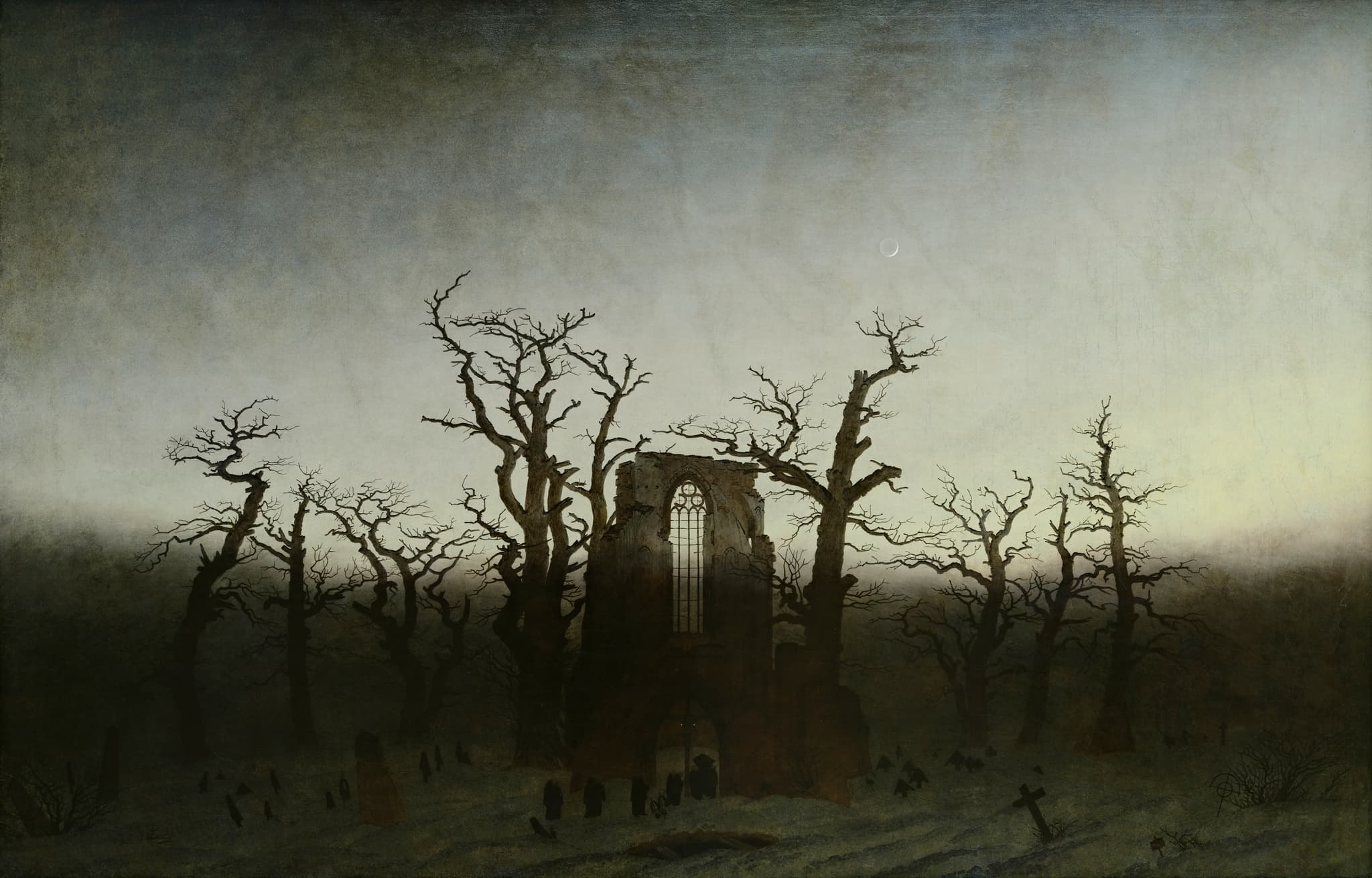
Abbey among the Oaks (Abtei im Eichwald, c. 1809–1810) is a cornerstone masterpiece by Caspar David Friedrich, long held by Berlin’s Alte Nationalgalerie. In a purely hypothetical, unconstrained sale, a rational fair-market bracket is $50–120 million, supported by cross-category Romantic benchmarks and a significant masterpiece premium.
Valuation Analysis
Work and status. Abbey among the Oaks (Abtei im Eichwald, c. 1809–1810) is one of Caspar David Friedrich’s defining masterpieces, conceived as the pendant to The Monk by the Sea and acquired shortly after the 1810 Berlin Academy exhibition by King Frederick William III for the Royal Prussian collection. It has remained in Berlin’s Nationalgalerie (Alte Nationalgalerie) ever since, where it is a signature image of the museum and of German Romanticism itself [1][2].
Valuation approach. We bracket the painting at $50–120 million on a hypothetical, unconstrained-sale basis. The artist’s modern public record for oils is thin and far below this level, anchored by smaller, non-iconic works: Landscape with Mountain Lake, Morning realized about $3.19m (Sotheby’s London, 12 Dec 2018) and Sunburst in the Riesengebirge about $2.75m (acquired by the Saint Louis Art Museum) [3][4]. These datapoints establish a market floor for autograph oils but do not capture the value of an apex, museum-keystone canvas.
Cross-category comparables and masterpiece premium. To set the ceiling, we look to landmark Romantic landscape prices, where top-tier Turner and Constable masterpieces have achieved the mid-eight figures at auction, roughly $50–65m in today’s dollars. Given Abbey among the Oaks’ canonical status, breathtaking scarcity (virtually all peer works are in museums), and the global profile reinforced by the 2024–26 Friedrich anniversary programs, a well-capitalized competition could plausibly match or exceed that band. This supports a wide nine-figure corridor and a substantial “masterpiece premium” that lifts the work far above the artist’s sparse auction record.
Demand and scholarship tailwinds. Recent seasons have seen intensified institutional focus on Friedrich, with seven-figure outcomes for exceptional drawings and high-profile museum acquisitions that underscore depth of demand and scholarly momentum [3][4]. Such dynamics typically elevate private-market pricing expectations for autograph works connected to the artist’s most iconic motifs.
Practical constraints. The Berlin canvas is effectively non-alienable: as part of a German public collection, any permanent export would require federal permission under the Kulturgutschutzgesetz (Cultural Property Protection Act) and is, in practice, implausible [5]. Accordingly, the $50–120m figure represents a rigorous, evidence-based fair-market benchmark for planning/insurance scenarios rather than a near-term liquidity outlook.
Conclusion. On historical importance, rarity, and cross-category benchmarks, Abbey among the Oaks commands a hypothetical $50–120 million valuation—placing it at or near the pinnacle of Romantic landscape painting in market terms.
Key Valuation Factors
Art Historical Significance
High ImpactAbbey among the Oaks stands among the most important images in Romanticism and is central to Friedrich’s legacy. Painted as the pendant to The Monk by the Sea and debuted in Berlin in 1810, it helped define Romantic landscape as a vehicle for metaphysical reflection. The work’s austere composition, monumental scale, and meditations on mortality and transcendence have ensured continuous scholarly attention and broad cultural resonance. It is regularly reproduced in survey texts and exhibitions, effectively serving as a visual shorthand for Friedrich’s achievement. By art-historical weight alone, it sits in the top echelon of 19th-century European painting, a status that justifies a meaningful masterpiece premium over routine market evidence.
Rarity and Market Liquidity
High ImpactAutograph Friedrich oils are exceptionally scarce in private hands; most masterpieces entered museums in the 19th and early 20th centuries. Oils that do surface are typically modest in scale or importance relative to the canonical works. The result is a market with minimal price discovery at the top and extraordinary asymmetry between cultural value and observed auction results. Scarcity at this level forces reliance on cross-category comparables and amplifies the “masterpiece premium.” In practice, Abbey among the Oaks is even rarer than a typical top-tier Turner or Constable, as virtually no equivalent German Romantic icons are available to collectors—supporting a valuation well beyond the artist’s recorded auction prices.
Provenance and Exhibition History
High ImpactThe painting’s provenance is unimpeachable: acquired soon after its 1810 debut by King Frederick William III for the Royal Prussian collection and continuously held by its successor institution, Berlin’s Nationalgalerie. Its exhibition and publication record is exhaustive, and it remains a signature image of the Alte Nationalgalerie. Such royal-to-national provenance and 200+ years of institutional stewardship confer maximum confidence in attribution, condition management, and scholarly significance. Works with this pedigree occupy the very top of any valuation scale; even hypothetical pricing must recognize the reduced risk profile and extraordinary cultural endorsement embedded in this ownership and display history.
Cross-Category Comparables and Masterpiece Premium
High ImpactWhile Friedrich’s recorded oil prices peak in the low single-digit millions, landmark Romantic landscapes by Turner and Constable have achieved the mid-eight figures at auction, providing the most relevant reference band for an apex Friedrich. Abbey among the Oaks is arguably more supply-constrained and as culturally resonant as these British touchstones, justifying a valuation that meets or exceeds that benchmark in an unconstrained sale. The work’s pendant relationship to The Monk by the Sea, institutional icon status, and alignment with themes that define Romanticism further expand the “masterpiece premium,” supporting a broad, nine-figure bracket despite thin direct auction comparables for the artist.
Sale History
Abbey among the Oaks has never been sold at public auction.
Caspar David Friedrich's Market
Caspar David Friedrich’s market is defined by extreme scarcity of oils and strong institutional demand. Most canonical canvases reside in museums, leaving limited price discovery for top-tier works. When autograph oils do appear, they have achieved multimillion-dollar results, notably around $3.2 million in 2018 for Landscape with Mountain Lake, Morning, and about $2.75 million for Sunburst in the Riesengebirge, acquired by the Saint Louis Art Museum. Recent surges in interest—driven by the 250th anniversary exhibitions and high-profile museum acquisitions—have elevated pricing for works on paper into the high six and low seven figures. Collectors prize clear provenance, strong links to iconic motifs, and fresh material, and will pay a premium for best-in-class examples.
Comparable Sales
Rome, from Mount Aventine
J. M. W. Turner
Apex British Romantic landscape, large museum‑caliber oil; the best public price anchor for blue‑chip Romantic masterpieces with comparable aura and ambition.
$47.4M
2014, Sotheby's London
~$63.0M adjusted
Modern Rome – Campo Vaccino
J. M. W. Turner
Top‑tier Turner cityscape from the same Romantic landscape tradition; demonstrates what leading masterpieces in this category can achieve at auction.
$44.9M
2010, Sotheby's London
~$64.7M adjusted
Venice, the Dogana and San Giorgio Maggiore
J. M. W. Turner
Record‑setting Turner at the time; luminous, iconic subject; establishes the upper range for masterwork Romantic oils in open auction.
$35.9M
2006, Christie's New York
~$55.9M adjusted
The Lock
John Constable
Large‑scale 'six‑footer' by Constable—apex British Romantic landscape; directly comparable in scale, ambition, and canonical weight to Friedrich’s pendant masterpieces.
$35.2M
2012, Christie's London
~$48.2M adjusted
Landscape with Mountain Lake, Morning (Landschaft mit Gebirgsee, Morgen)
Caspar David Friedrich
Direct same‑artist oil benchmark; smaller and less iconic but essential for anchoring the lower bound of Friedrich’s oil market.
$3.2M
2018, Sotheby's London
~$4.0M adjusted
Sunburst in the Riesengebirge
Caspar David Friedrich
Same‑artist oil acquired by a major museum; confirms price levels for non‑apex Friedrich oils just before the 250th‑anniversary spotlight.
$2.8M
2018, Sotheby's London
~$3.4M adjusted
Current Market Trends
The Old Masters and 19th-century sector has strengthened as collectors gravitate toward historically established names and proven art-historical significance. Within this context, demand concentrates at the very top: exceptional, well-provenanced works outperform, while mid-tier material remains selective. Romantic landscape icons by Turner and Constable continue to anchor the high end of the category, offering a benchmark for Friedrich’s apex works. Supply of Friedrich oils remains exceptionally thin, so recent price signals come primarily from strong drawings markets and institutional acquisitions. Overall momentum and institutional attention support higher expectations for the best material, but genuine liquidity for museum-grade Friedrich oils remains near zero.
Sources
- Staatliche Museen zu Berlin – Alte Nationalgalerie: Caspar David Friedrich Project
- Encyclopaedia Britannica – Monk by the Sea (notes purchase of the pendant pair by King Frederick William III)
- Sotheby’s – Caspar David Friedrich, Landscape with Mountain Lake, Morning (sale result, 12 Dec 2018)
- ArtfixDaily – Saint Louis Art Museum acquires ‘Sunburst in the Riesengebirge’ by Caspar David Friedrich
- Kulturgutschutz Deutschland – Ausfuhrbestimmungen (Cultural Property Protection Act)