How Much Is The Wanderer above the Sea of Fog Worth?
Last updated: February 8, 2026
Quick Facts
- Methodology
- extrapolation
We estimate Caspar David Friedrich’s The Wanderer above the Sea of Fog at $100–150 million in a hypothetical open-market sale. The work is the artist’s definitive masterpiece, with unparalleled cultural recognition and extreme scarcity of comparable paintings in private hands. Despite a modest public auction record for Friedrich’s oils, the painting’s canon-defining status supports nine-figure trophy pricing.
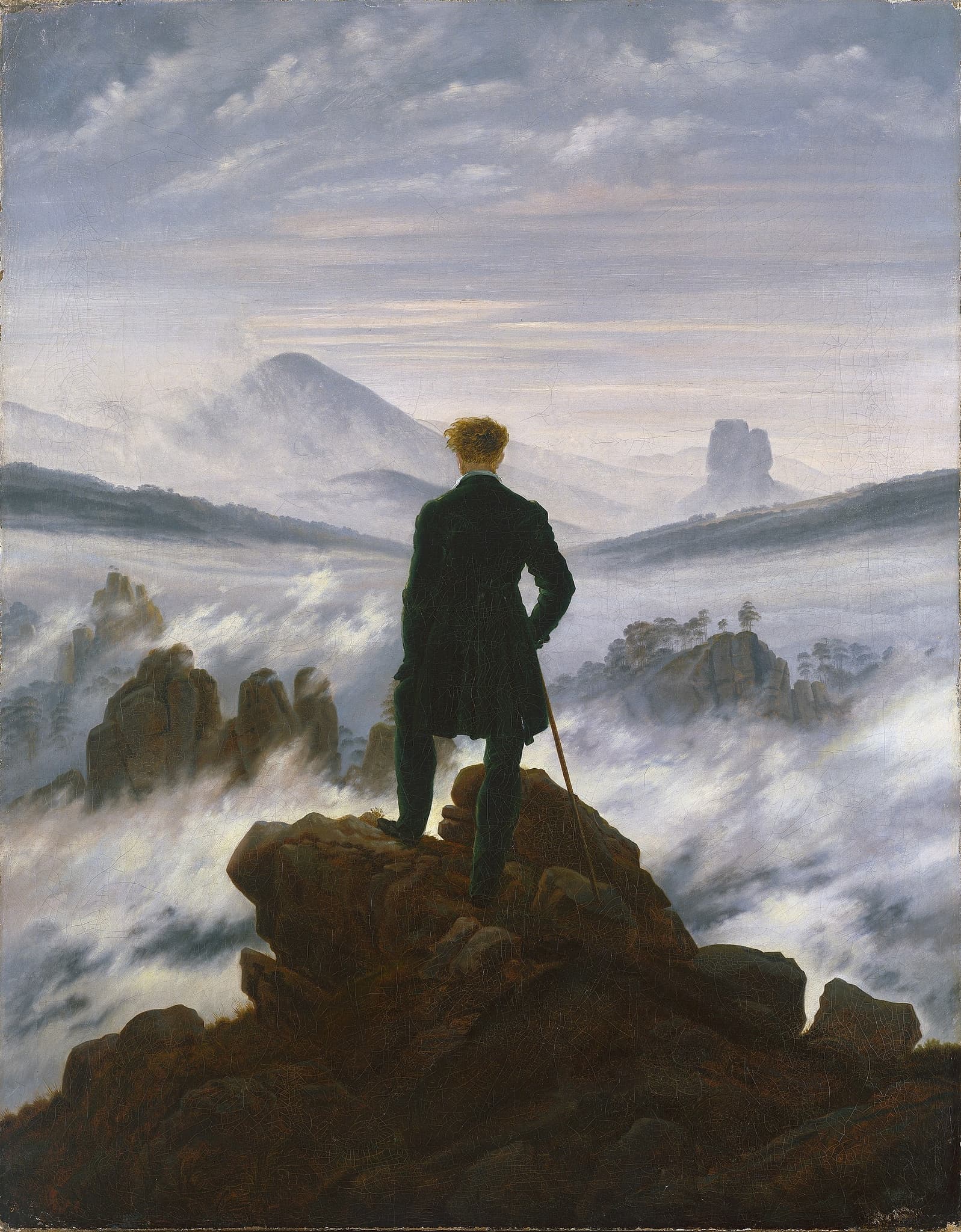
The Wanderer above the Sea of Fog
Caspar David Friedrich, ca. 1817 • Oil on canvas
Read full analysis of The Wanderer above the Sea of Fog →Valuation Analysis
Conclusion: We value Caspar David Friedrich’s The Wanderer above the Sea of Fog at $100–150 million for hypothetical fair-market sale. This range reflects the painting’s singular art-historical stature, unmatched image recognition within German Romanticism, and the near-total absence of truly comparable Friedrich oils in private hands. The work is on permanent loan to the Hamburger Kunsthalle, underscoring its institutional importance and the improbability of market appearance, but providing authoritative confirmation of status and custody [1].
Market anchor and extrapolation: Friedrich’s public auction record for an oil painting—set in 2018 at £2.53 million/$3.2 million—reflects the rarity and generally modest scale of tradeable works rather than demand for a signature masterpiece [2]. When exceptional primary material has surfaced, such as the 1804 Karlsruhe Sketchbook, competition has been intense and governance issues (cultural-property protection, export) have directly shaped outcomes; that sketchbook ultimately entered German public collections following protective listing procedures after a €1.819 million auction result [3]. The Wanderer, by contrast, is the most reproduced and recognizable image of the artist’s career and of German Romanticism as a whole, warranting extrapolation well beyond the artist’s auction benchmarks.
Trophy comparables and cross-category demand: In adjacent pre-modern categories, universally recognized “brand-image” masterpieces have realized nine-figure or high eight-figure prices at auction, including Botticelli’s Portrait of a Young Man Holding a Roundel at $92.2 million (2021) [5] and Turner’s Rome, from Mount Aventine at $47.4 million (2014) [6]. While Friedrich’s auction ceiling is lower due to supply constraints, the Wanderer’s cultural reach and textbook-level fame position it among the few works capable of attracting broad, trophy-seeking demand from global UHNW collectors and institutions. Its continued international exhibition profile—most recently as a marquee loan for The Met’s 2025 retrospective—reinforces this global recognition and scholarship [4].
Drivers of the $100–150 million range: The upper tier is supported by (i) canonical, best-in-class status within the oeuvre; (ii) extreme scarcity of museum-caliber Friedrich oils available to private buyers; (iii) iconic, highly legible imagery with cross-category appeal; and (iv) sustained institutional spotlight from major retrospectives. The lower bound reflects practical frictions, notably probable non-export status under German cultural-heritage law that could reduce the effective international buyer pool, as evidenced by the sketchbook episode [3]. Under an unconstrained, internationally accessible sale with excellent condition confirmed, competition could credibly test the top of, or exceed, this range; conversely, export restrictions would bias outcomes toward the lower half. Given current trophy-market dynamics and the painting’s cultural currency, $100–150 million is a prudent, defensible synthesis.
Key Valuation Factors
Art Historical Significance
High ImpactThis is Friedrich’s signature image and arguably the defining icon of German Romanticism, encapsulating core themes of the sublime, introspection, and the Rückenfigur. It is the most widely reproduced, taught, and referenced work in the artist’s oeuvre, often standing as the visual shorthand for the entire movement. Such canon-defining status elevates the painting beyond usual artist-specific pricing anchors, positioning it alongside a small cohort of pre-modern masterpieces whose cultural resonance drives trophy-level demand. In valuation terms, this primacy supports an aggressive multiple over Friedrich’s auction record, as the market prices not only authorship and quality but also the work’s unique role in art history and global cultural consciousness.
Scarcity and Supply
High ImpactThe overwhelming majority of Friedrich’s prime oils reside in German and European museums, and top-tier canvases almost never appear on the market. The 2018 auction record for an oil reflects second-tier availability, not a ceiling on demand for a seminal masterpiece. This structural scarcity magnifies competition when an A+ work is theoretically available, creating step-changes in price discovery. Wanderer sits at the apex of rarity: there is no closely substitutable Friedrich of comparable fame or iconography in private hands. In practical terms, the lack of supply pushes valuation methodology from simple comparables toward trophy extrapolation, justifying a significant premium above any existing, lower auction benchmarks for the artist.
Image and Cultural Resonance
High ImpactWanderer’s composition and silhouette are instantly recognizable beyond specialist circles—appearing in textbooks, museum marketing, album covers, and popular culture. That broad recognizability is a powerful demand amplifier because it expands the bidder universe beyond Romanticism collectors to generalist trophy buyers and institutions seeking emblematic images. In art finance terms, such an image carries a brand premium: it reduces buyer risk around future loan desirability, scholarship, and audience appeal. A painting with this level of cultural currency can command prices divorced from the artist’s routine market, more in line with rare, cross-category icons. This resonance materially supports nine-figure pricing when other fundamentals align.
Legal/Export Status and Market Access
Medium ImpactGiven its importance and custody in Germany, the painting would almost certainly qualify as protected cultural property, constraining export and potentially limiting the buyer pool to domestic institutions or collectors willing to hold the work in-country. The 2023 Karlsruhe Sketchbook episode illustrates how protective listing can override pure market momentum, channeling outcomes toward public collections [3]. Such frictions typically compress competitive tension and can dampen pricing. Our range incorporates this reality by setting a strong lower bound that contemplates restricted scenarios while reserving the upper bound for a fully open, internationally accessible sale. Clarity on exportability is thus a major sensitivity in any real-world transaction.
Scale, Medium, Condition, and Marketability
Medium ImpactAs a substantial oil on canvas with a striking, legible composition, the work is exceptionally market-strong. Museum stewardship and frequent exhibition imply careful conservation, and the valuation assumes excellent, stable condition with no structural compromises. For a painting of this visibility, even moderate condition issues can reduce bidding intensity; conversely, a clean report supports maximum trophy competition. The composition’s clarity and photogenic silhouette also enhance loan desirability and experiential impact in galleries, reinforcing institutional and donor interest. In sum, medium, scale, and presumed condition underpin liquidity and narrative strength, supporting pricing at the high end of pre-modern masterpieces when coupled with the work’s iconic status.
Sale History
The Wanderer above the Sea of Fog has never been sold at public auction.
Caspar David Friedrich's Market
Caspar David Friedrich is a cornerstone of 19th-century European art, yet his market is characterized by extreme scarcity of prime oils in private hands. Public auction records are therefore modest relative to his stature: the top price for an oil stands at £2.53 million/$3.2 million (Sotheby’s London, 2018), with companion works at similar levels [2]. Recent signals show strong demand for exceptional material: a seminal 1804 sketchbook hammered at €1.45 million (€1.819 million with premium) before entering German museums following protective measures [3], and a high-quality drawing achieved $720,000 at Sotheby’s New York in 2025 amid renewed institutional focus. Net-net, collectors face thin supply, with pricing power concentrated at the very top when masterpieces are hypothetically available.
Comparable Sales
Landscape with Mountain Lake, Morning (Landschaft mit Gebirgsee, Morgen)
Caspar David Friedrich
Same artist; rare oil painting from the mature period with sublime mountainous landscape and atmospheric light. Best public auction benchmark for CDF oils.
$3.2M
2018, Sotheby's London
~$4.1M adjusted
Sunburst in the Giant Mountains (Sonnenblick im Riesengebirge)
Caspar David Friedrich
Same artist; oil painting with dramatic mountainous vista and light effects, sold the same day as the artist’s record. Confirms pricing for significant but non-iconic CDF oils.
$2.7M
2018, Sotheby's London
~$3.5M adjusted
Karlsruhe Sketchbook (1804) ("Karlsruher Skizzenbuch von 1804")
Caspar David Friedrich
Same artist; top-tier, unique primary document (bound sketchbook). Although on paper, it shows current ceiling for exceptional CDF material and highlights cultural-property dynamics.
$2.0M
2023, Grisebach, Berlin
~$2.2M adjusted
The beach at Wieck near Greifswald (c.1815–21), pen and ink drawing
Caspar David Friedrich
Same artist; high-quality drawing that significantly outperformed estimate, evidencing robust demand around major exhibitions; useful for gauging works-on-paper momentum.
$720K
2025, Sotheby's New York
Rome, from Mount Aventine
J.M.W. Turner
Closest blue-chip trophy in Romantic landscape painting. Demonstrates what top-tier masterpieces in the Romantic landscape category can achieve at auction.
$47.4M
2014, Sotheby's London
~$64.5M adjusted
Portrait of a Young Man Holding a Roundel
Sandro Botticelli
Pre-modern ‘trophy’ benchmark showing nine-figure capacity for universally recognized masterpieces with cross-category appeal—relevant to valuing an icon like Wanderer.
$92.2M
2021, Sotheby's New York
~$109.7M adjusted
Current Market Trends
Across Old Masters and 19th-century European art, the market continues to bifurcate: routine material can be soft, while rare, brand-image masterpieces draw deep, global demand. High-profile sales such as Botticelli’s $92.2 million portrait (2021) and Turner’s $47.4 million landscape (2014) demonstrate ongoing trophy capacity for pre-modern icons [5][6]. For German Romanticism specifically, blockbuster exhibitions and scholarship have expanded audience and institutional appetite, while cultural-property protections can redirect outcomes toward public collections. In this context, a canonical, cross-category image like Wanderer would likely achieve a nine-figure result in an unconstrained sale, with legal/export clarity and condition the decisive variables around final price.
Study print
Study this painting as a print
Pair the full artwork with a museum-style study sheet focused on one meaningful detail.

Sources
- Hamburger Kunsthalle – Work page for Wanderer above the Sea of Fog (loan status/location)
- Sotheby’s London (Dec 12, 2018) – Artist auction record for an oil painting
- The Art Newspaper – Rare Caspar David Friedrich sketchbook jointly acquired by German museums (post-auction protective listing context)
- The Metropolitan Museum of Art – 2025 exhibition press release (The Soul of Nature)
- Sotheby’s – Botticelli Portrait of a Young Man Holding a Roundel achieves $92.2 million (2021)
- Sotheby’s – J.M.W. Turner, Rome, from Mount Aventine achieves £30.3m / $47.4m (2014)