How Much Is Bouquet of Sunflowers Worth?
Last updated: March 10, 2026
Quick Facts
- Insurance Value
- $65.0M (Analyst estimate (replacement value))
- Methodology
- comparable analysis
Claude Monet’s Bouquet of Sunflowers (1881, The Met) is a landmark floral still life from a prime period, exhibited at the 7th Impressionist exhibition. Based on recent Monet benchmarks and the premium commanded by the artist’s most celebrated still lifes, a fair‑market auction estimate today is $35–55 million, with a replacement (insurance) value around $65 million.
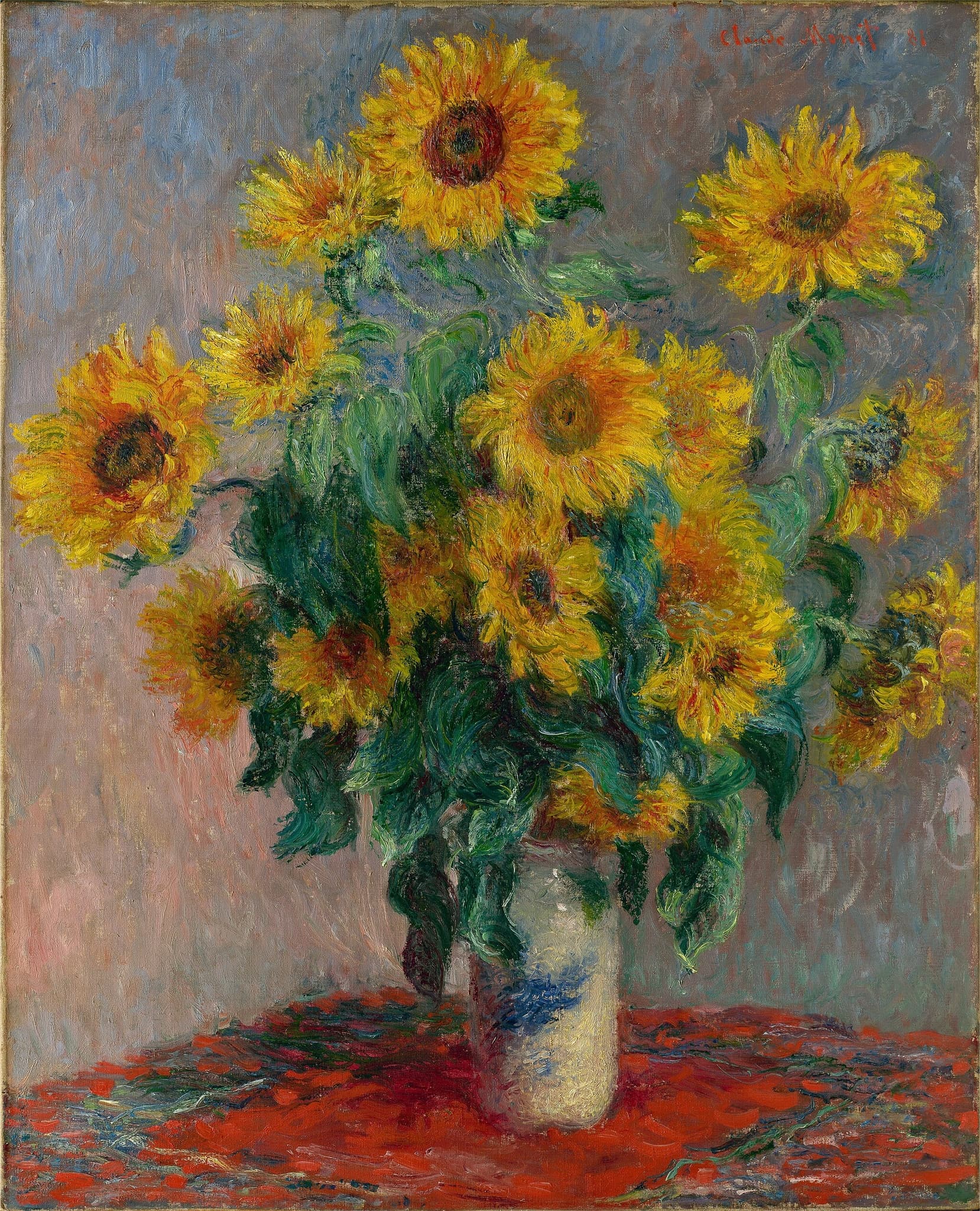
Bouquet of Sunflowers
Claude Monet, 1881 • Oil on canvas
Read full analysis of Bouquet of Sunflowers →Valuation Analysis
Conclusion: Monet’s Bouquet of Sunflowers is a museum‑enshrined, large‑scale floral still life from 1881—arguably the most coveted subject within his still‑life corpus—backed by blue‑chip artist liquidity and exceptional provenance at The Metropolitan Museum of Art (H. O. Havemeyer Collection, bequest 1929). It was shown at the 7th Impressionist exhibition in 1882, cementing its art‑historical status [1]. On a present‑day auction basis, the work supports a $35–55 million fair‑market range, with a notional institutional replacement value near $65 million.
Methodology: There is no public sale record for this specific canvas; valuation therefore rests on comparable analysis across Monet’s market. At the top of the artist’s price spectrum, late Water Lilies regularly command $60–75 million (e.g., $74.01m in 2023; $65.5m in 2024) [3][4], while the artist’s peak record is $110.7m for a Haystacks in 2019 [2]. Outside the Nymphéas, significant series pictures (Haystacks, Venice, Parliament, Poplars) routinely occupy the $35–75m band, with a 2024 Haystacks example at $34.8m bracketing the lower end of major Monets in marquee sales [5].
Positioning the still‑life comps: Recent Monet floral still lifes with less iconic motifs and generally smaller presence—Roses and Chrysanthemums—cleared about $10–11m in 2021–2022 [6][7]. Those results establish a floor for the category but understate the premium for a prime 1881 sunflower bouquet at grand scale with exhibition pedigree. Monet’s sunflower bouquets are the apex of his still‑life demand, and the Met picture’s size (about 40 x 32 in.), facture, and institutional canonization justify a multiple of those lesser still‑life benchmarks.
Rationale for $35–55 million: The estimate situates the painting clearly below late Water Lilies (the commercial ceiling) yet well above secondary still‑life outcomes, reflecting subject desirability, scale, period, and public stature. It also aligns with the demonstrated depth for first‑rate, non‑Nymphéas Monets in the $35–60m corridor during recent marquee seasons [3][4][5]. As a museum‑held icon with widely reproduced imagery and a Havemeyer provenance, its replacement (insurance) value reasonably outstrips likely auction realizations, hence a $65m notional figure [1].
Sensitivities: A current condition report could nudge the range within the band. Macro variables (FX, guarantee availability, and supply at the top end) modulate bidding intensity, but Monet’s cross‑border demand and institutional interest provide durable support. Within Monet’s oeuvre, sunflower bouquets are the clearest candidates to bridge the gap between still lifes and series landscapes; this estimate captures that premium without breaching the pricing territory reserved for the very best Nymphéas and series masterpieces [2][3][4].
Key Valuation Factors
Art Historical Significance
High ImpactPainted in 1881 and shown in the landmark 7th Impressionist exhibition of 1882, Bouquet of Sunflowers occupies a privileged position in Monet’s production of floral still lifes. This cluster of 1878–1882 bouquets represents a concentrated period of experimentation with color harmonies, impasto, and light effects on domestic subjects that echo, in miniature, the optical aims of his plein‑air landscapes. The Met’s canvas is among the most frequently reproduced floral Monets, widely used in scholarship and public‑facing materials. Its early exhibition history, prime period, and canonical profile within a globally recognized museum firmly anchor it among the most significant Monet still lifes, advancing both cultural and market value.
Subject, Scale, and Aesthetic Quality
High ImpactSunflowers are the most commercially resonant motif in Monet’s still-life repertoire. The Met canvas is both large and commanding (about 40 x 32 in.), delivering true ‘wall power’ through saturated yellows, rhythmic brushwork, and lively impasto. Collectors prize the immediacy and chromatic intensity of this series, and the painting’s scale distinguishes it from smaller, more intimate panels that typically set the lower benchmarks for Monet still lifes. Combined with refined color contrasts and a strong, frontal composition, the work’s presence places it at the category’s apex—supporting a multiple over secondary floral subjects (roses, chrysanthemums) and justifying a valuation that approaches, but remains below, major landscape series pricing.
Provenance, Exhibition, and Literature
High ImpactThe painting entered The Metropolitan Museum of Art via the H. O. Havemeyer collection (bequest 1929), one of the most storied American collections of French modernism. Museum custodianship confers enduring visibility, rigorous conservation oversight, and extensive scholarly citation, all of which enhance reputational and replacement value. Its appearance at the 7th Impressionist exhibition further deepens its documentary footprint. While museum-held works are rarely transacted, precisely this long, public institutional life helps justify a robust notional replacement figure and underpins collector confidence in a hypothetical sale scenario. In market terms, this pedigree compares favorably with the provenance profiles of the most successful Monet lots at auction.
Market Liquidity and Demand for Monet
Medium ImpactMonet remains one of the most liquid, globally demanded artists, with consistent eight‑figure outcomes and a record of $110.7m for Meules (2019). In 2023–2024, large, late Water Lilies achieved $74.01m and $65.5m, demonstrating a resilient ceiling for best‑in‑class works even amid selective markets. This depth supports premium pricing for top non‑series categories such as exceptional still lifes. Although still lifes typically trail the artist’s blockbuster series, the sunflower bouquets bridge that gap. The breadth of bidding—from U.S. and Europe to Asia—reduces concentration risk and underwrites confidence in the $35–55m band, especially for a work with museum‑grade stature and scale that can headline a marquee evening sale.
Condition and Conservation Considerations
Medium ImpactA current condition report is indispensable to performance at the top of the range. Factors for an 1881 oil include the stability of impasto, potential surface abrasion, past cleanings or restorations, and stretcher/canvas integrity. Museum stewardship typically implies careful climate control and professional conservation, a positive input for both marketability and replacement value. In a transaction, pristine surface quality and untroubled restoration history would embolden third‑party guarantees and aggressive estimates; conversely, material issues could compress bidding toward the lower half of the range. Given The Met’s custodianship, baseline expectations for condition are strong, but valuation prudence reserves the upper bound for demonstrably excellent state.
Sale History
Bouquet of Sunflowers has never been sold at public auction.
Claude Monet's Market
Claude Monet is a cornerstone of the global art market and a perennial leader in the Impressionist category. His auction record stands at $110.7 million for Meules (2019), and late Water Lilies canvases have recently realized $74.01 million (2023) and $65.5 million (2024), attesting to durable demand for the artist’s top series. Beyond the Nymphéas, major works from Venice, Parliament, Haystacks, and Poplars frequently clear the $35–60 million band at marquee evening sales. Liquidity is reinforced by cross‑regional bidding, with strong participation across the U.S., Europe, and Asia. Monet’s market benefits from prolific scholarship, constant museum visibility, and a deep collector base, enabling price resilience even in selectively risk‑on environments.
Comparable Sales
Fleurs dans un pot (Roses et brouillard)
Claude Monet
Same artist; floral still life from the late 1870s, close in period to the 1881 sunflower bouquets; strong but less iconic subject and likely smaller scale—sets a recent baseline for Monet still lifes.
$10.4M
2021, Sotheby's New York
~$12.4M adjusted
Massif de chrysanthèmes
Claude Monet
Same artist; floral still life (1897). Later than 1881 and a less iconic motif than sunflowers; useful as the closest high‑quality still‑life benchmark in the last few years.
$11.1M
2022, Sotheby's London
~$12.2M adjusted
Meules à Giverny
Claude Monet
Same artist; marquee series picture (Haystacks). Not a still life, but a prime Monet subject that brackets the upper range for non‑Water Lilies trophies and helps calibrate demand in the $30m–$40m band.
$34.8M
2024, Sotheby's New York
~$35.7M adjusted
Peupliers au bord de l’Epte, crépuscule
Claude Monet
Same artist; blue‑chip Poplars series record. Not a still life, but shows current appetite for top non‑Water Lilies Monets around the low‑to‑mid $40m level—useful for bracketing a top Monet still life.
$43.0M
2025, Christie's New York
Le Grand Canal et Santa Maria della Salute
Claude Monet
Same artist; iconic Venice subject that consistently commands trophy pricing. Serves as an upper‑bound comparator for Monet masterpieces outside the Water Lilies.
$56.6M
2022, Sotheby's New York
~$62.5M adjusted
Nymphéas (Water Lilies)
Claude Monet
Same artist; late Water Lilies—Monet’s most commercial category. Not a still life, but establishes the contemporary ceiling for top Monet demand.
$65.5M
2024, Sotheby's New York
~$67.1M adjusted
Current Market Trends
High‑end Impressionist and Post‑Impressionist markets remain selective but strong for historically enshrined blue‑chip names. Supply quality and the presence of guarantees are decisive: top lots with pristine provenance and compelling subjects continue to achieve robust results, while mid‑tier material is more price‑sensitive. Monet sits at the forefront of this bifurcation. Late Water Lilies confirm a stable ceiling, and strong outcomes for non‑Nymphéas series underpin broader demand. Within Monet’s hierarchy, exceptional floral still lifes—especially the 1881 sunflower bouquets—command a meaningful premium over other still lifes and narrow the gap to landscape series, supported by broad international appetite and institutional interest.
Study print
Study this painting as a print
Pair the full artwork with a museum-style study sheet focused on one meaningful detail.
Sources
- The Metropolitan Museum of Art — Bouquet of Sunflowers object record
- Sotheby’s — Monet’s Meules sells for $110.7m (artist record, 2019)
- Christie’s — Le bassin aux nymphéas achieves $74,010,000 (Nov 2023)
- Sotheby’s — Fall 2024 auction recap including Nymphéas at $65.5m
- The Art Newspaper — Sotheby’s Modern Evening Sale (May 2024), Meules à Giverny $34.8m
- Artnet News — Top lots (March 2022): Monet’s Massif de chrysanthèmes ~$11.08m
- Rehs Gallery — Comments on the Art Market (June 2021): Monet Fleurs dans un pot $10.4m