Bouquet of Sunflowers

by Claude Monet

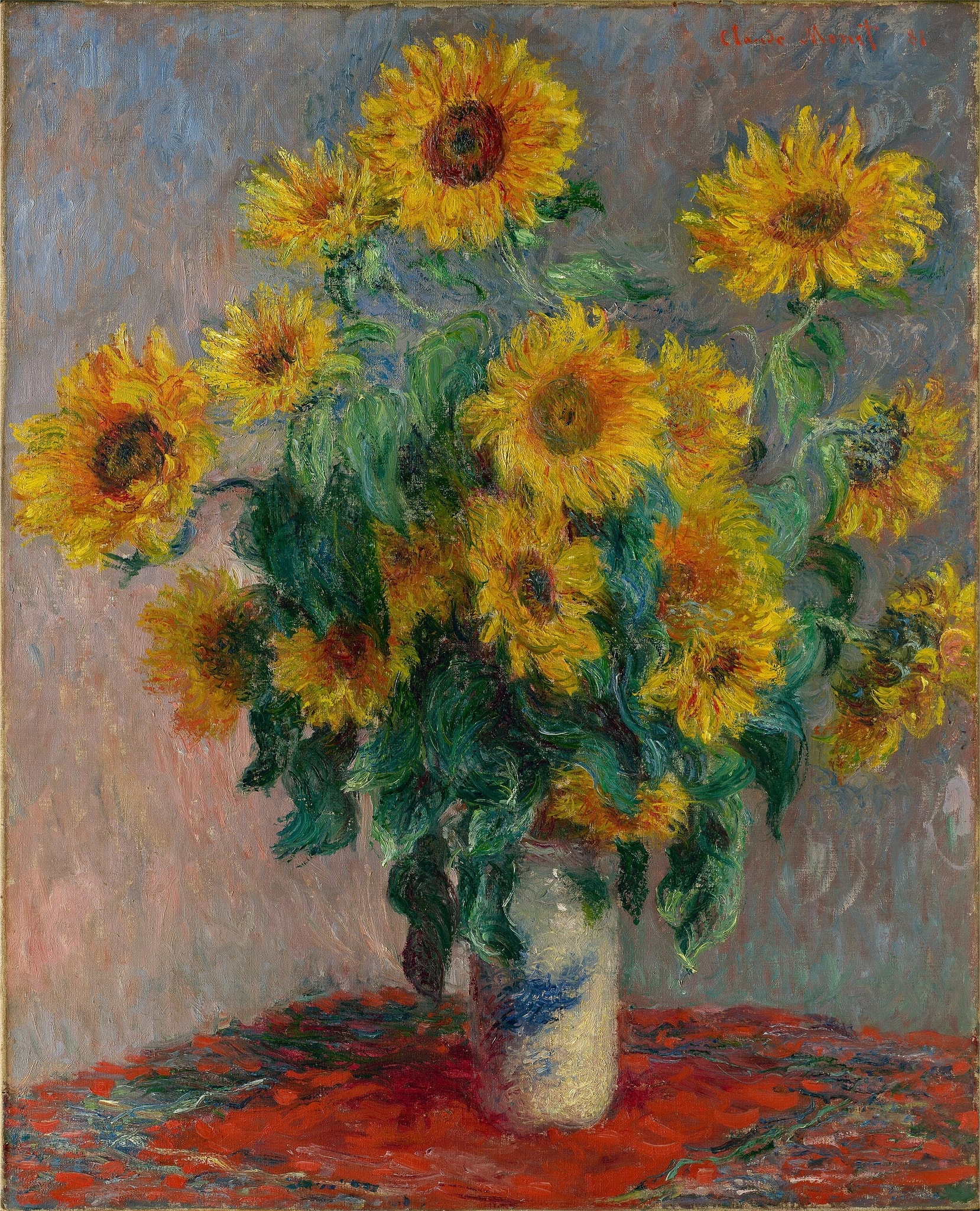
Claude Monet’s Bouquet of Sunflowers detonates with solar color and restless brushwork: yellow heads flare from a pale vase, thrust forward by a blazing red cloth against a cool, lilac‑gray wall. The painting converts a domestic bouquet into an arena where light, time, and touch supersede contour, staging blooms from vigor to fray in a single, pulsing image [1][2].
💰

Market Value

$35-55 million

How much is Bouquet of Sunflowers worth?

Study Print Studio

Create a personal study print

Build a companion study sheet around the part of this painting that speaks to you most. Choose a detail, shape an interpretation, and walk away with something personal and display-worthy.

Fast Facts

Year
1881
Medium
Oil on canvas
Dimensions
101 x 81.3 cm
Location
The Metropolitan Museum of Art, New York
See all Claude Monet paintings in New York
Bouquet of Sunflowers by Claude Monet (1881) featuring Sunflower heads, Red table covering, Cool lilac-gray background, Pale ceramic (Japanese) vase

Click on any numbered symbol to learn more about its meaning

Meaning & Symbolism

Monet engineers a dynamic system of oppositions so the bouquet reads as living energy rather than arranged objects. The red table covering heats the lower register, throwing the yellow heads forward, while the cool, gray‑lilac wall withdraws into depth; this complementary clash ignites the petals’ cadmiums and ochres. Petal rims spark with orange while centers absorb light into maroon‑brown, and the leaves twist in saturated greens that surge and slacken across the form. The brushwork is emphatically broken and tactile: strokes splay along petal edges, churn within the flower disks, and scud across the background, so nothing sits inert. Individual heads broadcast different temporal states—some face us with open assertion, others torque sideways, and several at the bouquet’s rim fray or bow—binding a cycle of bloom and decline into one frame. Monet declines vanitas symbols and instead lets facture and color articulate duration: time is embedded in the paint’s speed and pressure, in the way yellow meets violet and red to flare, then cool at the edges 127. This chromatic theater was not incidental. During the Vétheuil period Monet planted sunflowers along his garden path and translated that motif from outdoors to the studio, turning flowers into serial problems of light, temperature, and touch 13. Bouquet of Sunflowers, painted in 1881 and shown at the Seventh Impressionist Exhibition in 1882, was praised for its brio and daring, signaling how decisively Monet had reconceived still life as an experiment in perception 1. Technically, the canvas aligns with his near‑contemporary floral studies: structure is laid in, then petals and grounds are built with differentiated strokes, revisions, and chromatic layering to orchestrate optical lift without hard contour 2. The pale ceramic vase—recorded in period testimony as a “large Japanese vase”—adds a note of Japonisme consistent with Monet’s collecting, yet it functions here chiefly as a cool, light trap that steadies the chromatic tumult above 16. As for symbolism, the sunflower’s historic ties to heliotropism and devotion offer a resonant undertone, but Monet’s emphasis remains optical; the painting’s “meaning” coalesces less in emblem than in felt experience, where resilience and fading are conveyed by the tilt of a head and the drag of a loaded brush 4. Why Bouquet of Sunflowers is important is thus twofold. First, it shows Impressionism remaking still life into a theater of perception—a site where warm–cool counterpoint, complementary contrast, and gestural tempo enact time without narrative 12. Second, it reveals Monet’s Vétheuil still lifes as both lifeline and laboratory, sustaining him financially while sharpening the chromatic audacity that would underwrite later series work 5. Its critical reception in 1882 and its citation in Van Gogh’s correspondence confirm the painting’s impact within the late‑19th‑century sunflower constellation, prefiguring how the motif could carry modern painting’s ambitions for color and touch 16. In short, the painting compresses abundance and transience into a single, luminous surge—an earthly sun assembled from strokes of paint—demonstrating how Impressionism preserves the fleeting by making vision itself the subject.

Explore Deeper with AI

Ask questions about Bouquet of Sunflowers

Popular questions:

Powered by AI • Get instant insights about this artwork

💬 Ask questions about this artwork!

Interpretations

Technical Process and Optical Engineering

Monet’s sunflower bouquet functions as an optical machine: underlayers establish tonal scaffolding, while distinct brush types build petals, disks, and grounds to maximize simultaneous contrast and edge vibration. Comparative technical studies of his 1881–82 florals show iterative revisions, wet‑into‑wet passages, and differentiated stroke families—fan‑like filaments on rims, churned impasto in centers, and lateral scumbles across the field—that orchestrate lift without contour. Rather than blending on the palette, Monet leverages optical mixture in situ, letting cadmium yellows spark against cool violets and the red table’s thermal register. The result is not decorative excess but a calibrated system where facture and color conduct perceptual charge, turning still life into a dynamic testbed for seeing 21.

Source: Art Institute of Chicago (Online Scholarly Catalogue)

Garden-to-Studio Ecology

The bouquet is the studio corollary to Monet’s Vétheuil garden ecology. Museum accounts note he planted sunflowers along his path, then transposed that living motif indoors, compressing outdoor temporality into a controlled theater of color and touch. Seen against his garden canvases, Bouquet of Sunflowers reads as a site transfer: ambient light and phenological stages are re‑mediated under studio conditions to test how environmental cues can be recreated through pigment temperature and stroke choreography. This garden–studio continuum reframes still life as ecological study—how place, season, and cultivation are metabolized into paint—rather than a tabletop genre isolated from the world 31.

Source: Norton Simon Museum; The Metropolitan Museum of Art

Economic Lifeline and the Labor of Perception

Scholarship on Monet’s Vétheuil years argues that flower still lifes were both lifeline and laboratory: they sold when landscapes stalled and, crucially, incubated the chromatic boldness that powers his later series. Read through this lens, the bouquet records the artist’s work discipline—serial setup, iterative problem‑solving, market‑savvy subject choice—while refusing academic finish. Its “brio and daring,” noted by 1882 critics, doubles as a professional wager: the commodity here is perceptual intensity itself, crafted through speed, pressure, and risk on the surface. Monet monetizes sensation without diluting experiment, aligning artistic labor with modern markets 51.

Source: Charles Stuckey (via Christie’s); The Metropolitan Museum of Art

From Emblem to Experience: Recasting Devotion

Sunflowers historically signified devotion through heliotropism—think Van Dyck’s emblematic bloom. Monet pointedly withholds emblematic props, yet the bouquet’s varied orientations—frontality, torque, bow—echo a dispersed, secular turning-toward-light. The painting thus secularizes devotion: fidelity becomes an optical phenomenon, not an icon. By absorbing symbolic charge into color temperature and stroke, Monet replaces emblem with experience; spiritual resonance persists as a byproduct of how yellow meets violet and how heads seek or lose light within the chromatic field 41.

Source: National Portrait Gallery (London); The Metropolitan Museum of Art

Reception and the Sunflower Constellation

Exhibited in 1882, the work drew praise for brio and daring, marking still life as a frontline of Impressionist innovation. Its afterlife is equally telling: Van Gogh later singled out Monet’s sunflowers “in a large Japanese vase” as “very fine,” situating the canvas within a competitive, dialogic sunflower motif across the 1880s. This reception confirms the bouquet’s role in redefining still life as a theater of perception, where coloristic audacity carries meaning. Monet’s handling—kinetic petals, saturated warms against retreating cools—sets terms that Van Gogh radicalizes, but the wager is Monet’s: make modern significance arise from color and touch rather than allegorical program 176.

Source: The Metropolitan Museum of Art; Van Gogh Letters; The Washington Post

Related Themes

About Claude Monet

Claude Monet (1840–1926) led Impressionism’s pursuit of open-air painting and optical immediacy, especially during his Argenteuil years focused on modern leisure and light. He later developed serial studies of changing conditions, culminating in the Water Lilies cycle [2].
View all works by Claude Monet

More by Claude Monet

Boating by Claude Monet

Boating

Claude Monet (1887)

Monet’s Boating crystallizes modern leisure as a drama of perception, setting a slim skiff and two pale dresses against a field of dark, mobile water. Bold cropping, a thrusting oar, and the complementary flash of hull and foliage convert a quiet outing into an experiment in <strong>modern vision</strong> and the <strong>materiality of water</strong> <sup>[1]</sup><sup>[2]</sup>.

The Thames below Westminster by Claude Monet

The Thames below Westminster

Claude Monet (about 1871)

Claude Monet’s The Thames below Westminster turns London into <strong>light-made architecture</strong>, where Parliament’s mass dissolves into mist and the river shivers with <strong>industrial motion</strong>. Tugboats, a timber jetty with workers, and the rebuilt Westminster Bridge assert a modern city whose power is felt through atmosphere more than outline <sup>[1]</sup>.

Haystacks Series by Claude Monet | Light, Time & Atmosphere by Claude Monet

Haystacks Series by Claude Monet | Light, Time & Atmosphere

Claude Monet

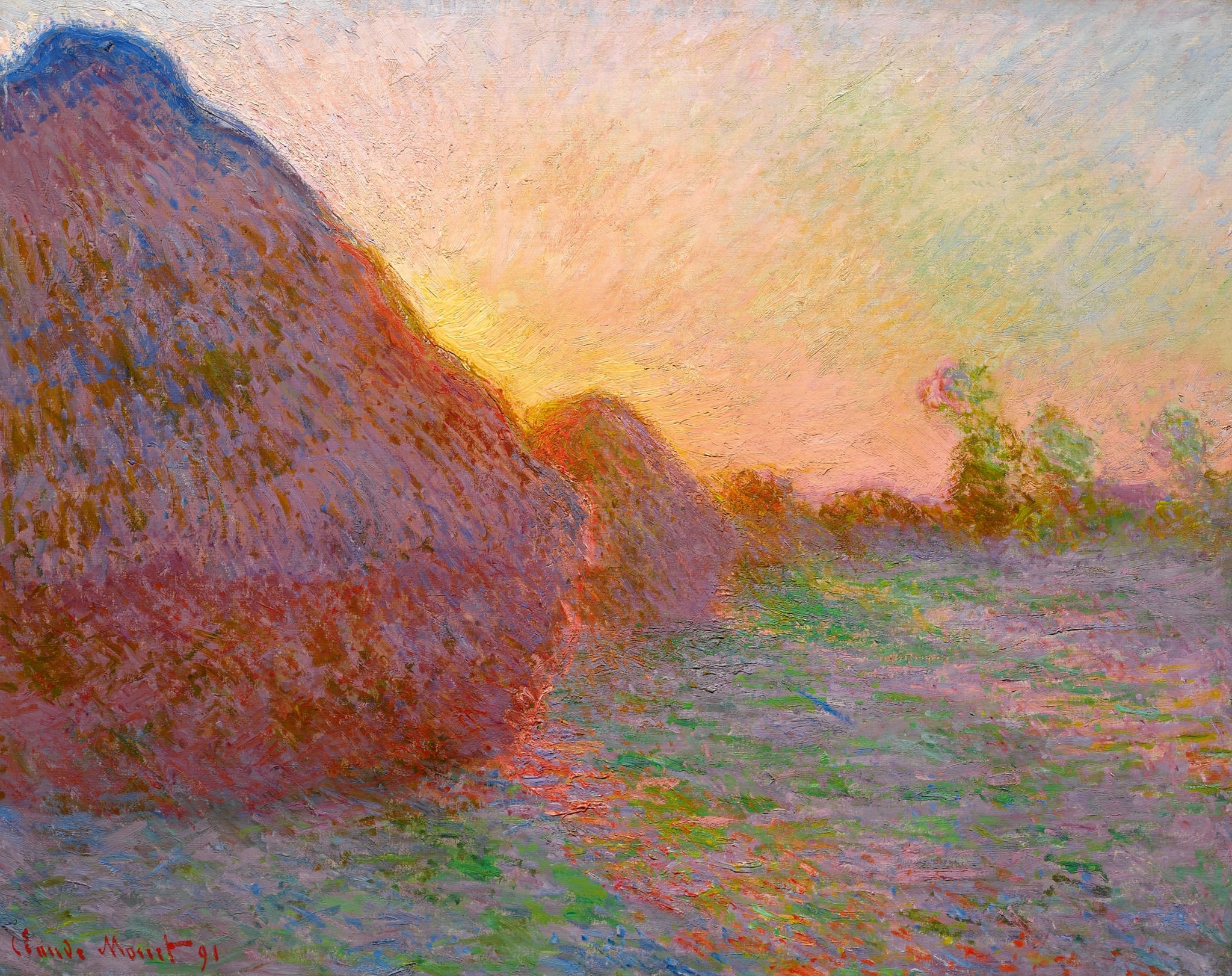
Claude Monet’s <strong>Haystacks Series</strong> transforms a routine rural subject into an inquiry into <strong>light, time, and perception</strong>. In this sunset view, the stacks swell at the left while the sun burns through the gap, making the field shimmer with <strong>apricot, lilac, and blue</strong> vibrations.
Women in the Garden by Claude Monet

Women in the Garden

Claude Monet (1866–1867)

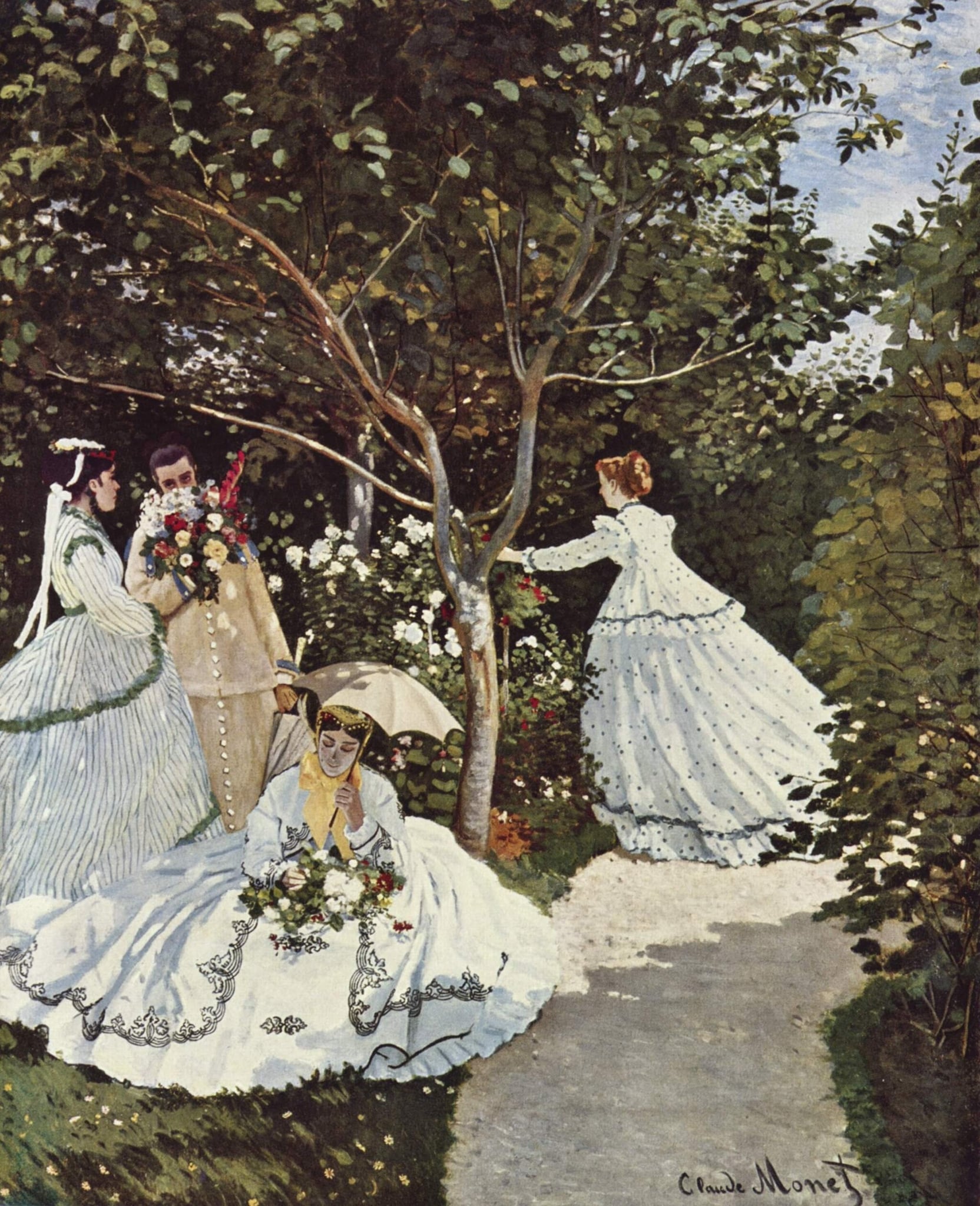
Claude Monet’s Women in the Garden choreographs four figures in a sunlit bower to test how <strong>white dresses</strong> register <strong>dappled light</strong> and shadow. The path, parasol, and clipped flowers frame a modern ritual of leisure while turning fashion into an instrument of <strong>perception</strong>. The scene reads less as portraiture than as a manifesto for painting the <strong>momentary</strong> outdoors <sup>[1]</sup><sup>[3]</sup>.
The Train in the Snow (The Locomotive) by Claude Monet

The Train in the Snow (The Locomotive)

Claude Monet (1875)

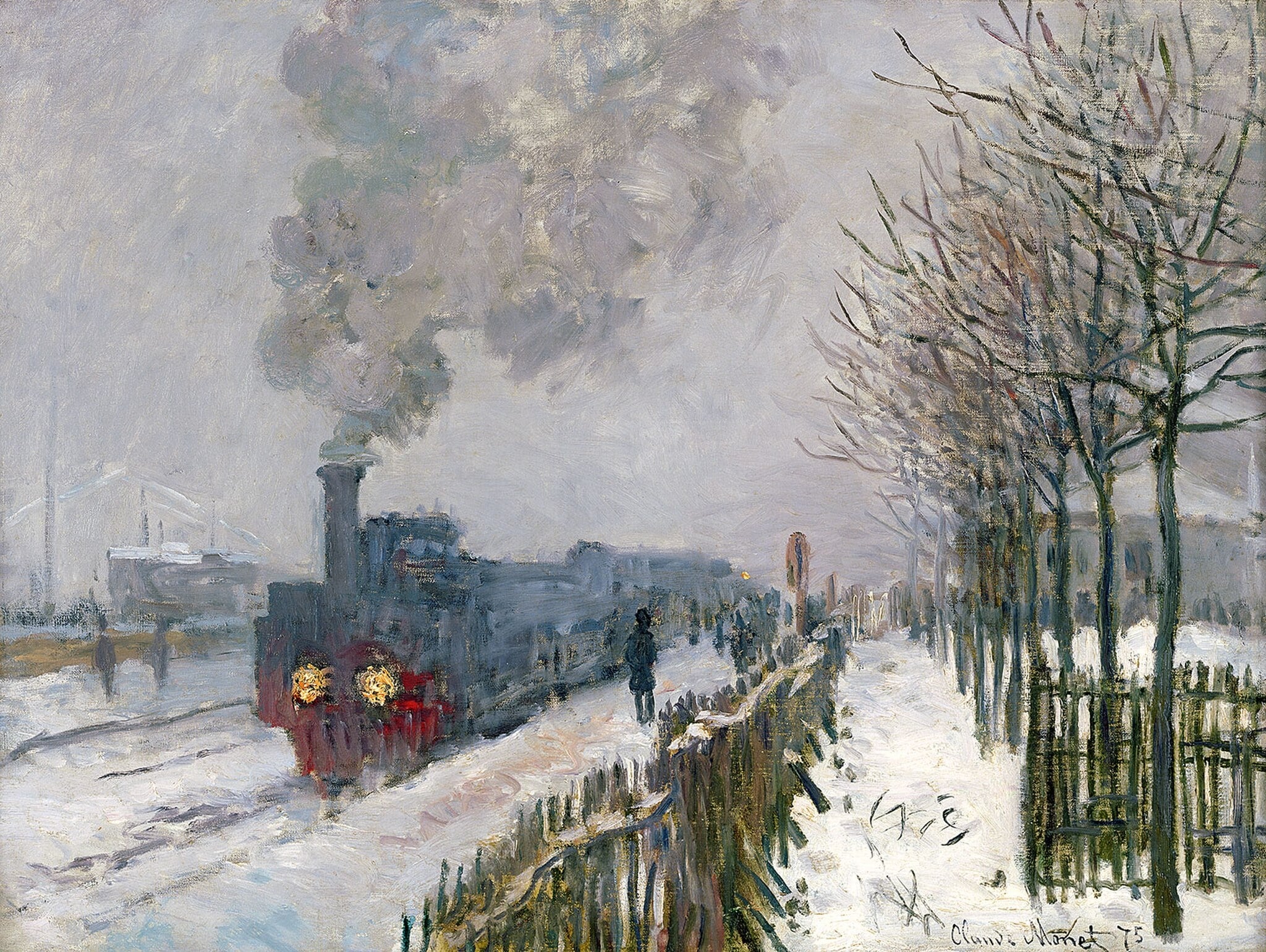
Claude Monet’s The Train in the Snow (The Locomotive) (1875) turns a suburban winter platform into a study of <strong>modernity absorbed by atmosphere</strong>. The engine’s twin yellow headlights and a smear of red push through a world of greys and violets as steam fuses with the low sky, while the right-hand fence and bare trees drill depth and cadence into the scene <sup>[1]</sup><sup>[4]</sup>. Monet fixes not an object but a <strong>moment of perception</strong>, where industry seems to dematerialize into weather <sup>[1]</sup><sup>[2]</sup>.
The Artist's Garden at Giverny by Claude Monet

The Artist's Garden at Giverny

Claude Monet (1900)

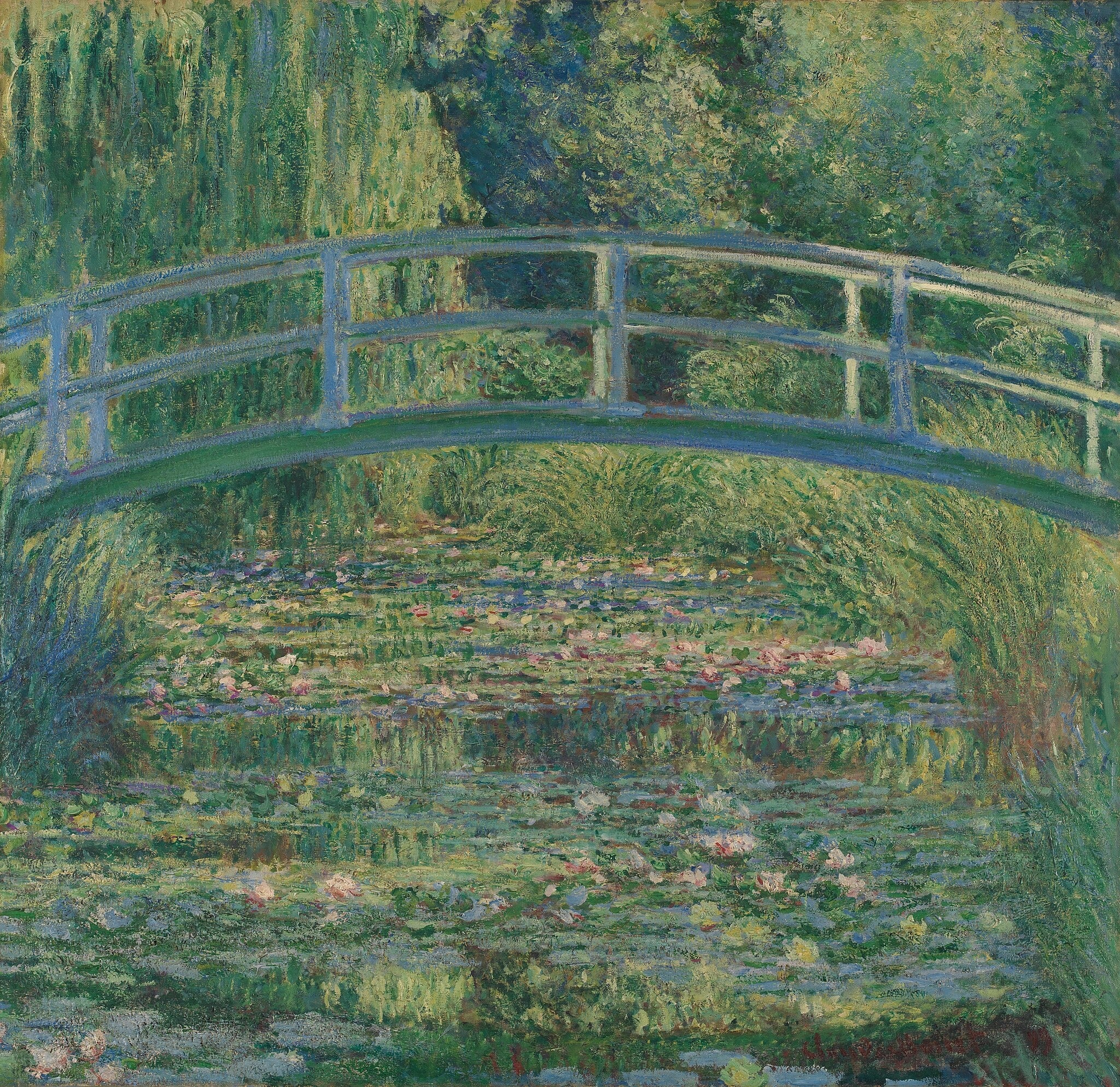
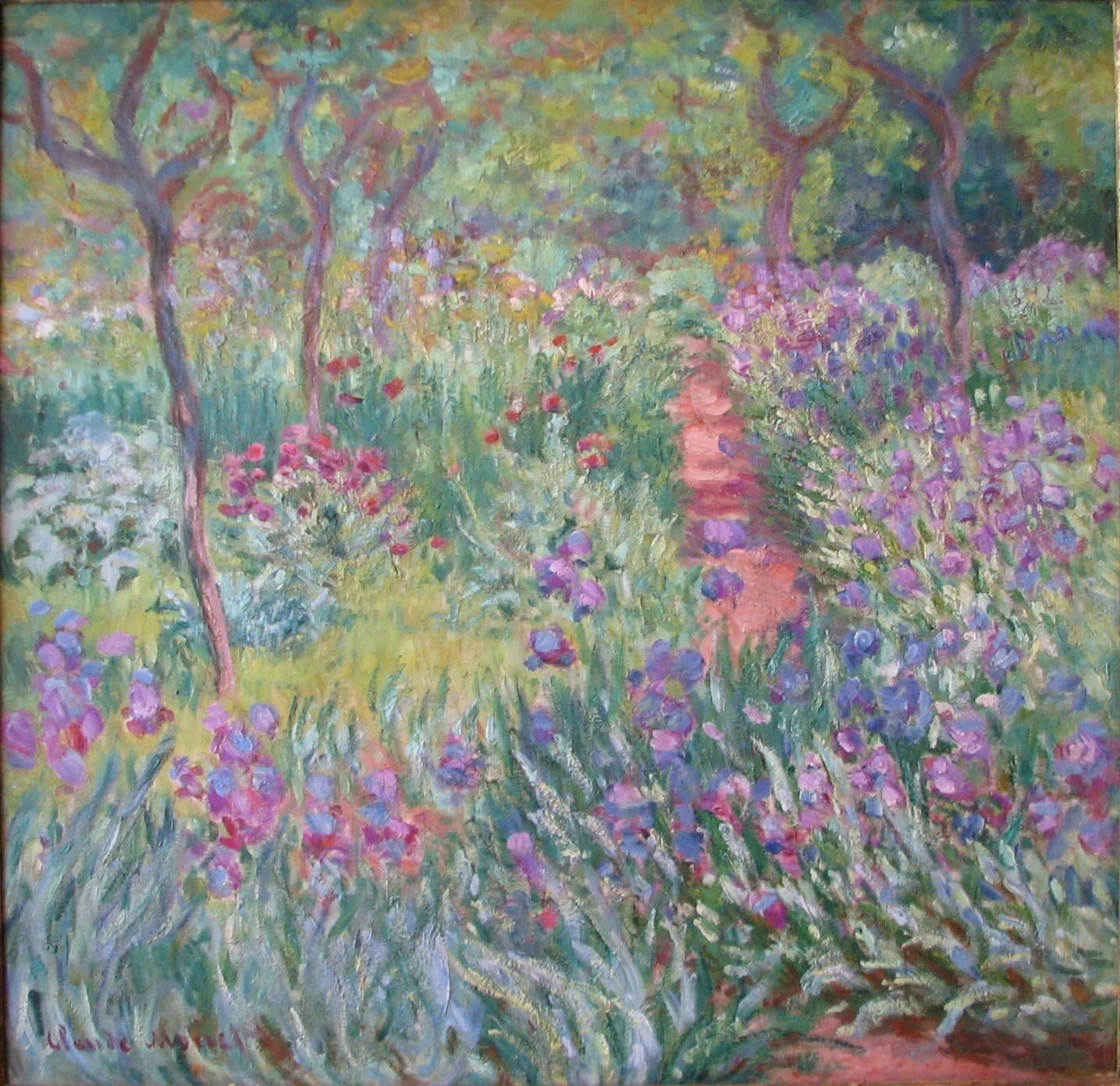
In The Artist's Garden at Giverny, Claude Monet turns his cultivated Clos Normand into a field of living color, where bands of violet <strong>irises</strong> surge toward a narrow, rose‑colored path. Broken, flickering strokes let greens, purples, and pinks mix optically so that light seems to tremble across the scene, while lilac‑toned tree trunks rhythmically guide the gaze inward <sup>[1]</sup><sup>[3]</sup>.