How Much Is Garden at Sainte-Adresse Worth?
Last updated: March 10, 2026
Quick Facts
- Last Sale
- $1.4M (1967, Christie's London)
- Insurance Value
- $200.0M (Reasoned replacement estimate based on market comparables)
- Methodology
- comparable analysis
Garden at Sainte-Adresse (1867) is an iconic early Monet of exceptional scale and renown, long considered a cornerstone of his pre‑Impressionist output. Anchored to recent top-tier Monet results and the 2019 record, a fair-market auction estimate of $120–170 million is warranted, with clear potential to challenge the artist’s peak.
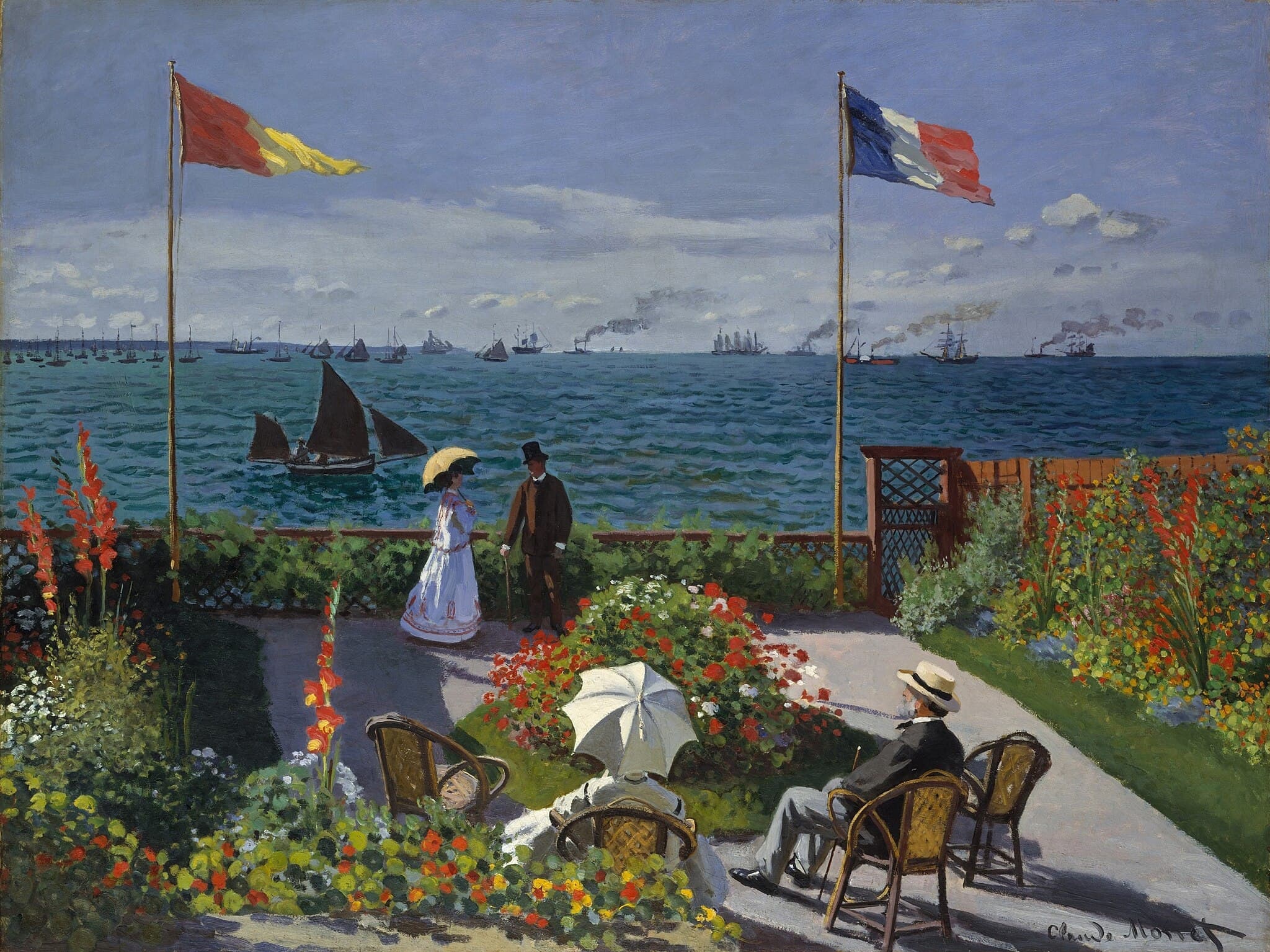
Garden at Sainte-Adresse
Claude Monet, 1867 • Oil on canvas
Read full analysis of Garden at Sainte-Adresse →Valuation Analysis
Estimated fair-market value (public auction): $120–170 million. Claude Monet’s Garden at Sainte-Adresse (1867) is a definitive early masterpiece—large, luminous, and widely reproduced—housed since 1967 in The Metropolitan Museum of Art, New York [1]. Its historic stature, scale (c. 98 × 130 cm), and rarity among Monet’s figure-in-landscape subjects position it at the apex of demand for non–Nymphéas Monets. Using recent marquee results and Monet’s record as benchmarks, this work sits squarely in trophy territory and would attract a broad, cross-category bidder pool.
Market anchors and comparables. Monet’s auction record stands at $110.7 million for Meules (Haystacks) at Sotheby’s New York in 2019, a watershed result that established the modern ceiling for best-of-kind Monets [3]. In the current cycle, large, high-quality Nymphéas canvases have reached $74.0 million (Christie’s, 2023) and $65.5 million (Sotheby’s, 2024), demonstrating sustained depth for A‑caliber works by Monet under today’s conditions [4][5]. Against these benchmarks, Garden at Sainte-Adresse—arguably the most celebrated early Monet with figures—merits a premium position: it combines landmark art-historical importance with powerful visual impact and broad name recognition.
Artwork-specific drivers. Painted in 1867, the sunlit terrace scene unites brisk maritime light with an ambitious multi-figure composition, prefiguring Impressionist concerns with atmosphere and modern leisure. The painting’s recognition is outsized relative to most early Monets, reinforced by an exemplary literature and exhibition pedigree (including the 4th Impressionist Exhibition in 1879, as recorded by the Met) [1]. Comparable works of this fame, composition, and scale are effectively unavailable in private hands, amplifying scarcity value.
Provenance and liquidity signals. The last public sale occurred at Christie’s London on December 1, 1967, where it realized £588,000 (≈$1.41 million at the contemporaneous exchange rate) before being acquired for The Met; this was headline news at the time and remains an important historical price point [2]. While the painting is not for sale, its unimpeachable museum ownership and long publication history strengthen its desirability were it hypothetically deaccessioned or sold by a future owner.
Positioning within current market conditions. Despite a cooler macro backdrop in 2024–2025, the Impressionist/Modern segment has remained comparatively resilient, with a consistent “flight to quality” that favors canonized blue-chip names and best-of-series works [6]. Within this context, a single-lot, globally marketed offering of Garden at Sainte-Adresse would command dominant attention. The $120–170 million range reflects: (i) the 2019 Monet record as a tested benchmark [3]; (ii) recent $65–74 million Nymphéas prices that validate deep bid-side capacity [4][5]; and (iii) the work’s iconic status, scale, and scarcity. Replacement (insurance) value would reasonably exceed likely auction outcomes due to sourcing difficulty and irreplaceability.
Key Valuation Factors
Art Historical Significance
High ImpactPainted in 1867 and exhibited with the Impressionists in 1879, Garden at Sainte-Adresse is a cornerstone of Monet’s pre‑Impressionist production. Its synthesis of brilliant coastal light, modern leisure, and a multi‑figure arrangement anticipates the movement’s core concerns. Among early Monets, few images match its fame, scholarly discussion, and frequency of reproduction. This level of recognition substantially elevates willingness to pay among both Monet specialists and cross‑category ‘trophy’ collectors seeking culturally definitive works, not merely decorative landscapes. The painting’s status as a teaching‑book illustration and museum highlight confers brand equity that translates directly into price power and resilience at auction.
Market Comparables and Record Prices
High ImpactMonet’s market is deep and global, with an all‑time auction record of $110.7m for Meules (2019) and recent Nymphéas trophies at $74.0m (2023) and $65.5m (2024). These results validate the capacity of the bidder base to transact at very high levels for best‑of‑kind works. Garden at Sainte-Adresse, while earlier than Monet’s late series, is comparably iconic and arguably rarer in private-market terms. Against these anchors, a $120–170m range is well supported: it prices a premium to recent $60–75m outcomes and positions the work to challenge the artist’s record, reflecting its broader cultural resonance and scarcity.
Scale, Composition, and Subject
High ImpactAt roughly 98 × 130 cm (38 5/8 × 51 1/8 in.), the canvas delivers commanding wall power unusual for early Monet figure scenes. The vivid terrace, fluttering flags, and channel traffic create a dynamic, highly legible composition that appeals to both seasoned collectors and new entrants. Figurative content in Monet—especially of this ambition—is scarcer on the market than pure landscapes, and it broadens demand beyond serial landscape buyers. Large size, immediate recognizability, and masterful light effects significantly amplify the trophy premium versus smaller, later, or less complex compositions.
Provenance, Exhibition, and Publication
High ImpactA distinguished, transparent chain—from early ownership through Durand‑Ruel to Rev. Theodore Pitcairn, a landmark 1967 Christie’s sale, and acquisition by The Met—confers exceptional credibility. The work has been extensively exhibited and published, enhancing both scholarship and public familiarity. Such documentation reduces transactional friction, facilitates global marketing, and supports aggressive third‑party guarantees. At the ultra‑trophy level, this level of provenance and literature often proves decisive, as buyers prize not only the image but the narrative that accompanies it.
Condition and Conservation
Medium ImpactWhile museums seldom publish detailed object-level condition data, The Met’s long-term stewardship suggests a high standard of care. For valuation, we assume sound structural integrity and no material condition impediments, in line with its regular display and loan history. At this price tier, condition nuances (e.g., lining history, retouching, varnish) can shift bidding by meaningful increments. A recent independent condition report would be required to calibrate the upper bound precisely, but given the work’s prominence and curatorial oversight, the baseline expectation remains strong.
Sale History
Christie's London
Single-lot evening sale; hammer £588,000; purchased by Agnew’s acting for The Met; USD ≈$1.41m at $2.40/£.
Claude Monet's Market
Claude Monet is a top‑tier, highly liquid blue‑chip artist with a truly global buyer base. His all‑time auction record is $110.7 million (Meules, 2019), and recent marquee results include $74.0 million for a large Nymphéas in 2023 and $65.5 million in 2024, underscoring continued depth for core series at the highest level. While market peaks often cluster around Water Lilies, Haystacks, and major London/Venice views, demand extends across his oeuvre for works with strong subject, scale, and provenance. Supply is selective and quality‑sensitive; thus, A+ examples reliably dominate evening sales, attract third‑party guarantees, and command cross‑category attention from trophy buyers in the US, Europe, and Asia.
Comparable Sales
Meules (Haystacks)
Claude Monet
Same artist; absolute trophy from a canonized series. Although later (1890–91) and a different subject, it calibrates the modern ceiling for best‑of‑kind Monets and the depth of global demand.
$110.7M
2019, Sotheby's New York
~$140.7M adjusted
Le bassin aux nymphéas (Water Lilies)
Claude Monet
Same artist; large, blue‑chip late series picture (c. 1917–19). Establishes the current high band for top Monets in marquee evening sales.
$74.0M
2023, Christie's New York
~$78.6M adjusted
Waterloo Bridge, soleil voilé
Claude Monet
Same artist; top example from the coveted London series (1899–1903). Demonstrates pricing for highly recognized serial subjects outside Water Lilies/Haystacks.
$64.5M
2022, Christie's New York (Paul G. Allen Collection)
~$71.4M adjusted
Le Grand Canal et Santa Maria della Salute
Claude Monet
Same artist; major Venice view (1908), another trophy‑level series with strong cross‑border appeal. Useful for bracketing high six‑ to low nine‑figure demand.
$56.6M
2022, Sotheby's New York
~$62.7M adjusted
Moulin de Limetz
Claude Monet
Same artist; late‑1880s landscape with architecture and water (1888). Not a headline series but a strong quality benchmark from the earlier, pre‑Giverny‑late phase.
$28.6M
2024, Christie's New York
~$29.6M adjusted
Matinée sur la Seine, temps net
Claude Monet
Same artist; key serial subject (1897) showing demand for high‑quality but non‑trophy Monets in the current cycle, helpful for mid‑tier bracketing.
$18.0M
2024, Christie's London
~$18.6M adjusted
Current Market Trends
The Impressionist/Modern segment has been comparatively resilient within a cooler overall auction environment. 2024 saw thinner liquidity above $10m broadly, yet blue‑chip historical names benefited from a ‘flight to quality,’ with top Monets continuing to clear strong prices in marquee sales. By late 2025, major houses reported renewed confidence and active Asian participation at the high end. The category remains highly selective: iconic images with museum‑caliber provenance and outstanding condition attract deep competition, while merely good examples face more measured bidding. Pricing at the ultra‑trophy tier is increasingly global and event‑driven, rewarding single‑lot or tightly curated offerings with robust editorial and curatorial framing.
Study print
Study this painting as a print
Pair the full artwork with a museum-style study sheet focused on one meaningful detail.
Sources
- The Metropolitan Museum of Art – Object record: Garden at Sainte-Adresse (1867)
- TIME – Report on the 1967 Christie’s sale and Met acquisition
- Sotheby’s – Monet’s Meules sells for $110.7m (artist record), May 2019
- Christie’s – Marquee Week results (includes Monet at $74.0m), Nov 2023
- Artnet News – Sotheby’s Modern sale sees Monet Nymphéas at $65.5m, Nov 2024
- Art Basel & UBS – The Art Market 2024 (Auctions overview)