How Much Is The Palazzo Ducale (The Doge’s Palace) Worth?
Last updated: March 15, 2026
Quick Facts
- Methodology
- comparable analysis
Based on directly comparable 1908 Venice canvases by Monet that sold for ~$35–36 million in 2015 and 2019 and adjusting for current demand and scarcity, The Palazzo Ducale (The Doge’s Palace) would likely command $45–60 million today. This range assumes standard museum-quality condition and leverages the work’s prime subject, scale, and distinguished provenance.
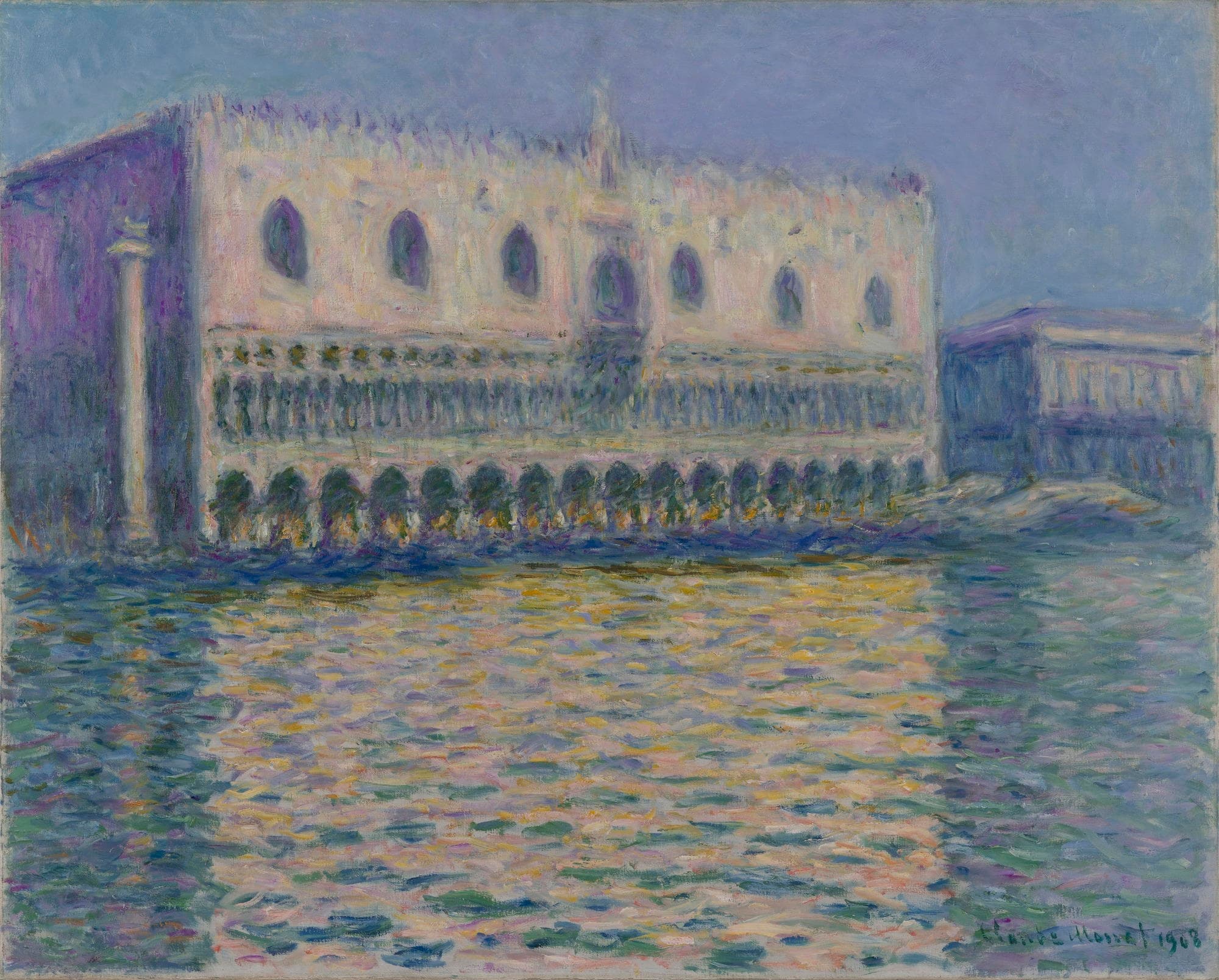
The Palazzo Ducale (The Doge’s Palace)
Claude Monet, 1908 • Oil on canvas
Read full analysis of The Palazzo Ducale (The Doge’s Palace) →Valuation Analysis
Estimated fair market value: $45–60 million. This valuation is anchored to the strongest apples‑to‑apples comparables: Monet’s 1908 Venice series canvases of near‑identical subject and scale. In February 2019, Sotheby’s London sold Le Palais Ducal for £27.5 million (about $36.2 million at the time), a work publicly described as a companion to the Brooklyn Museum painting [1]. In February 2015, Sotheby’s London sold Le Grand Canal (also 1908) for £23.7 million (about $35.5 million) [2].
Adjustment to today’s market. These two Venice benchmarks—$35–36 million before the recent rebound in blue‑chip Impressionism—set a robust floor for prime examples. Monet’s category leadership remains intact: the artist’s auction record is $110.7 million for Meules (2019) [3], while late‑series trophies continue to transact at high levels (e.g., a Nymphéas achieved $65.5 million in November 2024) [4]. Together, this supports a present‑day range in the mid‑to‑high eight figures for an A‑caliber Venetian view.
Work-specific strengths. The Brooklyn Museum canvas (oil on canvas, 32 × 39 in; 81.3 × 99.1 cm) represents one of Monet’s most coveted late motifs, the Doge’s Palace across the Bacino di San Marco, painted during the 1908 Venetian campaign [5]. The painting carries distinguished, well‑documented provenance—acquired from the artist by Bernheim‑Jeune/Durand‑Ruel, owned by Arthur B. Emmons, sold at the American Art Association in New York on January 14, 1920, then gifted by A. Augustus Healy to the Brooklyn Museum shortly thereafter—supporting market confidence and institutional stature [5].
Pricing mechanics. The $45–60 million bracket reflects: (i) direct subject/series comparables at ~$35–36 million in 2015–2019 [1][2]; (ii) the durability of top‑tier Monet demand, with late serial works consistently realizing $40–75 million across market cycles [3][4]; and (iii) scarcity premiums for museum‑grade Venetian pictures. Recent results also show breadth at ~$40–43 million for prime serial works beyond Venice (e.g., Poplars at $42.96 million in May 2025), reinforcing depth in this price band [6].
Positioning within the range. Assuming standard museum‑quality condition (no material condition issues, stable surface, sympathetic conservation), strong coloristic vibrancy, and robust exhibition history, this painting would likely clear the mid‑$50 millions at a well‑staged New York evening sale with appropriate third‑party support. A more conservative outcome near the mid‑$40 millions would mainly reflect short‑term macro volatility or condition/appearance constraints. On balance, the painting’s prime motif, scale, and provenance justify the stated $45–60 million estimate.
Key Valuation Factors
Art Historical Significance
High ImpactPainted during Monet’s 1908 Venetian sojourn, the Palazzo Ducale motif is a touchstone of his late career. These works distill Monet’s serial method—chromatic harmonies, ephemeral light, and architectural silhouette—into one of the most recognizable cityscapes in Impressionism. While the Water Lilies and Haystacks series define Monet’s broader fame, top Venice subjects are widely considered A‑category late works. Within institutional and private collections, Doge’s Palace and Grand Canal variants are particularly coveted, delivering a compelling balance of iconic subject, late style maturity, and display impact. This art-historical positioning underpins sustained, global demand at the high end and supports a valuation premium for prime examples in strong condition.
Series Scarcity and Subject Demand
High ImpactHigh‑quality Palazzo Ducale canvases are scarce in private hands, with many of the finest examples held by museums. Auction appearances are infrequent, and when strong works emerge, competition is deep. Directly comparable Doge’s Palace and Grand Canal paintings realized roughly $35–36 million in 2015 and 2019, forming a sturdy market baseline. Given the iconic subject and the late‑career refinement collectors prize—iridescent color, shimmering water, and silhouette—the series commands a liquidity premium over many secondary Monet subjects. Scarcity, coupled with easily legible wall power and canonical status, materially elevates the achievable price band for a work of this caliber.
Provenance and Institutional Status
Medium ImpactThe painting’s chain of ownership—artist to leading dealers (Bernheim‑Jeune/Durand‑Ruel), to a prominent American collector (Arthur B. Emmons), sold publicly in 1920, then gifted to the Brooklyn Museum—offers exemplary provenance. Long-term museum stewardship provides implicit condition oversight and scholarly validation, factors prized by buyers. While institutional ownership means this specific example is not for sale, provenance of this quality increases the hypothetical fair market value, as it reduces transactional risk and enhances narrative appeal in cataloguing and press. Such pedigree often correlates with stronger bidding when comparable works circulate.
Market Comparables and Liquidity
High ImpactRecent sales demonstrate robust pricing for prime Monet serial works: a Venetian Le Palais Ducal fetched about $36.2 million in 2019; Le Grand Canal brought roughly $35.5 million in 2015; and late‑series trophies (Water Lilies, Parliament) have reached $45–76+ million in the last few years. Monet’s category‑leading auction record ($110.7 million for Meules) underscores the depth of capital at the top. With renewed momentum in 2025 and continued global participation (including Asia-based bidders), liquidity at $40–60 million for A‑grade Monets remains consistent, justifying the stated range for a museum‑grade Palazzo Ducale.
Sale History
American Art Association, New York
From the collection of Arthur B. Emmons; purchased by A. Augustus Healy and gifted to the Brooklyn Museum days later. Price not published in accessible online records.
Claude Monet's Market
Claude Monet is a cornerstone of the global blue‑chip market. His auction record stands at $110.7 million for Meules (Sotheby’s, 2019), and late serial masterpieces like Parliament, Waterloo Bridge, and the Water Lilies frequently transact between roughly $35 million and $75 million. Even through 2024’s softer environment, a Nymphéas achieved $65.5 million, and in 2025 another prime serial work (Poplars) realized $42.96 million, illustrating resilient depth for A‑quality examples. Demand is international, with strong participation from U.S. and European collections and growing engagement from Asia. Monet’s iconic status, exhibition visibility, and limited supply of trophy‑level works sustain high liquidity and competitive pricing in evening sales.
Comparable Sales
Le Palais Ducal (The Doge’s Palace)
Claude Monet
Same artist/series/subject (Venice 1908), near-identical size and composition; Sotheby’s called it a companion to the Brooklyn canvas. Best like-for-like benchmark.
$36.2M
2019, Sotheby's London
~$45.4M adjusted
Le Grand Canal
Claude Monet
Same artist and 1908 Venice campaign; closely related subject and scale; a widely cited top Venice benchmark.
$35.5M
2015, Sotheby's London
~$48.1M adjusted
Le Palais Ducal (The Doge’s Palace)
Claude Monet
Same artist/series/subject (Venice 1908). Direct subject match; useful for understanding dispersion within the Palazzo Ducale subgroup.
$23.1M
2015, Sotheby's New York
~$31.3M adjusted
Waterloo Bridge, effet de brume
Claude Monet
Same artist, late serial cityscape (Thames series, c. 1899–1904); market proxy for top late-Monet architectural/urban serial works at the $35–40m level.
$36.9M
2022, Christie's London
~$40.5M adjusted
Le Parlement, soleil couchant
Claude Monet
Same artist and late serial cityscape (London Parliament series, 1900–03). Not Venice, but establishes the upper tier of demand for iconic late Monets.
$76.0M
2022, Christie's New York
~$83.3M adjusted
Current Market Trends
Impressionist and Post‑Impressionist markets softened in 2024 but stabilized in 2025, with this category leading auction growth on the back of selective, high‑quality consignments. Houses relied on guarantees and conservative estimates to catalyze participation, while buyers focused on canonical names with pristine provenance and compelling narratives. Within this context, Monet remains a bellwether: prime serial works continue to draw multiple bidders and clear at robust levels. With the artist’s centenary fueling institutional programming and visibility, the near‑term outlook for top‑tier Monets is constructive, albeit selective—quality, condition, and freshness to market remain decisive for pricing at $40 million and above.
Study print
Study this painting as a print
Pair the full artwork with a museum-style study sheet focused on one meaningful detail.
Sources
- Sotheby’s London, Impressionist & Modern Art Evening Sale (Lot: Monet, Le Palais Ducal, 2019)
- The Guardian – Monet’s Le Grand Canal sells for £23.7m (Feb 2015)
- Sotheby’s – Monet’s Meules sets $110.7m auction record (May 2019)
- Artnet News – Sotheby’s Modern sale led by Monet Nymphéas at $65.5m (Nov 2024)
- Brooklyn Museum – Claude Monet, The Doge’s Palace (object page)
- Christie’s – 20th/21st Century New York Auction Results (May 2025)