The Palazzo Ducale (The Doge’s Palace)

by Claude Monet

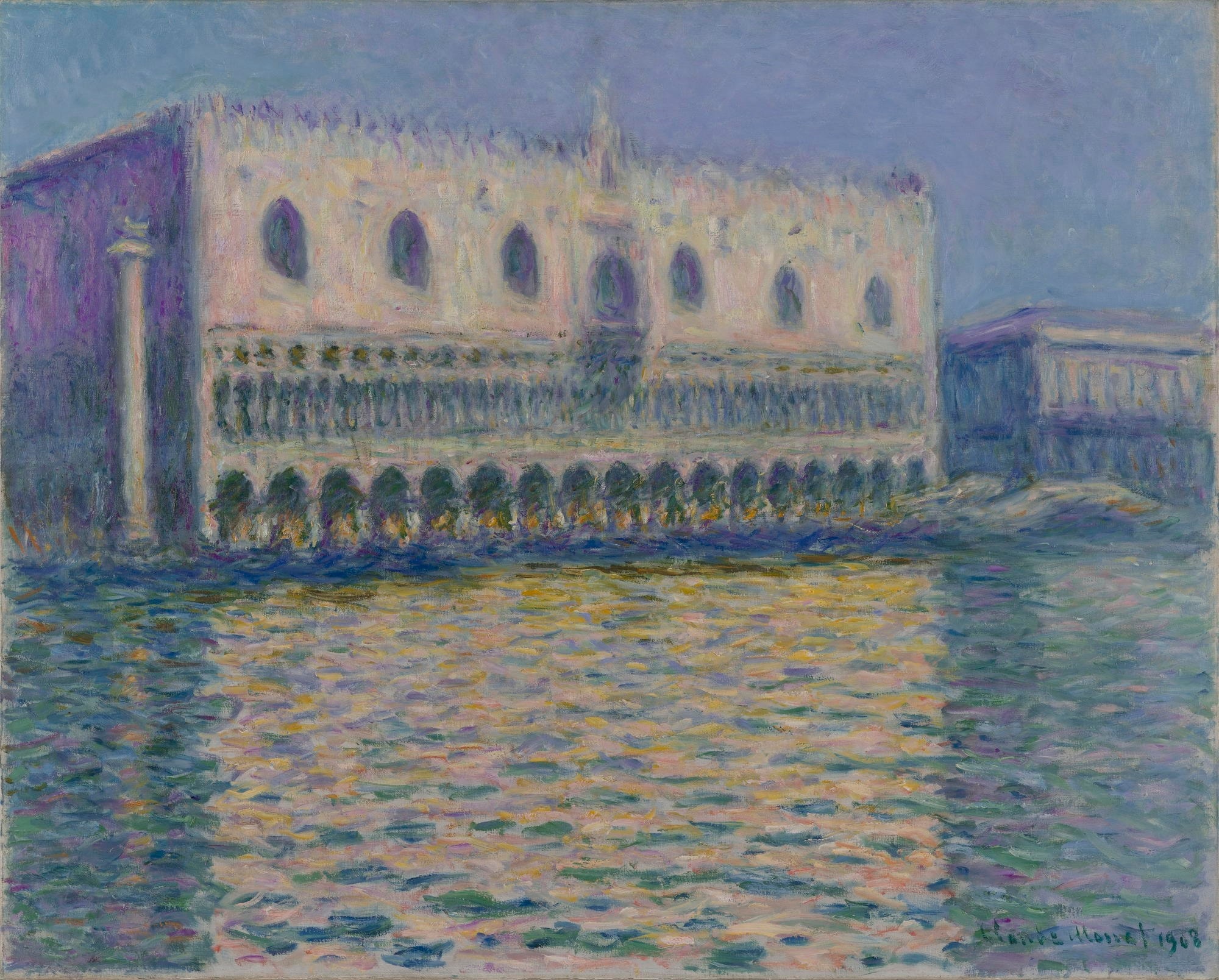
Claude Monet’s The Palazzo Ducale (The Doge’s Palace) converts Venice’s seat of power into an apparition of light and atmosphere. The lilac-and-rose façade dissolves into rhythmic brushwork while its broken reflection braids golds and violets across the canal. Monument becomes sensation, authority becomes shimmer.

Study Print Studio

Create a personal study print

Build a companion study sheet around the part of this painting that speaks to you most. Choose a detail, shape an interpretation, and walk away with something personal and display-worthy.

Fast Facts

Year
1908
Medium
Oil on canvas
Dimensions
81.3 x 99.1 cm
Location
Brooklyn Museum, New York
See all Claude Monet paintings in New York
The Palazzo Ducale (The Doge’s Palace) by Claude Monet (1908) featuring Broken water reflection, Pointed Gothic windows, Lower arcade rhythm, Solitary Piazzetta column

Click on any numbered symbol to learn more about its meaning

Meaning & Symbolism

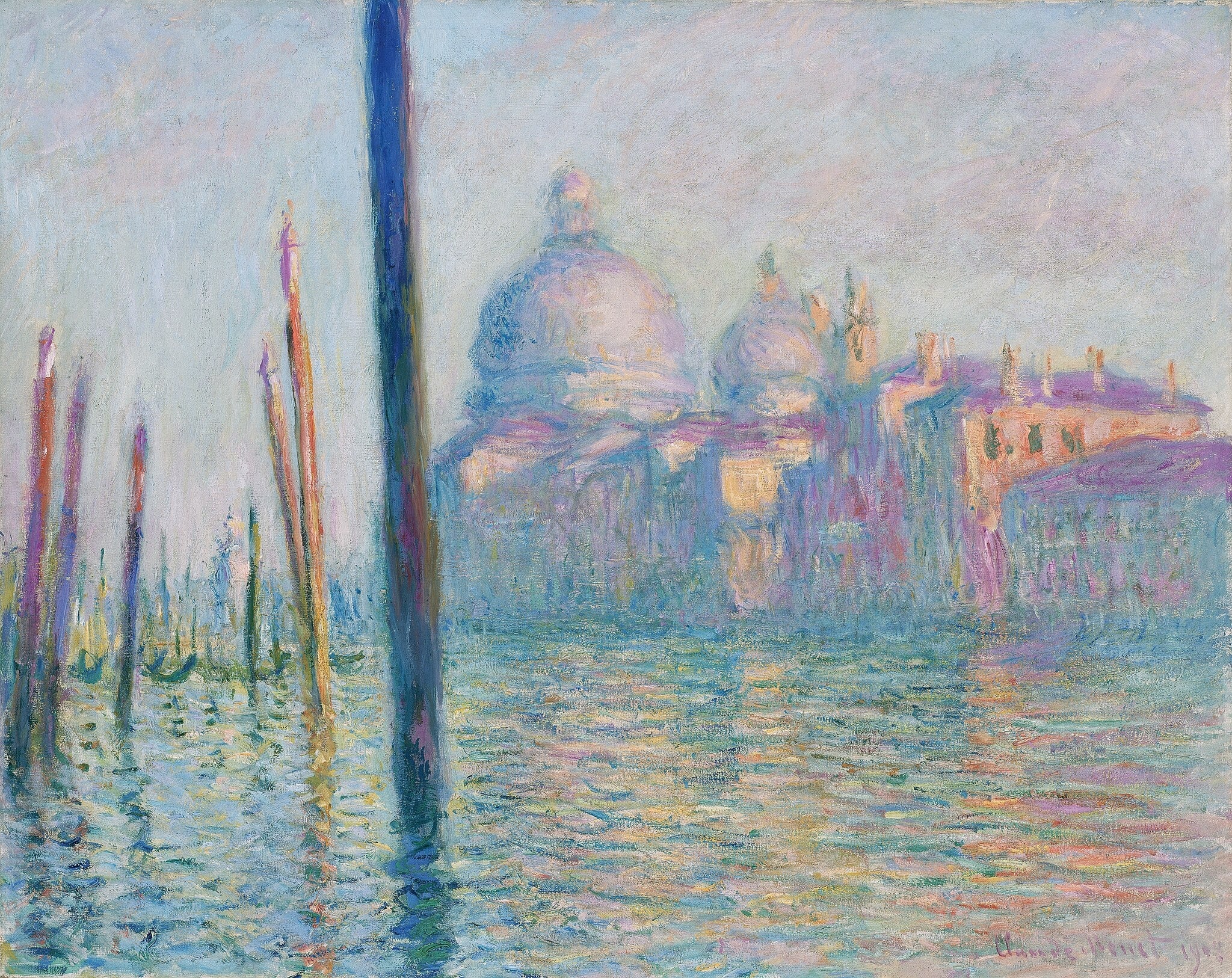
Facing the palace across the water, Monet collapses architecture into a performance of color. The façade’s pointed windows register not as measured tracery but as pulses of violet and ultramarine that drift within veils of lilac, rose, and pale gold; the lower arcade compresses into a dark rhythm, like a soundwave, rather than a count of arches. Along the left edge, a single pale column stands as a soft vertical accent—more chromatic chord than emblem—marking the Piazzetta’s threshold while refusing legible heraldry. Across the foreground, wide, quick strokes drag citron, peach, and teal laterally, so the canal becomes a mirror of broken color that pulls the eye downward. This joining of façade and reflection enacts the work’s thesis: stone is contingent on weather, hour, and tide. Monet’s own claim that the palace was “an excuse for painting the atmosphere” is made visible in the way contour evaporates where light is richest, especially along the sunstruck mid-band where the building seems to lift off its base and hover over ripples 1. Such choices are not mere optics; they recode civic authority. The Doge’s Palace—historic emblem of Venetian governance and justice—loses descriptive hierarchy and yields to luminous equality: water, sky, and wall carry the same painterly weight. The palace projects authority, but its reflection answers it, softening command into recurrence and drift. By setting water between himself and the structure, Monet maximizes light’s bounce, a tactic that turns the seat of state into a mutable interface of air and surface 4. Where Canaletto documented façades, Monet documents duration—a few minutes of Venetian haze. This temporalization is historically inflected: his Venetian canvases were finished after his return to Giverny and then acclaimed in the 1912 Bernheim-Jeune exhibition, which cemented their status as the mature culmination of his serial practice 2. In that context, the palace functions like Rouen Cathedral or the haystacks: a motif through which time is the true subject. The painting also advances a modern conversation with Turner and Whistler. Turner’s Venetian dissolutions offered a precedent for letting architecture melt into atmosphere; Monet, older and more structurally minded, finds a late style where color-intervals replace masonry and reflections cast the city as pure event 3. The cool lavender envelope that bathes the building, punctuated by warm streaks along the water, creates a chromatic counterpoint—authority versus flux—that never resolves, only shimmers. Even the faint indication of the Piazzetta column acts less as symbol than as tempo, a soft beat against horizontal swell; the traditional emblems it once carried are subdued into hue, implying that Venice’s identity, like its image here, survives as afterglow rather than inscription 6. This is why The Palazzo Ducale (The Doge’s Palace) is important: it demonstrates that modern painting can carry history not by describing it, but by atmospherically thinking it—showing how power, place, and memory persist as changing light on water 13.

Explore Deeper with AI

Ask questions about The Palazzo Ducale (The Doge’s Palace)

Popular questions:

Powered by AI • Get instant insights about this artwork

💬 Ask questions about this artwork!

Interpretations

Historical Context: Venice Between Collapse and Renewal

Monet’s 1908 views carry an unspoken timestamp: the backdrop of St Mark’s Campanile under reconstruction after its 1902 collapse. That quiet detail places the Doge’s Palace within a city literally being rebuilt, aligning the picture’s fugitive light with a Venice in transition. Though painted en plein air in autumn 1908, these canvases were completed and calibrated in Giverny, then unveiled in the 1912 Bernheim-Jeune exhibition of 29 Venetian works—an event that canonized Venice as the late apex of Monet’s serial method 23. In this frame, the palace is not only a Gothic emblem: it becomes a witness to historical duration, where civic memory is refracted through haze, tide, and a skyline under repair. The work articulates renewal without monumentality—history sensed as atmosphere rather than narrated in stone 23.

Source: Kunsthaus Zürich; The Met

Formal Analysis: Piers, Pulse, and Palette

Spatial anchoring arrives less from linear perspective than from pali—the mooring posts at right that punctuate horizontals with vertical color-chords, a modern counterpoint to the palace’s lateral sweep 4. Across the façade, tracery is reduced to chromatic pulses; below, the arcade compacts into a dark, syncopated band that reads like sound rather than architecture—Monet’s “armature for light” in action 1. The canal’s surface drags citron, teal, and rose laterally, welding reflection to structure. Richard Thomson notes the late palette’s “banana yellows” and “turquoise blues,” keyed to maximize bounce by placing water between painter and building 5. Seen together, these strategies convert depth into layered veils, so that Venice is constructed from intervals—beats of hue and value—rather than orthogonals or measured stone 145.

Source: Museum Barberini; Brooklyn Museum; Richard Thomson (Monet & Architecture)

Political Iconography Recast: From Emblem to Afterglow

The Piazzetta’s twin columns traditionally bear the Lion of St Mark and St Theodore—civic emblems that guard the Republic’s threshold. Monet keeps their place but not their legibility: they register as soft vertical tempi, chromatic beats rather than heraldic signs 16. This demotion of symbol to hue participates in a larger de-hierarchization: the Doge’s Palace—seat of governance—shares painterly weight with sky and water. Where Canaletto codified authority through crisp description, Monet’s haze folds power into recurrence and reflection, an authority answered by its own mirror. Thomson’s point that Monet situates water between himself and the structure describes a politics of mediation: power must pass through atmosphere, losing edges as it gains light 56. The result is history as afterglow—recognizable, persuasive, but no longer declarative 156.

Source: Brooklyn Museum; Richard Thomson (via Sotheby’s); Wikipedia (Piazzetta columns)

Comparative Lens: Turner, Whistler, and the Event of the City

Turner’s Venetian dissolutions licensed the sublimation of architecture into weather, while Whistler’s nocturnes modeled chromatic economy. Monet’s 1908 palace absorbs both legacies yet remains distinctly structural: the façade persists as a grid of intervals even as edges evaporate 45. Curators note the vantage and west-facing variant in Potsdam as a unique orchestration of silhouette, glare, and reflective scatter—architecture cast as event, not object 4. By serializing the motif and calibrating canvases back in Giverny, Monet converts the veduta lineage into an experiment in duration: not “what Venice is,” but “how Venice happens” over minutes. In this genealogy, Monet’s palace is less a building than a system for testing atmospheric logic: a late-style convergence of precedent, method, and urban shimmer 345.

Source: Museum Barberini; The Met; Richard Thomson (Monet & Architecture)

Reception and Market: Value of Atmosphere

When 29 Venetian canvases appeared at Bernheim-Jeune in 1912, critics recognized a consummation of Monet’s serial practice—architecture reimagined as time kept in color 35. That valuation, initially critical, has proven durable in the market: a closely related Palazzo Ducale canvas realized £27.5 million at Sotheby’s in 2019, a record for Monet’s Venetian views 5. The catalogue’s scholarly apparatus—linking dealers Bernheim-Jeune and Durand-Ruel, and citing Thomson’s analysis—signals how institutional and commercial frames co-produce meaning: the painting is prized not for topography but for atmospheric thinking. The price indexes a consensus that the work’s “subject” is neither palace nor panorama, but a repeatable optical event made singular on canvas—a modern commodity of duration and haze 35.

Source: Sotheby’s; The Met

Related Themes

About Claude Monet

Claude Monet (1840–1926) led Impressionism’s pursuit of open-air painting and optical immediacy, especially during his Argenteuil years focused on modern leisure and light. He later developed serial studies of changing conditions, culminating in the Water Lilies cycle [2].
View all works by Claude Monet

More by Claude Monet

Boating by Claude Monet

Boating

Claude Monet (1887)

Monet’s Boating crystallizes modern leisure as a drama of perception, setting a slim skiff and two pale dresses against a field of dark, mobile water. Bold cropping, a thrusting oar, and the complementary flash of hull and foliage convert a quiet outing into an experiment in <strong>modern vision</strong> and the <strong>materiality of water</strong> <sup>[1]</sup><sup>[2]</sup>.

The Thames below Westminster by Claude Monet

The Thames below Westminster

Claude Monet (about 1871)

Claude Monet’s The Thames below Westminster turns London into <strong>light-made architecture</strong>, where Parliament’s mass dissolves into mist and the river shivers with <strong>industrial motion</strong>. Tugboats, a timber jetty with workers, and the rebuilt Westminster Bridge assert a modern city whose power is felt through atmosphere more than outline <sup>[1]</sup>.

Haystacks Series by Claude Monet | Light, Time & Atmosphere by Claude Monet

Haystacks Series by Claude Monet | Light, Time & Atmosphere

Claude Monet

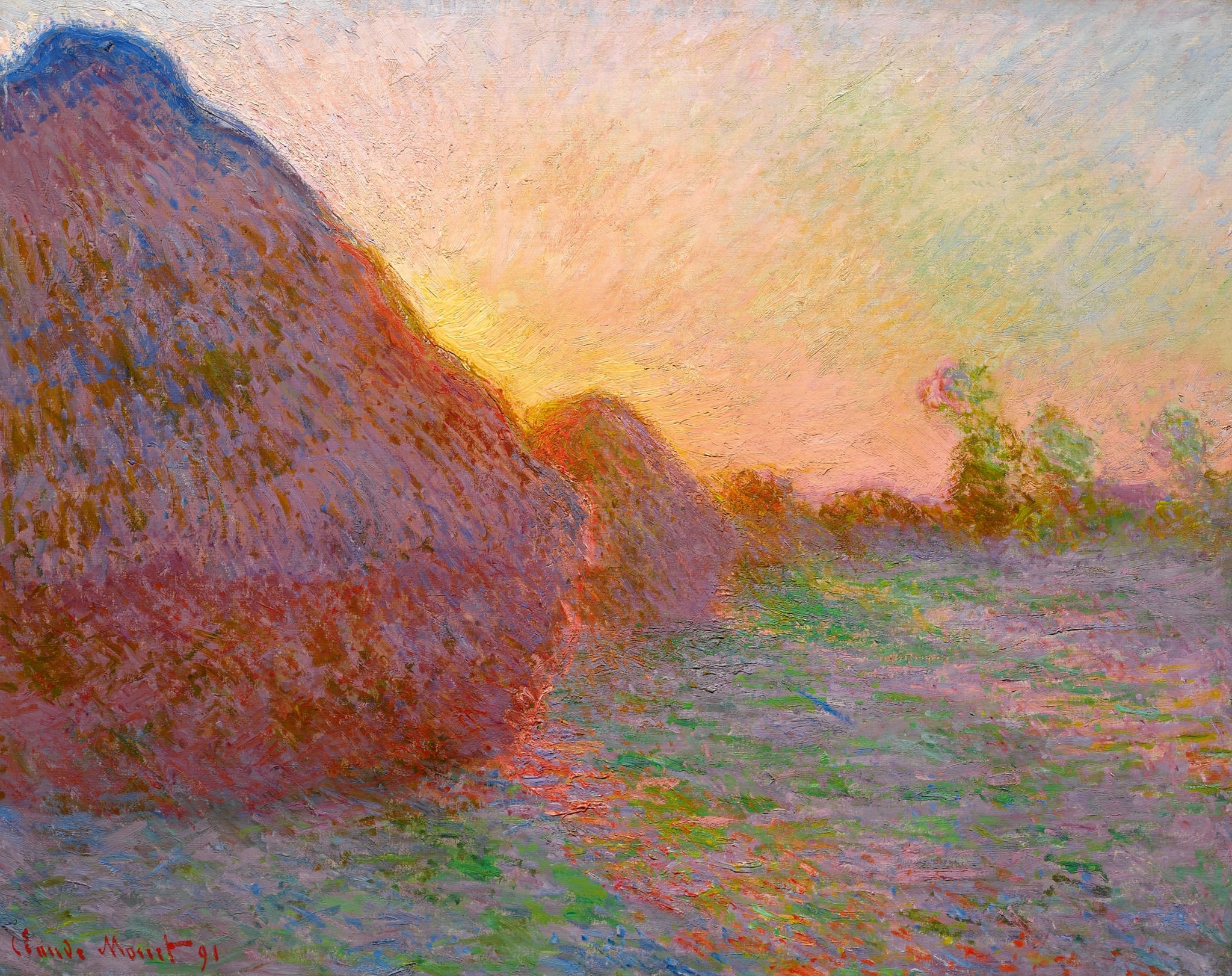
Claude Monet’s <strong>Haystacks Series</strong> transforms a routine rural subject into an inquiry into <strong>light, time, and perception</strong>. In this sunset view, the stacks swell at the left while the sun burns through the gap, making the field shimmer with <strong>apricot, lilac, and blue</strong> vibrations.
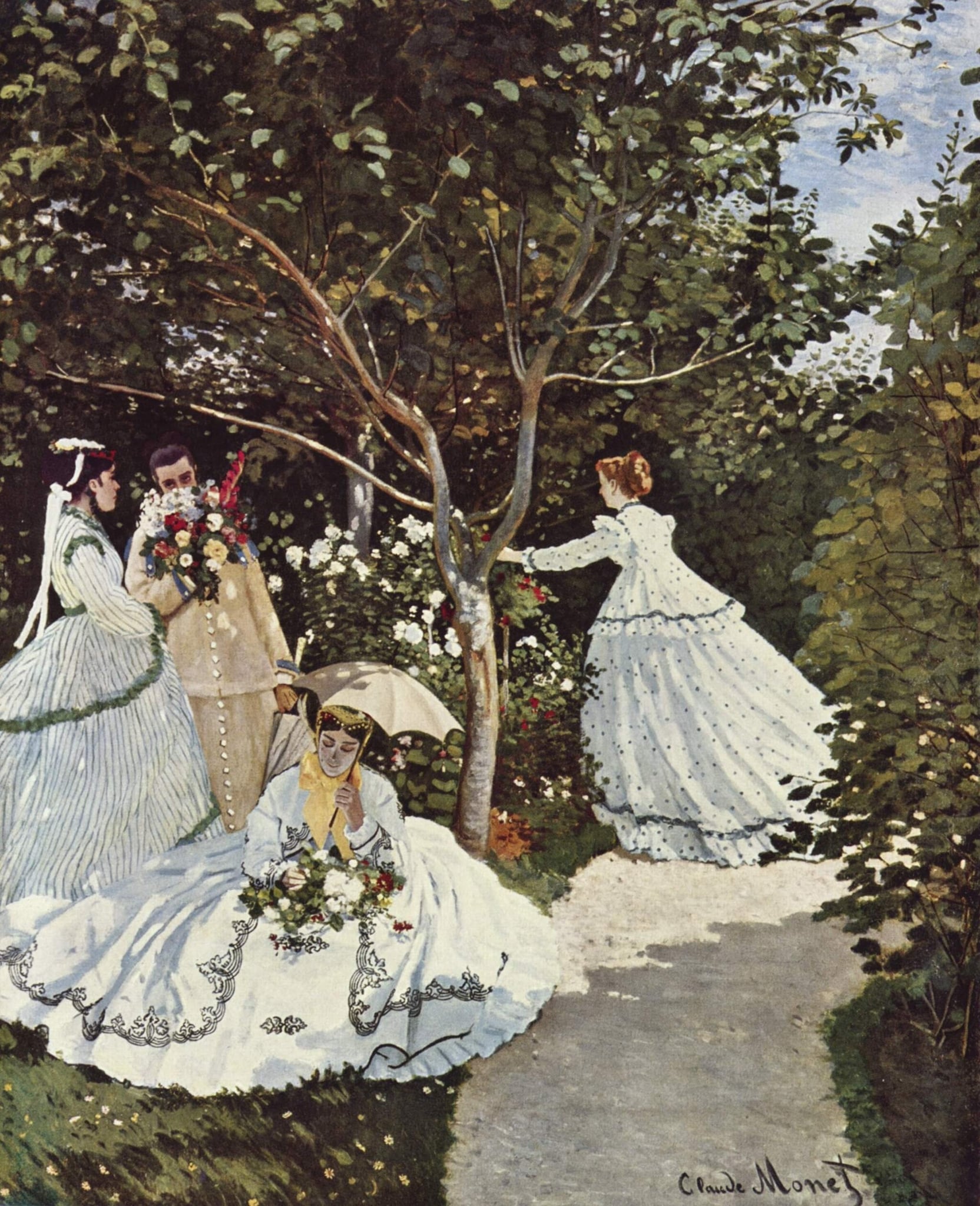
Women in the Garden by Claude Monet

Women in the Garden

Claude Monet (1866–1867)

Claude Monet’s Women in the Garden choreographs four figures in a sunlit bower to test how <strong>white dresses</strong> register <strong>dappled light</strong> and shadow. The path, parasol, and clipped flowers frame a modern ritual of leisure while turning fashion into an instrument of <strong>perception</strong>. The scene reads less as portraiture than as a manifesto for painting the <strong>momentary</strong> outdoors <sup>[1]</sup><sup>[3]</sup>.
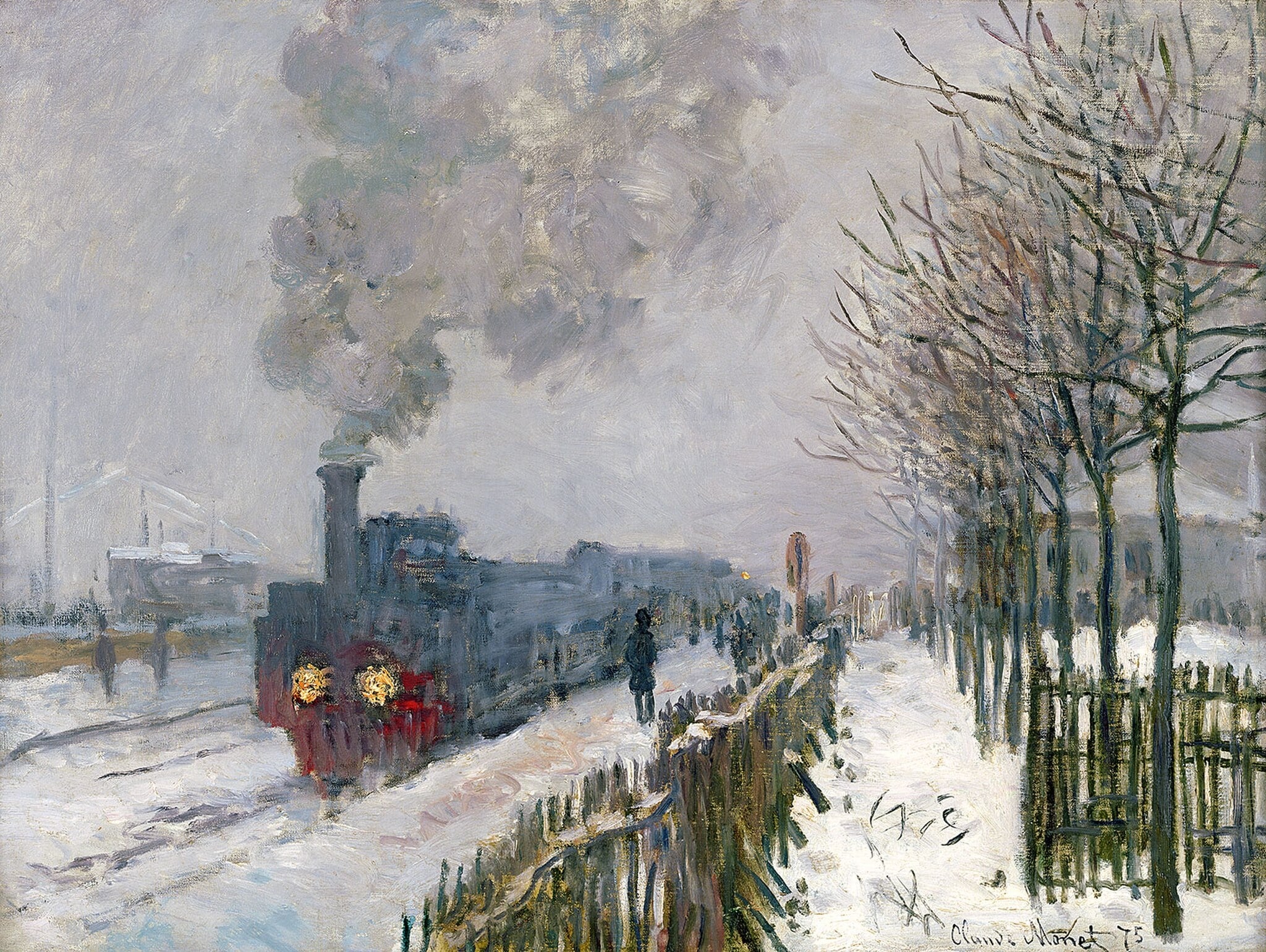
The Train in the Snow (The Locomotive) by Claude Monet

The Train in the Snow (The Locomotive)

Claude Monet (1875)

Claude Monet’s The Train in the Snow (The Locomotive) (1875) turns a suburban winter platform into a study of <strong>modernity absorbed by atmosphere</strong>. The engine’s twin yellow headlights and a smear of red push through a world of greys and violets as steam fuses with the low sky, while the right-hand fence and bare trees drill depth and cadence into the scene <sup>[1]</sup><sup>[4]</sup>. Monet fixes not an object but a <strong>moment of perception</strong>, where industry seems to dematerialize into weather <sup>[1]</sup><sup>[2]</sup>.
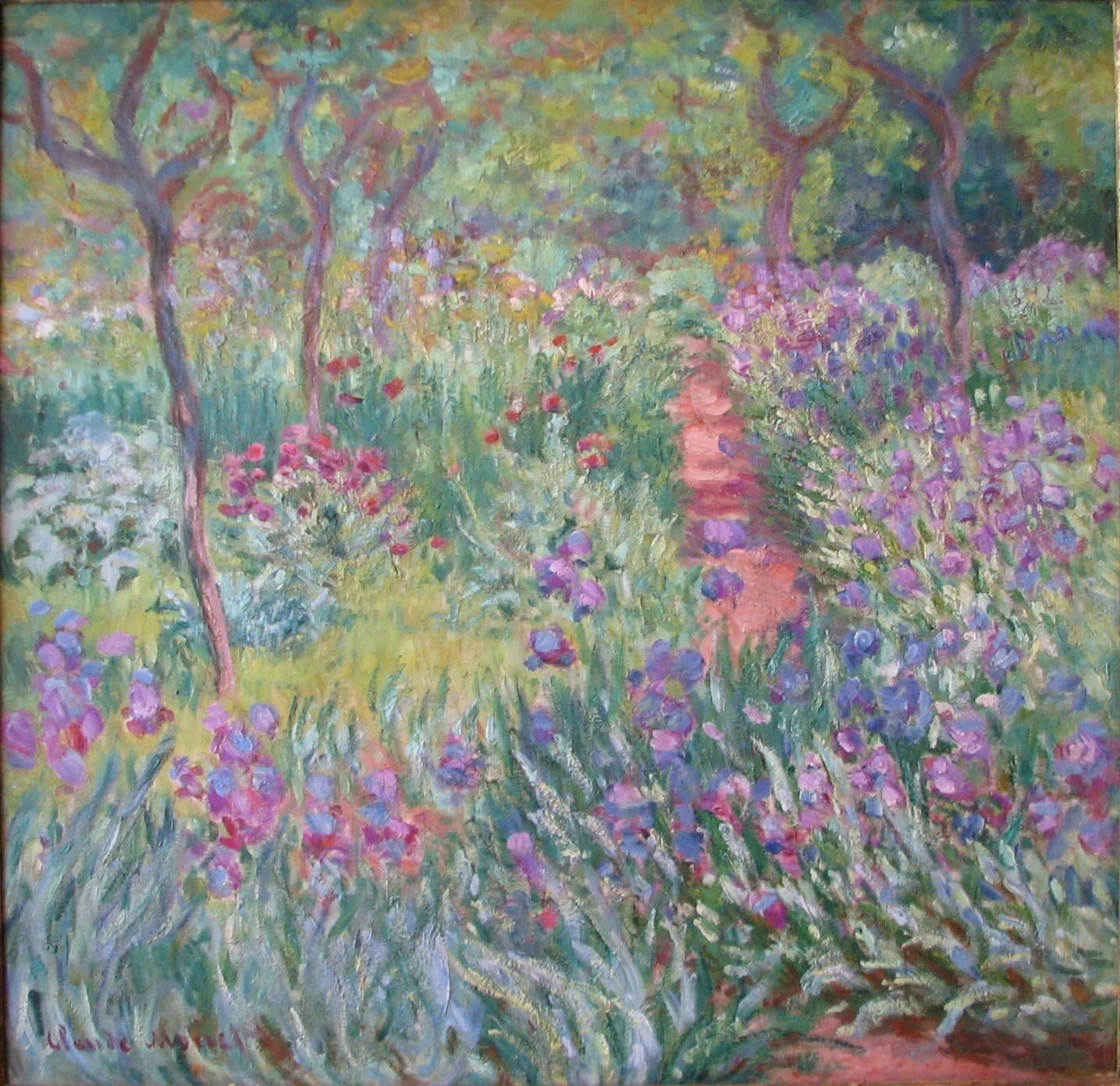
The Artist's Garden at Giverny by Claude Monet

The Artist's Garden at Giverny

Claude Monet (1900)

In The Artist's Garden at Giverny, Claude Monet turns his cultivated Clos Normand into a field of living color, where bands of violet <strong>irises</strong> surge toward a narrow, rose‑colored path. Broken, flickering strokes let greens, purples, and pinks mix optically so that light seems to tremble across the scene, while lilac‑toned tree trunks rhythmically guide the gaze inward <sup>[1]</sup><sup>[3]</sup>.