How Much Is Towing a Boat, Honfleur Worth?
Last updated: March 10, 2026
Quick Facts
- Insurance Value
- $9.0M (Replacement-cost appraisal based on comparable sales and Monet retail premiums)
- Methodology
- comparable analysis
Fair‑market (auction) value for Claude Monet’s Towing a Boat, Honfleur (1864; 55.2 × 82.1 cm; Memorial Art Gallery, Rochester) is estimated at $3.5–7 million. This range is anchored by closely related early Honfleur maritime comparables, notably a 1866 harbor scene at $3.3 million in 2022, and adjusted for scale, subject, institutional provenance, and current Monet market dynamics [1]. Recommended retail‑replacement (insurance) value is $9.0 million.
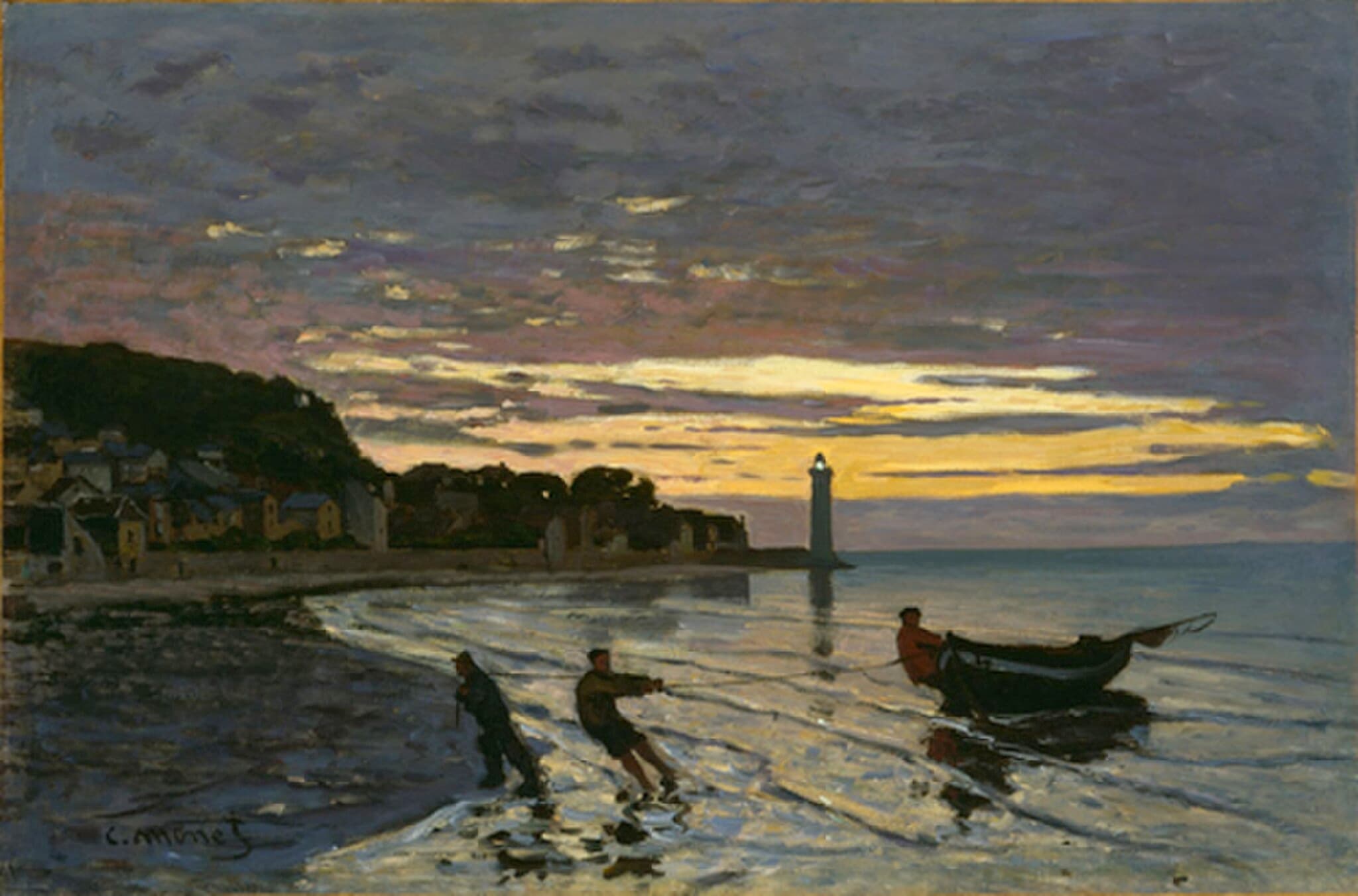
Towing a Boat, Honfleur
Claude Monet, 1864 • Oil on canvas
Read full analysis of Towing a Boat, Honfleur →Valuation Analysis
Work identified: Claude Monet’s Towing a Boat, Honfleur (Halage d’un bateau, Honfleur), oil on canvas, 55.2 × 82.1 cm (21.7 × 32.3 in), painted in 1864, is in the collection of the Memorial Art Gallery, University of Rochester (inv. 91.35), acquired as a 1991 gift from Marie C. and Joseph C. Wilson. The MAG object record and University of Rochester materials confirm ownership, dimensions, and credit line [3][4].
Method and key comparable: We derive a fair‑market (auction) range of $3.5–7 million using direct comparables among Monet’s early Normandy/Harbor subjects. The closest is Bateaux dans le port de Honfleur (1866), which realized $3,300,000 (Christie’s New York, Ann & Gordon Getty Collection, Oct 20, 2022) [1]. That canvas is slightly smaller and closely aligned in subject, period, and handling. A second data point—Barques de pêche (1866), Sotheby’s New York, May 17, 2023, estimated $800,000–1,200,000—illustrates the broad dispersion for 1860s Monets depending on size, composition, condition, and provenance [5]. Against this evidence, Towing a Boat, Honfleur’s larger format, clear narrative (figures towing a hull on the Honfleur shore), and institutional provenance justify a premium over the $3.3m benchmark, while still recognizing that pre‑1870 works outside Monet’s canonical series typically transact in the low‑ to mid‑single‑digit millions.
Market positioning: Monet’s market remains among the deepest globally, with major series works consistently commanding marquee sums; his auction record stands at $110.7 million for Meules (Haystacks) at Sotheby’s in 2019 [2]. Early coastal paintings like the present work are academically significant for Monet’s development yet priced at a substantial discount to the Nymphéas, Haystacks, Poplars, and Rouen Cathedral series—creating a well‑defined, selective buyer pool. The proposed $3.5–7 million range situates this painting at the upper end of early marine comparables when presented with strong condition, compelling cataloguing, and appropriate auction placement.
Provenance, condition, and insurance: Museum ownership (Memorial Art Gallery) and the Wilson gift are positives for confidence and visibility [3][4]. This valuation assumes good, stable condition consistent with date and medium; material conservation issues would shift value toward the lower bound, while exceptional surface quality and robust literature/exhibition history could support the upper end. For risk management, we recommend an insurance (retail‑replacement) value of $9.0 million to reflect dealer mark‑ups, placement costs, and the premium that may be required to source a like‑kind early Honfleur Monet in today’s market.
Key Valuation Factors
Art Historical Significance
Medium ImpactPainted in 1864, Towing a Boat, Honfleur sits in Monet’s formative, pre‑Impressionist period, when he was developing the plein‑air practice and coastal motifs that would underpin his mature style. While not part of a later ‘brand‑defining’ series, the work documents an important early Normandy subject and Monet’s evolving treatment of light, atmosphere, and labor at the water’s edge. This places it squarely within scholarly narratives about the 1860s and the artist’s path to Impressionism. Historically meaningful yet outside Monet’s most coveted series, its significance supports solid demand among connoisseurs and institutions focused on the artist’s early evolution, but typically at a market discount versus Nymphéas, Haystacks, Poplars, or Rouen Cathedral paintings.
Subject and Series Appeal
Medium ImpactThe Honfleur harbor and shoreline were core to Monet’s 1860s practice. Here, the human activity of towing a boat adds narrative appeal beyond a purely atmospheric marine, enhancing viewer engagement. That said, market pricing is strongly series‑driven in Monet: Harbor/boat scenes are admired but lack the global trophy status of Water Lilies or Haystacks. Within early marines, composition and legibility matter; the present canvas’s larger size and dynamic figuration should command a premium over quieter boat views. This factor lifts value relative to smaller, schematic 1860s marines but still places the work below the most sought‑after, later series in terms of global bidding depth and headline pricing.
Size and Condition
High ImpactAt 55.2 × 82.1 cm, the painting is a generously scaled easel work for the period, larger than many 1860s coastal studies. Size in Monet correlates meaningfully with market performance, magnifying presence and wall impact. Condition is paramount for works of this date: early canvases can exhibit vulnerability in impasto, surface abrasion, or old restorations. The proposed range assumes a clean, stable surface with no visually intrusive retouching. Superior condition would support the upper band; conversely, structural issues (planar distortions, widespread overpaint) or aesthetic compromises (yellowed varnish, toning) would push the value toward or below the midpoint. A current conservator’s report would be determinative for final pricing and insurance underwriting.
Provenance and Institutional Context
Medium ImpactThe Memorial Art Gallery (University of Rochester) ownership and the 1991 gift from Marie C. and Joseph C. Wilson (founder/chairman of Xerox) provide strong institutional provenance and donor association, enhancing credibility and due‑diligence confidence. Museum‑held status also implies professional care and exhibition potential, ancillary positives for buyer perception. If hypothetically deaccessioned, the museum imprimatur and Wilson provenance would be marketable advantages. Literature and exhibition history (not summarized publicly) could further strengthen demand; inclusion in major scholarly texts or notable exhibitions tends to lift estimates. Absent that, the institutional credit line remains a meaningful, if not transformational, value contributor in this price tier.
Market Comparables and Liquidity
High ImpactDirectly relevant sales frame value: a closely related Honfleur harbor scene from 1866 realized $3.3 million in 2022 (Christie’s, Ann & Gordon Getty Collection), setting a solid benchmark for early boat/harbor subjects of modest size [1]. Sotheby’s 2023 estimate of $800,000–1,200,000 for another small 1866 boat view shows how scale, composition, and quality drive dispersion in this segment [5]. Monet’s overall market remains exceptionally deep at the top end—with a $110.7 million record and regular eight‑figure results for iconic series—providing a supportive backdrop even as buyers are highly selective [2]. Within this context, the $3.5–7 million range reflects current liquidity for better‑sized, well‑presented early marines with institutional provenance.
Sale History
Towing a Boat, Honfleur has never been sold at public auction.
Claude Monet's Market
Claude Monet is a premier blue‑chip artist with durable global demand. His auction record stands at $110.7 million for Meules (Haystacks) at Sotheby’s in 2019, and major series works—Nymphéas, Haystacks, Poplars, and Rouen Cathedral—continue to attract multiple bidders, often with guarantees. The market is highly stratified: top‑quality, fresh‑to‑market pictures in iconic series command strong eight‑ and nine‑figure prices, while earlier or non‑series subjects transact in the low‑ to mid‑single‑digit millions depending on size, condition, and provenance. Depth from U.S., European, and Asian buyers underpins liquidity across price points, though recent seasons have shown increased selectivity and sharper pricing for secondary subjects. Institutional interest and centenary‑related programming continue to sustain visibility and confidence.
Comparable Sales
Bateaux dans le port de Honfleur
Claude Monet
Same artist; same Honfleur harbor subject with boats; close date (1866 vs. 1864); similar moderate easel scale; strong provenance (Ann & Gordon Getty). This is the closest like-for-like recent datapoint.
$3.3M
2022, Christie's New York
~$3.7M adjusted
La Pointe de la Hève à marée basse (Sainte-Adresse)
Claude Monet
Same artist; very early Normandy seascape (1865) closely aligned in period and coastal subject; comparable scale. A strong benchmark for high‑quality pre‑1870 marines.
$9.6M
2012, Christie's New York
~$13.3M adjusted
Hiver à Giverny
Claude Monet
Same artist; later but still 19th‑century landscape (1886). Not a marine, but useful as a conservative floor for smaller non‑series Monets outside the headline subjects.
$1.6M
2025, Sotheby's New York (Day)
Moulin de Limetz
Claude Monet
Same artist; later 1888 landscape, larger and more ‘classic Monet’ in palette/handling. Not subject‑matched, but indicates pricing for strong, non‑series Monets with institutional ties (deaccession).
$21.7M
2024, Christie's New York
~$22.3M adjusted
Peupliers au bord de l’Epte, crépuscule
Claude Monet
Same artist; iconic 1891 series (Poplars) with deep global demand. Not period/subject comparable, but provides an upper‑tier benchmark for Monet’s market ceiling outside Nymphéas/Haystacks.
$43.0M
2025, Christie's New York
Current Market Trends
Impressionist & Modern markets have become more selective since 2022, with overall auction volumes softening in 2024 but stabilizing into 2025. Buyers are concentrating capital on best‑in‑class, well‑provenanced works; secondary subjects or compromised condition face disciplined bidding. Within Monet, the ceiling remains high for trophy series pictures, while early marines and non‑series landscapes are priced rationally off recent comps. Guarantees and irrevocable bids help secure outcomes at the top end, but mid‑market results hinge on sharp estimates, fresh material, and quality presentation. For early Monets like this 1864 Honfleur scene, expect competitive interest from connoisseur collectors and select institutions, with price outcomes tracking recent single‑digit‑million benchmarks.
Study print
Study this painting as a print
Pair the full artwork with a museum-style study sheet focused on one meaningful detail.
Sources
- Christie’s: The Ann & Gordon Getty Collection—Evening Sale Results (Oct 20, 2022)
- Sotheby’s: Record-Breaking $110.7 Million Monet
- Memorial Art Gallery (University of Rochester) object record (Obj4477)
- University of Rochester Medical Center PDF reproducing the work and credit line
- Sotheby’s: Claude Monet, Barques de pêche (Modern Day Auction, May 17, 2023)