Towing a Boat, Honfleur

by Claude Monet

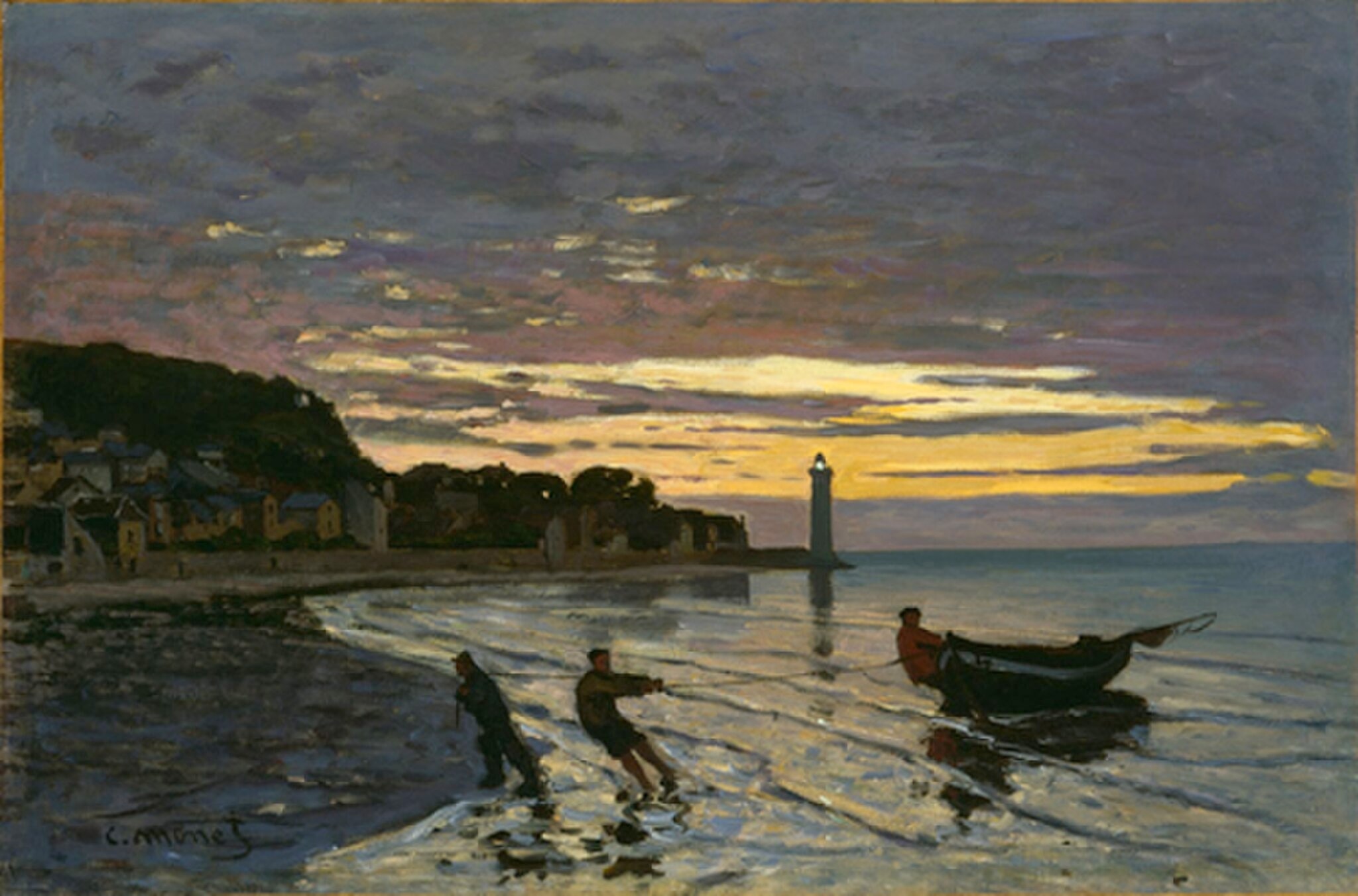
Claude Monet’s Towing a Boat, Honfleur frames coastal labor against a dusk of fugitive light and reflective sands, where three figures strain on taut ropes as a lighthouse holds steady on the horizon. The canvas turns a routine task into a meditation on endurance, guidance, and time’s passage.
💰

Market Value

$3.5–7 million

How much is Towing a Boat, Honfleur worth?

Study Print Studio

Create a personal study print

Build a companion study sheet around the part of this painting that speaks to you most. Choose a detail, shape an interpretation, and walk away with something personal and display-worthy.

Fast Facts

Year
1864
Medium
Oil on canvas
Dimensions
c. 55.2 × 82.1 cm
Location
Memorial Art Gallery, University of Rochester, Rochester, NY
See all Claude Monet paintings in New York
Towing a Boat, Honfleur by Claude Monet (1864) featuring Lighthouse (and reflection), Taut ropes, Small boat, Three silhouetted laborers

Click on any numbered symbol to learn more about its meaning

Meaning & Symbolism

Monet composes the shore as a theatre of coordination. At lower left, three silhouetted figures lean back against taut diagonal ropes, their bodies canted in unison as they heave a small boat across ribbed, water‑slick sand. Those diagonals cut against the long horizon and the dark mass of the headland and village at left, converting the beach into a field of vectors where human intention meets tidal drag. The boat, nose angled landward, rides shallow water that doubles the sky; strokes of lemon, rose, and slate are echoed on the sand in quick, broken touches, so the men appear to labor on the very colors of dusk. This fusion of labor and atmosphere—work literally taking place on reflected light—dramatizes resilience within natural rhythms. The small lighthouse on the Côte de Grâce stands to the right as a narrow, cool flame, its reflection a vertical plumb that steadies the composition and reads as a civic sign of guidance and collective safety, a recognized motif in Monet’s Honfleur cycle 257. The painting’s stakes are temporal as much as spatial. The receding glow along the horizon implies the day’s end; the task must conclude before darkness absorbs the beach. By letting the sky’s bands of color slip across the wet strand, Monet makes time visible: every ripple that catches yellow or violet records a different instant of fading light. This early attention to fugitive effects—noted across Monet’s 1864 Honfleur campaign—signals the proto‑Impressionist turn from stable contours to the optics of perception 2. Yet the canvas retains a sober, realist gravity in its silhouettes and measured tonalities, a balance shaped by Monet’s marine formation under Boudin and, crucially, Jongkind, whom Monet credited with having “educated [his] eye.” The controlled horizon and atmospheric calibration reflect that tutelage, anchoring exploratory light within disciplined structure 36. In this respect, the picture stands at the hinge between Courbet‑inflected realism and the open‑air immediacy Monet would soon enlarge, including in the Honfleur views that propelled his 1865 Salon debut 4. Equally decisive is Monet’s modern subject: a working harbor served by a lighthouse—an emblem of organized community—and men whose synchronized pull makes their silhouettes read almost like a single machine. The ropes’ drag lines scratch the wet surface, setting up a counter‑rhythm to the tide’s long horizontal wash, so that composition itself narrates cooperation overcoming resistance. The village tucked in shadow at left confirms the social frame; light belongs not only to the sky but to a network of human care, maintenance, and return. Thus the scene is not anecdote but infrastructure made visible: a harbor that guides, workers who retrieve, and a painter who records the instant when nature and society interlock. In making dusk both obstacle and medium, Monet proposes that perception is an act of work, too—the eye hauling form from flux. That proposition, already active here in 1864, is why Towing a Boat, Honfleur reads as an early credo for Monet’s lifelong project: to bind modern life to the moving envelope of light 12568.

Explore Deeper with AI

Ask questions about Towing a Boat, Honfleur

Popular questions:

Powered by AI • Get instant insights about this artwork

💬 Ask questions about this artwork!

Interpretations

Historical Context: Pre‑Salon Honfleur as Laboratory

Painted amid Monet’s intense 1864 Honfleur/Sainte‑Adresse campaign, the canvas functions as a proving ground for strategies that would underpin his 1865 Salon marines. The subject—a working beach with lighthouse—let him test marine atmospherics at scale while keeping composition disciplined: a low horizon, long bands of light, and a stable landmark for calibration. This coupling of open‑air observation with compositional control aligns with accounts of Honfleur as Monet’s summer workshop in perception and place. By the time he submitted mouth‑of‑the‑Seine views to the Salon, the grammar is set: quotidian labor framed by civic infrastructure, and dusk recorded as legible strata of color. The MAG painting thus reads less as a tangent than as a keystone in Monet’s pre‑Salon method—a rehearsal where optics, labor, and locality are fused 137.

Source: Norton Simon Museum; LACMA/Bridgeman; Memorial Art Gallery (collection record)

Symbolic Reading: The Lighthouse as Civic Technology

The Phare de l’Hospice—small but insistent—operates as more than a pictorial plumb. In 19th‑century port culture it encoded municipal investment in safety, navigation, and public order. Monet’s vertical beacon and its reflection set a counter‑axis to the tidal horizontals, staging a dialogue between governance and environment. Because Monet repeatedly returned to this signal in the Honfleur cycle, the motif accrues meaning: a recognizably modern technology that steadies perception and labor alike. Historically lit in 1857 and later decommissioned, the beacon also folds time into the scene, a modern device already aging as the painter watches. In this reading, the lighthouse becomes the painting’s civic spine, a slim column of authority through which the harbor’s diffuse energies are organized and made safe 418.

Source: Google Arts & Culture (The Lighthouse at Honfleur); LACMA/Bridgeman; Phareland (lighthouse history)

Formal Analysis: Jongkind’s Discipline, Monet’s Optics

The measured horizon, sober silhouettes, and calibrated tonal steps signal the discipline Monet absorbed from Johan Barthold Jongkind, whom he later said had educated his eye. Against this realist scaffolding, Monet tests optical notation: quick, broken touches that let wet sand mirror sky without overblending, and ribbons of low light that index the hour’s decay. The push‑pull between contour and flicker—between marine topography and atmospheric flux—emerges here as a hallmark of Monet’s proto‑Impressionist language. Rather than dissolving form wholesale, he permits stable masses (headland, village, figures) to coexist with fugitivity at the periphery, producing a controlled permeability of edges that feels observational rather than mannered—a tactical bridge from realism toward Impressionist perception 265.

Source: Art Institute of Chicago; Britannica (Impressionism overview); Britannica (Monet biography)

Social History: Coordinated Labor in a Tidal Economy

The diagonals of the haul-ropes and the synchronized lean of the crew stage coastal work as collective technology—a choreography honed by tides and schedules. In Impressionist terms, this is modern life: not grand narrative but the infrastructure of subsistence, maintenance, and return. The composition’s vector field (taut diagonals vs. tidal horizontals) narrates cooperation overcoming resistance without anecdotal sentiment. Read against 1860s harbor practice, the scene captures a liminal productivity window—dusk at low water—when effort must meet environment precisely. Monet’s choice to render the workers as a near‑single silhouette eschews portraiture in favor of role, a sign of classed, communal labor that underwrites the port’s safety and commerce while remaining structurally unspectacular—exactly the everyday the movement sought to dignify 651.

Source: Britannica (Impressionism overview); Britannica (Monet biography); LACMA/Bridgeman

Phenomenology of Time: Painting as a Light-Log

The picture operates like a time-instrument: wet sand and slack water become recording surfaces where each ripple captures a discrete band of waning color. Instead of depicting a single instant, Monet accumulates micro‑instants—the eye reading lateral swathes of lemon, rose, slate as a sequential fade. This accumulative method anticipates the logic of his later series: not the clock’s minute hand but atmospheric duration made visible. Crucially, the labor aligns with that duration; the haul must finish before the chromatic register extinguishes. In early Honfleur canvases, such coupling of work and weather suggests that seeing itself is labor: to pick form from flux is to act in time. Here, dusk is medium, deadline, and measure all at once 135.

Source: LACMA/Bridgeman; Norton Simon Museum; Britannica (Monet biography)

Related Themes

About Claude Monet

Claude Monet (1840–1926) led Impressionism’s pursuit of open-air painting and optical immediacy, especially during his Argenteuil years focused on modern leisure and light. He later developed serial studies of changing conditions, culminating in the Water Lilies cycle [2].
View all works by Claude Monet

More by Claude Monet

Boating by Claude Monet

Boating

Claude Monet (1887)

Monet’s Boating crystallizes modern leisure as a drama of perception, setting a slim skiff and two pale dresses against a field of dark, mobile water. Bold cropping, a thrusting oar, and the complementary flash of hull and foliage convert a quiet outing into an experiment in <strong>modern vision</strong> and the <strong>materiality of water</strong> <sup>[1]</sup><sup>[2]</sup>.

The Thames below Westminster by Claude Monet

The Thames below Westminster

Claude Monet (about 1871)

Claude Monet’s The Thames below Westminster turns London into <strong>light-made architecture</strong>, where Parliament’s mass dissolves into mist and the river shivers with <strong>industrial motion</strong>. Tugboats, a timber jetty with workers, and the rebuilt Westminster Bridge assert a modern city whose power is felt through atmosphere more than outline <sup>[1]</sup>.

Haystacks Series by Claude Monet | Light, Time & Atmosphere by Claude Monet

Haystacks Series by Claude Monet | Light, Time & Atmosphere

Claude Monet

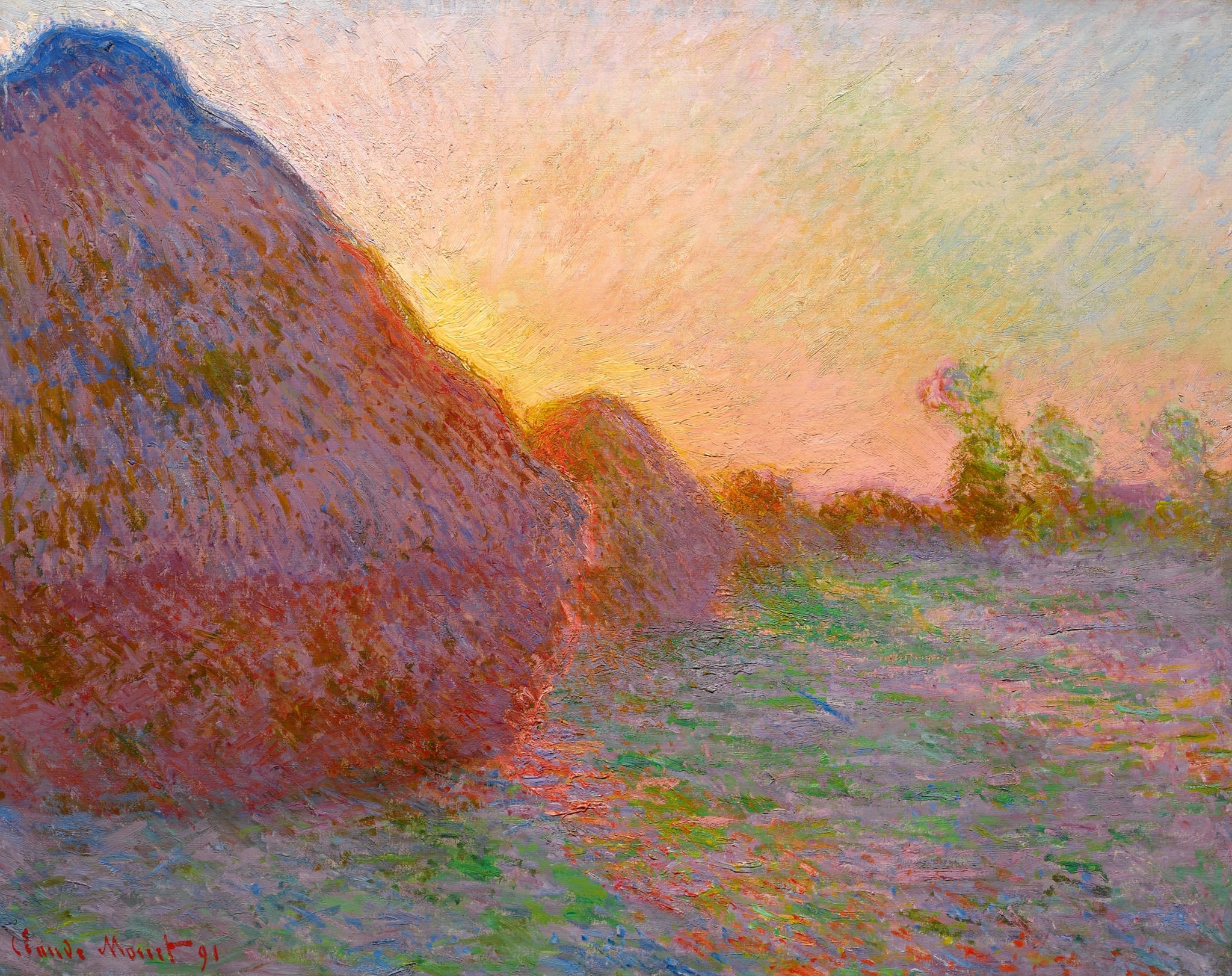
Claude Monet’s <strong>Haystacks Series</strong> transforms a routine rural subject into an inquiry into <strong>light, time, and perception</strong>. In this sunset view, the stacks swell at the left while the sun burns through the gap, making the field shimmer with <strong>apricot, lilac, and blue</strong> vibrations.
Women in the Garden by Claude Monet

Women in the Garden

Claude Monet (1866–1867)

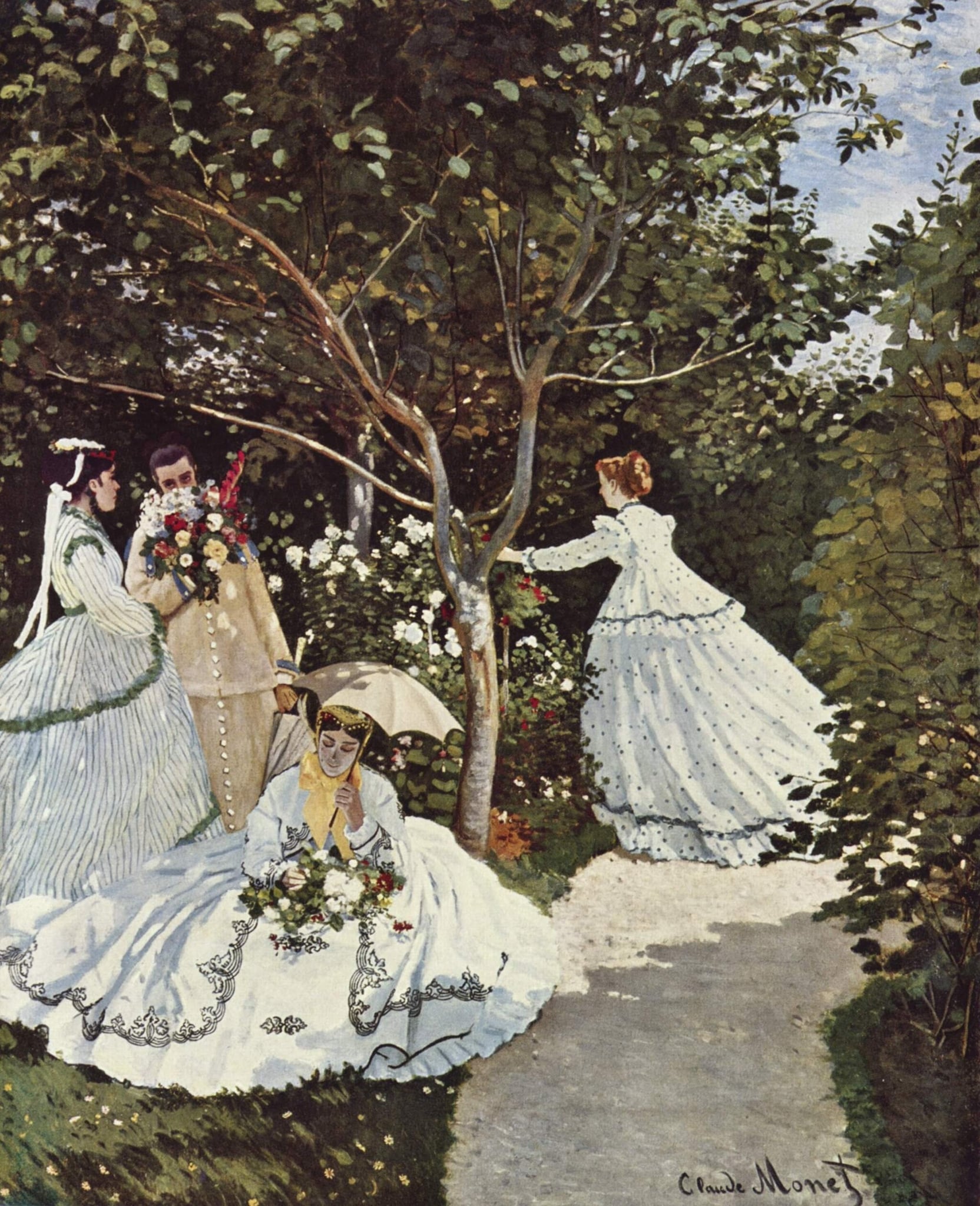
Claude Monet’s Women in the Garden choreographs four figures in a sunlit bower to test how <strong>white dresses</strong> register <strong>dappled light</strong> and shadow. The path, parasol, and clipped flowers frame a modern ritual of leisure while turning fashion into an instrument of <strong>perception</strong>. The scene reads less as portraiture than as a manifesto for painting the <strong>momentary</strong> outdoors <sup>[1]</sup><sup>[3]</sup>.
The Train in the Snow (The Locomotive) by Claude Monet

The Train in the Snow (The Locomotive)

Claude Monet (1875)

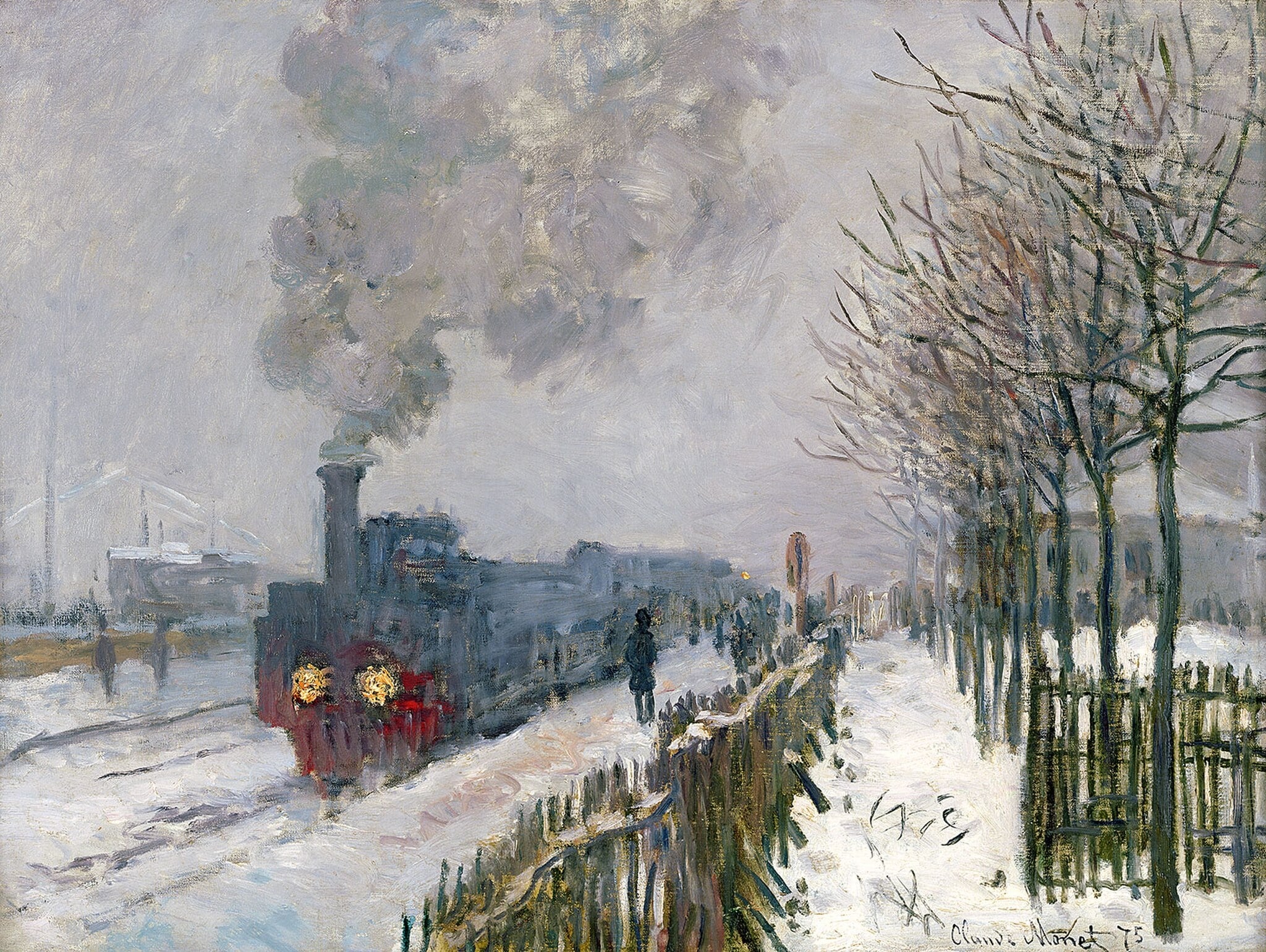
Claude Monet’s The Train in the Snow (The Locomotive) (1875) turns a suburban winter platform into a study of <strong>modernity absorbed by atmosphere</strong>. The engine’s twin yellow headlights and a smear of red push through a world of greys and violets as steam fuses with the low sky, while the right-hand fence and bare trees drill depth and cadence into the scene <sup>[1]</sup><sup>[4]</sup>. Monet fixes not an object but a <strong>moment of perception</strong>, where industry seems to dematerialize into weather <sup>[1]</sup><sup>[2]</sup>.
The Artist's Garden at Giverny by Claude Monet

The Artist's Garden at Giverny

Claude Monet (1900)

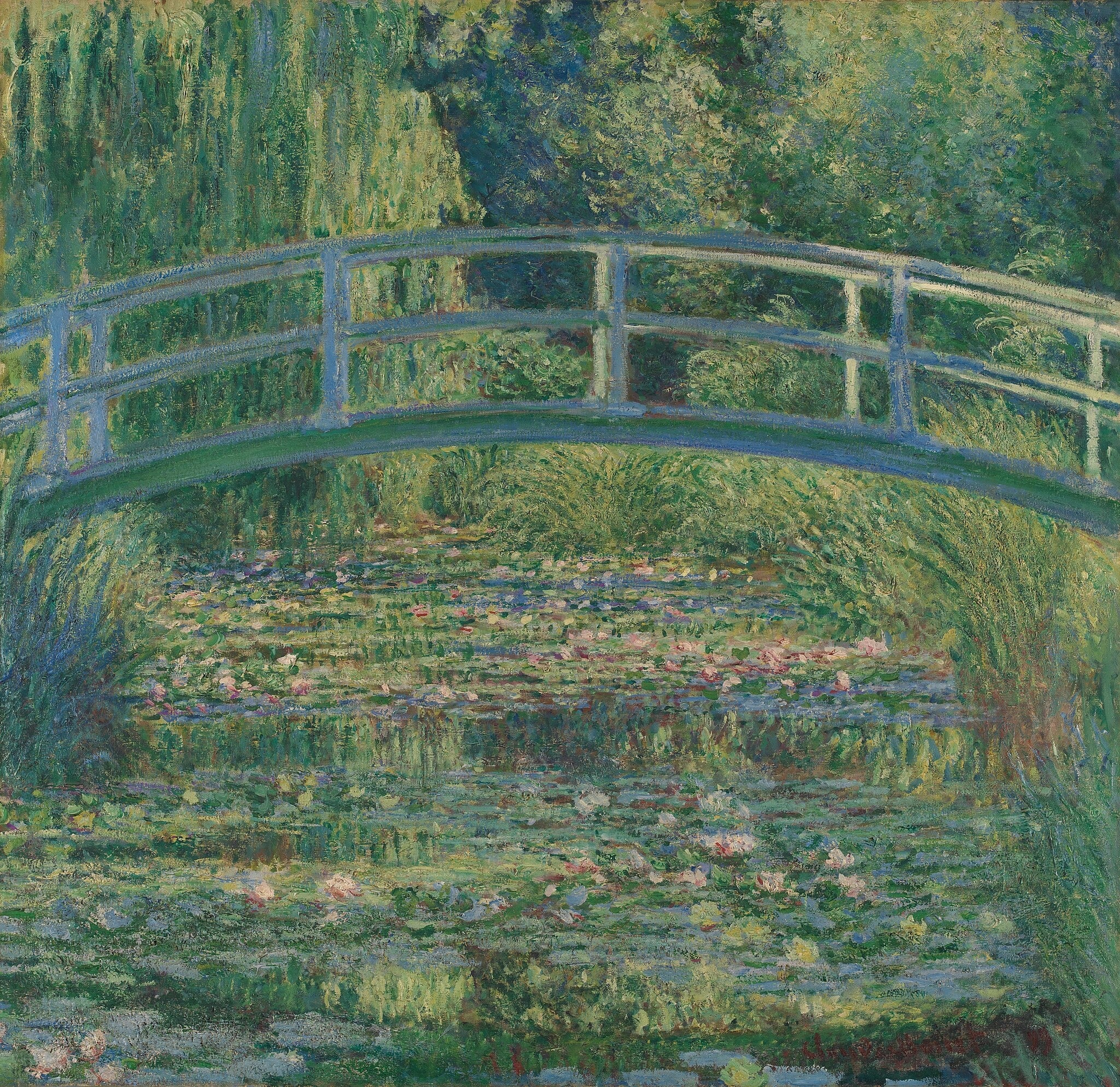
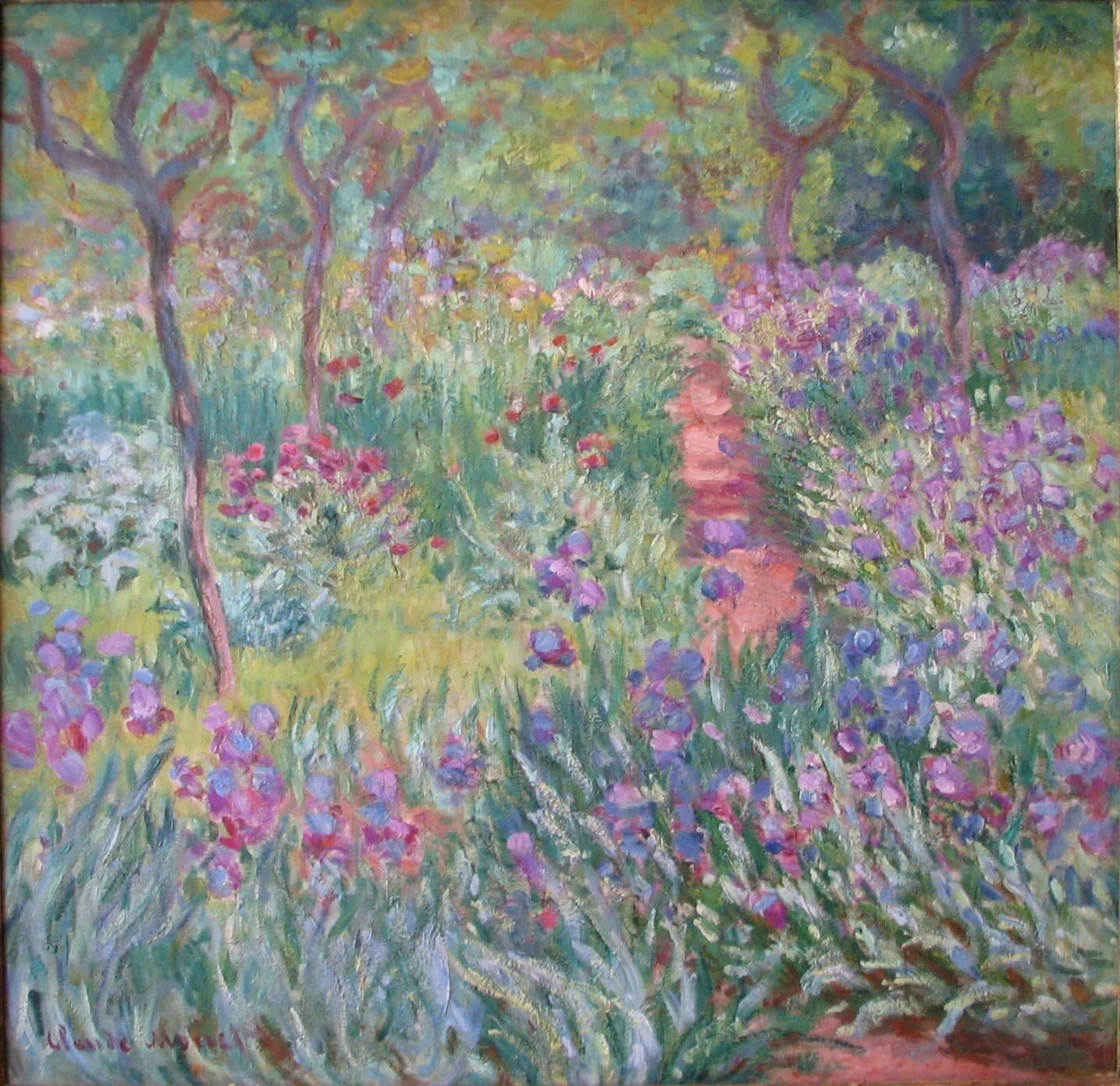
In The Artist's Garden at Giverny, Claude Monet turns his cultivated Clos Normand into a field of living color, where bands of violet <strong>irises</strong> surge toward a narrow, rose‑colored path. Broken, flickering strokes let greens, purples, and pinks mix optically so that light seems to tremble across the scene, while lilac‑toned tree trunks rhythmically guide the gaze inward <sup>[1]</sup><sup>[3]</sup>.