How Much Is Hero and Leandro Worth?
Last updated: June 25, 2026
Quick Facts
- Methodology
- comparable analysis
Cy Twombly’s Hero and Leandro (1985) is a major, museum-scale canvas from the artist’s core myth-history cycle, exhibited at Dulwich Picture Gallery and long held in a private collection. Anchored by recent eight-figure comparables for large mythic/gestural Twomblys, we value it at $25–40 million, with upside in a fully marketed, guaranteed evening sale.
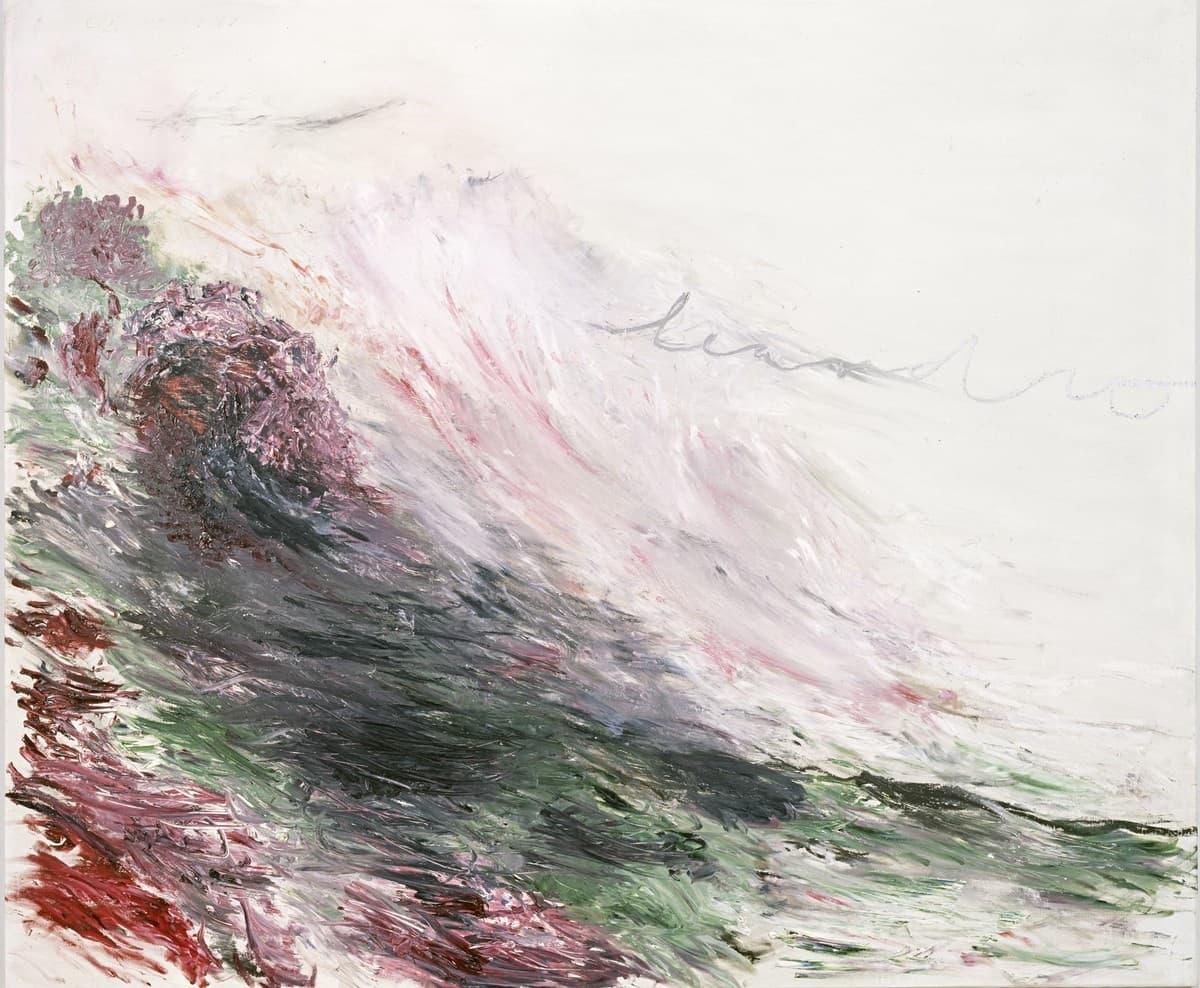
Hero and Leandro
Cy Twombly, 1985 • Oil and oil-based house paint on canvas
Read full analysis of Hero and Leandro →Valuation Analysis
Work and context. Hero and Leandro (1985) is a large, museum-scale canvas (approx. 202 × 254 cm) executed in oil and oil-based house paint, squarely within Twombly’s celebrated 1980s classical-myth cycle. The painting is dedicated “(To Christopher Marlowe),” signaling the artist’s signature interweave of literature, history, and gestural inscription. It has a high-profile exhibition history (Twombly and Poussin: Arcadian Painters, Dulwich Picture Gallery, 2011) and is consistently cited as residing in a private collection [1]. The work has not appeared at public auction, so valuation relies on adjacent, recent blue-chip comparables.
Method and key comparables. We benchmark against large, myth-inflected or canonical Twombly paintings that have established recent price points. On the upper side of the most closely related group, a prime 2005 Bacchus canvas realized $41.64m at Phillips in 2022 [2]. On the lower side, a 2004 Bacchus achieved $19.96m at Christie’s in 2023 amid a thinner top-end market [3]. Twombly’s overall ceiling remains defined by his $70.5m Blackboard record (1968) at Sotheby’s in 2015, which sets the outer bound for his most coveted series [4].
Positioning this work. The 1985 myth-history canvases occupy a tier valued below the 1960s icons and the Blackboard peak, yet above most late works on paper and many mid-period minor canvases. A market-adjacent anchor is the $38m 1969 (Bolsena-period) canvas sold at Sotheby’s in 2022—another museum-scale, historically central work that helps frame the upper mid-band for A-quality Twombly paintings [6]. Given Hero and Leandro’s scale, medium, and subject, plus its exhibition pedigree, it aligns between the strong Bacchus results and the high-importance 1960s series—supporting a $25–40m fair-market range.
Market tone and timing. After a softer 2024, top-tier Post-War demand has reset around quality. Christie’s May 2026 evening sales (led by the Agnes Gund group) demonstrated renewed depth for blue-chip material, including a major Twombly that achieved ~ $45.5m with fees—his strongest public price of the past few years and a clear signal of regained confidence at the top end [5]. In this environment, supply of named, museum-scale Twombly myth canvases is scarce, a dynamic that typically amplifies competition when such works surface.
Conclusion and strategy. We estimate Hero and Leandro at $25–40 million, reflecting its art-historical weight, scale, medium, and visibility, balanced against the hierarchy that still favors 1960s Blackboards and select early icons. In a prime evening sale with a competitive guarantee and full global marketing, the work should carry an estimate band in the $20–30 million region and is well-positioned to finish in the low-to-mid $30 millions if image quality and condition are first-rate. Privately, ask levels in the high $30 millions would be consistent with recent A-tier comparables [2][3][6].
Key Valuation Factors
Art Historical Significance
High ImpactHero and Leandro (1985) belongs to Twombly’s central 1980s classical-myth cycle, where the artist fuses gestural abstraction with textual and literary references. The dedication to Christopher Marlowe underscores Twombly’s dialogue with poetry and antiquity, themes that anchor his scholarly and market stature. While the 1960s Blackboards and early icons remain the market apex, the 1980s myth canvases are deeply embedded in institutional shows and literature and are widely pursued by core collectors. This specific subject—narrating love, peril, and the sea—aligns with the artist’s most resonant mythic narratives, contributing directly to its desirability and pricing power within the oeuvre.
Series/Subject Desirability
High ImpactCollectors place a premium on named, classically themed Twombly canvases that integrate text, history, and painterly drama. Market behavior around the Bacchus canvases and other myth-inflected works shows sustained willingness to pay in the high eight figures for strong, large-format examples. Hero and Leandro carries that same mythic charge, with legible titling and an explicit literary dedication, features that enhance salability and auction storytelling. Within Twombly’s internal market hierarchy, the 1980s myth paintings sit below the 1960s apex but above most late works on paper and mid-tier canvases—supporting the estimate range proposed here when combined with scale and exhibition profile.
Scale, Medium, and Image Strength
High ImpactAt approximately 202 × 254 cm (79.5 × 100 in), the painting is museum-scale and executed in oil and oil-based house paint—Twombly’s most commercially accepted materials. Large, immersive canvases with potent inscriptional elements routinely outperform smaller or less resolved examples. The physical presence afforded by this format, combined with mythic titling and energetic facture, positions the work for primetime evening sale placement. The scale also broadens the buyer pool internationally: leading institutions and top private collectors prioritize room-dominating Twomblys, which typically realize stronger, less volatile outcomes relative to works on paper or modestly scaled paintings.
Provenance, Exhibition & Literature
Medium ImpactThe work’s appearance in Twombly and Poussin: Arcadian Painters at Dulwich Picture Gallery (2011) and its association with a respected secondary-market dealer (Thomas Ammann Fine Art) are strong qualitative positives that support confidence, vetting, and global visibility. Robust literature citations (including catalogue references and reproductions) typically increase buyer conviction and can translate to tighter bidding spreads. While loan insurance values are not public, the Dulwich exhibition and continued scholarly referencing indicate a well-documented history. Confirmation of pristine condition and comprehensive publication entries could push the realized price toward the top of the stated range in a competitive sale.
Sale History
Hero and Leandro has never been sold at public auction.
Cy Twombly's Market
Cy Twombly is a cornerstone of the Post-War canon, with deep institutional representation and a durable, globally diversified collector base. His auction record stands at $70.5 million for a 1968 Blackboard painting (Sotheby’s, 2015), and major canvases across key series—Blackboard, early 1960s icons, Bolsena, and 2000s Bacchus—regularly command eight-figure prices. Even through the 2024 market slowdown, top-format Twomblys maintained liquidity, with renewed strength evident in 2025–2026 marquee sales. Named, museum-scale myth/history works remain particularly coveted because they synthesize text, gesture, and classical subject matter in a way unique to the artist, ensuring consistent demand when high-quality, fresh examples appear.
Comparable Sales
Untitled (Bacchus), 2005
Cy Twombly
Same artist; large, gestural, myth-inflected series (Bacchus); museum-scale canvas and top-tier market demand—strong proxy for a major classical-myth canvas.
$41.6M
2022, Phillips New York (20th Century & Contemporary Art Evening Sale)
~$46.0M adjusted
Untitled (Bacchus 1st Version II), 2004
Cy Twombly
Same artist; mythic Bacchus theme; comparable large format and gestural red loops; anchors the lower end of pricing for trophy-scale myth subject canvases.
$20.0M
2023, Christie's New York (21st Century Evening Sale)
~$21.1M adjusted
Untitled, 1969 (Bolsena)
Cy Twombly
Same artist; major, highly coveted series; large museum-scale canvas. While earlier and not myth-titled, it establishes the upper-mid tier for blue-chip Twombly paintings.
$38.0M
2022, Sotheby's New York (Contemporary Evening Auction)
~$41.9M adjusted
Untitled, 2007 (The Macklowe Collection)
Cy Twombly
Same artist; late, large, paint-rich canvas with prime-scale presence; a bellwether for what the market pays for top-tier, room-dominating Twombly paintings.
$58.9M
2021, Sotheby's New York (The Macklowe Collection Evening Sale)
~$70.2M adjusted
Untitled (Blackboard), 1968 (Emily Fisher Landau Collection)
Cy Twombly
Same artist; canonical series pricing benchmark; while not myth-themed, it calibrates demand for A‑tier Twombly paintings at auction in recent seasons.
$26.8M
2023, Sotheby's New York (Emily Fisher Landau)
~$28.3M adjusted
Leda and the Swan, 1962
Cy Twombly
Same artist; explicitly classical‑myth subject, museum‑level importance and literature—closest thematic proxy, though earlier period, for a myth canvas like Hero and Leandro.
$52.9M
2017, Christie's New York (Post-War & Contemporary Art Evening Sale)
~$69.7M adjusted
Current Market Trends
Blue-chip Post-War markets reset in 2024 as ultra-high-end volumes thinned, then stabilized in 2025–2026 with stronger sell-through and trophy-level depth concentrated on the best, freshest material. Recent New York evening auctions signaled revived appetite for museum-caliber works, aided by judicious guarantees and tighter estimates. Within this context, supply scarcity of first-rate Twombly canvases amplifies competition when significant examples surface. Large-format, mythic/gestural paintings—especially those with clear titles, strong literature, and exhibition pedigrees—continue to anchor eight-figure outcomes, while mid-tier material is more selective. This two-speed dynamic favors a properly marketed Hero and Leandro with a competitive guarantee in a primetime sale.
Study print
Study this painting as a print
Pair the full artwork with a museum-style study sheet focused on one meaningful detail.
Sources
- Dulwich Picture Gallery – Twombly and Poussin: Arcadian Painters (Large Print Guide, 2011)
- Phillips – Cy Twombly, Untitled (2005) (Bacchus), price realized $41,640,000
- Christie’s Press – 21st Century Evening Sale totals $107,451,800 (includes Twombly Bacchus 2004 at $19,960,000)
- Sotheby’s – Cy Twombly by the Numbers (auction record $70.5m for 1968 Blackboard)
- Christie’s – 20th/21st Century New York, May 2026: Results and highlights (includes Twombly result from the Agnes Gund group)
- Sotheby’s – Contemporary Evening Auction (context for 1969 Twombly at $38m)