How Much Is Leda and the Swan Worth?
Last updated: June 26, 2026
Quick Facts
- Methodology
- comparable analysis
Anchored to Christie’s May 17, 2017 sale of a sister 1962 Leda (realized USD 52,887,500) and supported by other marquee Twombly canvases, the defensible market estimate for a museum‑quality Cy Twombly Leda and the Swan (1962) is USD 45–75 million. Final outcome will pivot on scale, condition, provenance/exhibition history and sale method.
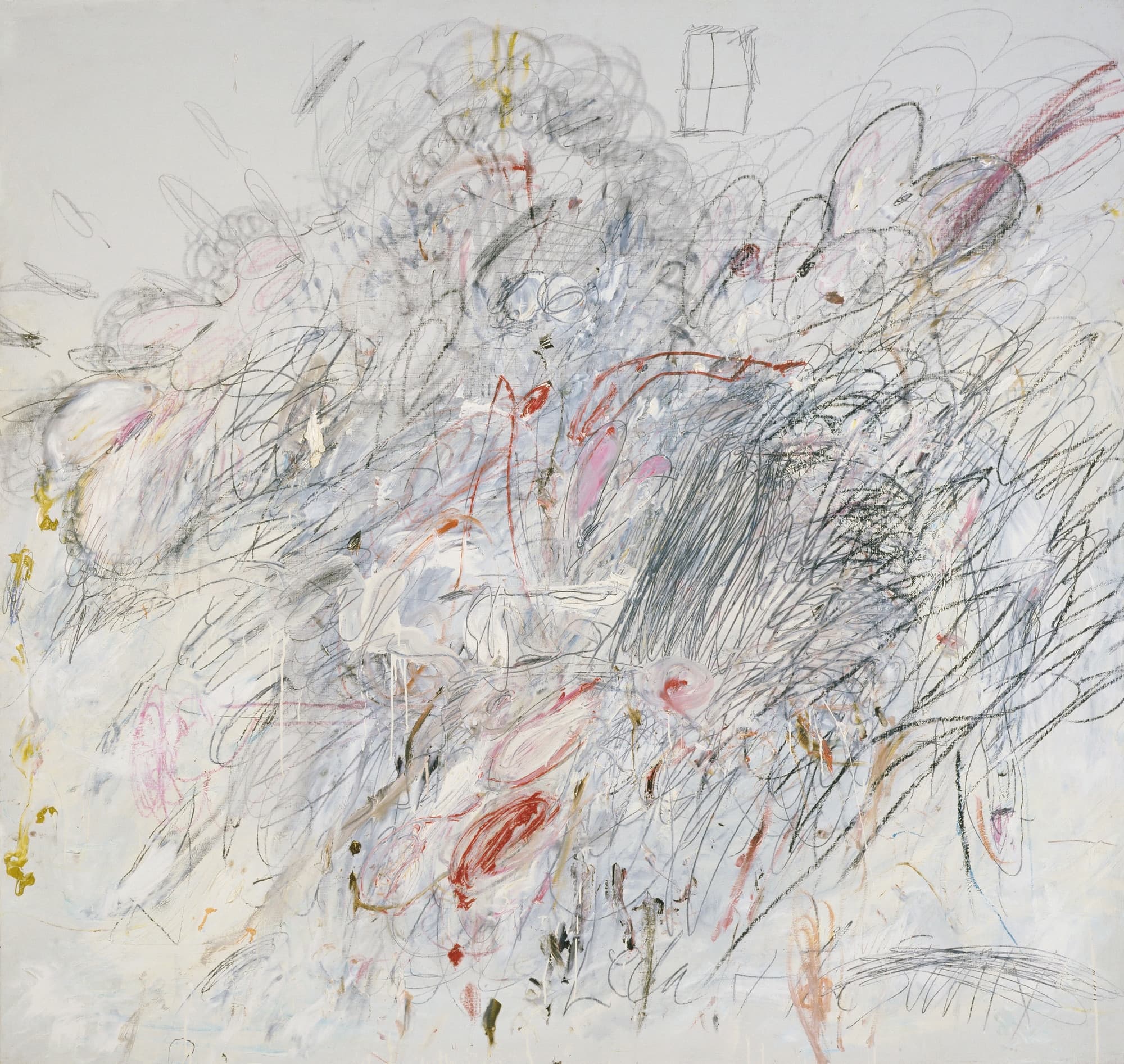
Leda and the Swan
Cy Twombly, 1962 • Oil, pencil, and crayon on canvas
Read full analysis of Leda and the Swan →Valuation Analysis
Valuation anchor and context. The primary market anchor is Christie’s sale of a large 1962 Leda and the Swan on 17 May 2017 (realized USD 52,887,500), a direct comparable by year, subject and scale [1]. MoMA’s permanent collection contains a sister 1962 Leda (190.5 × 200 cm) and that institutional ownership confirms the composition’s art‑historical importance while removing that particular canvas from market circulation [2]. For a hypothetical sale of a museum‑quality 1962 Leda comparable in size, condition and documentation to the Christie’s lot, the market range below reflects observed auction behaviour for top Twombly canvases since 2015.
Comparable sales and ceiling/floor dynamics. Twombly’s auction record (the 1968 blackboard work sold in 2015 at roughly USD 70–71M) establishes a practical ceiling for the highest‑quality canvases; other large canvases realized in the USD ~41–53M band in the 2017–2022 window and confirm a strong multi‑tens‑of‑millions market for mature 1960s works [3]. The 2017 Leda therefore acts as the primary direct comparable; subsequent large‑canvas sales (Sotheby’s 2021, Christie's/Phillips marquee lots) form the working comp set used to bracket the estimate.
Key value drivers. Price is driven primarily by four interlocking factors: physical scale (large format commands a premium), condition and conservation history (stability of crayon/pencil/paint and any restorative intervention), provenance/exhibition/publication (museum ownership, inclusion in retrospectives and catalogue raisonné citations materially enhance value) and sale modality (evening sale with guarantees and competitive bidding versus day/online sale or confined private transfer). Any negative on these—significant restoration, thin provenance, or small format—can push realizations well below the lower bound; positive signals push toward or above the high end.
Market and sale‑route considerations. Museums seldom deaccession major works; if MoMA’s Leda were ever offered, donor restrictions, institutional policy and reputational concerns would shape the sale route, likely favoring a targeted sale to another institution or a brokered private placement rather than an open evening hammer—each route has different price expectations. Conversely, a fresh‑to‑market private consignment in a marquee evening sale (as the 2017 Christie’s lot was) tends to maximize headline price and competitive bidding [1].
Conclusion and recommended next steps. The recommended defensible market band for a museum‑quality Twombly Leda and the Swan (1962) is USD 45–75M, with a midpoint near USD 55–60M depending on the factors above. For a formal insured or sale estimate, obtain the MoMA object record (dimensions, accession/provenance), a full conservator’s condition report, and catalogue‑raisonné/exhibition citations, then seek a confidential pro‑forma from a major auction house to finalize an estimate and sale strategy.
Key Valuation Factors
Art Historical Significance
High ImpactCy Twombly's engagement with classical myth and gestural script in the early 1960s is central to his historical profile. A 1962 Leda directly embodies the artist's synthesis of mythic subject matter and calligraphic mark‑making—the exact concerns that underpin Twombly's canonical status in post‑war art history. Institutional ownership (MoMA) of a sister canvas is further evidence of the composition's curatorial importance and increases scholarly visibility. For collectors and museums seeking canonical examples, a well‑documented 1962 Leda ranks as a major work within Twombly's oeuvre and therefore supports valuation toward the artist's blue‑chip band.
Provenance & Exhibition/Scholarly Record
High ImpactProvenance and exhibition documentation materially influence price. A work with long, clean provenance, appearances in major retrospectives, and illustration in catalogues raisonnés attracts institutional and private bidders at a premium. The Christie’s 2017 lot was described as 'fresh to market' after long private ownership and achieved a strong result; conversely, a canvas lacking exhibitions or catalogue references suffers discounts. Donor restrictions, title encumbrances, or unclear export rights can also limit buyer pool or require legal remedies, each reducing achievable price. For a formal valuation, provenance verification and catalogue citations are essential.
Condition & Conservation
High ImpactTwombly’s mixed media protocols (oil, crayon, pencil) require careful technical assessment. Surface abrasions, crayon/pencil stability, inpainting, canvas relining and any historic restorative interventions can each reduce buyer confidence and price—sometimes substantially. A pristine, unrestored large 1962 canvas with a clear conservator record will be treated as 'museum‑quality' and push the estimate higher. By contrast, significant restoration or unstable media commonly reduces competitive bidding and forces lower estimates. A full condition report and high‑resolution imaging are therefore mandatory prior to any formal valuation or offering.
Market Comparables & Auction Dynamics
High ImpactAuction comparables are the quantitative anchor: the Christie’s 2017 Leda (USD 52.9M) is the direct comp; Twombly’s 2015 blackboard record (~USD 70.5M) sets a workable ceiling. Other large canvases realized in the USD ~41–47M band and establish a practical median. Evening‑sale presentation, single‑owner provenance, and guarantees increase final prices; day‑sale or online contexts depress them. Macro timing (market peaks, 2024 softness and 2025–26 recovery) also affects outcomes. The combination of comp evidence and sale dynamics underpins the USD 45–75M band presented above.
Sale History
Christie's New York
Sotheby's New York
Sotheby's New York
Cy Twombly's Market
Cy Twombly is a blue‑chip postwar figure whose market is dominated by large, canonical canvases from the 1960s–1970s. His auction record (mid‑tens to low‑seventies of millions, depending on the lot and year) and consistent institutional demand place him among the highest‑value postwar artists. The market is two‑tiered: marquee evening‑sale canvases with strong provenance command multi‑tens of millions, while works on paper and smaller pieces trade in the mid‑six to low‑seven‑figure band. Collector appetite for major Twomblys remains robust, especially for works with museum exhibition history and single‑owner provenance.
Comparable Sales
Leda and the Swan (1962)
Cy Twombly
Direct match: same title/year/large-format Twombly canvas; sold fresh-to-market in May 2017 for $52,887,500 (price realized incl. premium). Serves as the primary market anchor for 1962 Leda canvases.
$52.9M
2017, Christie's New York
~$69.4M adjusted
Untitled (Blackboard), 1968
Cy Twombly
Artist auction record and late-1960s monumental blackboard work; same artist and similar monumental scale/market category. Establishes the market ceiling for Twombly canvases.
$70.5M
2015, Sotheby's New York
~$95.8M adjusted
Untitled (Rome) — large blackboard (c.1960s)
Cy Twombly
Large 1960s 'Rome'/blackboard-style canvas sold in May 2021 for $41.6M; closely comparable by period, scale and aesthetic to Leda works and shows sustained demand post-2017.
$41.6M
2021, Sotheby's New York
~$49.4M adjusted
Untitled (Bacchus series, 2005)
Cy Twombly
Large evening-sale Twombly canvas (Bacchus series) sold Nov 2017 for $46,437,500; comparable for scale and evening-sale marketability, though later in date and different series than the 1962 Leda.
$46.4M
2017, Christie's New York
~$61.0M adjusted
Untitled (large Bacchus)
Cy Twombly
Major Phillips evening-sale result (Nov 2022) for a large Twombly canvas; indicates continued multi‑tens‑of‑millions demand for marquee canvases into 2022.
$41.6M
2022, Phillips New York
~$45.7M adjusted
Current Market Trends
Top‑end blue‑chip works remain resilient after a 2024 softening; 2025–2026 saw recovery driven by marquee guaranteed and single‑owner sales. Supply of high‑quality Twomblys is limited, so when museum‑quality canvases appear in evening sales they still attract strong competitive bidding. The market is sensitive to sale context: evening auctions and estate consignments outperform day/online sales. Upcoming Twombly centennial programming (2028) may provide a mid‑term positive demand impulse for canonical works.
Study print
Study this painting as a print
Pair the full artwork with a museum-style study sheet focused on one meaningful detail.