Leda and the Swan

by Cy Twombly

Cy Twombly’s Leda and the Swan condenses the Greek myth into an orgiastic collision of marks: graphite scrawls, smeared whites, blush pinks, and eruptive reds radiate from a dark, compressed vortex. A sketched window-like rectangle, heart and phallic glyphs puncture the storm, making desire and violence legible as emblems rather than images [1].

Study Print Studio

Create a personal study print

Build a companion study sheet around the part of this painting that speaks to you most. Choose a detail, shape an interpretation, and walk away with something personal and display-worthy.

Fast Facts

Year
1962
Medium
Oil, pencil, and crayon on canvas
Dimensions
190.5 × 200 cm (6 ft 3 in × 6 ft 6 3/4 in)
Location
The Museum of Modern Art (MoMA), New York
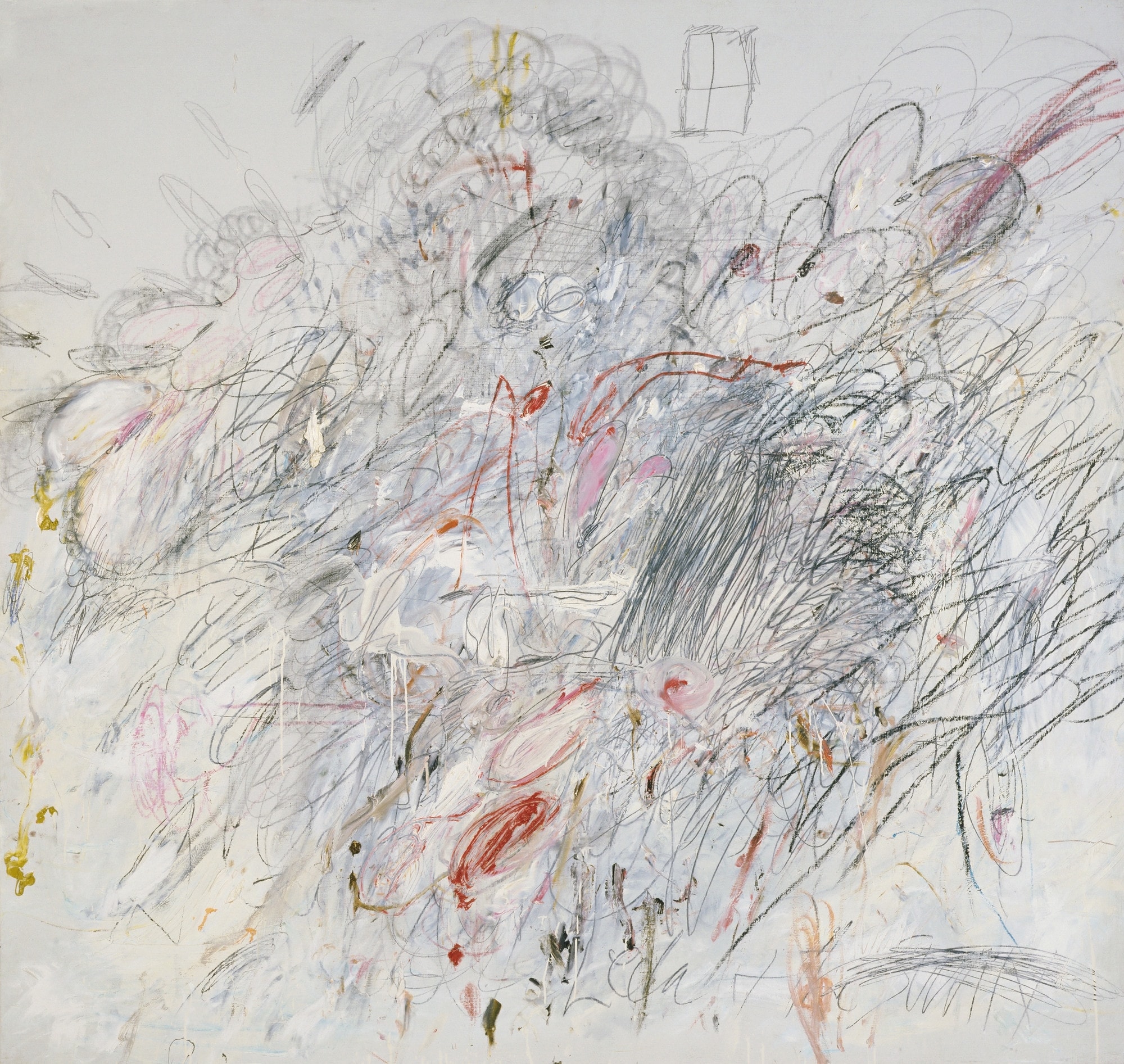
Leda and the Swan by Cy Twombly (1962) featuring Window-like rectangle, Trident-like mark, Central vortex (knotted hatching), Red wound/oval

Click on any numbered symbol to learn more about its meaning

Meaning & Symbolism

Twombly’s strategy is to collapse figure and ground until the myth’s central act is experienced as a shock-wave. At the composition’s center-right, a dense knotted patch of black-green hatching serves as a core of compressed energy; from it, pale greys, whites, and pinks flare outward in quick, oval loops that allude to wings and breasts without stabilizing into illustration. Red ellipses and gashes—particularly a bloody oval low center—beat like wounds against the chalky field, while drips slide downward like the afterflow of impact. Across the upper zone, the artist draws a sober, squared window; nearby, a trident-like mark rises and a heart and explicit phallic glyphs ride the turbulence. These signs do not explain the event; they puncture it. In MoMA’s reading, the field is an “orgiastic fusion” where feathers and flesh are inseparable, and Twombly’s graphite, crayon, and ruddy oil are laid down in “furiously thrashing overlays” 1. The effect is that the rape of Leda appears not as tableau but as collision, a physical registration in which eros is inseparable from brutality. The luminous ground refuses to offer refuge; it is the atmosphere in which the event disperses, a white heat that intensifies the sense of exposure. This rewriting of myth depends on Twombly’s alignment of painting with writing. The scrawls recall both Abstract Expressionist gesture and the automatist, graffiti-like inscriptions of ancient walls; the canvas becomes a palimpsest that viewers must read as much as see 1. The glyphs—heart, phallus, window—operate like textual operators: they compress narrative stakes (desire, act, spectatorship) into legible shorthand while the surrounding storm preserves indeterminacy. Mary Jacobus’s account of Twombly as a painter of poetry clarifies this double action: language appears as fragment and prompt, luring us into assembling meaning from partial signs 4. In Leda and the Swan, that reading carries historical consequence. The encounter begets Helen and thus the Trojan War; Twombly’s frantic field therefore carries the seed of epic catastrophe, relocating “history painting” from staged bodies to the residues of mark-making 1. The picture’s Rome, 1962 context matters: having immersed himself in classical antiquity after settling in Rome in 1957, Twombly channels the heat and ferocity that erupted in the preceding Ferragosto works into canonical subjects, turning them into volatile modern frescoes of impact 25. The painting’s scale—over six feet square—insists on bodily confrontation; the viewer stands within arm’s length of scratches, erasures, and smeared pinks, tracking the hand’s speed and the oil’s viscosity as indices of force. What remains is not a swan, not Leda, but a field of consequences: a vortex where memory and desire survive as traces, and where beauty’s feathered promise and violence’s red fact are one and the same 14.

Explore Deeper with AI

Ask questions about Leda and the Swan

Popular questions:

Powered by AI • Get instant insights about this artwork

💬 Ask questions about this artwork!

Interpretations

Formal/Material Analysis

Twombly makes the myth legible through the behavior of materials: graphite scumbles, waxy crayon skids, and ruddy oil dragged and allowed to drip. MoMA reads these as “furiously thrashing overlays,” an index of force rather than an image of bodies 1. The composition’s dense, knotted hatching works as a core of compression from which loops radiate, converting figure-ground into an impact diagram. This handling extends the volcanic tactility of the 1961 Ferragosto canvases into a canonical subject, so that the medium’s rheology—smear, clot, drip—stands in for narrative climax 15. In this register, facture is fate: the painting’s truth-value lies not in depiction but in how matter has been stressed, abraded, and made to flow under pressure.

Source: MoMA; Christie’s (citing Bastian cat. rais.)

Classicism Reanimated (Twombly vs. Poussin)

Rather than staging myth like Poussin’s tableaux ordonnés, Twombly detonates it. The Dulwich “Twombly & Poussin” framework emphasizes that Twombly’s classicism is affective and fragmentary, translating Ovidian metamorphosis into marks that refuse contour and decorum 4. In Leda, the “window” and glyphs act as skeletal syntax amid painterly tumult, a counterpoint to Poussin’s rational architecture. Where Poussin idealizes narrative through balance and legibility, Twombly courts ruin and residue, aligning antiquity with the modern city’s graffiti and palimpsests. The result is a classicism of aftermath: myth not as exemplar but as eruption, where beauty and brutality are coextensive swirls in a chalky atmospheric field 14.

Source: Dulwich Picture Gallery (Cullinan, Twombly & Poussin); MoMA

Poetry-in-Paint: Reading the Glyphs

Mary Jacobus frames Twombly as a painter of fragments whose notations solicit reading as much as looking. In Leda, the heart, phallus, and the squared window operate like textual operators—condensing desire, act, and spectatorship into legible prompts while the surrounding scrawl preserves indeterminacy 13. This is a poetics of the half-said: language appears as “fragment and prompt,” luring viewers into assembling myth from partial evidence 3. The painting thus toggles between semantic sparks and gestural noise, making interpretation an ethical labor—how do we read violence when its “letters” are legible but its bodies are dissolved? Twombly’s scriptive field stages that dilemma as both aesthetic and moral problem.

Source: Mary Jacobus (Princeton University Press); MoMA

History Painting Recast

MoMA links this assault to its consequence: the birth of Helen and the Trojan War. Twombly relocates history painting from orchestrated bodies to residual marks, converting mythic causation into a field of traces that must be reconstructed by the viewer 1. The scale (over six feet square) enforces bodily proximity to scratches and erasures, updating the grand format for a modern archive of touch. In this sense, Leda functions as a prelude to conflict: a private catastrophe that seeds public cataclysm, rendered not through martial spectacle but through the forensics of facture. The painting becomes an origin story of war written in stain, drip, and abrasion—history as impact memory rather than scene 12.

Source: MoMA (object record; 1994 Retrospective)

Spectatorship and the Window

The sober, squared window at the top registers as a meta-image—an aperture, screen, or viewing device inside the painting. MoMA singles it out as a counterform to the surrounding turbulence, and it can be read as a reflexive frame that questions how we look at sexual violence in art 1. Adjacent glyphs—a heart and phallic signs—implicate desire within the same visual system that structures spectatorship, suggesting that looking is not neutral but already charged. The window, then, is both shield and invitation: a conceptual distance that is immediately violated by the field’s splatters and drips. Twombly folds our gaze into the work’s mechanics, making the ethics of viewing part of the composition’s grammar 1.

Source: MoMA

Seriality, Heat, and Rome

Between 1960 and 1963 Twombly returned to Leda in at least six treatments, a serial engagement that refined how myth could be registered rather than depicted 5. The 1962 canvas painted in Rome carries forward the Ferragosto series’ sweltering energy—summer heat translated into sticky paint, accelerated loops, and volatile drips 5. Situated within his Roman classicism, the work reads like a modern fresco of impact, importing the city’s ancient walls and graffiti into the myth cycle’s surface 2. Seriality matters: each Leda recalibrates density, glyph placement, and chromatic wounds, making meaning contingent on iteration and studio experiment rather than on a single authoritative image. The MoMA version sits at this cycle’s apex in the museum canon 125.

Source: Christie’s (citing Bastian cat. rais.); MoMA

Related Themes

About Cy Twombly

Cy Twombly (1928–2011) trained in Boston, New York, and at Black Mountain College before settling in Rome in 1957. His work probes the boundary between writing and drawing, evolving from graffiti‑like mark‑making to the late‑1960s blackboard paintings and, later, classical and botanical cycles that entwine text, gesture, and memory [7].
View all works by Cy Twombly

More by Cy Twombly