Untitled (New York City)

by Cy Twombly

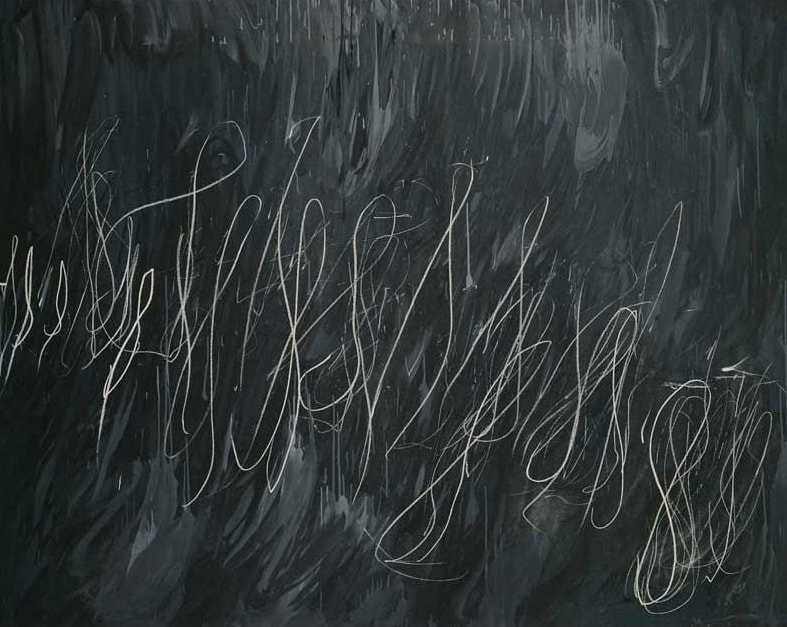
Cy Twombly’s Untitled (New York City) (1968) converts the city into tempo and gesture: white, looping lines lash across a slate field like cursive untethered from words. The work stages writing-as-motion, registering pressure shifts, drips, and erasures as a live record of urban time [1][5].

Study Print Studio

Create a personal study print

Build a companion study sheet around the part of this painting that speaks to you most. Choose a detail, shape an interpretation, and walk away with something personal and display-worthy.

Fast Facts

Year
1968
Medium
Acrylic on canvas
Dimensions
201 × 261.5 cm
Location
Museum Brandhorst, Munich
Untitled (New York City) by Cy Twombly (1968) featuring Looped cursive line (pseudo‑writing), Vertical drips/streaks, Slate ‘blackboard’ ground, Compressed knots/tangles

Click on any numbered symbol to learn more about its meaning

Meaning & Symbolism

Across a dark, slate‑gray ground mottled with vertical swipes and faint drips, a band of thin, chalk‑like loops sweeps laterally in the lower half of the canvas. The line surges, loosens, and tightens: tall arabesques flare into open ovals, then knot into compressed scribbles, then whip into descending hooks at the far right. This visible modulation—fast sweeps, pauses where the hand seems to hover, heavier downstrokes that almost bite into the ground—enacts what Roland Barthes called the primacy of the ductus, the path and pressure of the hand as meaning in itself 5. Instead of forming letters, the script repeatedly approaches legibility and withdraws, converting handwriting practice into pseudo‑writing—a rehearsal emptied of message but dense with time. The painting thus reads like a one‑take performance: a horizontal score in which speed, fatigue, restart, and emphasis are inscribed as fact. Museum Brandhorst underscores this temporal registration, noting how the work records changes of pressure, approach, contact, and release—micro‑events that make the surface a chronicle rather than a picture of anything fixed 1. The title “New York City” guides this chronicle toward an urban key. The repeated loops gather like rush‑hour currents: lanes that merge, overtake, and snag. The upper field’s streaking gray—a rain‑slick veil of near‑vertical strokes—presses downward, while the calligraphic band pushes laterally, creating a cross‑rhythm analogous to weather meeting movement. In this friction, the canvas becomes a diagram of urban repetition: not architecture but recurrence, the practiced cursive of daily routes and habits. Twombly’s late‑1960s “blackboard” paintings consistently exploit the gray‑ground/white‑mark convention to invoke a schoolroom without instruction—the slate that promises teaching but withholds content 4. Here that pedagogy is redirected: the lesson is that meaning can be constituted by tempo and difference within sameness. The loops recur, but no two are equivalent; seriality becomes a test of attention, akin to post‑minimal procedures that value iteration yet keep the maker’s body present—Varnedoe’s useful bridge between Abstract Expressionist gesture and cooler late‑modern systems 6. Technically, the series often combines gray paint with white, chalk‑like inscription; even when the Brandhorst canvas is cataloged as acrylic on canvas, the surface stages the same legible‑illegible tension that the Whitney and others describe for 1968 works, where crayon‑like marks are drawn into or across wet gray grounds to fuse writing and painting 12. That fusion grounds why Untitled (New York City) is important. By refusing to deliver a word while meticulously staging how a word might begin, Twombly reassigns value from lexical clarity to experiential duration. The viewer’s eye tracks the line’s rises and fades much as a listener tracks phrasing in music: downbeats appear in the longer, more weighted loops near center; syncopations flicker where hairline filaments double back and tangle. The painting offers no endpoint—only a horizon of continuation—mirroring the city’s perpetual restart. Within Twombly’s oeuvre, this work crystallizes the blackboard project of the late 1960s (c. 1966–71), in which he interrogates the border between drawing and writing, image and text, by casting the canvas as a temporal device rather than a window 34. Anchored in Barthes’s insight that Twombly’s art privileges the event of making, Untitled (New York City) shows how a single oscillating line, reiterated across a slate, can carry the city’s noise, speed, and sedimented memory without ever naming them 51.

Explore Deeper with AI

Ask questions about Untitled (New York City)

Popular questions:

Powered by AI • Get instant insights about this artwork

💬 Ask questions about this artwork!

Interpretations

Semiotic Lens: Ductus as Meaning

Rather than encode language, Twombly’s line asserts ductus—the path, speed, and pressure of the hand—as the carrier of sense. This aligns with Roland Barthes’s account of Twombly, where the mark functions as an event and an index of the body rather than a sign pointing outward to a lexical referent. The canvas becomes a script of temporal syntax: accelerandi, hesitations, and emphatic downstrokes supply rhythm in place of grammar. In this reading, the painting’s refusal of legibility is not privation but positive content—a record of making that turns the artist’s gesture into a cultural sign. The result collapses writing and drawing into a single, performative inscriptional act, where time, contact, and release form the work’s semantics 51.

Source: Roland Barthes (via Cy Twombly Foundation); Museum Brandhorst

Pedagogy and the Blackboard: A Withheld Lesson

The gray ground plus white looping marks invokes a school blackboard, yet the lesson never arrives. Twombly described these coils as “pseudo‑writing,” an abstraction of cursive that rehearses literacy while suspending meaning. This pedagogical staging turns the canvas into an image of practice without instruction—muscle memory, not message. Institutions like the Art Institute of Chicago stress how the blackboard format deliberately evacuates didactic content, redirecting attention to repetition, recall, and motor learning. Museum Brandhorst further emphasizes how micro‑changes in pressure and pace become the real “curriculum” recorded by the surface. The painting thus critiques the expectation that images should inform, proposing instead an operative pedagogy of looking—to study duration, difference, and the body’s acquisition of script 31.

Source: Art Institute of Chicago; Museum Brandhorst

Post‑Minimal Seriality with a Body

Kirk Varnedoe framed Twombly’s grey paintings as bridging Abstract Expressionist gesture and post‑minimal seriality. Untitled (New York City) operates like a rule‑based run‑on: a line repeats across a register, but never identically. Unlike Minimalism’s impersonal modules, Twombly’s serial loop keeps the maker’s presence audible—friction, fatigue, restart—so that system and subjectivity cohabit. The work behaves as a horizontal score, where performance and iteration synchronize rather than cancel each other. This tension makes the piece exemplary of a late‑modern inquiry into how procedures can contain, but not erase, the contingency of touch. In this light, Twombly’s loops are not random; they are a disciplined, quasi‑algorithmic testing of sameness under the pressure of the body’s time 61.

Source: MoMA (Kirk Varnedoe, Cy Twombly: A Retrospective); Museum Brandhorst

Urban Phenomenology: Weather, Flow, Congestion

The title orients the work toward New York as an experiential system. The near‑vertical gray streaks read as a weather veil, pressing down against the lateral band of traffic‑like loops—an image of cross‑rhythms where atmosphere meets flow. SFMOMA characterizes the “blackboards” as studies in repetition and tempo; here, that tempo becomes infrastructural: merges, stalls, overtakes. Brandhorst’s focus on contact and release makes the painting legible as a seismograph of transit, translating urban movement into embodied notation. Rather than depict buildings, Twombly abstracts the city’s durations—rush, lull, bottleneck—into a kinetic palimpsest, offering a phenomenology of metropolitan life that is sensed as pacing before it is recognized as place 41.

Source: SFMOMA; Museum Brandhorst

Material Ambiguity: Chalk Effect vs. Acrylic Fact

Brandhorst records the medium as acrylic on canvas, yet describes shifts of “chalk”‑like pressure, echoing the series practice where Twombly often drew into wet gray paint with white crayon to fuse writing and ground. The Whitney’s technical notes on a related 1968 work confirm this wet‑into‑dry hybrid, producing incised, graffiti‑like whites that read as chalk while being waxy crayon embedded in paint. This ambiguity is not incidental: it sustains the blackboard illusion while insisting on painterly facture, keeping the eye oscillating between surface and script. Conservation‑wise, such passages record the haptic event—drag, lift, bite—rendering material process permanently legible as part of the work’s meaning 21.

Source: Whitney Museum of American Art; Museum Brandhorst

Related Themes

About Cy Twombly

Cy Twombly (1928–2011) trained in Boston, New York, and at Black Mountain College before settling in Rome in 1957. His work probes the boundary between writing and drawing, evolving from graffiti‑like mark‑making to the late‑1960s blackboard paintings and, later, classical and botanical cycles that entwine text, gesture, and memory [7].
View all works by Cy Twombly

More by Cy Twombly