Hero and Leandro

by Cy Twombly

Hero and Leandro compresses myth into a single, diagonal surge of paint that fuses sea, storm, and desire. The impasto wave drives from lower left to upper right, while the faint graphite name “leandro” thins into the white ground, turning language into a last breath. Twombly converts Marlowe’s poem and the Greek legend into a painterly elegy where gesture stands in for fate [1][2][3].

Study Print Studio

Create a personal study print

Build a companion study sheet around the part of this painting that speaks to you most. Choose a detail, shape an interpretation, and walk away with something personal and display-worthy.

Fast Facts

Year
1985
Medium
Oil and oil-based house paint on canvas
Dimensions
202 × 254 cm
Location
Private collection; exhibited Dulwich Picture Gallery, London
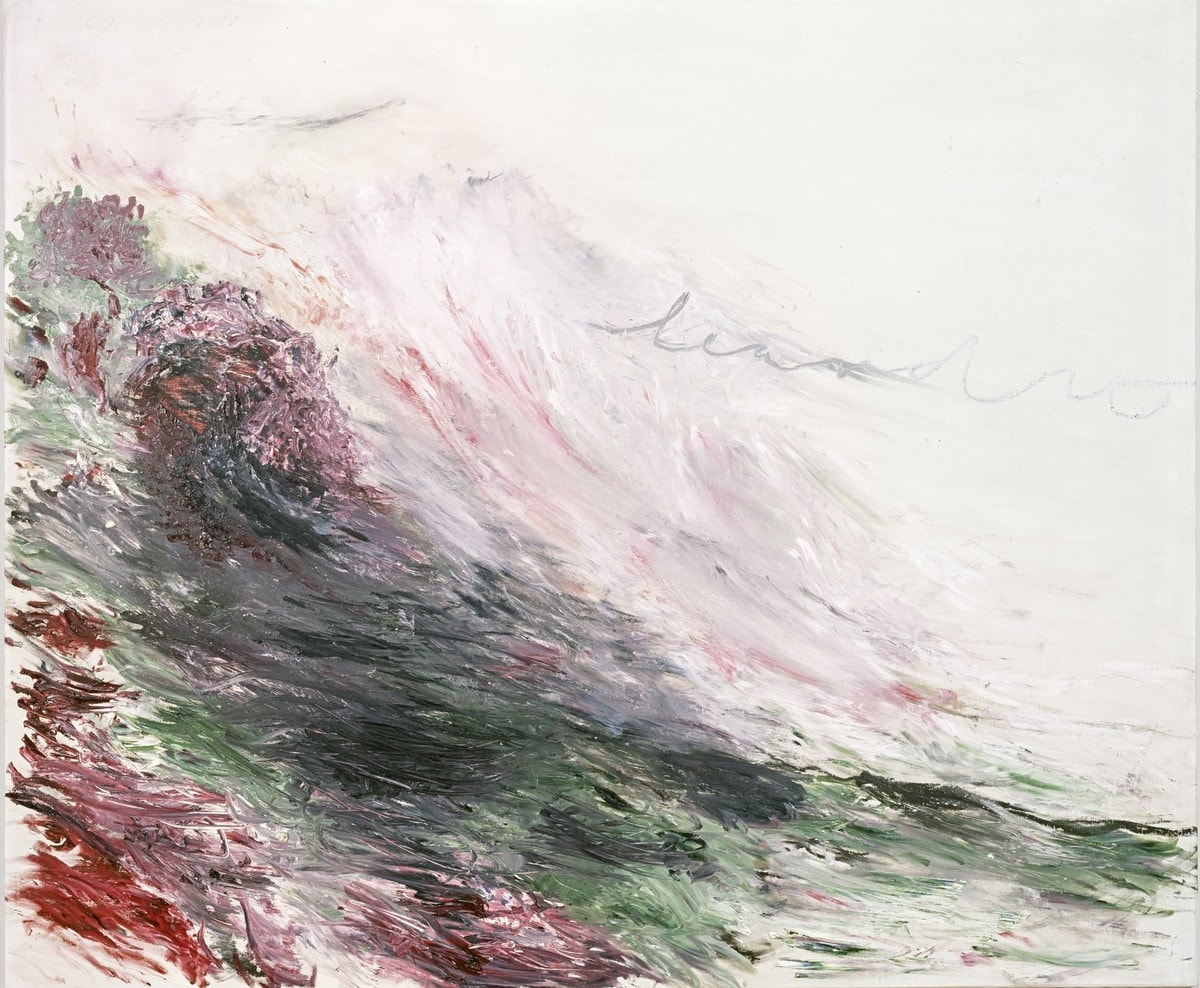
Hero and Leandro by Cy Twombly (1985) featuring Diagonal impasto wave, Handwritten name “leandro”, Vast white field, Red blooms and stains

Click on any numbered symbol to learn more about its meaning

Meaning & Symbolism

Twombly engineers the painting so that form does the telling. The diagonal mass of dragged oils—sea‑greens, mauves, slate greys, and bruised reds—performs the swim and the storm simultaneously: a forward thrust that also overwhelms. At upper right, the penciled “leandro” thins and stutters into the chalky field; the name functions as epitaph rather than label, a breath that expires as the sea takes him. The vast, nearly vacant white registers as extinguished lamp, foam, and sky, a mutable void where orientation collapses. The agitated reds bloom within the surge, converting erotic charge into mortal consequence—desire materialized as viscosity and stain. Nothing is staged as literal illustration; instead, Twombly fuses inscription and gesture so that narrative becomes process, and loss becomes texture 1234. Twombly’s choices anchor this elegy in a specific lineage. The 1985 canvas was painted after reading Christopher Marlowe’s Hero and Leander; the picture translates the poem’s hinge—the lamp blown out, the lover lost—into a grammar of sweep, drag, drip, and erasure 13. Earlier iterations from 1981–84 already paired a cresting wave with the written “Leandro,” establishing the tactic of letting a single scrawled name tether myth to matter even as it dissolves in light 2. Here that tactic is sharpened: the word hovers in the upper right, physically less substantial than the impasto, so meaning palpably yields to weather. In this way Twombly stages a modern form of tragedy: fate is not a god in the scene but the medium itself—paint that surges faster than language can hold it. Critics have noted how the red passages read as flesh and blood, an ambiguity that doubles the myth’s drowning with a contemporary sense of elegy; the picture mourns both the lovers and the poet who shaped their English afterlife, tightening the work’s meta‑elegiac voltage without resorting to anecdote 14. What results is an “inverse ekphrasis”: rather than words describing an image, paint metabolizes a poem and returns it as sensation and time. The lower‑left turbulence is desire’s onset; the sweeping diagonal is the swim under rising wind; the whitening upper field is the lost signal and the sea’s final cover. The meaning of Hero and Leandro is therefore not hidden symbolism but enacted transformation—how a name becomes breath, breath becomes spray, and spray becomes silence. This is why Hero and Leandro is important within Twombly’s project and postwar art more broadly: it shows how abstraction can carry narrative authority, binding antiquity to the present through gesture, inscription, and erasure rather than depiction. The painting insists that tragedy today is legible as speed and residue—the marks that remain when language is swept under by the weather of feeling and the element of paint 1234.

Explore Deeper with AI

Ask questions about Hero and Leandro

Popular questions:

Powered by AI • Get instant insights about this artwork

💬 Ask questions about this artwork!

Interpretations

Historical Context: Gaeta, the Sea, and Twombly’s 1980s Turn

In the early 1980s Twombly reoriented his practice toward nature and the classical past, often working on Italy’s Tyrrhenian coast. That littoral setting matters: the sea is not backdrop but the painting’s operative grammar—sweep, surge, and spindrift. The Dulwich label confirms the 1985 canvas follows a reading of Marlowe, while MoMA frames related 1981/84 works as “abstract seascapes,” already pairing a cresting wave with the scrawled “Leandro.” This coastal turn supplies the work’s kinetics: marine weather becomes method, and the studio becomes a site where myth is re‑experienced as motion. The diagonal mass is thus less an illustrative wave than a Mediterranean force field, translating storm logic into paint handling—dragged house paint, oil, and vaporous whites that echo foam, sky, and the lamp’s lost signal 12.

Source: Dulwich Picture Gallery; MoMA

Inverse Ekphrasis: Painting that Reads a Poem

Hero and Leandro operates as inverse ekphrasis: instead of words describing images, paint translates verse into sensation and time. The extinguished lamp—the poem’s hinge—arrives not as icon but as a whitening field that unlights the surface. Twombly metabolizes Marlowe’s rhetoric into a syntax of sweep, drip, and fade, so that plot becomes temporal drag across the canvas. This is not illustration but transduction: textual cadence turns into painterly rhythm; a proper noun (“Leandro”) becomes breath and then spray. Twombly’s broader practice, as the Foundation notes, entwines literature with mark‑making, using inscription fragments to tether myth to matter even as they dissolve. The result is a painting that “reads” the poem back to us as weather, registering narrative as atmosphere and residue 36.

Source: Poetry Foundation; Cy Twombly Foundation

Materiality as Fate: When the Medium Overrules Language

The painting literalizes the claim that fate is the medium. Viscous house paint and oil—dragged, smeared, allowed to run—perform the storm’s acceleration and Leander’s exhaustion. The scrawled “leandro,” physically thinner than the impasto, is subordinated to tidal matter; language becomes a failing signal in hostile conditions. MoMA’s account of the 1981/84 sequence already identifies this tactic—letting a single name anchor the scene while painterly process unseats it. In 1985 Twombly intensifies the imbalance: the diagonal surge outraces the pencil, staging tragedy as a mismatch between inscription and element. The Dulwich label’s emphasis on dribbles and drowning clarifies the stakes: liquidity cancels legibility, making the work a case study in how material agency can eclipse narrative control 12.

Source: MoMA; Dulwich Picture Gallery

Meta‑Elegy: From Lovers’ Tragedy to Poet’s Blood

Critics have read the red blooms as more than seawater agitation: they flirt with blood. While the museum label stays neutral, reviews propose a doubled elegy in which Leander’s drowning overlays the violent death of Marlowe, to whom the painting is dedicated. This speculative but resonant reading thickens the painting’s memorial register: mythic loss meets literary history, and the canvas mourns both character and author. The reds oscillate between eros (the heat that drives the swim) and wounding, tightening the hinge where desire becomes consequence. In this lens, Twombly’s chroma acts like citation, importing biographical fate into painterly weather—an elegy that refuses anecdote yet allows contemporary blood to seep into antique sea 451.

Source: The Guardian; The Arts Desk; Dulwich Picture Gallery

Epigraphy and Expiration: The Name as Last Breath

The penciled “leandro” functions less as label than as epigraph that expires. Positioned high and right, it thins into the chalky field, performing the poem’s extinguished lamp as a lexical fading. MoMA’s discussion of the earlier sequence highlights how a single scrawl tethers abstraction to narrative; Mary Jacobus extends this by showing how Twombly’s writing works as voiceprint—a trace of utterance more than stable text. In Hero and Leandro the name is a vanishing index of presence: an elegiac breath that cannot withstand the medium’s weather. The work thereby converts inscription into temporality—writing becomes duration, and duration becomes loss—collapsing semantics into the sensory event of graphite succumbing to paint 27.

Source: MoMA; Mary Jacobus

A Contemporary Sublime: Orientation Collapse and the Lamp’s Undoing

The painting modernizes the sublime by swapping mountain for maritime void. The wide, chalky expanse registers as sea, foam, sky—and the poem’s extinguished lamp—so that figure/ground relations destabilize and orientation collapses. The viewer’s eye rides the diagonal surge before losing purchase in the whitening field, a staged unmooring aligned with Marlowe’s storm. Dulwich’s focus on drowning and dribbles, paired with the Poetry Foundation’s lamp‑hinge, clarifies why the blank is not absence but force: a climatological sublime that exceeds pictorial control. Twombly domesticates this terror through painterly cadence—drag, pause, smear—allowing awe to be felt as tempo rather than spectacle, a postwar update in which speed, residue, and erasure stand in for thunderclap and cliff 13.

Source: Dulwich Picture Gallery; Poetry Foundation

Related Themes

About Cy Twombly

Cy Twombly (1928–2011) trained in Boston, New York, and at Black Mountain College before settling in Rome in 1957. His work probes the boundary between writing and drawing, evolving from graffiti‑like mark‑making to the late‑1960s blackboard paintings and, later, classical and botanical cycles that entwine text, gesture, and memory [7].
View all works by Cy Twombly

More by Cy Twombly