How Much Is The Four Seasons (Quattro Stagioni) Worth?
Last updated: June 26, 2026
Quick Facts
- Methodology
- comparable analysis
Assuming a complete, well-documented Four Seasons (Quattro Stagioni) cycle by Cy Twombly, the market value is estimated at $40–120 million. The range reflects major auction comparables for large Twombly canvases and multi-panel lots, adjusted for provenance, condition, and institutional significance.
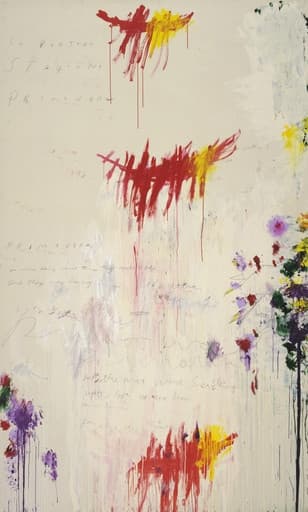
The Four Seasons (Quattro Stagioni)
Cy Twombly • Oil and mixed media on canvas (four-part cycle)
View more by Cy Twombly →Valuation Analysis
Valuation conclusion: For a complete, authenticated Four Seasons (Quattro Stagioni) four-panel cycle by Cy Twombly offered with strong provenance and in sound condition, I place the likely market value at $40–120 million. This range is based on direct institutional presence of the cycle in major collections, plus public auction evidence from Twombly's highest-performing canvases and multi-panel offerings [1][2].
Institutional ownership materially strengthens the work's market proposition: MoMA holds a Four Seasons set (gift of the artist) and Tate holds a Quattro Stagioni cycle, establishing the composition's museum‑quality standing and rarity in private hands [1]. That institutional validation is a primary upward price driver: works of this scale and subject matter are scarce on the open market and attract both blue‑chip collectors and institutional bidding interest.
Public auction comparables set the market ceiling and mid‑points. Twombly headline sales (notably the 2015 Blackboard record and several subsequent large‑canvas results, plus a high‑profile multi‑panel lot in 2021) show that market demand for singular, canonical canvases regularly reaches the tens of millions and can exceed $50–70 million in exceptional cases [2]. Those realizations inform per‑panel and aggregate expectations: a museum‑quality four‑panel cycle could reasonably trade at multiples of mid‑market single canvases if sold intact, particularly in a well‑prepared single‑owner sale.
Key value modifiers that determine where any specific Quattro Stagioni falls in the $40–120M band include: (1) provenance and documentary history (gallery invoices, ownership chain, catalogue raisonné entry and Foundation authentication), (2) condition and any conservation history, (3) whether the set is complete and normally exhibited as a single unit or has been separated, and (4) the sale channel (major evening sale or curated single‑owner sale vs. secondary or private channels). Gaps or disputes in provenance or unresolved conservation issues can compress value sharply; conversely, a freshly marketed, exhibition‑ready cycle with pedigree can command results at the top of the range.
Recommendation: Before placing a firm reserve or marketing the work, obtain (A) a Twombly Foundation/authentication statement or catalogue raisonné confirmation, (B) a full conservation/condition report, and (C) written estimates from evening‑sale specialists at Christie’s, Sotheby’s and Phillips to test private‑sale interest and auction appetite. With that documentation, the estimate above can be narrowed materially and an optimal sales strategy selected.
Key Valuation Factors
Art Historical Significance
High ImpactThe Quattro Stagioni cycle is among Twombly's late‑career monumental references to classical themes; institutional examples are held by MoMA and Tate, confirming the cycle's canonical status. That art‑historical weight materially increases value because museums and major collectors prize complete cycles that demonstrate an artist's thematic and technical mastery. Scholarly attention and exhibition history for this motif amplify demand and can convert academic significance into market premium. A set confirmed as integral to Twombly's mature oeuvre will therefore attract the deepest buyer pool and command prices toward the top of the range.
Provenance & Exhibition History
High ImpactClear, continuous provenance—gallery invoices, ownership chain, exhibition labels and catalogue citations—substantially increases marketability and price. A documented museum exhibition history or inclusion in major catalogues raisonné adds trust and tends to transform an otherwise private object into a contestable museum‑quality lot. Gaps, anonymous ownership periods, or disputed title introduce buyer hesitation and can reduce realized price dramatically; conversely, fresh‑to‑market single‑owner sales or museum deaccessions typically achieve premium outcomes.
Condition & Completeness
High ImpactCondition is central for large mixed‑media canvases: original surface integrity, absence of unstable restorations, and retention of the artist's intended scale matter. A complete four‑panel set is worth materially more than separated panels sold individually; conversely, missing panels or non‑original reconfigurations reduce value. A conservator's report that documents minimal intervention, stable supports and color fidelity will preserve value; significant conservation needs will depress price and may raise transaction costs beyond market tolerance.
Market Comparables & Liquidity
High ImpactRecent high‑profile Twombly sales establish the upper‑market context: single canvases have fetched $30–70M+ and a major multi‑panel lot has sold in the tens of millions, demonstrating buyer willingness to pay for monumentality and provenance. Liquidity for works at the top end depends on timing, sale channel, and the freshness of provenance. A major evening sale or single‑owner event maximizes exposure; private treaties may achieve speed but sometimes at the cost of headline value. Comparable lot performance informs realistic expectations for a four‑panel cycle.
Authenticity, Title & Legal Risk
Medium ImpactAuthentication by the Twombly Foundation or catalogue raisonné inclusion is essential. Any unresolved claims—restitution, export restrictions, or liens—can block sale or sharply reduce buyer interest. Clear title and export readiness make institutional and international buyers viable, expanding the potential purchaser base. Legal risk reduces market value and may deter marquee auction houses from accepting a lot, so addressing these issues before marketing is crucial for capturing the high end of the estimate.
Sale History
The Four Seasons (Quattro Stagioni) has never been sold at public auction.
Cy Twombly's Market
Cy Twombly is a blue‑chip postwar/contemporary artist whose market is concentrated at the top end. His canonical large canvases and landmark series are institutionally sought and have produced headline auction results—including multi‑tens‑of‑millions outcomes and a 2015 record for a Blackboard painting—while smaller works and works on paper trade at much lower levels. Demand is driven by museums, major private collectors, and a limited supply of museum‑quality, large‑scale works. Market segmentation is pronounced: a well‑documented major canvas commands a premium that lesser works do not.
Comparable Sales
Untitled (Blackboard), 1968
Cy Twombly
Artist auction record and market ceiling for Twombly; large, canonical single‑canvas work that sets the top comparability for museum‑quality, monumental pieces.
$70.5M
2015, Sotheby's New York
~$90.2M adjusted
Untitled (large multi-panel, single-owner/Macklowe sale)
Cy Twombly
Large-format, multi-panel Twombly sold from a high‑profile single‑owner sale — closest auction analogue in scale and market interest to a four‑panel cycle like Quattro Stagioni.
$58.9M
2021, Sotheby's New York (Macklowe single-owner sale)
~$65.9M adjusted
Untitled (2005)
Cy Twombly
Major late‑period Twombly canvas sold in an evening sale; shows strong demand for important late works (useful mid‑tier benchmark below Blackboard/multi‑panel peaks).
$41.6M
2022, Phillips New York (Evening Sale)
~$45.0M adjusted
Untitled [Bolsena]
Cy Twombly
Large lyrical Twombly canvas (Bolsena) sold at auction; comparable in painterly language and scale to multi‑panel late works — helpful for valuing large, museum‑quality cycles.
$38.7M
2020, Sotheby's New York
~$44.5M adjusted
Untitled (from the Emily Fisher Landau sale)
Cy Twombly
Important single‑owner sale example showing mid‑tier market for fresh‑to‑market, museum‑quality Twomblys; useful as a conservative lower bound for large late works.
$26.8M
2023, Sotheby's New York (Emily Fisher Landau sale)
~$28.1M adjusted
Current Market Trends
The current market supports top‑tier Twombly works but shows dispersion beneath headline lots; major institutional exhibitions, foundation gifts and single‑owner consignments drive peak prices. Private sales remain important for very high‑value works, while mid‑market material experiences variable demand. Auction houses continue to favor presenting significant Twomblys in curated evening sales, where freshness, provenance and exhibition history most strongly influence realized prices.