How Much Is Untitled (Bacchus series, largest example) Worth?
Last updated: June 26, 2026
Quick Facts
- Last Sale
- $46.4M (2017, Christie's New York)
- Methodology
- comparable analysis
Based on recent, directly comparable auction results for large Bacchus canvases by Cy Twombly, I estimate the market value of Untitled (Bacchus series, largest example) at USD 35–55 million. This range reflects auction anchors (notably Christie’s Nov 2017 and Phillips Nov 2022) adjusted for current market conditions, provenance and condition.
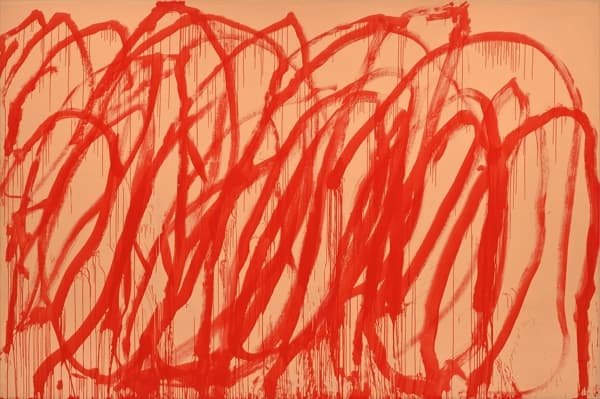
Untitled (Bacchus series, largest example)
Cy Twombly, 2005 • Acrylic, oilstick and crayon on canvas/wood panel
View more by Cy Twombly →Valuation Analysis
Valuation conclusion: Using recent auction comparables and current market signals, I place the market value for Cy Twombly’s "Untitled (Bacchus series, largest example)" at USD 35,000,000–55,000,000. The estimate is grounded in realized prices for the largest-format Bacchus canvases and calibrated for provenance, condition and sale format.
The principal anchors are auction results for near-identical monumental Bacchus canvases. A canvas described by Christie’s as "the largest work from the Bacchus series" realized $46,437,500 in November 2017 [1], and a closely comparable monumental Bacchus (127 3/4 x 192 in.) realized $41,640,000 at Phillips in November 2022 [2]. At the lower end of the series, other Bacchus examples sold in the mid-teens to low-twenties million range (Sotheby’s ~ $15.37M, Christie’s $19.96M), demonstrating a material stratification within the group [3][4].
Given those anchors, the mid-market expectation for a largest-format Bacchus canvas in clean provenance and excellent condition sits in the mid‑to‑high tens of millions. I adopt a $35–55M band to reflect two realistic scenarios: a conservative outcome (weaker provenance, minor conservation issues, or non-evening sale) toward the low end; and a trophy outcome (museum provenance or marquee-collection provenance, illustrated/exhibited, evening-sale placement with active bidding) toward or above the high end. Recent marquee sales of major Twombly works (for example a high-profile lot in May 2026) show sustained demand for top-quality Twomblys but also indicate results cluster below the artist’s record and vary by lot narrative [5].
Key sensitivities that would move this range materially are provenance/publication history, a formal condition report (including any restoration), confirmed cataloguing/authentication by the Twombly Foundation or catalogue raisonné entry, and sale strategy (house, timing, evening vs day sale). Procedural next steps to firm up a final asking price: obtain high-resolution photography and a full condition report, assemble complete provenance and exhibition documentation, request a formal presale appraisal from the major houses, and (if intending to sell) target an evening sale at Christie’s, Phillips or Sotheby’s after securing catalogue support.
Bottom line: Treat USD 35–55M as a market‑ready opinion conditional on verification of provenance, condition and authentication. With museum-level provenance and strong publication/exhibition history the work can reasonably be expected to perform at or above the top of the band; absent those elements expect the sale to settle toward the lower half of the band.
Key Valuation Factors
Art Historical Significance
High ImpactCy Twombly is one of the most important painters of post‑war lyrical abstraction; his large late‑career canvases — and the Bacchus series in particular — occupy a distinct place in his oeuvre as monumental, late gestures that synthesize myth, calligraphic mark‑making and painterly color fields. The "largest example" of a named series typically has outsized cultural interest because it best exemplifies the series’ formal and expressive ambitions. Institutional interest (museum exhibitions, dedicated galleries such as the Menil’s Twombly holdings, and foundation/cat. raisonné entries) materially raises collecting demand and supports top‑end pricing for works that are demonstrably representative and well‑documented.
Provenance & Exhibition History
High ImpactProvenance and literature are decisive for Twombly pricing. A canvas with continuous gallery sale records from a blue‑chip dealer or ownership by a named museum or marquee private collection (and with exhibition citations and illustrations in catalogues) typically achieves a premium relative to an otherwise comparable lot. Conversely, gaps in ownership history, unclear export documentation, or absence from major exhibition catalogues reduce buyer certainty and demand, producing discounts. For the largest Bacchus canvas, museum or notable collection provenance can move value from the mid‑range into the trophy bracket.
Condition & Conservation
High ImpactTwombly’s heavily gestural surfaces and large‑format canvases can be susceptible to localized abrasion, surface dirt, stretcher issues, or later retouching. Major bidders and institutions expect a full conservation history and a current, professional condition report. Noticeable restoration, relining or unstable paint can reduce marketability and materially depress the sale price (often by tens of percent for important lots). Pristine condition and well‑documented conservation history are therefore essential to realize the upper end of the valuation band.
Comparable Sales & Market Liquidity
High ImpactAuction results for large Bacchus canvases provide the primary quantitative anchors: Christie’s Nov 2017 $46.44M and Phillips Nov 2022 $41.64M are direct precedents for the largest examples, while mid‑teens to low‑twenties million results establish the lower tier. The market for Twombly at the high end remains liquid for marquee lots, but liquidity declines outside trophy examples. Consequently, realized comparables and the specific sale context (estate or marquee consignment, evening sale) are the most influential pricing drivers.
Size & Visual Impact
Medium ImpactScale is a premium attribute for Twombly: the largest canvases make a stronger institutional case and attract a narrower but deeper pool of buyers prepared to pay a premium for 'wall‑filling' presence. That said, very large works incur higher shipping, insurance and installation costs and appeal to fewer private buyers; the net effect is usually a positive premium for museum‑quality examples but a narrower margin of purchaser competition than for smaller, more transportable works.
Sale History
Christie's New York (Post‑War & Contemporary Evening Sale)
Phillips New York (Evening Sale)
Sotheby's New York
Christie's New York (21st Century Evening Sale)
Christie's New York (20th Century Evening Sale)
Cy Twombly's Market
Cy Twombly is a blue‑chip post‑war artist with sustained institutional representation and a history of high auction results. His market is work‑by‑work: canonical mid‑career groups (Blackboards, Rome works) set the highest historic marks, while late‑career series such as Bacchus have become important secondary‑market drivers when offered in large format with strong provenance. Twombly’s auction record remains an outlier for a seminal mid‑career work, but the market for top‑quality Twomblys continues to produce multi‑million and multi‑tens‑of‑millions results when the lot narrative and documentation are persuasive.
Comparable Sales
Untitled (2005) — largest work from the Bacchus series
Cy Twombly
Same artist, same Bacchus series, identical canvas described by the house as the largest example — direct high‑end benchmark.
$46.4M
2017, Christie's New York
~$60.2M adjusted
Untitled (2005) — monumental Bacchus canvas (127 3/4 x 192 in.)
Cy Twombly
Near‑comparable large‑format Bacchus canvas from the same late series and similar monumental scale — strong secondary‑market indicator for large Bacchus canvases.
$41.6M
2022, Phillips New York
~$45.3M adjusted
Untitled (Bacchus 1st Version V) (2004)
Cy Twombly
Same Bacchus series but an earlier '1st Version' and materially lower scale/significance — shows the lower price band within the series.
$15.4M
2016, Sotheby's New York
~$20.4M adjusted
Untitled (Bacchus 1st Version II) (2004)
Cy Twombly
Same series and date group (2004) but a non‑monumental/earlier version — useful as a lower‑tier comparable within the Bacchus group.
$20.0M
2023, Christie's New York
~$20.8M adjusted
Current Market Trends
The recent market is bifurcated: trophy, well‑provenanced consignments at marquee sales still command significant prices, while mid‑market segments are more selective. Recent marquee sales (2017–2026) show sustained demand for top Twomblys but also price dispersion by lot quality and provenance. Timing, sale format and catalogue support are critical to achieving the upper end of estimates.
Sources
- Christie's — Post‑War & Contemporary results (Nov 15, 2017) — 'largest work from the Bacchus series'
- Phillips — Untitled (2005), monumental Bacchus lot (Nov 15, 2022)
- Coverage of Sotheby's Contemporary sale results (May 11, 2016) — Bacchus lower-tier comparable
- Christie's press release / lot reporting (Nov 7, 2023) — Bacchus example
- Christie's — Specialist highlights, Evening May 2026 (Gund lot sale context)