The Accolade
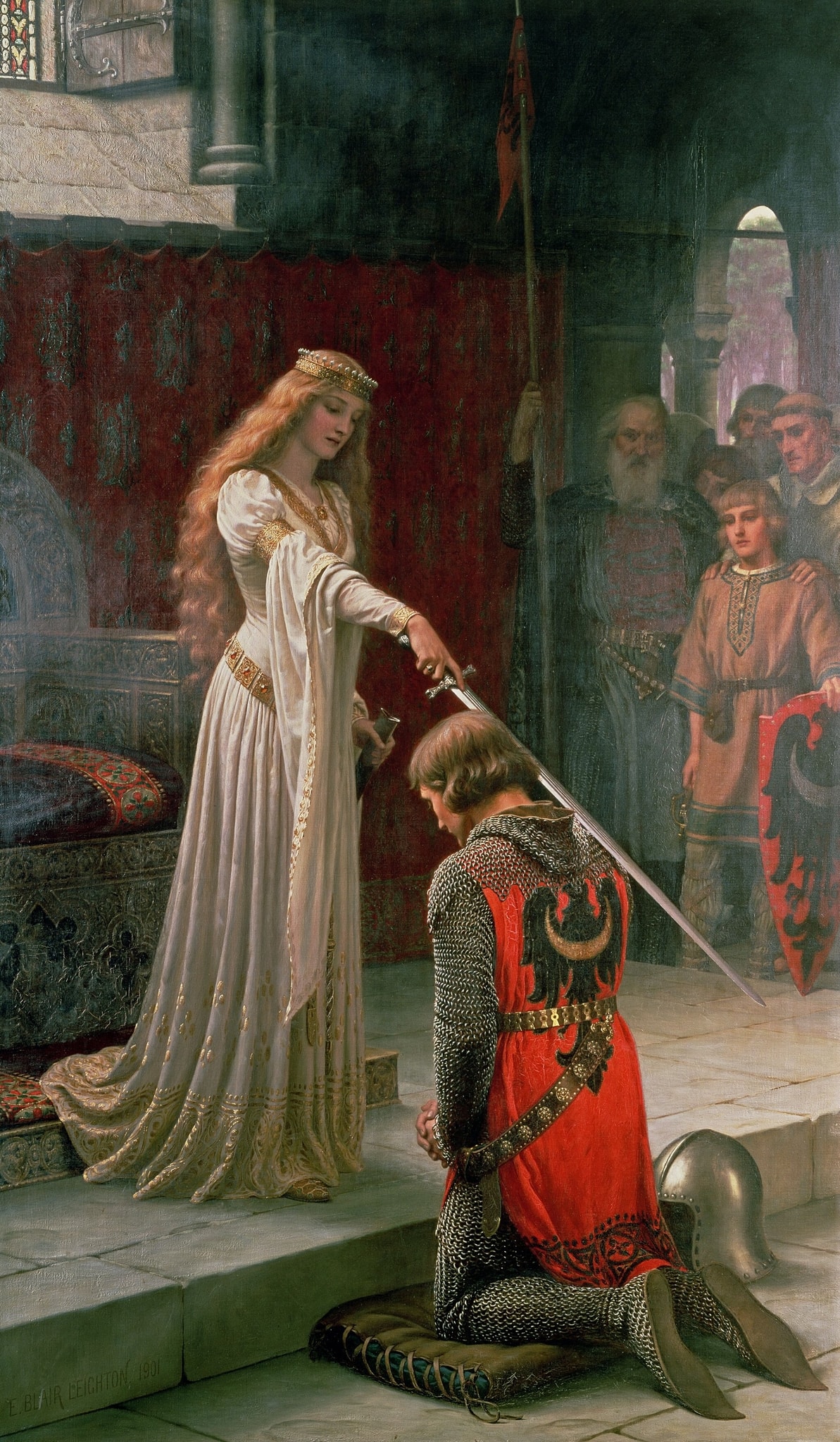
Edmund Leighton’s The Accolade (1901) crystallizes the rite of knighthood as a moral initiation, staging duty conferred by grace rather than force. A lady in radiant white touches her sword to the shoulder of a kneeling knight in chain mail and scarlet surcoat, before a crimson tapestry and carved throne, while shadowed witnesses affirm the solemnity of the moment [1][2].
Study Print Studio
Create a personal study print
Build a companion study sheet around the part of this painting that speaks to you most. Choose a detail, shape an interpretation, and walk away with something personal and display-worthy.
Fast Facts
- Year
- 1901
- Medium
- Oil on canvas
- Dimensions
- 182.3 x 108 cm
- Location
- Private Collection
Click on any numbered symbol to learn more about its meaning
Meaning & Symbolism
Leighton builds the drama around three converging vectors—light, gesture, and hierarchy—to convert ceremony into conviction. Light concentrates on the lady’s white gown and hair, then flashes along the blade before dimming into the crimson tapestry and stone recess; illumination thus seems to descend with the sword, casting honor as a gift rather than a seizure of power 1. The kneeling knight, helmet set aside on the step and hands clasped, accepts vulnerability as the precondition of service; his chain mail and bright red surcoat, emblazoned with an invented black device, signal strength awaiting direction rather than a personal heraldic claim 12. In this chamber—throne to the left, stained glass and arches to the right, onlookers recessed in shadow—Leighton encloses the rite within a quasi‑sacral court, where feudal authority and spiritual aspiration coincide 6. The pivotal touch of steel to shoulder embodies the essential act of dubbing; historically variable in form, it survives as the ritual shorthand of investiture that Victorian viewers instantly recognized 3.
That clarity of sign is the point. The lady’s role is not decorative; she functions as the conduit by which might is moralized. In Victorian medievalism, the feminine often articulates purity and restraint, disciplining martial energy through ideals of courtly love; Leighton visualizes that ethic in the measured line of her arm and the controlled, almost weightless lay of the sword 46. The knight’s lowered head and the cushion beneath his knees render humility as chosen, not coerced, while the removed helmet and grounded scabbard suspend aggression at the threshold of a new identity 3. Even the décor participates in meaning: the red textile backdrop stabilizes the scene’s axis of honor, setting the lady’s white against the knight’s scarlet so that virtue and valor interlock rather than compete. The onlookers—older retainer with staff, youth with shield—register a generational relay: tradition witnesses and renews itself in the act.
As historical genre, The Accolade refines the Pre‑Raphaelite inheritance into Edwardian polish: archaeological plausibility is less important than ethical legibility 24. Exhibited at the Royal Academy in 1901, the work met an audience primed by Tennysonian Arthurianism and the broad medieval revival to read chivalry as a modern code—duty to sovereign, protection of the weak, fidelity to promise—here presented with academic finish and narrative economy 26. The painting’s lasting appeal follows from that synthesis. By using the sword as a ray of delegated authority, the white gown as a visual theology of virtue, and the kneeling figure as an icon of chosen service, Leighton compresses a culture’s aspirations into a single, lucid image. The scene does not illustrate a named episode; it idealizes the very mechanism by which societies authorize power—submission to rule so that strength can serve rather than dominate 134.
Explore Deeper with AI
Ask questions about The Accolade
Popular questions:
Powered by AI • Get instant insights about this artwork
💬 Ask questions about this artwork!
Interpretations
Ritual Theory: Liminality and Investiture
Read as a rite of passage, the scene maps classic phases of separation, limen, and incorporation: the set‑aside helmet and grounded scabbard mark withdrawal from ordinary combat; the kneeling posture and cushion signal the threshold; the sword‑touch enacts incorporation into a new status. This is not mere illustration but a carefully staged moment of liminality, where identity is suspended and then reconstituted as duty. By choosing the visually unambiguous sword‑tap—one of several historical variants—Leighton streamlines the rite into a universally legible emblem of oath‑bound service, aligning anthropological clarity with Edwardian moral didacticism 34.
Source: Encyclopaedia Britannica; Oxford Handbook of Victorian Medievalism
Gendered Sovereignty: The Lady as Moral Magistrate
Victorian medievalism often assigned women the work of moral adjudication: the lady’s purity licenses the transfer of force into law. Here, her measured arm and white habit operate like a living scepter, converting chivalric eros into disciplined agape—a courtly‑love logic repurposed for modern ethics. Rather than decorative muse, she is a juridical presence whose virtue legitimizes public authority. This gendered division of symbolic labor—male action tempered by female ideal—tracks with broader nineteenth‑century discourses on separate spheres and the feminization of moral authority in art, making the painting a didactic allegory of sovereignty by consent rather than coercion 46.
Source: Oxford Handbook of Victorian Medievalism; Victorian Web
Serial Narration: From Departure to Vow
The Accolade sits between Leighton’s God Speed (1900) and The Dedication (1908), forming a serial ethic: departure (eros and parting), investiture (public authorization), and vow (private consecration). Read together, these canvases stage a continuum from personal motive to institutional duty to inward resolve, mapping how chivalric identity is produced across scenes and years. The Academy context amplified this readability for a mass audience fluent in Tennysonian codes. Leighton’s academic finish and narrative economy ensure each panel can stand alone, yet in sequence they articulate a late‑Victorian pedagogy of character: desire refined, power delegated, will stabilized 278.
Source: Christie’s (God Speed lot essay); Christie’s (RA 1901 listing); Alfred Yockney, 1913
Politics of Light: Making Power Look Benevolent
Leighton’s lighting is ideological craft. The descending gleam along the blade and the irradiated white of the gown frame authority as a gift rather than domination, a classic academic strategy that harmonizes compositional climax with ethical persuasion. The shadowed spectators recede, ceding the pictorial pulpit to a two‑figure axis where virtue (white) and valor (scarlet) appear mutually validating. In an Edwardian marketplace that prized uplifting medieval scenes, such chromatic rhetoric functioned as soft propaganda for hierarchical order—duty rendered beautiful, submission reframed as chosen service, and sovereignty visually domesticated under the sign of purity 67.
Source: Victorian Web; Christie’s (Accolade lot note)
Historicism vs. Invention: Ethical Legibility Over Accuracy
The generalized heraldry, invented device, and composite Gothic setting signal a priority: ethical legibility over documentary accuracy. Far from error, this is a program—stripping parochial identifiers to craft a timeless grammar of chivalry. The result traveled well in reproduction, helping the privately held canvas achieve public iconicity. Leighton’s academic craft, honed in the Royal Academy orbit, makes the picture an argument for historical genre as moral fable: precise enough to feel ‘medieval,’ abstract enough to be exemplary. In this balance of plausibility and invention, the painting models how Edwardian culture curated the past to meet present needs 156.
Source: Bridgeman Images; British Museum (artist bio); Victorian Web
Related Themes
About Edmund Leighton
Edmund Leighton (London, 1852–1922) was an English painter of highly finished historical genre scenes, best known for medieval and Regency subjects. Trained at the Royal Academy Schools, he exhibited frequently at the Royal Academy and distilled Victorian medievalism into polished, narrative images such as God Speed (1900) and The Accolade (1901) [5][2].
View all works by Edmund Leighton →