The Kiss (Hayez)
Francesco Hayez’s The Kiss (Hayez) fuses intimate passion with political resolve: a clandestine embrace staged on a cold stone threshold as departure looms. The man’s outward-angled foot on the stair and the flash of a dagger compress time to a final instant before flight, while tricolour cues fold love into the Risorgimento alliance of 1859 [1]. The painting’s cool masonry and theatrical light make private tenderness read as public courage.
Study Print Studio
Create a personal study print
Build a companion study sheet around the part of this painting that speaks to you most. Choose a detail, shape an interpretation, and walk away with something personal and display-worthy.
Fast Facts
- Year
- 1859
- Medium
- Oil on canvas
- Dimensions
- 112 × 88 cm
- Location
- Pinacoteca di Brera, Milan
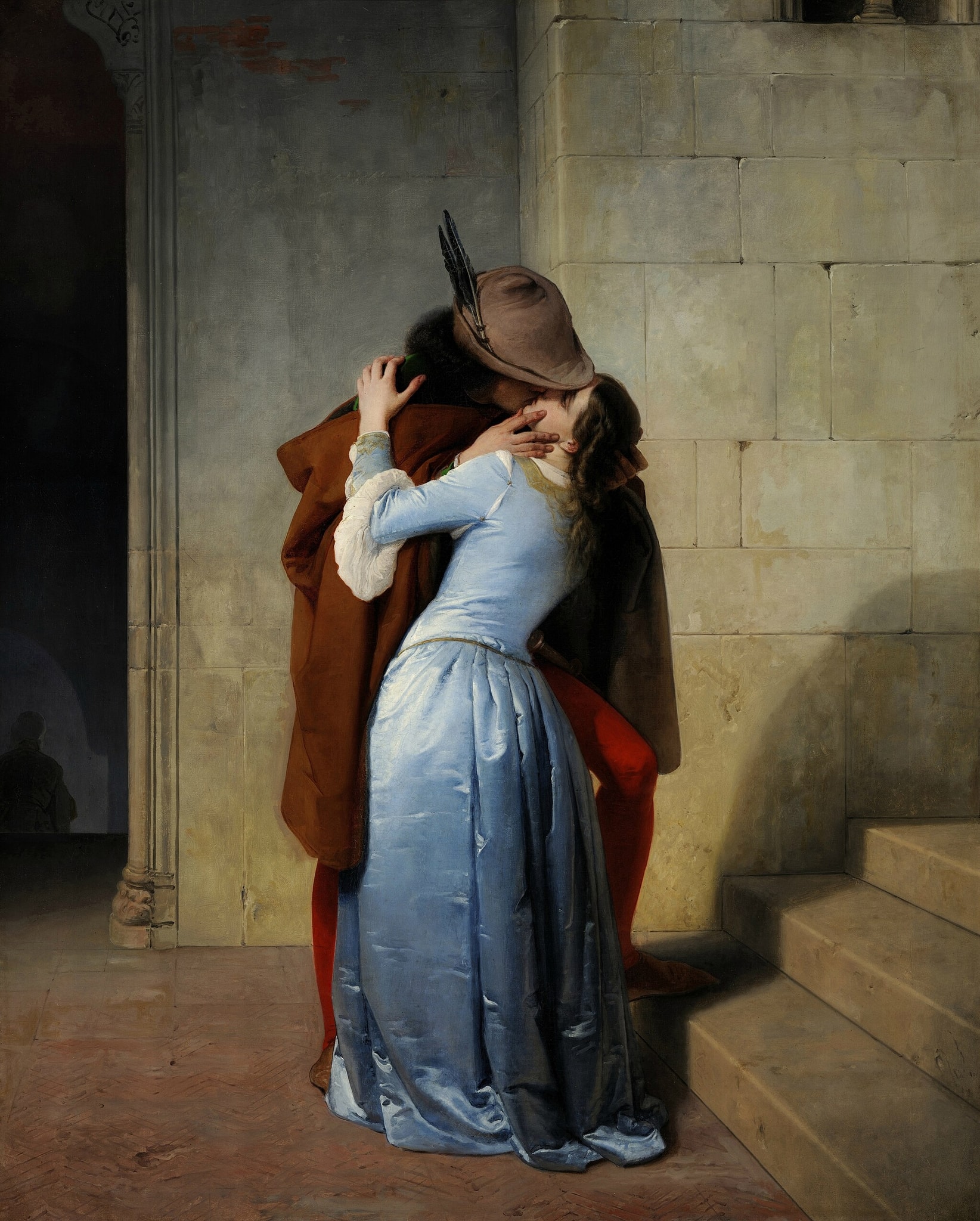
Click on any numbered symbol to learn more about its meaning
Meaning & Symbolism
Hayez builds the scene as a suspended act of departure. The man’s left foot plants on the first stair, heel lifted and pointed outward, while his torso pivots back into the woman’s embrace; his knee wedges between hers to anchor balance for a movement he cannot delay. The feathered cap shadows his face as he leans in, making the kiss feel both urgent and concealed. The polished blue satin of her dress catches the strongest light, turning her body into a bright counterform against the stone. This enamel‑like surface—crafted with a modern palette including intense blues and vermilion—sharpens contrasts so that flesh and cloth seem to glow against the alcove’s chill blocks 3. Every element announces imminence: the half‑drawn angle of his cloak, the small hilt at his side suggesting clandestine action, and the dim silhouette seated in the archway, a watcher whose role remains unresolved—spy, accomplice, or household presence 4.
Within that compressed instant, Hayez encodes history. Contemporary viewers in 1859 would have recognized the color politics: the man’s vivid red stockings, a green lining at his shoulder, and the woman’s blue‑white dress align Italian and French flags to salute the Franco‑Piedmontese alliance that had just wrested Lombardy from Austrian control 1. The medievalizing costumes and stone architecture provide a safe historical veil, but the staging is programmatic: private passion stands in for public sacrifice, the kiss equated with an oath to the nation. The man’s poised escape up the steps makes the embrace a hinge between intimacy and action, implying that love authorizes risk rather than restrains it. Even the clandestine setting—an inset doorway with a fall of shadow to the left—reads as conspiracy space, a threshold where lovers and patriots cross from safety to exposure.
This dual register explains the painting’s cultural force in Milan. Exhibited triumphantly at Brera in September 1859, it offered a legible emblem for a newly hopeful polity and quickly circulated as a model image, echoed by peers within a Romantic triad of Manzoni’s letters, Verdi’s music, and Hayez’s pictures in the city’s nation‑making narrative 15. The meaning of The Kiss (Hayez) therefore exceeds romance: it is a civic rite visualized as a kiss, binding private loyalty to collective destiny. Later variants would sharpen or recalibrate the chromatic code—whitening the dress in 1861, adjusting props in 1867—confirming that Hayez himself treated the image as an adaptable political sign 2. Yet the original’s power lies in its equilibrium: stone versus skin, secrecy versus proclamation, stoppage versus flight. By welding these opposites into one breathless instant, Hayez gives viewers an icon of courage at the threshold, the exact place where love becomes action 1.
Explore Deeper with AI
Ask questions about The Kiss (Hayez)
Popular questions:
Powered by AI • Get instant insights about this artwork
💬 Ask questions about this artwork!
Interpretations
Technical/Material Lens: Chromatic Modernity under a Medieval Veil
Beneath the historicizing costume lies a rigorously modern color science. Non‑invasive analyses of Hayez’s practice identify pigments such as Prussian blue, ultramarine, chrome green, vermilion, and Naples yellow—materials that enable the painting’s glassy specular highlights and saturated contrasts. That “enamel‑like” sheen is not mere prettiness: it turns fabric and flesh into optical beacons, projecting clarity and resolve within a shadowed threshold. In other words, the medieval mise‑en‑scène depends on a cutting‑edge 19th‑century palette to achieve its emblematic punch. Form and ideology converge: the technological brilliance of the surface literalizes the picture’s program to make private emotion legible as public commitment in 1859 Milan 12.
Source: Pinacoteca di Brera; Journal of Cultural Heritage (Frizzi et al.)
Reception/Visual Culture: From Icon to Template
The Kiss rapidly migrated from singular tableau to reproducible civic icon. Within a few years, artists such as Girolamo Induno folded the composition into domestic narrative paintings, treating Hayez’s lovers as a household image and thereby naturalizing Risorgimento ideals in everyday interiors. This swift canonization signals how effectively Il bacio served as a portable emblem of duty and affection, easily copied, cited, and displayed. Curators later situated Hayez alongside Manzoni and Verdi, a Milanese triad whose images, texts, and music coalesced into the culture of nation‑making. The Kiss thus functions not only as a picture but as a template for patriotic feeling disseminated across media and class boundaries 481.
Source: Ministero della Cultura; Wikipedia (Induno), cross-checked with Brera
Gendered Choreography: Desire, Agency, and Anonymity
Hayez scripts intimacy as a negotiation of exposure and control. The man’s face is obscured by his cap and cloak, his identity subordinated to function; his leg intrudes between hers to stabilize motion, marking him as the vector of imminent action. The woman, bathed in light and wrapped in reflective satin, becomes a luminous anchor—a figure of affect and visibility against which his secrecy reads. This asymmetry reflects Romantic gender codes that align masculine agency with departure and feminine virtue with constancy and display. Yet the kiss is mutual: affect authorizes action, and her radiance legitimizes his risk, translating desire into civic permission for the venture beyond the threshold 17.
Source: Pinacoteca di Brera; Treccani (biographical/period frame)
Politics of Ambiguity: Surveillance, Conspiracy, Threshold Space
The left‑background silhouette and the discreet dagger hilt complicate the embrace with a grammar of peril. The setting reads as a conspiracy space—a recess where secrecy meets exposure—while the watcher’s unresolved role (spy, accomplice, domestic) installs surveillance as a structural condition of love and politics. This ambiguity is not narrative laziness but strategic opacity: it universalizes the scene for an audience living through shifting alliances and precarious victories. The painting’s dramaturgy hinges on partial concealment—faces shadowed, cloak lifted, hilt hinted—so that risk is felt rather than illustrated, making viewers complicit in decoding danger at the brink of departure 156.
Source: Pinacoteca di Brera; Zanichelli (iconographic detail); Haltadefinizione (visual confirmation)
Variant Logic: Palette as Political Dialect
Hayez revisited The Kiss to recalibrate its message for changing moments. The 1861 version whitens the woman’s dress, tightening the tricolor code at Italian unification; the 1867 variant adjusts architecture and props, aligning the image with international exhibition contexts. These are not minor atelier repetitions but deliberate acts of semiotic tuning, proving the composition’s adaptability as a political sign. By modulating hue and accessory, Hayez treats color and setting as a dialect capable of addressing different publics while preserving the core syntax of threshold, oath, and flight. The Brera original remains the matrix, its equilibrium inviting later accent marks rather than wholesale revision 31.
Source: Finestre sull’Arte; Pinacoteca di Brera
Related Themes
About Francesco Hayez
Francesco Hayez (1791–1882) was the leading figure of Italian Romantic painting, long associated with Milan’s Accademia di Brera as professor and director. His history paintings and politicized allegories made him central to Risorgimento culture, alongside Manzoni and Verdi [5][7].
View all works by Francesco Hayez →