Saturn Devouring His Son Auction History
Goya’s Saturn Devouring His Son has no public auction or private sale record. Painted as a mural in Goya’s house and later transferred to canvas, it was donated by Baron d’Erlanger to the Spanish State in 1881 and entered the Prado in January 1882 [2][1][8]. The work remains in the Museo Nacional del Prado, and no credible price has ever been recorded [1][3].
- Artwork
- Saturn Devouring His Son
- Artist
- Francisco Goya
- Sale type
- No known public sale
- Current location / owner
- Museo Nacional del Prado, Madrid
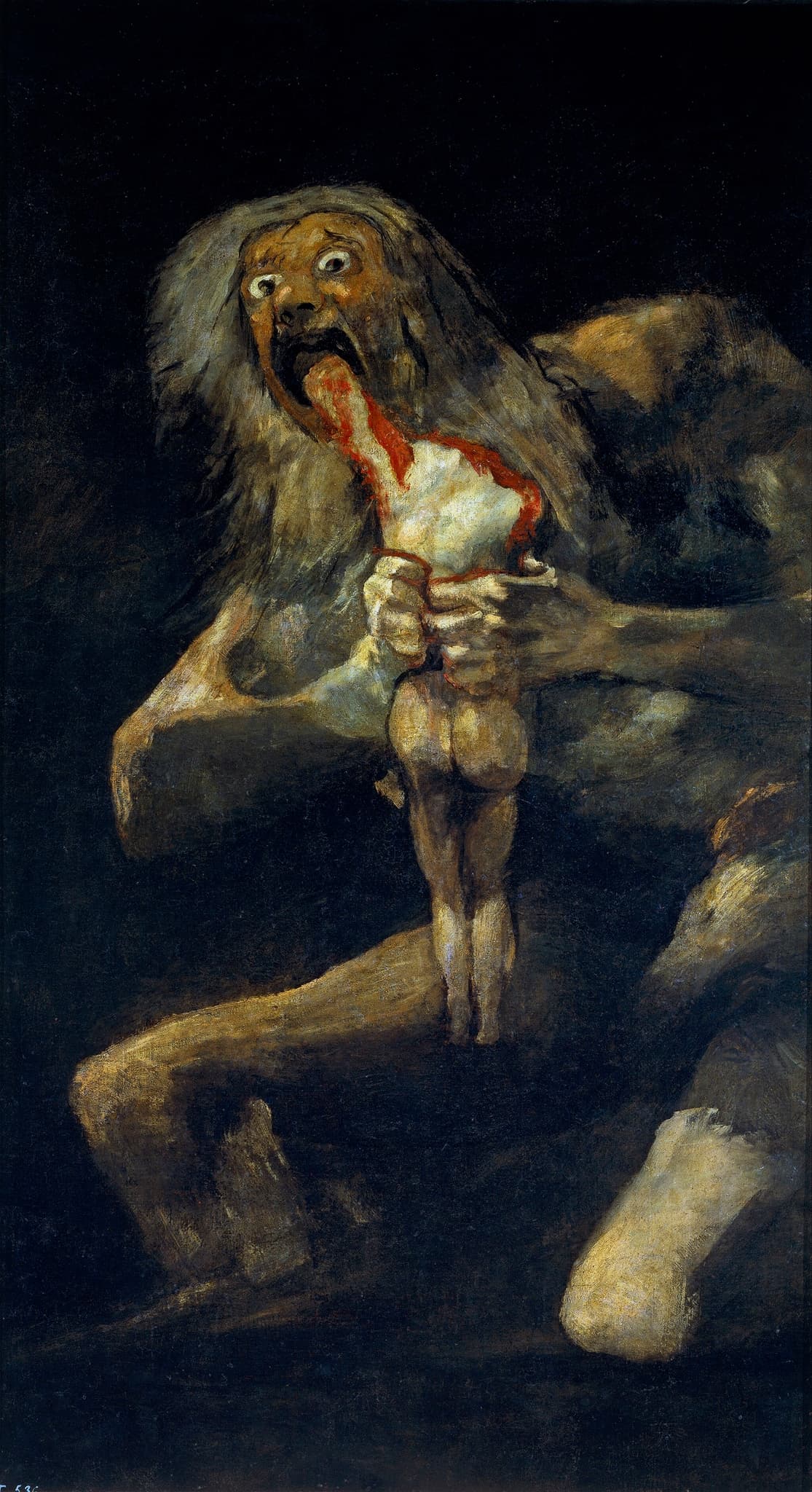
Auction and Ownership Timeline
Goya buys the Quinta del Sordo
Madrid
Goya purchases the house near Madrid where he will later paint the Black Paintings, including Saturn Devouring His Son [5][4].
Painted as a mural at the Quinta del Sordo
Quinta del Sordo, Madrid
Goya executes the Black Paintings directly on plaster walls c. 1820–1823; Saturn Devouring His Son occupied a wall in the house [4][1].
Bequeathed with the house to Mariano Goya
Madrid
Before departing for France, Goya leaves the Quinta del Sordo—and its wall paintings—to his grandson Mariano [5].
House passes to Javier Goya
Madrid
Sources differ on the date; a transfer from Mariano to his father Javier occurred around 1830–1833 [6][5].
Quinta del Sordo sold to Segundo Colmenares
Madrid
Real-estate sale; the Black Paintings remained in situ on the walls [2].
Property passes to Louis Rodolphe Caumont
Madrid
Ownership of the house changes to Caumont/Coumont; the murals remain in place [2].
Baron d’Erlanger acquires the Quinta del Sordo
Madrid
Frédéric Émile d’Erlanger purchases the property and commissions the transfer of Goya’s murals to canvas [2][4].
Murals transferred to canvas
Madrid
Under d’Erlanger, Prado restorer Salvador Martínez Cubells removes the Black Paintings from the walls and mounts them on canvas [2][4].
Shown at the Exposition Universelle, Paris
Palais du Trocadéro, Paris
The 14 transferred canvases, including Saturn, are exhibited at the Palais du Trocadéro; they attract limited interest and do not sell [3][2].
Donated to the Spanish State
Madrid
By Royal Order of 20 December 1881, Baron d’Erlanger donates the complete series to the State for the national museum [2][1].
Provenance and Ownership
Painted in situ by Francisco Goya at the Quinta del Sordo c. 1820–1823 as part of the Black Paintings series [4][1]. Goya owned the property and in 1823 bequeathed the house (with the murals on its walls) to his grandson Mariano [5]. Around c. 1830–1833, the house passed to Goya’s son Javier (dates vary in sources) [6][5].
In 1859 the Quinta was sold to Segundo Colmenares, then in 1860 to Louis Rodolphe Caumont [2]. In 1873 Baron Frédéric Émile d’Erlanger acquired the property and soon ordered the murals transferred to canvas by Salvador Martínez Cubells (1874–1878) [2][4]. The canvases were shown in Paris in 1878 but did not sell [3][2].
On 20 December 1881, d’Erlanger donated the full group to the Spanish State by Royal Order, and the works entered the national museum (now the Prado) in January 1882, as recorded in the Gaceta de Madrid [2][1][8]. Current location: Museo Nacional del Prado, Madrid [1].
Quick Facts
- Last known sale
- Not publicly reported
- Known sale price
- Not publicly reported
- Sale type
- No known public sale
- Venue / institution
- Museo Nacional del Prado (Spanish State)
- Current owner or location
- Museo Nacional del Prado, Madrid (Spanish State)
- Publicly viewable?
- Yes
Why This Sale Matters
There is no public auction or private sale record for Saturn Devouring His Son. After Baron Frédéric Émile d’Erlanger had the Black Paintings removed from Goya’s house and mounted on canvas (1874–1878), he attempted to present them in Paris in 1878, but they drew limited commercial interest; instead he donated the group to the Spanish State in 1881, and they entered the national museum in January 1882 [2][3][1][8]. This non-commercial path is crucial: it removed the series from the art market and made them pillars of Spain’s cultural patrimony.
Because the Black Paintings have never been traded, there is no credible price history for this work, and any valuation would be speculative. Goya’s auction market is instead measured by other categories—principally portraits and cabinet pictures—where his current auction record stands at $16.4 million (with fees) for a pair of 1805 portraits sold at Christie’s New York in 2023 [7]. That benchmark, while strong, underscores how the artist’s most culturally defining works—including the Black Paintings—exist outside the market entirely.
For collectors, dealers, and historians, the significance of this ownership history is twofold. First, it highlights the distance between museum-canon Goyas and the objects available at auction, affecting comparability and price expectations across the artist’s oeuvre. Second, the 19th-century transfer from mural to canvas—followed by an early public donation—illustrates how conservation decisions and institutional stewardship can permanently shape market availability and scholarly reception [2][4]. In short, Saturn Devouring His Son is a museum-held masterpiece with no market analogue, central to understanding Goya’s legacy but irrelevant to setting auction comparables.
Related Pages
Other auction histories by Francisco Goya
Sources
- Saturn Devouring His Son – object record — Museo Nacional del Prado
- Erlanger, barón Frédéric Émile d’ – encyclopedia entry — Museo Nacional del Prado
- Una obra, un artista: Las Pinturas Negras de Goya — Museo Nacional del Prado
- Pinturas negras [Goya] – encyclopedia overview — Museo Nacional del Prado
- La Quinta del Sordo – exhibition page — Museo Nacional del Prado
- Rinconete: La Quinta del Sordo — Instituto Cervantes
- Christie’s Old Masters New York: record-breaking Goya portraits — The Art Newspaper
- Gaceta de Madrid (8 January 1882) – acceptance of donation — Boletín Oficial del Estado