The Third of May 1808 Auction History
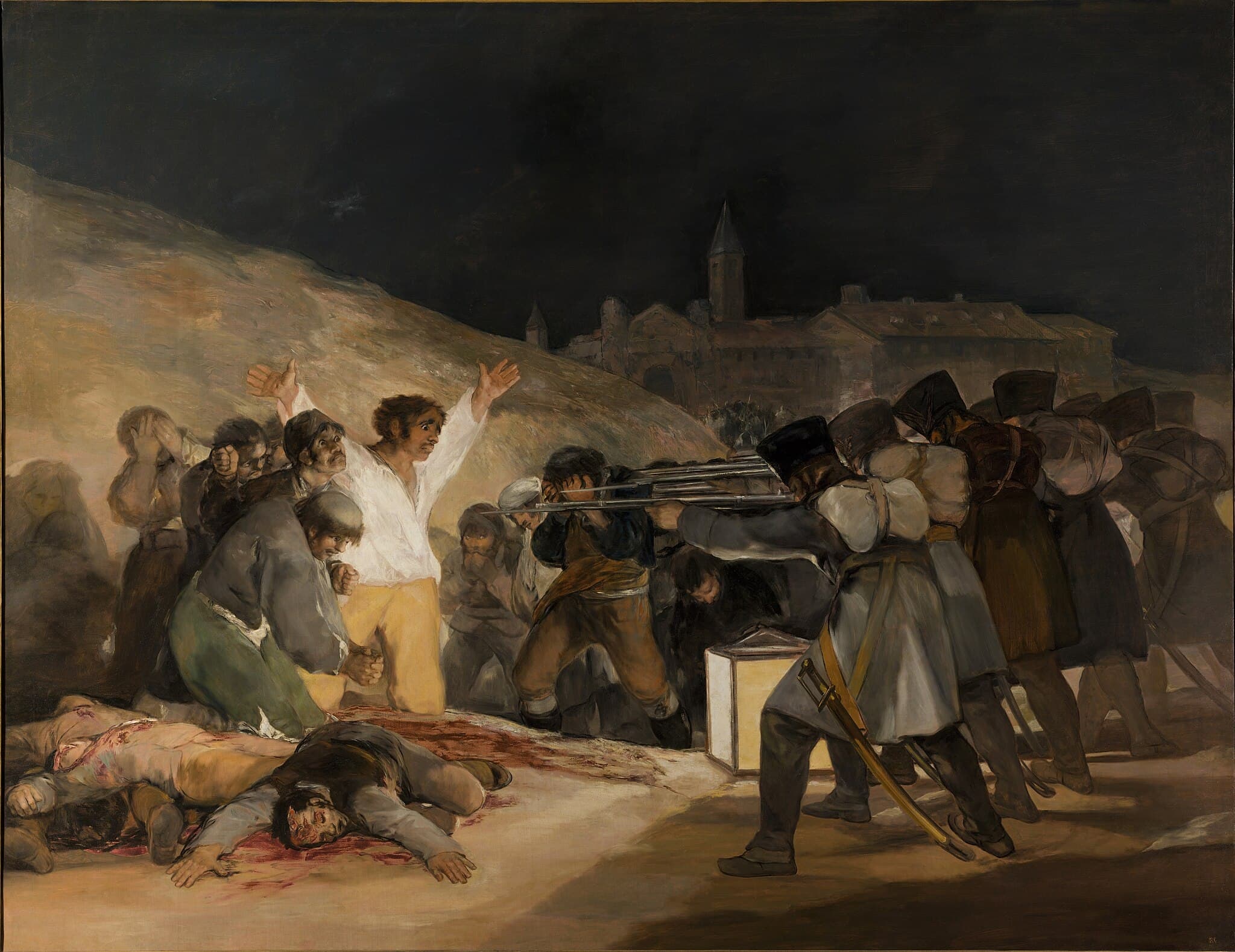
Goya’s The Third of May 1808 has no auction or private-sale history. Commissioned in 1814 for Spain’s royal/state collection, it entered the Prado by 1834 and remains a Spanish State asset. Under the Prado Statute, works assigned to the museum are inalienable, so the painting is not marketable.
- Artwork
- The Third of May 1808
- Artist
- Francisco Goya
- Best-known sale or transfer
- Never sold; inalienable Prado collection
- Sale type
- No known public sale
- Current location / owner
- Museo Nacional del Prado, Madrid
Auction and Ownership Timeline
Painted in Madrid for a State commission
Madrid
Goya executed the canvas in 1814 after petitioning the Council of Regency on 24 February 1814 to commemorate the 1808 uprising; he received monthly support during its execution [3].
Placed in the Royal Palace, Madrid
Royal Palace, Madrid
Contemporary frame invoices (July/November 1814) indicate financing by Ferdinand VII for display in the Royal Palace [1].
Registered in the Museo del Prado
Museo Nacional del Prado, Madrid
Transferred from the royal collection and recorded in the Prado’s Depósito Grande in 1834 [1].
Early public display noted
Museo Nacional del Prado, Madrid
Théophile Gautier described seeing the painting on view at the Prado in the 1840s, confirming early museum display [1].
Evacuated during the Spanish Civil War
Madrid; Valencia; Catalonia
Evacuated from Madrid to Valencia and Catalonia for safekeeping as part of the Prado evacuations [4].
Transport damage during Benicarló transfer
Benicarló, Castellón
During the Valencia–Catalonia transfer in March 1938, the May 2 and May 3 canvases suffered serious transport damage (Benicarló incident) [4].
Returned from Geneva
Geneva; Madrid
After temporary custody in Geneva under the League of Nations, the painting returned to Spain in 1939 [4].
Prado Statute confirms inalienability
Madrid
Royal Decree 433/2004 approved the Statute of the Museo Nacional del Prado, declaring works assigned to the museum public-domain, inalienable assets [2].
Major conservation addressing war-era damage
Museo Nacional del Prado, Madrid
Prado conservators completed significant treatment in 2007–2008, addressing a long vertical tear and losses consistent with the 1938 incident [7].
Provenance and Ownership
Commission and early placement (1814): Goya painted The Third of May 1808 in 1814 after petitioning the Council of Regency; contemporary documentation and frame invoices indicate financing for display in the Royal Palace under Ferdinand VII [3][1].
Prado and State ownership: By 1834 the painting had entered the Museo del Prado from the royal collection and has remained under Spanish State ownership there (inv. P00749) [1][5]. Under Royal Decree 433/2004, works assigned to the Prado are public-domain, inalienable property—hence no auction or private-sale history for this work [2]. During the Spanish Civil War it was evacuated, suffered transport damage in 1938, and later underwent major conservation (2007–2008) [4][7].
Quick Facts
- Last known sale
- Not publicly reported
- Known sale price
- Not publicly reported
- Sale type
- No known public sale
- Venue / institution
- Museo Nacional del Prado, Madrid
- Current owner or location
- Spanish State; assigned to Museo Nacional del Prado, Madrid
- Publicly viewable?
- Yes
Why This Sale Matters
There is no auction or private-sale history for The Third of May 1808. The painting was produced in 1814 for Spain’s royal/state collection, entered the Prado by 1834, and remains a Spanish State asset assigned to the museum [1]. The Prado Statute (Royal Decree 433/2004) makes such works public-domain and explicitly inalienable, so this masterpiece is not marketable [2].
While the absence of transactions means no direct price benchmarks exist for this canvas, its stature anchors Goya’s reputation and shapes how collectors and institutions value other categories of his work. In the public market, the artist’s top auction result is the $16.4m sale of a pair of portraits at Christie’s New York in 2023—far below the hypothetical value of a museum-defining history painting, and a reminder that the most canonical works by Old Masters often reside permanently in public collections and outside commerce [6].
The painting’s documented history—including early royal display, its registration at the Prado, evacuation during the Spanish Civil War, damage in 1938, and major conservation completed in 2007–2008—adds cultural and scholarly significance rather than market liquidity [1][4][7]. For market reference, collectors seeking comparable Goyas typically look to portraits and works on paper that do enter trade, but The Third of May 1808 itself remains a cornerstone of the Prado’s holdings (inv. P00749) and a fixed point in the artist’s legacy [5].
Related Pages
Other auction histories by Francisco Goya
Sources
- Museo Nacional del Prado – El 3 de mayo en Madrid o los fusilamientos — Museo Nacional del Prado
- Real Decreto 433/2004, por el que se aprueba el Estatuto del Museo Nacional del Prado — Boletín Oficial del Estado
- Museo del Prado – 2 y 3 de mayo de 1808 (contexto y encargo) — Museo Nacional del Prado
- Arte protegido: Protección del patrimonio artístico durante la Guerra Civil — Museo Nacional del Prado
- Fundación Goya en Aragón – El tres de mayo de 1808 (P00749) — Fundación Goya en Aragón
- Christie’s Old Masters sale in New York breaks records with Goya portraits — The Art Newspaper
- El Prado restaura ‘El 3 de mayo de 1808’ — El País