How Much Is My Grandparents, My Parents, and I (Family Tree) Worth?
Last updated: April 3, 2026
Quick Facts
- Methodology
- comparable analysis
My Grandparents, My Parents, and I (Family Tree), 1936 (oil/tempera on zinc, 30.7 x 34.5 cm), is museum‑held (MoMA) and therefore not presently market‑available. If hypothetically offered today under normal market conditions and in stable conservation, a reasonable auction/private‑sale estimate is $2,000,000–$10,000,000, reflecting strong provenance and scholarly importance but tempered by small scale, zinc support, and the existence of much larger, more iconic Kahlo works that set the market ceiling.
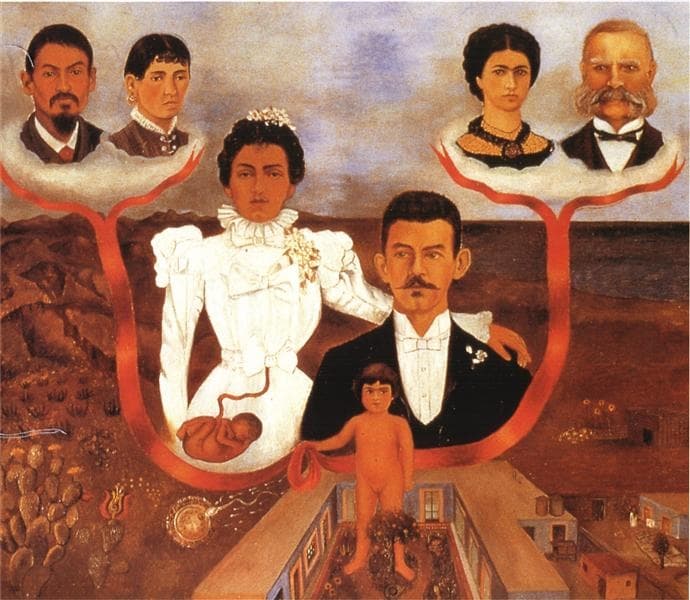
My Grandparents, My Parents, and I (Family Tree)
Frida Kahlo, 1936 • Oil and tempera on zinc
View more by Frida Kahlo →Valuation Analysis
Valuation conclusion: On a hypothetical market offering today, Frida Kahlo’s My Grandparents, My Parents, and I (Family Tree) (1936) would most plausibly realise between $2,000,000 and $10,000,000, assuming clear title, routine export permissions, and conservation condition consistent with museum care. The painting is in the permanent collection of The Museum of Modern Art (gift of Allan and Beatrice Roos, 1976), so any real sale is contingent on deaccession policy and institutional approval; the present estimate is therefore a theoretical market value conditional on availability and condition [1].
The range is derived through a comparable analysis: Kahlo’s auction ceiling has been re‑set by a small number of large, iconic oils that have realised tens of millions (for example, Diego y yo, sold at Sotheby’s in 2021, which establishes the upper bound for top‑tier canvases) [2]. Those outsized results do not translate directly to a small, early autobiographical zinc panel. When smaller, scholarly‑important Kahlo figure works come to market they typically trade in the low to mid single‑digit millions; that band is the most relevant comparative bracket for this composition.
Key upward value drivers for this painting are strong, direct provenance (sale from the artist through Julien Levy to Allan and Beatrice Roos, later gifted to MoMA), inclusion in catalogue and scholarship, and clear institutional validation from museum acquisition. Offsetting factors are the modest dimensions (≈31 x 35 cm), the uncommon zinc support (which raises conservation considerations that can suppress aggressive bidding), and the fact that this work is not among Kahlo’s handful of iconic, mass‑recognised masterpieces. Condition is critical: a fully stable, museum‑conserved panel supports value near the top of the range; significant conservation intervention or structural instability could push realizations toward the lower bound.
Market scenario: if the work remained in museum ownership it would not appear on the market. Were it deaccessioned or offered by a private owner, the most likely sale path would be a controlled private sale or a major‑house auction with strong institutional and private interest; in that environment a $2M–$10M outcome is realistic, with premium results possible only if fresh scholarship or a high‑profile exhibition re‑energises collector competition. To firm this estimate into an insurance or reserve value, obtain an in‑person condition report focused on the zinc support, compile recent lot‑level comparables of similar scale/period Kahlo oils, and solicit written estimates from the Latin‑American art desks at leading houses.
Sources informing this analysis include the MoMA collection record for the work and headline Kahlo auction results that set the market context; further refinement requires condition, deaccession/legal status, and detailed comparable lot data.
Key Valuation Factors
Art Historical Significance
High ImpactMy Grandparents, My Parents, and I (Family Tree) is a clearly autobiographical, early‑period work that contributes to scholarship on Kahlo’s family iconography and self‑representation. While not one of the handful of global “name recognition” masterpieces that drive the artist’s auction ceiling, it is documented in major catalogues and has museum provenance, which gives it substantial art‑historical weight. Institutional validation increases appeal to both private collectors and museums, and scholarly importance means the painting can attract bids beyond what a comparable unattributed or poorly‑provenanced small work might command.
Provenance & Exhibition History
High ImpactProvenance is strong and continuous: sale by the artist through Julien Levy to Allan and Beatrice Roos (1938) and subsequent gift to MoMA (1976) provide an unbroken and well‑documented chain of ownership. Museum acquisition is a positive value driver because it signals curatorial acceptance and reduces attribution risk. However, museum ownership also suppresses immediate market liquidity—deaccession is rare and administratively complex—so the painting’s market availability is hypothetical and any sale would require institutional approvals which can affect timing and sale strategy.
Condition & Support (zinc panel)
Medium ImpactThe work is executed on a zinc panel, an uncommon support for Kahlo and one that requires specialist conservation care. Zinc can be dimensionally stable but is vulnerable to corrosion and bonding issues when humidity or past treatments have occurred. A recent, detailed condition report from a conservator experienced with metal supports is essential—stable, museum‑grade conservation will support the estimate near the top of range; conversely, evidence of instability, past heavy restoration, or ongoing conservation needs could materially reduce market value or limit buyer interest.
Scale, Medium & Market Rarity
Medium ImpactAt roughly 31 x 35 cm the painting is modest in scale; larger Kahlo oils with blockbuster provenance have set the market ceiling. Small size and metal support typically reduce the headline auction potential relative to marquee canvases, but Kahlo’s works are scarce on the market and demand remains strong among collectors and institutions. Rarity of availability can elevate interest, but scale and medium act as moderating factors—consequently, market outcomes for similar works have clustered in the low‑to‑mid single‑digit millions rather than the tens of millions.
Sale History
Frida Kahlo's Market
Frida Kahlo is among the strongest sellers in 20th‑century Latin American art: a handful of major oils have set multi‑million and record prices, demonstrating very high demand at the top end. Supply is thin—many of Kahlo’s most important works reside in public collections—so when museum‑quality or well‑provenanced pieces appear they attract intense institutional and private competition. The market differentiates sharply between iconic, large‑scale canvases (which establish the ceiling) and smaller, early or study works (which typically trade in lower, though still substantial, ranges). Overall sentiment toward Kahlo remains robust.
Comparable Sales
Diego y yo
Frida Kahlo
Same artist; major oil self-portrait that set a high benchmark for Kahlo's auction market — useful for the upper bound of value (but much larger/more iconic than the MoMA panel).
$34.9M
2021, Sotheby's New York
~$39.1M adjusted
El sueño (La cama)
Frida Kahlo
Record-setting Kahlo sale (Nov 2025) — establishes top-end potential for museum‑quality, high‑profile works; not directly comparable by scale/support/subject but critical for market ceiling.
$54.7M
2025, Sotheby's New York
Two Nudes in a Forest (Dos desnudos en el bosque)
Frida Kahlo
Closer in scale/period to My Grandparents... — an earlier/smaller Kahlo figure composition that traded in the mid‑single‑digit millions; more directly informative for likely market range for small early Kahlo works.
$8.0M
2016, Christie's New York
~$9.6M adjusted
Current Market Trends
The market for major‑name Kahlo works has been strong in recent years, with rare museum‑quality oils achieving record results and driving broader collector interest. Supply constraints and growing institutional competition sustain high prices for top works; however, volatility in global luxury markets and conservation/legal complexities (e.g., export permissions, deaccession rules) can influence timing and realized prices. Small, well‑provenanced works continue to attract buyers but generally do not reach the same multiples as the artist’s flagship masterpieces.