How Much Is Self‑Portrait with Thorn Necklace and Hummingbird Worth?
Last updated: April 1, 2026
Quick Facts
- Methodology
- comparable analysis
This museum-held 1940 Frida Kahlo self‑portrait is effectively off‑market but, under typical open‑market conditions and assuming clear legal status and good condition, a defensible auction range is $30–60M with a working central estimate near $40–45M. The estimate is based on direct high‑end Kahlo auction comparables and the painting’s iconographic importance.
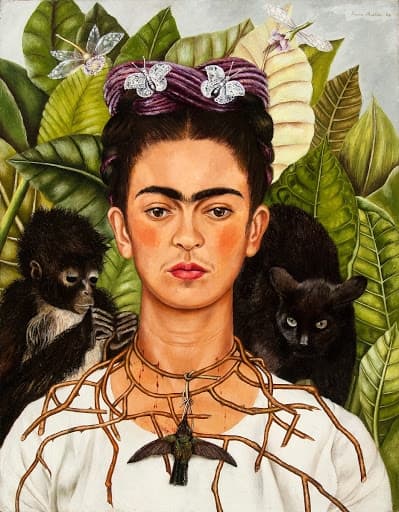
Self‑Portrait with Thorn Necklace and Hummingbird
Frida Kahlo, 1940 • Oil on canvas on masonite
View more by Frida Kahlo →Valuation Analysis
Valuation conclusion: On a hypothetical open‑market offering, Self‑Portrait with Thorn Necklace and Hummingbird (Frida Kahlo, 1940) would reasonably be expected to achieve in the range of $30,000,000–$60,000,000, with a working central value near $40–45M. This assessment assumes the work is marketable (no insurmountable donor or export restrictions), is in stable/museum‑grade condition, and is presented during a major-sale week where institutional and private bidders compete. The work is in the Harry Ransom Center’s Nickolas Muray collection and has not appeared at auction in the modern market [1].
The estimate is grounded in comparable auction outcomes for major Kahlo works. Diego y yo (1949) realised approximately $34.9M (final buyer’s‑premium inclusive figure) at Sotheby’s New York in November 2021, establishing a practical reference point for high‑end demand for an iconic Kahlo self‑portrait [2]. More recently, a 1940 Kahlo self‑portrait (El sueño (La cama)) set a higher ceiling in November 2025 with a reported final price near $54.7M, demonstrating the market’s capacity to push exceptional Kahlo portraits into the mid‑tens of millions under peak conditions [3]. Placing the Ransom Center painting between these two anchors yields the $30–60M band.
Method and assumptions: This is a comparable‑analysis valuation that treats buyer’s‑premium inclusive public sale results for peer works as market anchors. Key inputs: (1) subject/date proximity (same year, iconic single‑figure self‑portrait); (2) rarity of museum‑quality Kahlo canvases on the market; (3) provenance and exhibition history (museum ownership increases credibility but can complicate saleability); and (4) standard auction dynamics (guarantees, third‑party underwriting, and competitive institutional bidding). The range includes a margin for variability from sale conditions, buyer composition, and macroeconomic factors.
Major sensitivities that could move the result outside this band are institutional/ legal restrictions (deaccession rules or donor restrictions that render the work effectively unsellable), condition‑related discounts (conservation issues materially reduce competitive bidding), and timing/market liquidity (a strong evening sale with multiple guarantees can push a result above the upper bound; conversely, weak demand or export limits can depress bids). Insurance/replacement valuations held by the institution are often confidential and may differ from hypothetical open‑market estimates [1].
Practical next steps: For a formal, binding appraisal: confirm the Ransom Center’s legal and deaccession status, obtain a detailed conservation report, and engage a major auction house or accredited appraiser to test market appetite and produce presale estimates. Public comparables and institutional considerations support the $30–60M open‑market range for a museum‑quality 1940 Kahlo self‑portrait under normal high‑profile sale conditions [1][2][3].
Key Valuation Factors
Art Historical Significance
High ImpactThis painting is an archetypal Kahlo self‑portrait: dated 1940, it deploys core iconography (thorn necklace, hummingbird, animal companions, dark field) that figures centrally in scholarly and popular presentations of her work. The combination of personal symbolism and visual immediacy makes it highly recognisable and frequently reproduced, which increases cultural value and market interest. Institutional provenance and exhibition history amplify significance: museums and curators prize canonical images, and such works are prioritized when institutions and major private collectors compete. Because significance directly correlates with both the number of potential bidders and willingness to pay premiums, this factor exerts a strong upward effect on the estimate.
Market Rarity & Demand
High ImpactFrida Kahlo oil paintings — especially major self‑portraits from her mature period — rarely come to the public market. Scarcity concentrates demand among a global pool of museums, high‑net‑worth private collectors, and foundations, frequently producing competitive bidding and elevated final prices. Recent high‑profile sales have demonstrated that when a canonical Kahlo appears, institutional players often participate aggressively, sometimes backed by guarantees. The imbalance between strong demand and low supply is one of the primary value drivers for this work and supports placement toward the higher end of the estimated band when market conditions are favorable.
Provenance & Legal/Institutional Status
High ImpactThe painting is part of the Nickolas Muray collection at the Harry Ransom Center (acquired into that collection in the 1960s), which provides excellent provenance and exhibition credentials but also raises practical issues: donor terms, institutional deaccession policies, and national export/ patrimonial controls can all limit or prevent sale. If the work is subject to binding restrictions it becomes effectively off‑market and the figure above is theoretical; conversely, clean, transferable title with museum provenance will increase buyer confidence and command premium pricing. Confirming legal/ownership status is therefore essential to convert a theoretical market range into a realizable estimate.
Condition & Conservation
Medium ImpactA detailed, specialist condition report is required to finalize value. Cosmetic ageing or minor retouching typically has limited impact for major works; by contrast, structural problems (severe craquelure, loss, improper relining, or extensive invasive restoration) can materially reduce marketability and price. Collectors of top‑tier Kahlo works expect stable, exhibition‑worthy condition; conservations issues can produce discounts ranging from modest (single‑digit percentages) to substantial (double‑digit reductions) depending on severity. Any conservation history should be disclosed and assessed by an accredited conservator prior to formal appraisal or consignment.
Comparable Auction Results & Market Timing
High ImpactPublic sale anchors (Diego y yo, c. $34.9M in Nov 2021; El sueño (La cama), c. $54.7M in Nov 2025) provide direct market evidence for what top Kahlo self‑portraits can achieve. Timing (principal sales weeks), guarantees, and pre‑sale marketing materially influence outcomes: works offered with strong guarantees and in high‑visibility evening auctions attract larger bidder pools and can exceed estimates. Similarly, macroeconomic conditions, currency movements and collector sentiment toward Latin American and women artists influence final realizations. The comparable set justifies the estimated $30–60M band when sale circumstances are typical or favorable.
Sale History
Self‑Portrait with Thorn Necklace and Hummingbird has never been sold at public auction.
Frida Kahlo's Market
Frida Kahlo is a blue‑chip 20th‑century artist whose market has strengthened substantially over the past decade. Her works are scarce on the open market and achieve strong institutional and private demand when major examples appear. Auction records have risen into the tens of millions, reflecting both the artist's canonical art‑historical status and strong cultural recognition. Museums retain a number of Kahlo’s most important works, which reinforces scarcity and pushes prices higher for the few that come up for sale. Kahlo’s position benefits from wide public recognition, strong scholarly attention, and high demand from institutions seeking signature works.
Comparable Sales
El sueño (La cama)
Frida Kahlo
Same artist; a 1940 Kahlo self‑portrait (same year as the Ransom Center work). Large, museum‑quality self‑portrait that set the auction ceiling for Kahlo in 2025—direct market ceiling comparable.
$54.7M
2025, Sotheby's New York
Diego y yo (Diego and I)
Frida Kahlo
Same artist; high-profile, mid‑to‑late‑career self‑portrait intimately connected to Kahlo's public persona. The 2021 result established the market's willingness to pay tens of millions for an iconic Kahlo—useful for floor/central estimates.
$34.9M
2021, Sotheby's New York
~$41.4M adjusted
Diego y yo (previous sale)
Frida Kahlo
Same work sold previously (reported 1990 sale). Useful to show long‑term market appreciation and the effect of scarcity/market development for Kahlo over time; less directly comparable to modern blockbuster sales but informative for trend analysis.
$1.4M
1990, Sotheby's (reported)
~$3.3M adjusted
Current Market Trends
As of the mid‑2020s the market for museum‑quality works by established 20th‑century artists remains robust for marquee lots, with elevated interest in canonical female and Latin American artists. Major auction results and institutional competition continue to set new ceilings, though outcomes depend heavily on macroeconomic conditions, sale timing, and guarantees. Liquidity for top lots is strong, but market sensitivity to interest rates and geopolitical events can introduce short‑term variability.