How Much Is Viva la Vida (Watermelons) Worth?
Last updated: April 3, 2026
Quick Facts
- Insurance Value
- $30.0M (Indicative institutional indemnity estimate (representative midpoint))
- Methodology
- comparable analysis
Indicative market value for Frida Kahlo’s Viva la Vida (Watermelons) is approximately USD $20–60 million based on recent marquee Kahlo auction anchors and the painting’s high cultural prominence. Final placement within this range depends on confirmed ownership/legal status, condition, and whether the work could be offered internationally.
Valuation Analysis
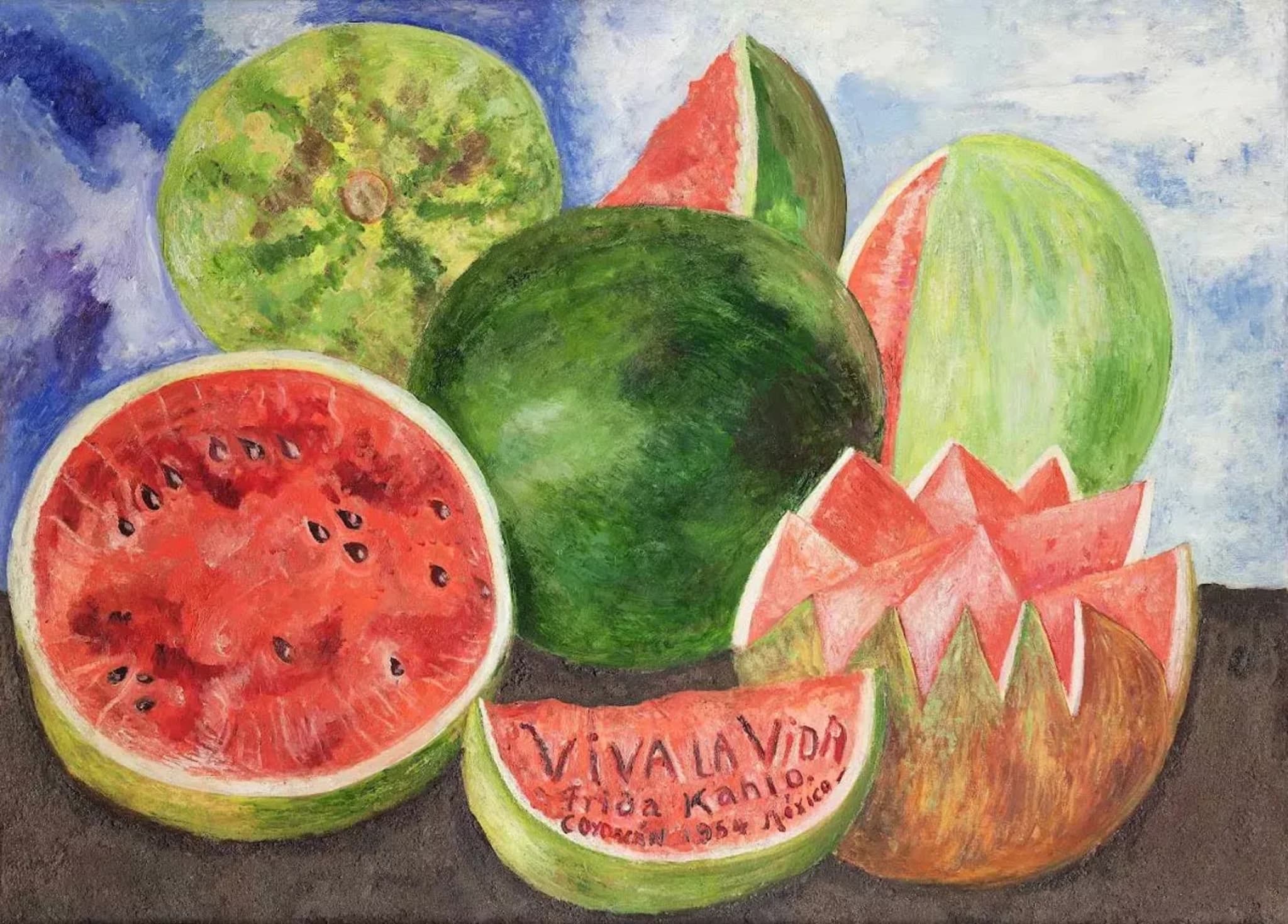
Valuation conclusion: Based on a comparable‑analysis approach anchored to recent headline Kahlo sales, a defensible market range for Viva la Vida (Watermelons), 1954, is approximately USD $20–60 million. This estimate assumes canonical attribution, clean provenance and marketable condition. Key comparables have reset the artist ceiling in recent seasons and materially influence market expectations [1],[3].
Comparables and market anchors: The most relevant auction anchors are Sotheby’s Nov 2025 record for El sueño (La cama) and Sotheby’s Nov 2021 sale of Diego y yo; these two lots define the contemporary top end for Kahlo and demonstrate collector willingness to bid aggressively for museum‑quality works [1],[3]. Smaller sketches and studies by Kahlo continue to sell in much lower bands, illustrating a steep tiering effect: headline canvases drive the ceiling while most works remain substantially below it.
Ownership and marketability: Public references list Viva la Vida as part of the Frida Kahlo Museum (Casa Azul) collection, which strengthens provenance and exhibition value but often implies practical immovability under Mexican patrimony rules [2]. If the work cannot be exported or deaccessioned, it is effectively non‑market and the realistic sale strategy would be a domestic institutional transfer or long‑term loan—scenarios that compress realized price relative to an open international evening sale.
Subject, significance and pricing impact: Although Kahlo’s self‑portraits generally command the highest scholarly and market attention, Viva la Vida’s status as one of her last paintings and an internationally recognized image gives it elevated demand compared with typical still lifes. That iconic status supports pricing toward the upper half of the range if market access is unrestricted and condition/provenance are impeccable.
Key value modifiers and recommended due diligence: Final valuation is highly sensitive to (a) confirmation of legal/export status (INAH/national patrimony), (b) a current condition/conservation report, (c) the complete provenance and exhibition/publication history, and (d) whether an auction house would offer guarantees or target a marquee evening sale. If any of these are adverse, expect significant downward adjustment.
Practical placement: Given the scarcity of Kahlo masterpieces and the recent market re‑rating, a prospective open international sale with perfect provenance and condition could reasonably realise in the low‑to‑mid tens of millions with upside toward the high tens in exceptional circumstances (single‑owner evening sale, competitive guarantees). If retained by Casa Azul or constrained by export rules, commercial realisation is unlikely and an institutional indemnity would be the relevant measure.
Next steps: Confirm current accession/ownership and legal status with Casa Azul and INAH; obtain a professional condition report; and solicit pre‑sale feedback from major auction specialists to refine a single pre‑sale estimate and sale strategy.
Key Valuation Factors
Art Historical Significance
High ImpactViva la Vida is widely cited and reproduced as one of Frida Kahlo’s most recognizable late works; it is commonly described as her final painting (1954). Its inscribed slogan and vivid still‑life motif give it strong cultural resonance beyond purely art‑historical circles, increasing its exhibition and publication desirability. While Kahlo’s self‑portraits are often judged the most central to her oeuvre, the combination of late date, iconic imagery and suitability for exhibition programming makes this work a high‑significance object. That elevated significance supports top‑tier market interest if the painting is marketable and in sound condition.
Market Scarcity / Supply
High ImpactThe supply of museum‑quality Kahlo canvases is extremely limited; most of her major works are held by Mexican institutions or prominent museums globally. This rarity creates a steep upside effect for any canonical canvas that reaches the international market: a single lot can reset market expectations (as happened with recent headline results). Scarcity increases price volatility—positive in the form of high ceilings for offered works, but negative in that outcomes are highly event‑driven and sensitive to legal or logistical constraints that reduce the bidder pool.
Provenance & Ownership
High ImpactDocumented museum ownership (Casa Azul/Banco de México trust) provides impeccable provenance and institutional validation, which typically increases buyer confidence and insurer comfort. However, Mexican national patrimony protections and institutional retention norms make deaccession/export difficult; such legal encumbrances materially reduce the pool of eligible bidders and therefore likely compress achievable prices. If the museum were to sanction an international sale and clear export, provenance would be a strong positive; if the work remains effectively inalienable, market value is largely hypothetical.
Condition & Conservation
Medium ImpactPhysical condition, conservation history and documentation are critical determinants of realized price and insurability. Kahlo painted on masonite in this period, which can exhibit stable surface condition but may have previous retouching or structural issues. A clean, fully documented conservation record preserves top market value; any need for stabilization or invasive treatment will reduce buyer appetite and may preclude loans to certain institutions until work is conserved. A professional, dated condition report is required for definitive pricing and insurance underwriting.
Sale History
Viva la Vida (Watermelons) has never been sold at public auction.
Frida Kahlo's Market
Frida Kahlo is firmly established as a blue‑chip modern artist with exceptionally strong brand recognition and institutional demand. The market is highly concentrated: a handful of museum‑quality canvases command headline prices and set market ceilings while smaller works trade in much lower bands. Recent high‑profile auction results (notably 2021 and 2025) have materially re‑rated the top of Kahlo’s market, increasing collector urgency for canonical pieces. Institutional exhibitions and renewed scholarly attention for women Surrealists and Latin American modernists have reinforced the artist’s market position, making Kahlo one of the most valuable Latin American artists at auction.
Comparable Sales
Diego y yo (1949)
Frida Kahlo
Same artist; late-period museum-quality painting sold in a marquee evening sale—primary auction anchor for Kahlo's market.
$34.9M
2021, Sotheby's New York
~$39.1M adjusted
El sueño (La cama) (1940)
Frida Kahlo
Same artist; canonical Kahlo work that established a new auction record (Nov 2025)—the current market ceiling for top Kahlo examples.
$54.7M
2025, Sotheby's New York
Roots (Raíces) (1943)
Frida Kahlo
Same artist; earlier, lower-tier major-sale example useful as a historical anchor showing long-term market appreciation and the scale for less central works.
$5.6M
2006, Sotheby's (2006 sale reported)
~$8.1M adjusted
Study / sketch (Frida Kahlo) — small work sold Nov 2025
Frida Kahlo
Same artist; small preparatory/sketch work sold at auction in Nov 2025—illustrates the lower end of Kahlo liquidity and price bands.
$292K
2025, Christie's New York (reported)
Les Distractions de Dagobert
Leonora Carrington
Different artist but same broad market segment (women Surrealists / Latin American/European Surrealism). This 2024 record demonstrates strong collector demand for female Surrealists and supports market re-rating relevant to Kahlo.
$28.5M
2024, Sotheby's New York
~$29.4M adjusted
Current Market Trends
Since 2023 the market for women Surrealists and Latin American modernists has strengthened, and Kahlo’s 2025 auction result reset the top of her market. The market is now polarised: marquee works and museum‑quality canvases attract premium, competitive bids while the broader category shows more selective liquidity. Institutional programming and renewed scholarship continue to drive demand for canonical works, but supply constraints and legal protections for national patrimony create practical limits on which works can ever reach the international market.