How Much Is Boy and Dog in a Johnnypump Worth?
Last updated: May 28, 2026
Quick Facts
- Methodology
- recent sale
Boy and Dog in a Johnnypump (1982) is a monumental, museum-grade Basquiat from the artist’s most coveted year. It was reported sold privately to Ken Griffin in 2020 for more than $100 million and has since been prominently exhibited, reinforcing its blue-chip status. Anchored by that transaction and top public comps since 2017, the current fair-market estimate is $100–140 million.
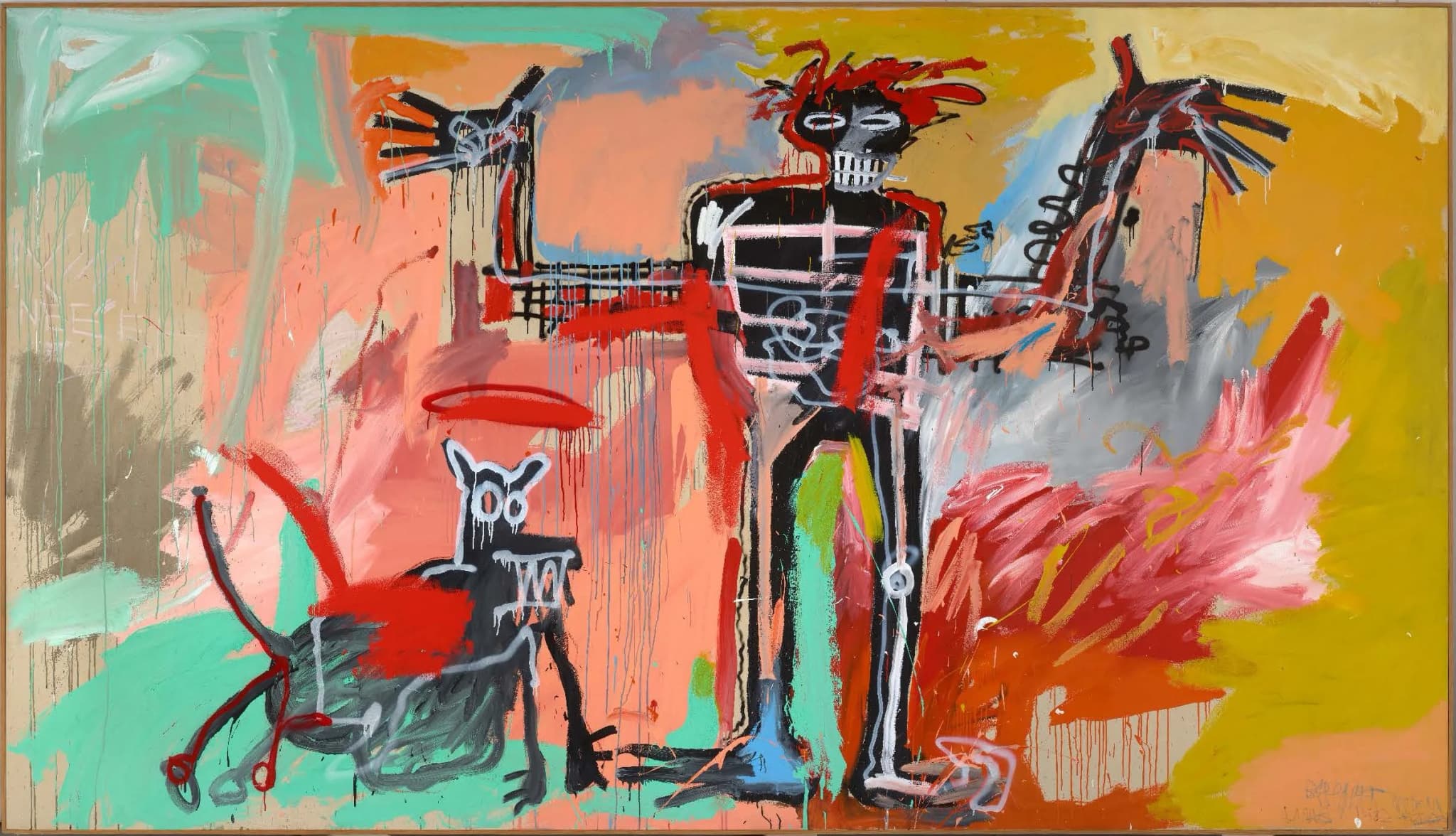
Boy and Dog in a Johnnypump
Jean-Michel Basquiat, 1982 • Acrylic, oil stick, and spray paint on canvas
Read full analysis of Boy and Dog in a Johnnypump →Valuation Analysis
Conclusion: The fair-market value of Jean-Michel Basquiat’s Boy and Dog in a Johnnypump (1982) is estimated at $100–140 million. This band is anchored by the widely reported 2020 private sale of this exact painting for more than $100 million and supported by recent public benchmarks for apex 1981–83 Basquiat canvases [1].
Anchor transaction and stature. In June 2020, Bloomberg reported that Ken Griffin acquired Boy and Dog in a Johnnypump for a price exceeding $100 million, immediately placing the work among the most valuable Basquiats ever traded [1]. Since then, its stature has only increased through high-profile museum exposure, including the Hirshhorn’s 2024–25 Basquiat × Banksy show, signaling institutional endorsement and enhancing market confidence [7]. The painting is a large (approximately 96 × 164 in), compositionally resolved 1982 canvas—Basquiat’s most coveted year—featuring a powerful, instantly recognizable motif that has been extensively reproduced and exhibited (earlier in the Brant collection’s museum shows, such as Fondation Beyeler) [8].
Comparable market evidence. Public auction results for top-tier Basquiat since 2017 set a clear framework for nine-figure pricing. The artist’s record remains Untitled (1982, skull) at $110.5 million (Sotheby’s, 2017) [2]. Another skull painting, In This Case (1983), achieved $93.1 million at Christie’s in 2021 [3]. Monumental, panoramic works of comparable ambition have commanded $67.1 million (El Gran Espectáculo (The Nile), 1983; Christie’s, 2023) [4]. Strong 1982 examples continued to clear at high levels in 2022–24, including $85 million at Phillips (Untitled, 2022) and $46.4–46.5 million for Untitled (ELMAR) in 2024 [6][5]. Against this backdrop, a celebrated, museum-grade 1982 icon with a verified >$100 million private benchmark justifies a current range of $100–140 million.
Why this work sits at the apex. Market premiums concentrate around 1981–83, large-scale, institutionally validated works—precisely where Boy and Dog resides. Its scale, peak-year date, visual immediacy, and extensive exhibition history place it in the same echelon as Basquiat’s canonical canvases that have led evening sales. The additional halo from recent museum loans typically supports pricing at or above prior private marks, assuming strong condition and strategic sale orchestration.
What could move the needle. A marquee New York sale with a competitive third-party guarantee and coordinated global marketing could press the upper end of this band if multiple trophy buyers engage. Conversely, any material condition issues or a thinly marketed sale window would bias outcomes toward the lower end. On balance, given the painting’s rarity, profile, and demonstrated liquidity, $100–140 million represents a robust, defensible current valuation [1][2][3][4][5][7][8].
Key Valuation Factors
Art Historical Significance
High ImpactPainted in 1982—Basquiat’s most coveted year—Boy and Dog in a Johnnypump is a signature, museum-level image that encapsulates the artist’s fusion of street iconography, raw expressionism, and incisive social observation. The subject is immediately legible and culturally resonant (the New York ‘johnnypump’), while the painting’s energy, scale, and layered mark-making exemplify the artist at full maturity. Its repeated appearance in scholarly exhibitions and publications has embedded it in the canon, positioning it alongside the most cited Basquiats of 1981–83. This deep art-historical relevance drives sustained collector demand and underpins durable pricing power at the very top of the market.
Rarity, Scale, and Date
High ImpactThis is a monumental horizontal panorama (approximately 96 × 164 inches) from the exact peak window—1981–83—where Basquiat’s market concentrates its highest values. Large, landmark 1982 canvases are exceedingly scarce, and only a handful possess the combination of ambition, condition, and wall power comparable to this painting. Works of similar size and ambition seldom appear publicly, and those that do have anchored evening sales and commanded nine-figure or near-nine-figure prices. The work’s size and the primacy of its year materially elevate it above strong but smaller or later examples, warranting a premium relative to otherwise high-quality 1980s comparables.
Provenance and Exhibition History
High ImpactFormerly in the Peter Brant collection and long exhibited under that credit, the painting benefits from elite provenance and deep institutional exposure. The reported 2020 acquisition by Ken Griffin at >$100 million further cements its blue-chip status and signals confidence from a best-in-class collector. Subsequent loans, including to the Art Institute of Chicago and the Hirshhorn’s 2024–25 program, compound its institutional profile and public recognition. This ‘museum-tested’ visibility reduces perceived risk for future buyers and typically translates to stronger bidding and higher insurance valuations, all else equal, especially in the current, quality-driven market environment.
Market Liquidity and Demand
High ImpactBasquiat’s top-tier market remains one of the deepest in contemporary art. Since 2017, apex works have achieved $110.5m (record), $93.1m (skull), and $67.1m (monumental panorama), with strong 1982 canvases repeatedly clearing in the $40m–$85m zone depending on scale and iconography. Against those public markers, this painting’s reported >$100m private sale sets a direct benchmark, while the work’s fame, date, and scale suggest immediate liquidity among global trophy buyers. In a selective but stable top end, institutionally validated 1982 icons remain priority targets; competition, guarantees, and sale choreography could readily push the work toward the upper bound of the estimate.
Sale History
Private sale
Widely reported private sale to Ken Griffin at 'more than $100 million'; figure shown here is a conservative approximation based on reports.
Jean-Michel Basquiat's Market
Jean-Michel Basquiat ranks among the most coveted postwar artists, with a sustained, global collector base and frequent eight- and nine-figure outcomes for apex material. The artist’s auction record is $110.5 million for Untitled (1982) at Sotheby’s in 2017, an American-artist record at the time [2]. Subsequent high-water marks include In This Case (1983) at $93.1 million (Christie’s, 2021) [3]; El Gran Espectáculo (The Nile) (1983) at $67.1 million (Christie’s, 2023) [4]; and an $85 million Untitled (1982) at Phillips in 2022 [6]. Even amid market selectivity since 2023, demand for large, peak-year canvases has remained firm, with strong 1982 examples achieving $46.4–46.5 million at Phillips in 2024 [5]. The market rewards scale, date (1981–83), iconography, and museum pedigree.
Comparable Sales
Untitled (1982, skull)
Jean-Michel Basquiat
Same artist; peak year 1982; large, iconic skull canvas that anchors the top of Basquiat’s market and sets a ceiling for blue‑chip works from this period.
$110.5M
2017, Sotheby's New York
~$146.1M adjusted
In This Case (1983)
Jean-Michel Basquiat
Same artist; prime 1983; large museum‑level skull painting closely comparable in ambition and market tier to Boy and Dog in a Johnnypump.
$93.1M
2021, Christie's New York
~$111.3M adjusted
El Gran Espectáculo (The Nile) (1983)
Jean-Michel Basquiat
Same artist; monumental panoramic painting with comparable wall power and institutional profile; closely matches Boy and Dog’s scale and ambition.
$67.1M
2023, Christie's New York
~$71.1M adjusted
Untitled (1982)
Jean-Michel Basquiat
Same artist; peak year 1982; large, high‑impact canvas with headline result, demonstrating current pricing depth for A‑tier 1982 Basquiats.
$85.0M
2022, Phillips New York
~$94.1M adjusted
Untitled (ELMAR) (1982)
Jean-Michel Basquiat
Same artist; 1982; large canvas with strong recent price, useful for bracketing 1982 works slightly smaller/less iconic than the top tier.
$46.4M
2024, Phillips New York
~$47.6M adjusted
Warrior (1982)
Jean-Michel Basquiat
Same artist; 1982; key figurative subject and strong market result in Asia, indicating global demand for peak‑period works.
$41.7M
2021, Christie's Hong Kong
~$49.9M adjusted
Current Market Trends
Top-tier contemporary and postwar markets have become more selective since 2023, but high-quality ‘trophy’ works with prime period, scale, and provenance continue to clear at premium levels. Within Basquiat’s category, demand centers on 1981–83, large canvases with institutional exhibition and strong literature. Public auction comparables since 2021 illustrate durable depth from the mid-eight to low-nine figures, while private transactions set the highest benchmarks for truly iconic works. With supply of comparable 1982 monuments extremely tight, competition remains robust for museum-grade examples, and well-orchestrated sales in New York continue to command the strongest global bidding.
Study print
Study this painting as a print
Pair the full artwork with a museum-style study sheet focused on one meaningful detail.
Sources
- Bloomberg: Ken Griffin Buys Basquiat Painting for More Than $100 Million
- The New York Times: Basquiat Painting Sells for $110.5 Million at Auction
- Christie’s: 21st Century Evening Sale results (May 2021)
- Artnet News: By the Numbers — Christie’s 21st Century Evening Sale (May 2023)
- The Art Newspaper: Basquiat at Phillips New York sells for $46m (May 2024)
- Phillips: Press release — Most Successful Auction in Company History (May 2022)
- Smithsonian (Hirshhorn): Basquiat × Banksy exhibition announcement (2024–25)
- Fondation Beyeler: Basquiat — Past Exhibitions (crediting The Brant Foundation)