Boy and Dog in a Johnnypump

by Jean-Michel Basquiat

Boy and Dog in a Johnnypump (1982) stages a wiry, x‑rayed boy with arms flung wide beside a bristling dog under a red arc that doubles as a halo and the spray of a New York johnnypump. Basquiat fuses childhood play and urban peril in a heat‑drenched field of oranges, yellows, and mints, emblematic of his breakthrough Neo‑Expressionism and the 1982 Modena cycle. The painting asserts Black presence and survival with ferocious scale and velocity [1][2].

Study Print Studio

Create a personal study print

Build a companion study sheet around the part of this painting that speaks to you most. Choose a detail, shape an interpretation, and walk away with something personal and display-worthy.

Fast Facts

Year
1982
Medium
Acrylic, oil stick, and spray paint on canvas
Dimensions
240 × 420.4 cm (approx. 94.5 × 165.5 in)
Location
Private collection (on loan to the Hirshhorn Museum, Washington, DC, 2024–25)
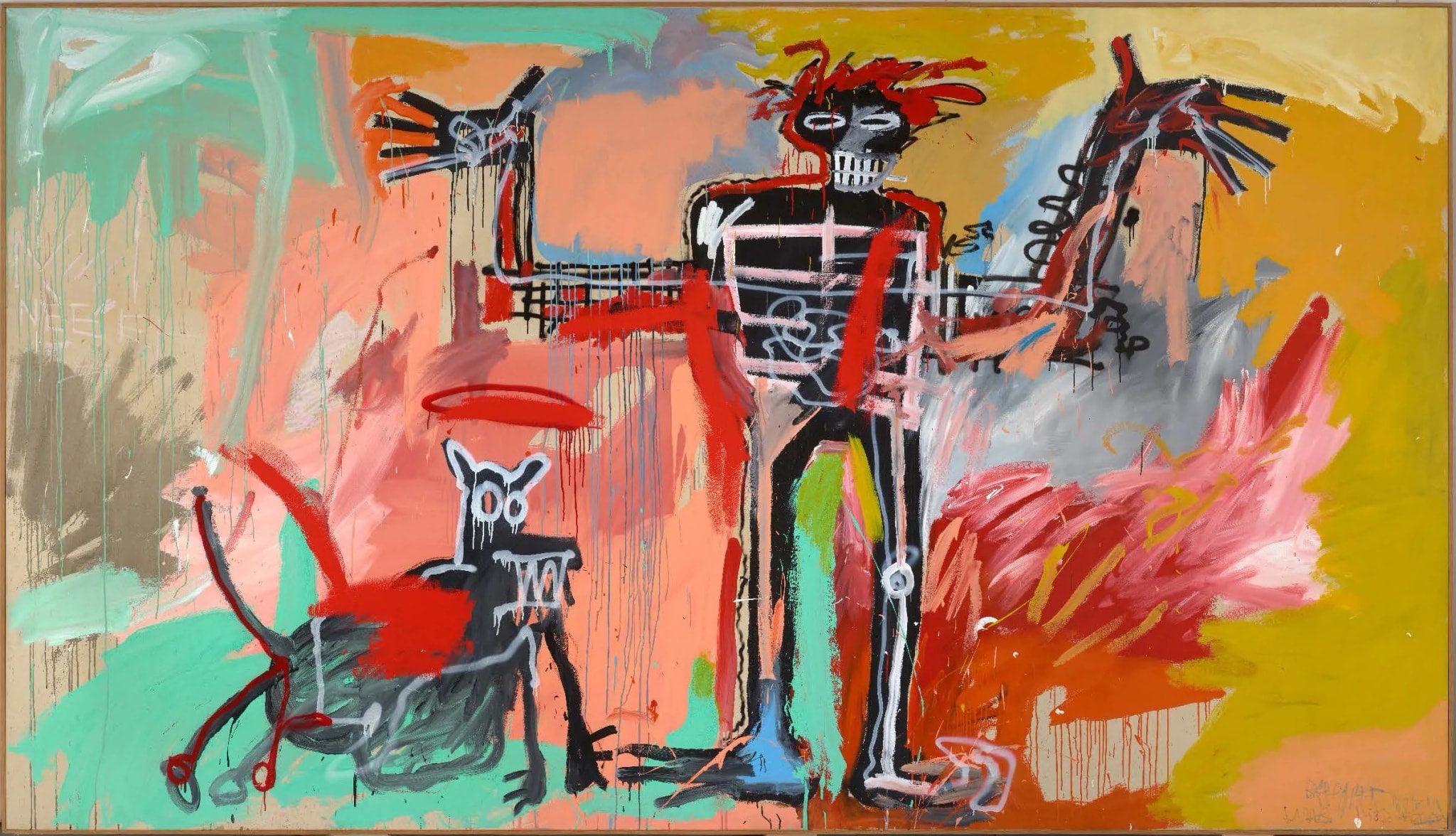
Boy and Dog in a Johnnypump by Jean-Michel Basquiat (1982) featuring Red arc (halo/johnnypump spray), Dog with bared teeth, X‑ray ribcage, Cruciform, arms‑flung pose

Click on any numbered symbol to learn more about its meaning

Meaning & Symbolism

Basquiat engineers the canvas as a field of heat and velocity, then inserts a figure who refuses containment. The central boy—blackened body, white rib grid, squared shoulders—extends both arms so wide they nearly scrape the frame, a recurrent Modena posture that reads as simultaneously imploring and triumphant 2. The white lattice of ribs announces an X‑ray view derived from Basquiat’s study of medical diagrams, turning the body inside‑out to insist on mortality even as the stance claims space 4. Jagged red slashes traverse the torso and shoulders like arterial surges; along the outstretched forearms, stacked finger‑fans and black drips act like sparking terminals. At the boy’s feet, a streak of mint and pink licks upward, welding the body to the hot ground. Above and beside him, scumbled sherbets—orange, yellow, peach—are crosscut by graffiti marks and drips, staging the painting within a sonic city where color behaves like heat haze and noise 12. The dog, bug‑eyed with serrated teeth, is pitched in the same black‑line cartooning as the boy’s skull‑mask grin. Between them hovers a red ellipse that doubles as halo and hydrant spray, the painting’s titular johnnypump made legible by New York slang and summertime practice 15. This symbol binds devotion, danger, and delight: a halo confers sanctity; a hydrant confers fleeting relief that is also policed. The pairing boy/dog, rendered as kin by shared outlines and drips, enacts an ambivalence central to Basquiat’s project—companionship that can guard or bite, play that can bless or bruise. The composition’s left‑leaning push—dog lunging, boy’s right arm raking outward—meets a counterforce of red and gray turbulence on the right, so the figure reads as holding a line, a street‑stage where survival is a performance of balance and nerve 12. Basquiat’s signs are also claims. The red ring affiliates with his broader crown/halo lexicon, here shifted from a literal headpiece to an environmental anointing that drenches the neighborhood as much as the hero 2. The boy’s spiky, flame‑like hair, black grin bars, and squared chest assemble a mask of self‑coronation without renouncing fragility; the ribcage makes that fragility explicit 14. In 1982—the artist’s pivotal year—this synthesis of comic ferocity, anatomical literacy, and street memory became a public language that repositioned Black life at the center of advanced painting, a fact underscored by the work’s monumental scale within the Modena group and its continuing prominence in contemporary display 13. The painting’s importance is thus double: it preserves a specific, local rite (kids and dogs in the hydrant’s blast) while transforming it into an allegory of freedom under pressure. By yoking joy to jeopardy, and by granting his subject the space of a mural‑sized arena, Basquiat forges an image of presence that is both personal—likely self‑referential in the dreadlocked “boy”—and historical, asserting that the city’s most ephemeral moments of relief can also be epochs of art and memory 12.

Explore Deeper with AI

Ask questions about Boy and Dog in a Johnnypump

Popular questions:

Powered by AI • Get instant insights about this artwork

💬 Ask questions about this artwork!

Interpretations

Symbolic Reading: Secular Baptism and Environmental Anointing

The red ellipse hovering between boy and dog reads, per Beyeler, as a halo while the title cues hydrant spray—a double sign that reimagines urban water as rite. Basquiat’s broader crown/halo lexicon migrates from headgear to atmosphere here, shifting sanctification from individual hero to neighborhood field. That sanctity is not innocent: hydrant relief is seasonal, contested, and often policed, so the “anointing” carries risk. The painting thus reworks Christian iconography into civic ritual—an ecstatic, time‑bound baptism measured by heat waves and municipal oversight. In this lens, the work blesses the street while acknowledging the precarious terms of that blessing 126.

Source: Fondation Beyeler; NYC Department of Environmental Protection

Formal Analysis: Heat, Velocity, and Counterthrust

Across the Modena cycle, Basquiat choreographs bodies against chromatic weather systems; here a leftward lunge meets a raking counterforce so the central figure “holds a line.” The compressed palette of sherbets, reds, and grays reads as thermal mapping, while spray and scumble create optical “noise,” a modernist transcription of street acoustics. The wide Modena posture—arms extended to the canvas limits—engineers tension between containment and expansion, activating the painting’s width like a stage. The dog’s jagged contour echoes the boy’s, producing visual kinship and rhythmic syncopation across the span. This is a picture built from pushes and pulls: linear attack vs. atmospheric drag; planar spread vs. skeletal inwardness; cartoon silhouette vs. painterly vapor. The result is a muscular dramaturgy of space and speed, not merely description of a scene 12.

Source: Fondation Beyeler (The Modena Paintings, room guide and press dossier)

Historical Context: Modena 1982 and the Breakthrough Scale

Painted during Basquiat’s brief, intense Modena residency, the canvas belongs to a suite of eight monumental works produced for a show that never materialized. That collapse paradoxically dispersed the paintings, seeding them into influential collections and exhibitions. 1982 marks Basquiat’s takeoff: large‑scale, high‑velocity figuration sharpened by diagrammatic anatomy and graffiti inflection, culminating in participation at Documenta 7. In this frame, Boy and Dog in a Johnnypump is not an isolated image of play but a key early articulation of Basquiat’s public language—where Black urban memory commands wall‑sized authority. The canvas’s amplitude—over four meters wide—translates street immediacy into institutional scale, a move that underwrote his rapid ascent within Neo‑Expressionist discourse 124.

Source: Fondation Beyeler; Guggenheim Museum (Basquiat overviews)

Sociopolitical Lens: From Play to Policing (Basquiat × Banksy)

The Hirshhorn’s pairing of this canvas with Banksy reframes Basquiat’s exuberant boy within a later politics of surveillance and stop‑and‑search. Set against Banksy’s dystopic urban theater, the johnnypump’s fleeting relief shades into a debate about who gets to occupy public space without suspicion. Basquiat’s image becomes a historical anchor: a 1982 assertion of joy and presence that, in dialogue with Banksy, reads as a prehistory of contested streetscapes under intensified policing. Exhibition context here is interpretive torque—curatorial juxtaposition recodes leisure as a civil right and the hydrant’s mist as a fragile commons 3.

Source: Hirshhorn Museum and Sculpture Garden (Basquiat × Banksy)

Material/Anatomical Lens: Radiography, Speed, and Vulnerability

Medium matters: acrylic, oil stick, and spray paint enable Basquiat’s rapid shifts from opaque scumble to graphic incision to aerosol bloom. The exposed rib lattice draws on his deep study of anatomical diagrams (e.g., Gray’s Anatomy), importing radiographic seeing into an arena of street heat. This x‑ray syntax cuts against the work’s bravura scale, insisting on corporeal fragility even as the figure claims the canvas. Oil stick’s waxy drag and spray’s particulate cloud stage the body as both diagram and atmosphere—flesh as schema, environment as pulse. The material facture is thus ethical: velocity registers urban urgency; anatomy registers risk 24.

Source: Fondation Beyeler (materials checklist); Guggenheim Museum (Basquiat resources)

Related Themes

About Jean-Michel Basquiat

Jean-Michel Basquiat (1960–1988) emerged from late‑1970s New York graffiti into a rapid early‑1980s ascent, translating street language into a painterly vocabulary of anatomy, history, and Black cultural memory. A childhood encounter with Gray’s Anatomy seeded his lifelong use of medical diagrams and labeled fragments. By 1981–82 he had become central to Neo‑Expressionism, advancing a portrait tradition that exposes the psyche as a mapped interior [1][3].
View all works by Jean-Michel Basquiat

More by Jean-Michel Basquiat