Untitled

by Jean-Michel Basquiat

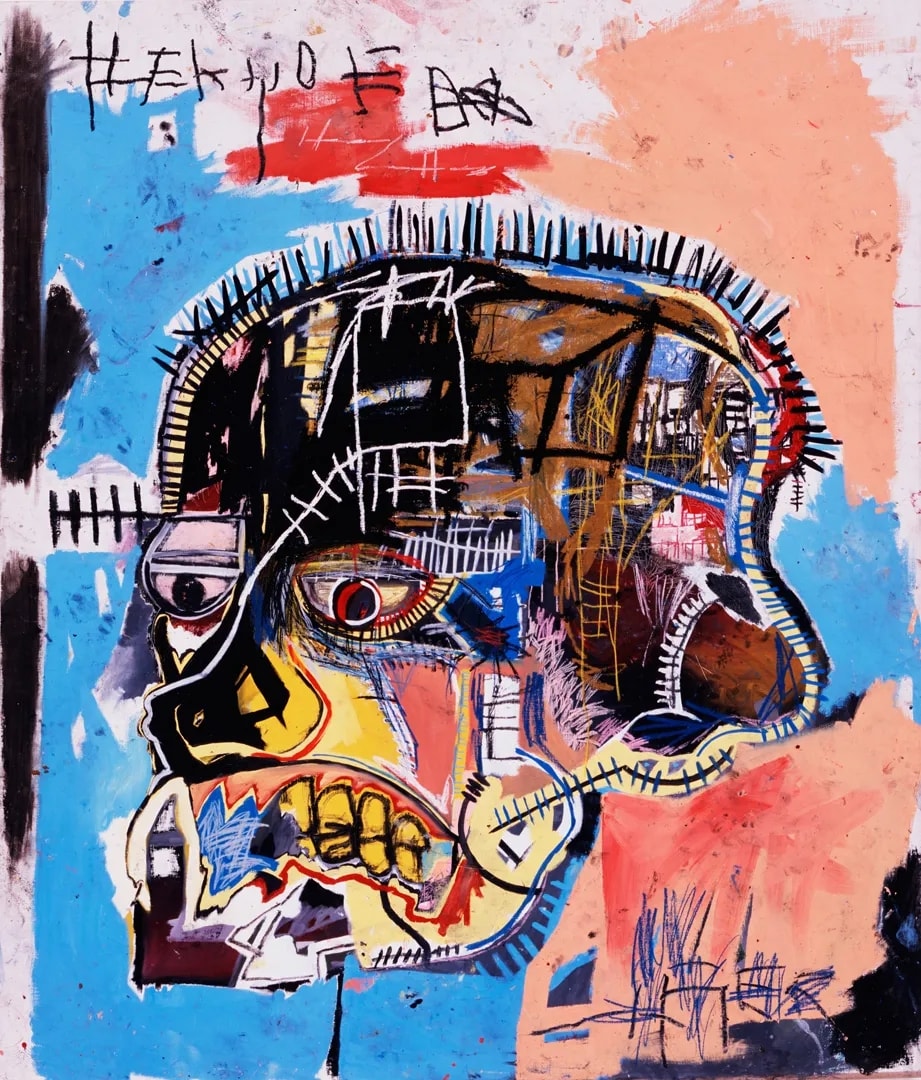
Untitled confronts the viewer with a cutaway head that fuses portrait and x‑ray, mapping the psyche as anatomy. Searing lines, sutures, and bared teeth stage a battle between expression and damage, turning the act of seeing into an autopsy of identity. Basquiat’s volatile color blocks of powder blue and peach intensify the sense of a self under pressure and alive with current.

Study Print Studio

Create a personal study print

Build a companion study sheet around the part of this painting that speaks to you most. Choose a detail, shape an interpretation, and walk away with something personal and display-worthy.

Fast Facts

Year
1981
Medium
Acrylic and oilstick on canvas
Dimensions
205.7 × 175.9 cm (approx.)
Location
The Broad, Los Angeles
Untitled by Jean-Michel Basquiat (1981) featuring Crown-like hair spikes, Exposed teeth biting a blue shard, Cutaway head / x-ray skull

Click on any numbered symbol to learn more about its meaning

Meaning & Symbolism

Basquiat builds a sovereign, over‑life‑size head whose interior is not hidden but performed. The red‑rimmed left eye fixes the viewer while the right eye skews laterally, splitting witness from wound; the jaw’s exposed dental arcade clamps against a jagged blue shard, where speech turns to injury and articulation to abrasion. Stitches run along the mandible and temple, and hatch marks score the cranium like radiographic sutures, converting medical notation into a street script. Across the face, bands of powder blue, peach, rust, and black collide; erasures and redrawings keep the surface electrically unstable, a record of revision that contradicts the myth of the artist as mere improviser. This is not a trophy of death but a thinking head that fuses cutaway diagram and mask, revealing memory and perception as anatomical terrain 23. The compositional field extends the thesis. Vector‑like arrows and gridded lattices puncture the headspace, echoing Basquiat’s habit of using diagrammatic signs to tether attention and to mark sites of pain or power 4. The snout‑like nasal cavity and the notational ear canal recall Gray’s Anatomy plates that Basquiat mined since childhood, yet they have been denatured by graffiti syntax—loops, crosshatches, and blocks of color that import the city’s noise into clinical illustration 3. In this hybrid grammar, science and surveillance sit beside the possibility of weaponry; forms that read as lab beakers or tools double as blades, staging the body as a site where knowledge and violence cohabit 4. At the brow, the dense queue of short black spikes operates as both hair and telemetry, a crown transfigured into barbs, asserting status while indexing vulnerability. Everywhere the line is aggressive and self‑correcting, an audit trail of looking and thinking that refuses to congeal into a single, stable likeness 12. Why Untitled is important is that it fixes, on a single canvas, Basquiat’s core innovation: identity rendered as a contested anatomy. Created at the threshold of his breakthrough into the gallery system, the work’s repeatedly worked surface reads as an index of pressure—fame, categorization, racialized looking—and as an insistence on self‑definition that cannot be flattened into a mask or medical specimen 12. By keeping the image suspended “between life and death,” Basquiat reclaims the diagnostic gaze and turns it outward; the painting examines the viewer as much as the head it displays. In doing so, it anchors a lineage of contemporary portraiture that treats the figure as an information system—part diagram, part elegy, part manifesto—and it stands as one of the clearest statements of Basquiat’s project to merge the vitality of the street with the archive of the body 123.

Explore Deeper with AI

Ask questions about Untitled

Popular questions:

Powered by AI • Get instant insights about this artwork

💬 Ask questions about this artwork!

Interpretations

Ontological Debate: Head, Not Skull

Fred Hoffman argues that the image is a head—a hybrid, interior–exterior view—rather than a memento mori “skull.” This distinction matters: it repositions the work from morbid emblem to a living, cognitive anatomy that stages perception, memory, and pain as active processes. The extended, months‑long reworking (unusual for Basquiat) supports this reading; the surface becomes evidence of sustained inquiry rather than performative rawness. Seen this way, the teeth, sutures, and skewed eyes are not mere death tropes but instruments of thought under pressure, aligning the painting with diagram and self‑portraiture rather than vanitas. The mislabel “Skull” flattens this complexity; restoring “head” foregrounds the painting’s bid to picture consciousness and self‑definition in real time 1.

Source: Fred Hoffman (Basquiat.com)

Anatomy as Archive: From Gray’s Anatomy to Black Self-Fashioning

Basquiat’s lifelong study of Gray’s Anatomy provided a lexicon—ear ossicles, sutures, dental arcades—that he reanimates with graffiti syntax to claim the medical diagram as a personal and cultural archive. MoMA notes how his drawings label bones and nerves like study sheets; on canvas, those schemata collide with scrawl and color blocks, converting neutral science into a site of embodied history. In the Broad head, the cutaway ear canal, cranial hatching, and notational arrows fuse clinical legibility with street semiotics, asserting authorship over bodies historically objectified by diagnostic regimes. The result is not illustration but a counter‑diagram: anatomy retooled to articulate Black presence, memory, and resistance within institutions that once rendered such bodies data or specimen 32.

Source: MoMA Magazine; The Broad

Diagram, Tool, Weapon: Hybrid Sign Systems

Curators reading cognate 1981 heads identify glyphs that toggle between laboratory beaker and tomahawk, and arrows that behave as notational vectors. In the Broad painting, similar shapes frame the head as a battlefield where knowledge and force cohabit. The beaker invokes empiricism; the blade implies colonial and contemporary violence. This semiotic slippage—instrument/weapon, note/attack—animates the picture’s field and complicates the authority of scientific seeing. The head becomes a site of contested technology, its interior mapped by marks that can test, heal, surveil, or harm. Such doubleness extends to the jagged blue shard at the jaw, where speech meets abrasion: language as tool and cut, articulation and injury, a politics of the mouth visualized in paint 42.

Source: The Metropolitan Museum of Art; The Broad

Surface as Pressure Index: Process, Fame, and Self-Editing

The Broad emphasizes the work’s repeatedly reworked surface as an index of anxiety and exposure during Basquiat’s breakthrough into the gallery system. Rather than confirming the myth of the untutored prodigy, the palimpsest surface functions as process art—erasure, redraw, correction—as if the painter audited his own image against market and media scrutiny (Ricard’s “Radiant Child” looming in the background). The aggressive, self‑correcting line reads like a disciplinary mark, yet its restlessness insists on self‑definition over stereotype. In this lens, facture is biography: material revisions track negotiations with fame, racialized looking, and authorship. The painting thus doubles as an artist’s proof of identity under construction, not a fixed emblem delivered to commerce 2.

Source: The Broad (curatorial text); René Ricard context

The Returned Gaze: Diagnostics, Surveillance, and the Viewer

The red‑rimmed eye that fixes the viewer stages a reversal of the diagnostic gaze: the examined subject looks back, scrutinizing the examiner. This exchange turns clinical vision into a scene of mutual accountability, undermining one‑way surveillance associated with medicine, ethnography, and policing. By keeping the image suspended “between life and death,” Basquiat weaponizes uncertainty: is this an x‑ray we control, or a mask that judges our looking? The painting thereby tests spectatorship itself, making viewers feel the pinning arrows and notational grids as tools that might also target them. The head does not submit to measurement; it measures us, asserting agency within—and against—the epistemologies that claim to know the body best 21.

Source: The Broad; Fred Hoffman

Comparative Lens: 1981 Head vs. 1982 Blue-Ground Skull

Setting the Broad’s 1981 head against the 1982 blue‑ground skull clarifies Basquiat’s evolving portrait-diagram. The 1981 canvas is an over‑life‑size, heavily reworked cutaway that foregrounds process and cognitive interiority; the 1982 work presents a more consolidated visage floating on saturated blue, a totemic intensity prized by the market. Exhibitions of the 1982 painting spotlight its aura and icon status; the 1981 head reads as investigative, its palimpsest arguing against a single, consumable likeness. Together they map a shift from searching anatomy to sovereign icon, complicating how we parse “Basquiat’s skulls” and reminding us that the category contains distinct ontologies—head as thinking machine versus head as emblem—each with different stakes for identity and reception 512.

Source: Brooklyn Museum; Fred Hoffman; The Broad

Related Themes

About Jean-Michel Basquiat

Jean-Michel Basquiat (1960–1988) emerged from late‑1970s New York graffiti into a rapid early‑1980s ascent, translating street language into a painterly vocabulary of anatomy, history, and Black cultural memory. A childhood encounter with Gray’s Anatomy seeded his lifelong use of medical diagrams and labeled fragments. By 1981–82 he had become central to Neo‑Expressionism, advancing a portrait tradition that exposes the psyche as a mapped interior [1][3].
View all works by Jean-Michel Basquiat

More by Jean-Michel Basquiat
Dustheads by Jean-Michel Basquiat

Dustheads

Jean-Michel Basquiat (1982)

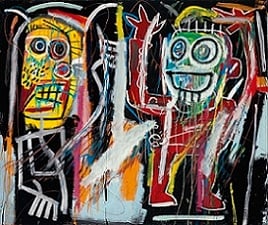
Dustheads stages two electrified, mask-like figures lunging out of a saturated black field, their concentric eyes and bared teeth pumping with <strong>manic, nocturnal energy</strong>. The title’s nod to PCP (“angel dust”) fuses <strong>ecstasy and menace</strong>, turning the scene into a charged allegory of altered perception and survival in downtown New York, 1982 <sup>[1]</sup><sup>[6]</sup>.
In This Case by Jean-Michel Basquiat

In This Case

Jean-Michel Basquiat (1983)

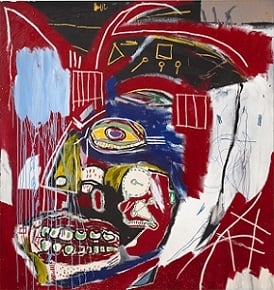
In This Case thrusts a flayed, X‑ray‑like head against a <strong>searing red field</strong>, where boxed teeth, a target‑bright <strong>single eye</strong>, and schematic glyphs above the brow turn the face into a site of <strong>classification and alarm</strong>. Jean-Michel Basquiat fuses anatomy with street mark‑making to stage a confrontation with <strong>mortality, surveillance, and Black embodiment</strong> <sup>[1]</sup><sup>[2]</sup>.

Boy and Dog in a Johnnypump by Jean-Michel Basquiat

Boy and Dog in a Johnnypump

Jean-Michel Basquiat (1982)

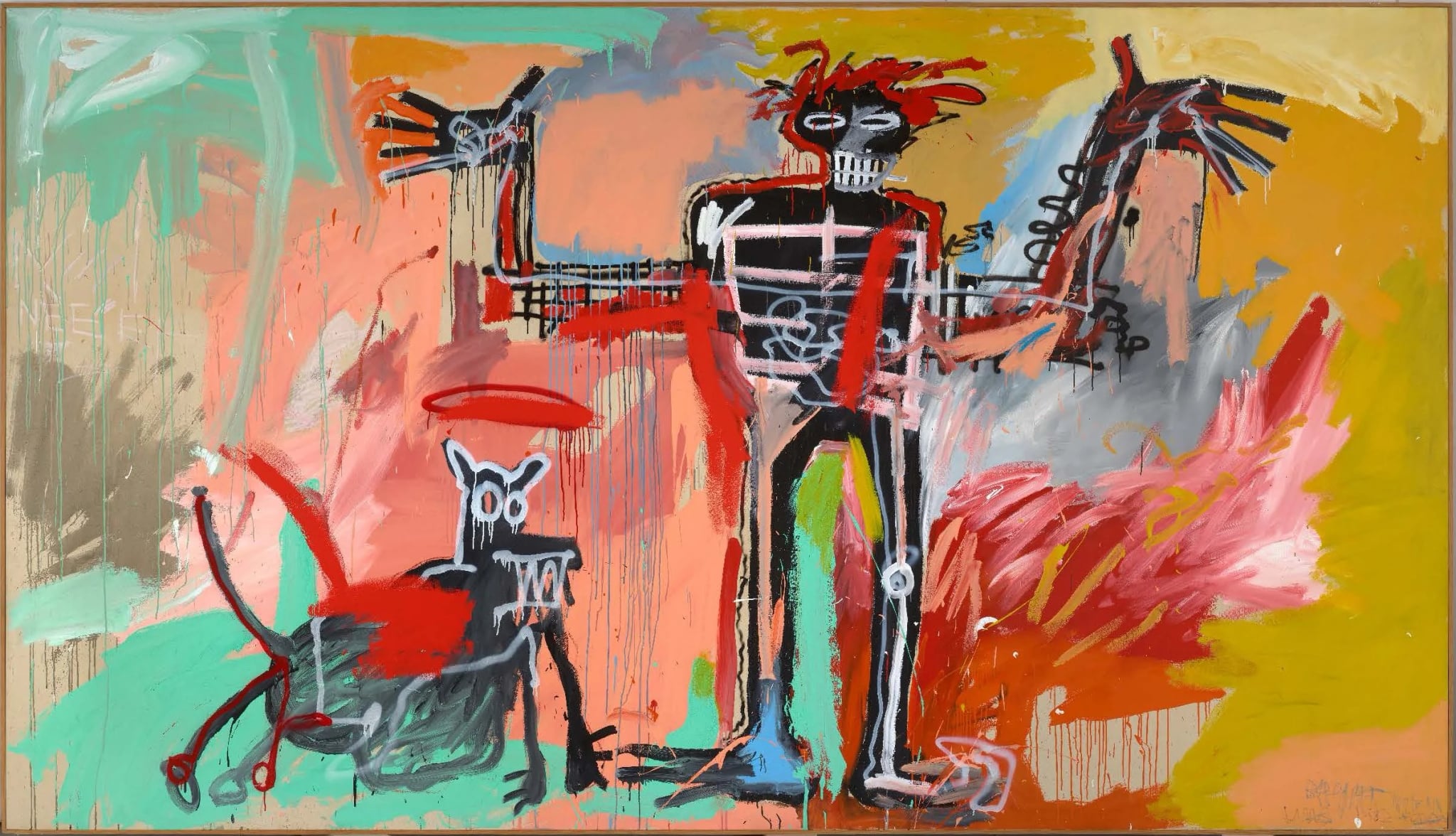
<strong>Boy and Dog in a Johnnypump</strong> (1982) stages a wiry, x‑rayed boy with arms flung wide beside a bristling dog under a red arc that doubles as a halo and the spray of a New York <strong>johnnypump</strong>. Basquiat fuses <strong>childhood play</strong> and <strong>urban peril</strong> in a heat‑drenched field of oranges, yellows, and mints, emblematic of his breakthrough <strong>Neo‑Expressionism</strong> and the 1982 Modena cycle. The painting asserts Black presence and survival with ferocious scale and velocity <sup>[1]</sup><sup>[2]</sup>.