Dustheads
Study Print Studio
Create a personal study print
Build a companion study sheet around the part of this painting that speaks to you most. Choose a detail, shape an interpretation, and walk away with something personal and display-worthy.
Fast Facts
- Year
- 1982
- Medium
- Acrylic, oilstick, spray enamel, and metallic paint on canvas
- Dimensions
- 182.8 x 213.3 cm (72 x 84 in.)
- Location
- Private collection (undisclosed)
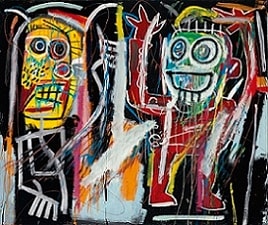
Click on any numbered symbol to learn more about its meaning
Meaning & Symbolism
Explore Deeper with AI
Ask questions about Dustheads
Popular questions:
Powered by AI • Get instant insights about this artwork
Interpretations
Formal Analysis: Layer Logic and Reversal
Source: Christie’s lot essay; Brooklyn Museum (Marc Mayer)
Urban Kinetics: Siren Optics and Street Grammar
Source: Christie’s lot essay; Fondation Beyeler exhibition catalogue
Iconography & Race: Halo as Reparative Device
Source: Sotheby’s Institute of Art; Christie’s lot essay; Brooklyn Museum (Marc Mayer)
Anatomy as Memento Mori and X-Ray Aesthetic
Source: Brooklyn Museum (Marc Mayer); Christie’s lot essay
Psychological/Pharmacological Lens: PCP and Perceptual Overdrive
Source: Christie’s lot essay; PubMed (PCP clinical overview)
Market/Institutional Frame: Value, Stigma, and High Finance
Source: Christie’s lot essay; U.S. Department of Justice (civil complaint)
Related Themes
About Jean-Michel Basquiat
More by Jean-Michel Basquiat
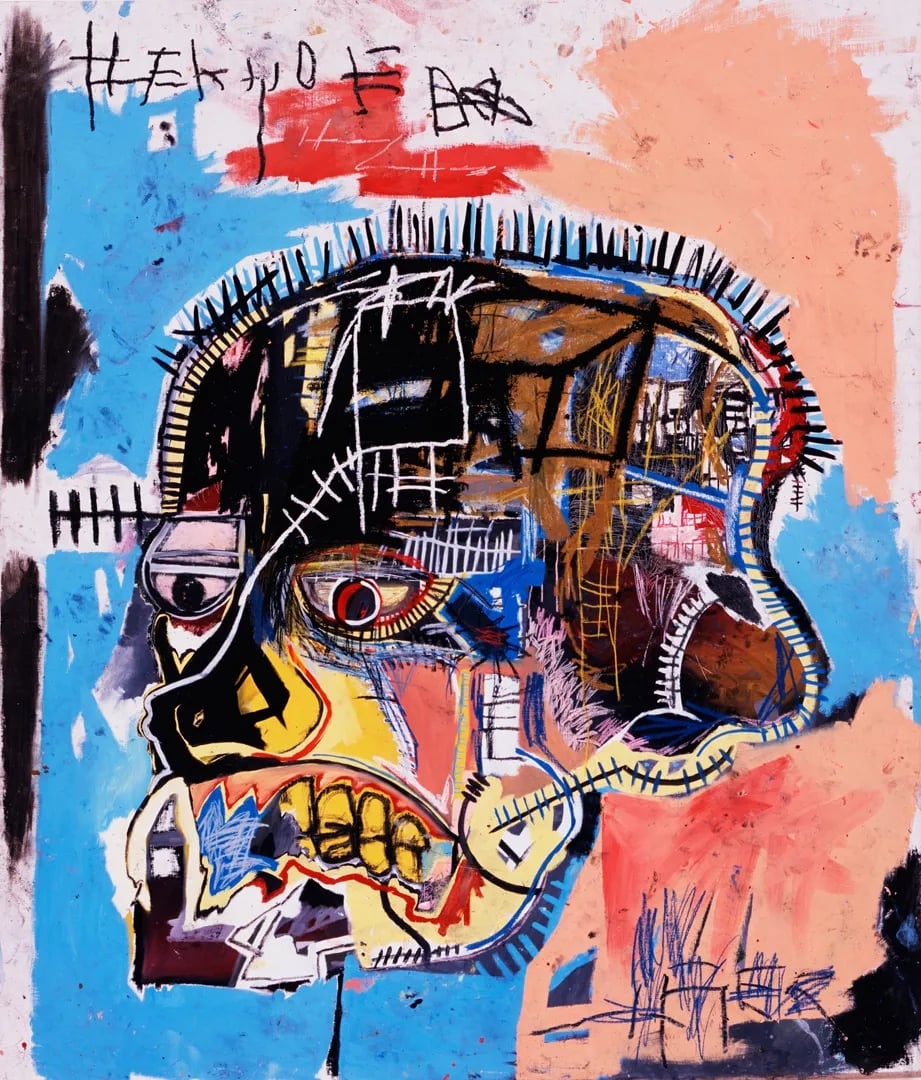
Untitled
Jean-Michel Basquiat (1981)
Untitled confronts the viewer with a cutaway <strong>head</strong> that fuses portrait and <strong>x‑ray</strong>, mapping the psyche as anatomy. Searing lines, sutures, and bared teeth stage a battle between expression and damage, turning the act of seeing into an autopsy of identity. Basquiat’s volatile color blocks of <strong>powder blue</strong> and <strong>peach</strong> intensify the sense of a self under pressure and alive with current.
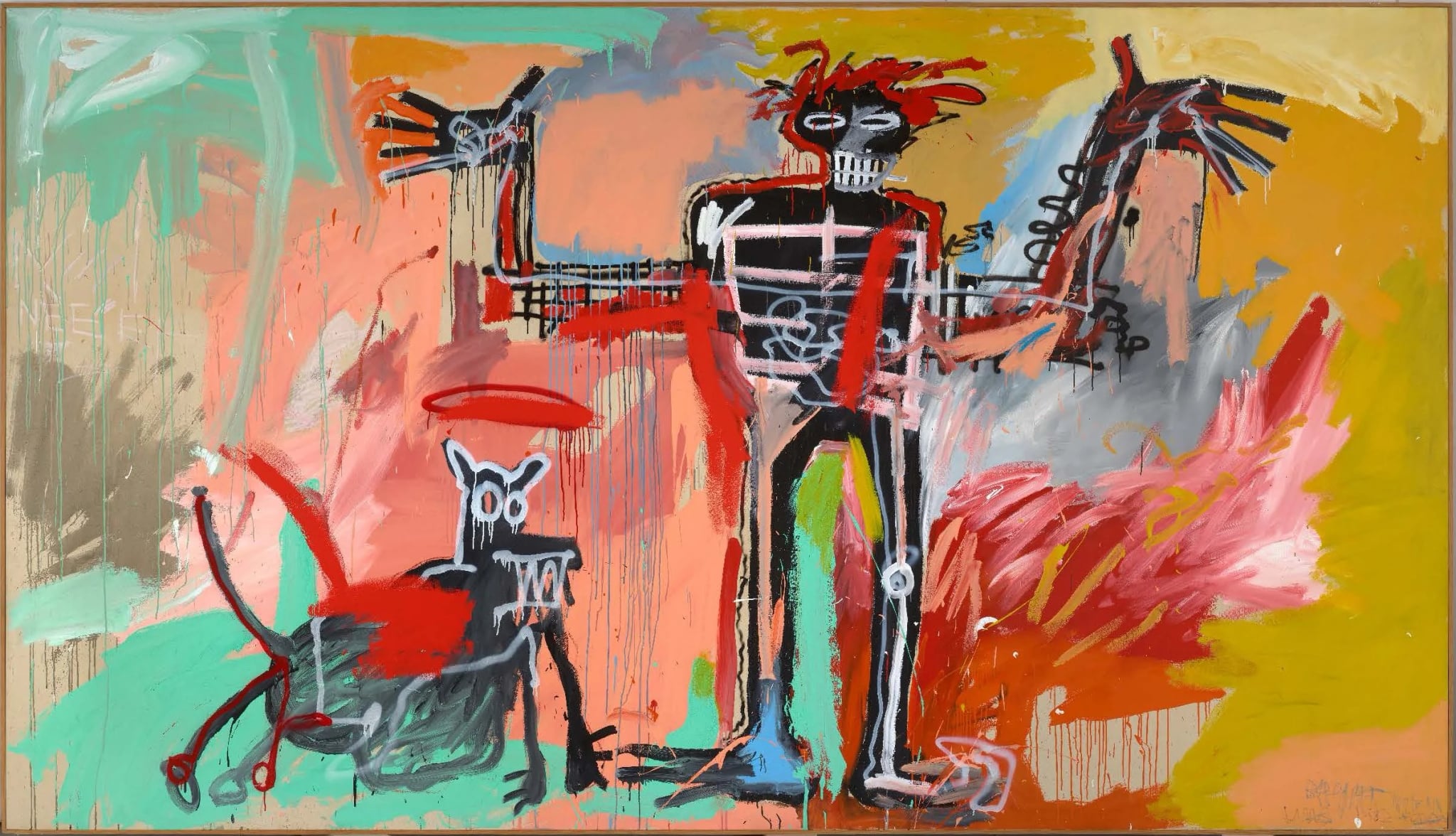
Boy and Dog in a Johnnypump
Jean-Michel Basquiat (1982)
<strong>Boy and Dog in a Johnnypump</strong> (1982) stages a wiry, x‑rayed boy with arms flung wide beside a bristling dog under a red arc that doubles as a halo and the spray of a New York <strong>johnnypump</strong>. Basquiat fuses <strong>childhood play</strong> and <strong>urban peril</strong> in a heat‑drenched field of oranges, yellows, and mints, emblematic of his breakthrough <strong>Neo‑Expressionism</strong> and the 1982 Modena cycle. The painting asserts Black presence and survival with ferocious scale and velocity <sup>[1]</sup><sup>[2]</sup>.
In This Case
Jean-Michel Basquiat (1983)
In This Case thrusts a flayed, X‑ray‑like head against a <strong>searing red field</strong>, where boxed teeth, a target‑bright <strong>single eye</strong>, and schematic glyphs above the brow turn the face into a site of <strong>classification and alarm</strong>. Jean-Michel Basquiat fuses anatomy with street mark‑making to stage a confrontation with <strong>mortality, surveillance, and Black embodiment</strong> <sup>[1]</sup><sup>[2]</sup>.