Jean-Michel Basquiat
Biography
Themes in Their Work
Most Expensive Jean-Michel Basquiat Paintings
Explore ranked valuations of Jean-Michel Basquiat's most valuable works →
Featured Artworks
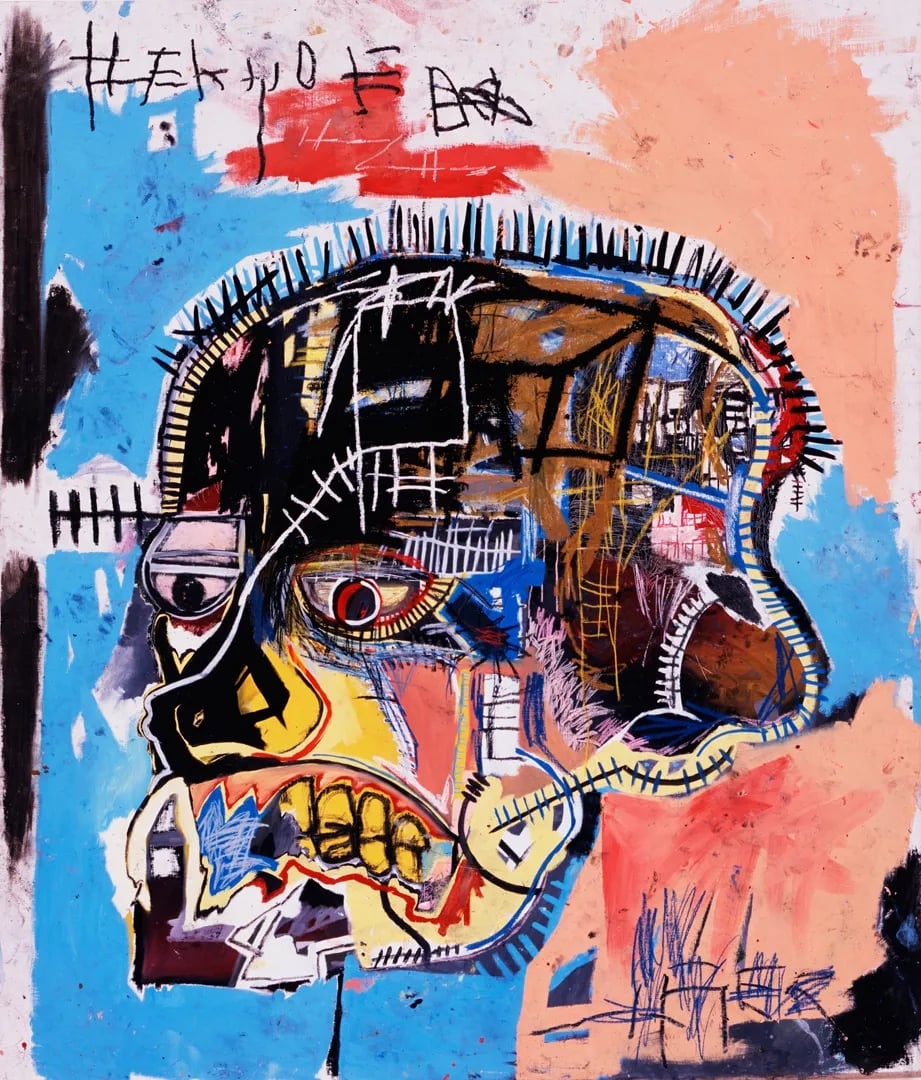
Untitled
Jean-Michel Basquiat (1981)
Untitled confronts the viewer with a cutaway <strong>head</strong> that fuses portrait and <strong>x‑ray</strong>, mapping the psyche as anatomy. Searing lines, sutures, and bared teeth stage a battle between expression and damage, turning the act of seeing into an autopsy of identity. Basquiat’s volatile color blocks of <strong>powder blue</strong> and <strong>peach</strong> intensify the sense of a self under pressure and alive with current.
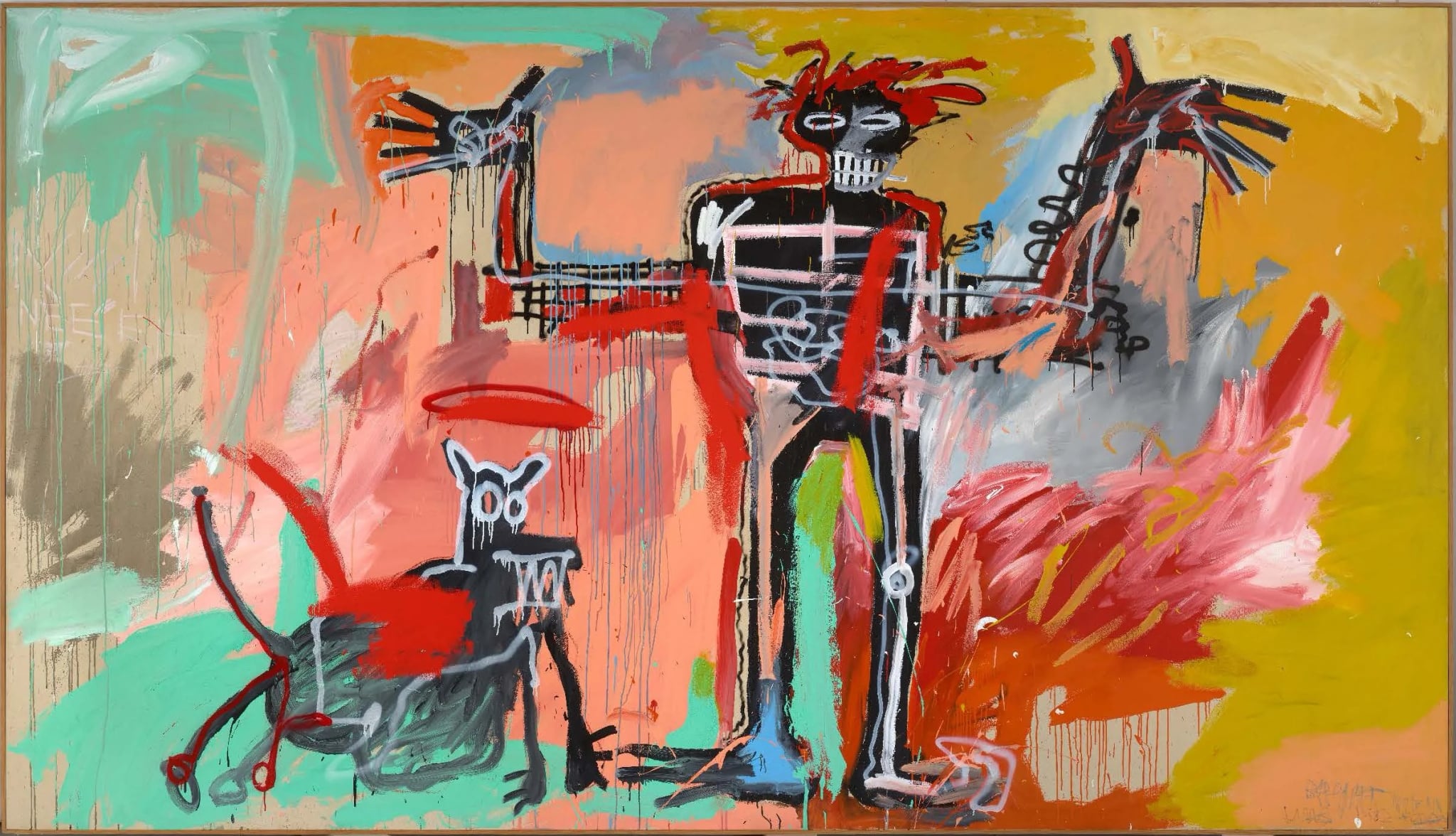
Boy and Dog in a Johnnypump
Jean-Michel Basquiat (1982)
<strong>Boy and Dog in a Johnnypump</strong> (1982) stages a wiry, x‑rayed boy with arms flung wide beside a bristling dog under a red arc that doubles as a halo and the spray of a New York <strong>johnnypump</strong>. Basquiat fuses <strong>childhood play</strong> and <strong>urban peril</strong> in a heat‑drenched field of oranges, yellows, and mints, emblematic of his breakthrough <strong>Neo‑Expressionism</strong> and the 1982 Modena cycle. The painting asserts Black presence and survival with ferocious scale and velocity <sup>[1]</sup><sup>[2]</sup>.
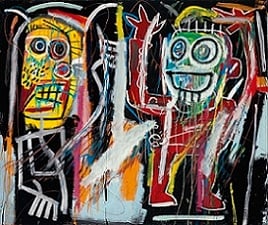
Dustheads
Jean-Michel Basquiat (1982)
Dustheads stages two electrified, mask-like figures lunging out of a saturated black field, their concentric eyes and bared teeth pumping with <strong>manic, nocturnal energy</strong>. The title’s nod to PCP (“angel dust”) fuses <strong>ecstasy and menace</strong>, turning the scene into a charged allegory of altered perception and survival in downtown New York, 1982 <sup>[1]</sup><sup>[6]</sup>.
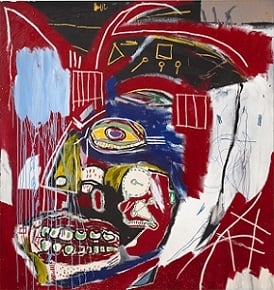
In This Case
Jean-Michel Basquiat (1983)
In This Case thrusts a flayed, X‑ray‑like head against a <strong>searing red field</strong>, where boxed teeth, a target‑bright <strong>single eye</strong>, and schematic glyphs above the brow turn the face into a site of <strong>classification and alarm</strong>. Jean-Michel Basquiat fuses anatomy with street mark‑making to stage a confrontation with <strong>mortality, surveillance, and Black embodiment</strong> <sup>[1]</sup><sup>[2]</sup>.