In This Case

by Jean-Michel Basquiat

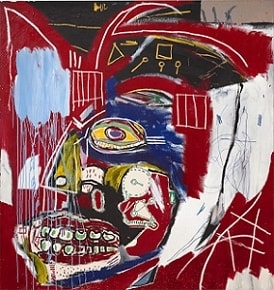
In This Case thrusts a flayed, X‑ray‑like head against a searing red field, where boxed teeth, a target‑bright single eye, and schematic glyphs above the brow turn the face into a site of classification and alarm. Jean-Michel Basquiat fuses anatomy with street mark‑making to stage a confrontation with mortality, surveillance, and Black embodiment [1][2].

Study Print Studio

Create a personal study print

Build a companion study sheet around the part of this painting that speaks to you most. Choose a detail, shape an interpretation, and walk away with something personal and display-worthy.

Fast Facts

Year
1983
Medium
Acrylic and oilstick on canvas
Dimensions
197.8 × 187.3 cm (77 7/8 × 73 3/4 in.)
Location
Private collection
In This Case by Jean-Michel Basquiat (1983) featuring Boxed/enumerated teeth, Searing red field, Single target-like eye

Click on any numbered symbol to learn more about its meaning

Meaning & Symbolism

Across the canvas, Basquiat sets a monumental head in profile, its boxed, enumerated teeth and cross‑sectioned jaw thrust forward like a clinic display while a single, bulging eye—ringed in acid yellows and greens—locks into a vigilant stare. These are not neutral diagrams: by isolating the teeth in rectilinear frames and crowning the brow with control‑panel glyphs (triangles, keys, boxes), he converts medical and technical notation into a language of exposure and governance. The field of saturated scarlet bleeds around the head; drips and scumbles slice through blue, black, and white planes, keeping the image in a constant state of emergency. This is an anatomy lesson that refuses passivity, an X‑ray that fights back 12. Basquiat’s lifelong study of anatomical illustration (notably Gray’s Anatomy) supplies the vocabulary of bone and section, but he corrupts that vocabulary with graffiti speed, erasures, and painterly noise, forcing viewers to see the violence latent in the act of looking—especially when the subject is a Black head rendered as a “case” to be examined 16. The painting detonates the tradition of vanitas: instead of a quiet skull reminding us to die, Basquiat’s head crackles with graphic energy, turning mortality into a live wire of thought and pain. Scholars have read his recurrent “heads” as hybrids—part portrait, part diasporic mask, part skull—and In This Case is the series at its most confrontational, the eye operating both as organ and emblem of surveillance and wound 12. The red ground functions as heat and alarm, converting the picture plane into a forensic theater where identity, history, and medicalized violence collide 14. bell hooks’s account of Basquiat’s fragmented Black bodies as records of abandonment and domination clarifies this charge: the boxed mouth and schematic brow reproduce the taxonomies of Western power even as the raw line and furious color seize them for self‑assertion 4. The title’s pun—“case” as container, diagnosis, or legal inquest—underscores how bodies are processed by systems; the painting insists on undoing that process by making the inner life inescapable 14. Situated in 1983, as Basquiat consolidated his global stature, the work converses with his earlier monumental heads while sharpening their political voltage. Curators have linked the painting’s emergency pitch to the climate surrounding the death of Michael Stewart later that year and to Basquiat’s contemporaneous response in Defacement; whether or not it is a direct tribute, the reading illuminates how the image registers the pressure of state and social violence on Black visibility 3. Art‑historically, Basquiat synthesizes Cubist fracture, Abstract Expressionist gesture, and street semiotics into a singular instrument: a portrait that reads like a radiograph of power. That fusion explains why In This Case remains a touchstone—an artwork that redefines how the body can be pictured when history, classification, and mortality are all burning through the same skin 124.

Explore Deeper with AI

Ask questions about In This Case

Popular questions:

Powered by AI • Get instant insights about this artwork

💬 Ask questions about this artwork!

Interpretations

Formal Analysis: A Portrait Engineered for Impact

In This Case operates like a constructed head built from intersecting systems: planar cuts recall Cubist dissection; ferocious oilstick lines and smeared passages channel Abstract Expressionist mark‑making; blocky boxes script a diagrammatic logic. The saturated scarlet ground is not backdrop but pressure field, driving figure–ground collisions that keep the image unstable. Teeth are gridded like a dental schema, and the chromatic, target‑like eye anchors a rotational thrust that propels the profile forward. This hybridization—“synthesizes Cubist fracture, Abstract Expressionist gesture, and street semiotics”—creates a portrait that is less likeness than instrument, a visual device calibrated to measure and broadcast psychic and social voltage. The result is a radiograph of power that uses painterly structure to dramatize exposure, injury, and assertion simultaneously 12.

Source: Christie’s (catalogue essay); Fondation Louis Vuitton

Historical-Political Lens: Policing the Visible

Read against 1983 New York, the painting’s alarmed red and surveillance‑charged eye align with an urban climate of state scrutiny and vulnerability for Black artists. Curators have linked its emergency pitch to the death of Michael Stewart later that year and Basquiat’s immediate response in Defacement—evidence of how his imagery could pivot to forensic testimony about policing and visibility. While not a declared memorial, In This Case absorbs that atmosphere: boxed, enumerated teeth echo the taxonomic habits of institutions that turn people into cases; the vigilant eye watches and is watched. The canvas thus doubles as witness statement and warning, previewing the overt critique that erupts in Defacement and situating Basquiat’s head series within a continuum of resistance to surveillance and medicalized control 13.

Source: Guggenheim Museum; Christie’s (Buchhart interpretation)

Black Studies/Feminist Critique: Taxonomy vs. Agency

bell hooks describes Basquiat’s fragmented bodies as records of abandonment and domination, but also as sites where representation is seized back through assertive self‑inscription. In This Case clarifies that dialectic: the mouth is boxed like a specimen, the skull cross‑sectioned like a chart—visual grammars through which Western systems name, number, and manage Black life. Yet Basquiat overdrives these grammars with eruptions of color, erasures, and speed, making the painting read as both injury and refusal. The head is literally a “case,” but the inner life is made inescapable: the stare counters the examiner’s gaze, and the scrawled architecture unmoors any stable taxonomic hold. Hooks’s lens reframes the work as a battlefield where inscription (control) is met by counter‑inscription (agency) in the same stroke 41.

Source: bell hooks, Art in America (1993); Christie’s

Africanist/Anthropological Lens: Mask–Skull Hybridity

Robert Farris Thompson’s Africanist framework helps parse Basquiat’s head as a hybrid of portrait, diasporic mask, and skull—a form that mediates between visible identity and ancestral presence. In This Case intensifies this syncretism: the profile projects like a mask in ritual use, yet its cutaway jaw and gridded teeth declare Western anatomical scrutiny. The fusion produces a contact zone where African‑diasporic embodiment meets European systems of knowledge, not as pastiche but as a living, contested interface. Basquiat’s signs—keys, boxes, triangles—behave like nkisi‑like activators; the eye becomes a charged node of protection and peril. Through this lens, the painting functions as a contemporary power object, mobilizing masking’s spiritual technologies to counteract the mortuary fixity of the skull 15.

Source: Robert Farris Thompson (via Gagosian/Christie’s); Jordana Moore Saggese, Reading Basquiat

Medium & Process: Diagram Turned Weapon

Basquiat’s deep reading of Gray’s Anatomy furnished a library of cuts, labels, and sectional views he retools at high velocity—what the summary calls graffiti speed. In This Case weaponizes the medical diagram: enumerated teeth and cross‑sections promise legibility, but the marks slip, drip, and overwrite, producing a palimpsest where knowledge is unstable and contested. This friction between diagram and gesture is the painting’s engine, flipping the clinical X‑ray into an expressive counter‑scan that exposes the violence of looking itself. The work thus becomes “an X‑ray that fights back,” using painterly noise to jam the circuitry of technical seeing while still delivering visceral anatomy—an epistemological feint that is as much about how we know bodies as what they are 61.

Source: The Guardian (Basquiat and Gray’s Anatomy); Christie’s

Related Themes

About Jean-Michel Basquiat

Jean-Michel Basquiat (1960–1988) emerged from late‑1970s New York graffiti into a rapid early‑1980s ascent, translating street language into a painterly vocabulary of anatomy, history, and Black cultural memory. A childhood encounter with Gray’s Anatomy seeded his lifelong use of medical diagrams and labeled fragments. By 1981–82 he had become central to Neo‑Expressionism, advancing a portrait tradition that exposes the psyche as a mapped interior [1][3].
View all works by Jean-Michel Basquiat

More by Jean-Michel Basquiat
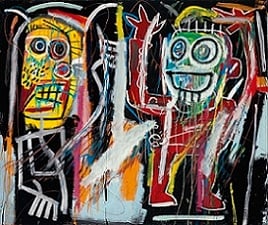
Dustheads by Jean-Michel Basquiat

Dustheads

Jean-Michel Basquiat (1982)

Dustheads stages two electrified, mask-like figures lunging out of a saturated black field, their concentric eyes and bared teeth pumping with <strong>manic, nocturnal energy</strong>. The title’s nod to PCP (“angel dust”) fuses <strong>ecstasy and menace</strong>, turning the scene into a charged allegory of altered perception and survival in downtown New York, 1982 <sup>[1]</sup><sup>[6]</sup>.

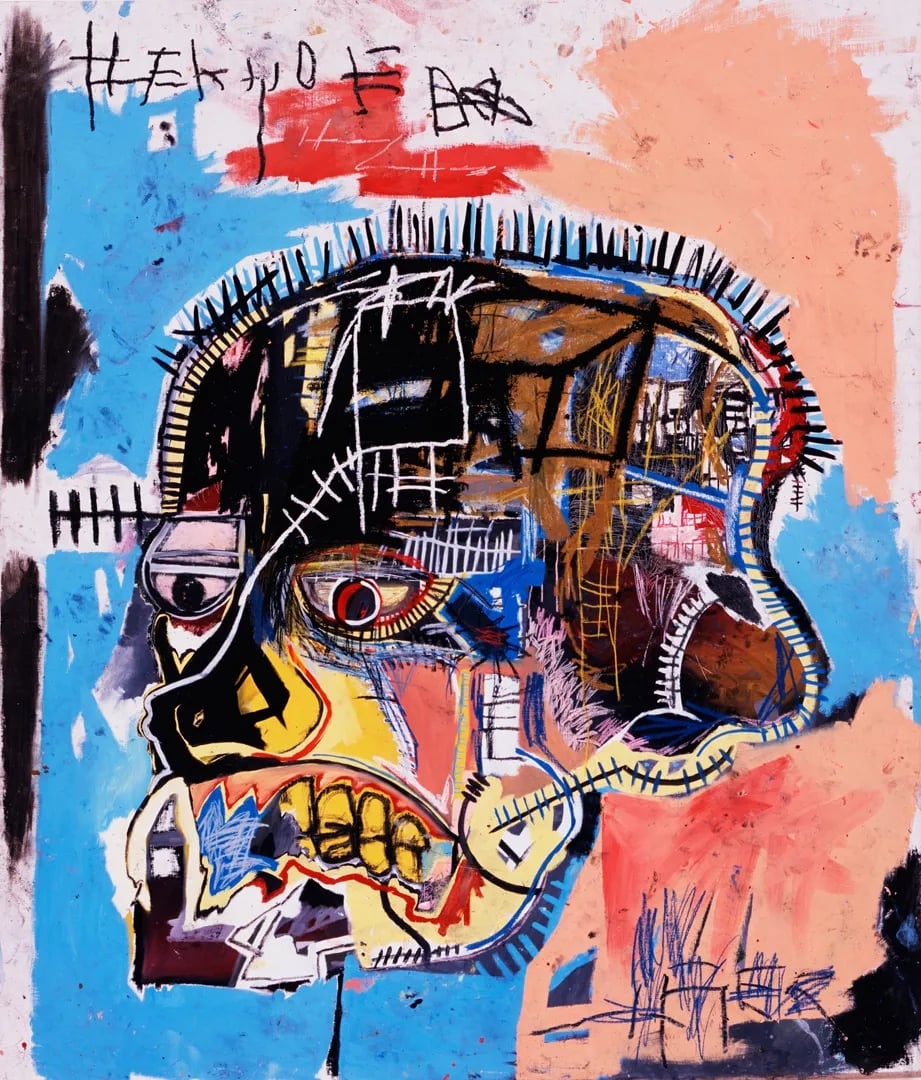
Untitled by Jean-Michel Basquiat

Untitled

Jean-Michel Basquiat (1981)

Untitled confronts the viewer with a cutaway <strong>head</strong> that fuses portrait and <strong>x‑ray</strong>, mapping the psyche as anatomy. Searing lines, sutures, and bared teeth stage a battle between expression and damage, turning the act of seeing into an autopsy of identity. Basquiat’s volatile color blocks of <strong>powder blue</strong> and <strong>peach</strong> intensify the sense of a self under pressure and alive with current.
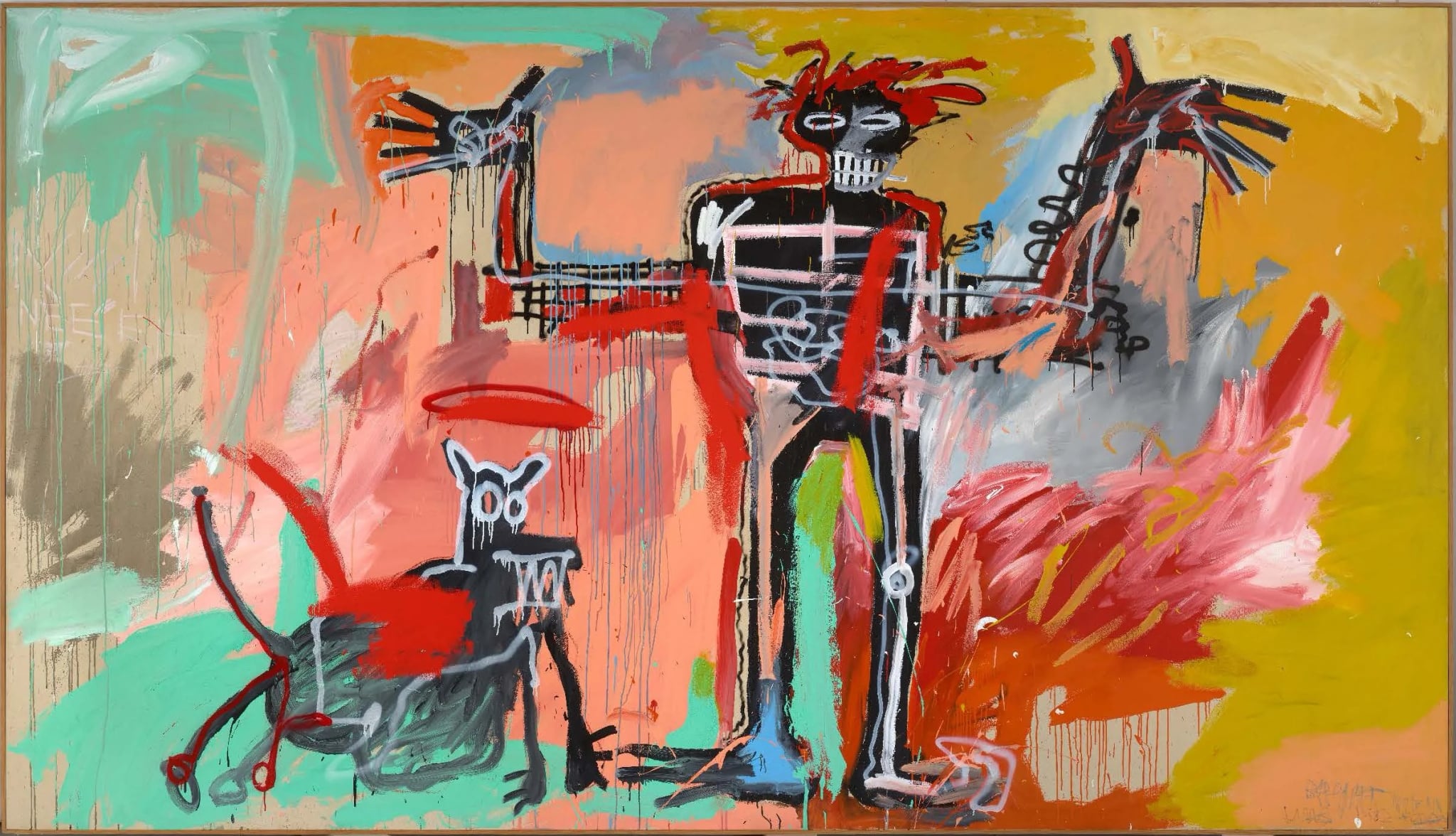
Boy and Dog in a Johnnypump by Jean-Michel Basquiat

Boy and Dog in a Johnnypump

Jean-Michel Basquiat (1982)

<strong>Boy and Dog in a Johnnypump</strong> (1982) stages a wiry, x‑rayed boy with arms flung wide beside a bristling dog under a red arc that doubles as a halo and the spray of a New York <strong>johnnypump</strong>. Basquiat fuses <strong>childhood play</strong> and <strong>urban peril</strong> in a heat‑drenched field of oranges, yellows, and mints, emblematic of his breakthrough <strong>Neo‑Expressionism</strong> and the 1982 Modena cycle. The painting asserts Black presence and survival with ferocious scale and velocity <sup>[1]</sup><sup>[2]</sup>.