How Much Is Untitled Worth?
Last updated: May 28, 2026
Quick Facts
- Methodology
- comparable analysis
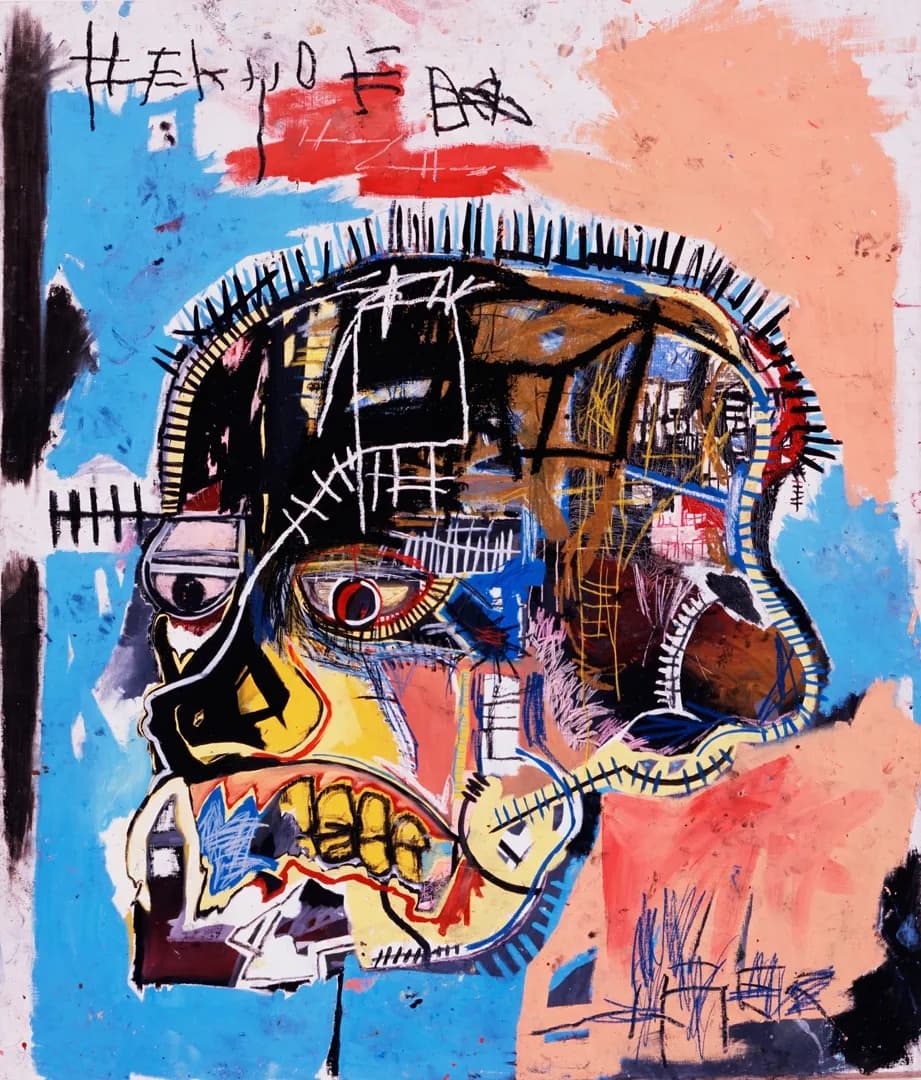
Prime 1981 Basquiat “head” in acrylic and oilstick on canvas, long held by The Broad and widely exhibited, positions this work at the top of the artist’s early output. Anchoring to strong public benchmarks for 1981 canvases (mid-$30Ms) and to recent top-tier Basquiat results ($46.5M–$67.1M in 2023–2024), a museum-grade premium supports a current private-sale/insurance valuation of $55–80 million.
Valuation Analysis
Conclusion: Untitled (1981) at The Broad is a canonical early Basquiat “head,” large in scale (approx. 81 × 69 in.), executed in the artist’s most coveted materials (acrylic and oilstick), and held in a top-tier public institution with continuous visibility. In today’s market, the most defensible fair value for private-sale or insurance purposes is $55–80 million, assuming sound condition consistent with museum care [1].
How the estimate was derived: We triangulate from two bands of comparables. First, public auction results for prime 1981 canvases—close to the subject in period and often in scale—clustered in the mid‑$20Ms to high‑$30Ms during the last decade’s peak cycles: La Hara (1981) at $34.97M (2017) and The Field Next to the Other Road (1981) at $37.1M (2015) establish a reliable historical floor for A‑quality 1981 paintings [5][6]. Second, we calibrate against the sustained appetite for Basquiat masterworks: the record-setting Untitled (1982) skull at $110.5M (2017), the 1983 skull In This Case at $93.1M (2021), the $85M 1982 canvas at Phillips (2022), and more recent marquee results of $67.1M (The Nile, 1983; 2023) and $46.5M (Untitled “ELMAR,” 1982; 2024) demonstrate deep demand at the very top end [2][3][4][7][8].
Positioning this work: Within Basquiat’s canon, the highest prices concentrate in 1982–83 skull/hero images. The Broad’s 1981 head is widely cited in relation to those masterpieces and is among the most recognized early heads due to constant museum exposure and frequent reproduction [1]. While its 1981 date argues for a measured discount to the 1982–83 apex, its scale, imagery, materials, and institutional provenance merit a premium to typical 1981 works traded publicly in the mid‑$30Ms. A prudent premium for museum-grade stature and iconic subject brings a present-day value into the mid‑$50Ms to around $80M.
Why the upper band is defensible: The head motif is a lodestar for Basquiat and a driver of top-decile pricing; the Broad’s example is a landmark of the artist’s breakout year and was shown at his debut solo gallery exhibition in New York, strengthening both art-historical and market narratives [1]. The scarcity of comparable early heads of this scale in private hands, combined with sustained trophy demand indicated by 2023–2024 results, supports competitive private-bid potential into the upper $70Ms for this picture in the right context [7][8].
Assumptions and use: This estimate presumes excellent, stable condition for the oilstick passages and no significant restorations. It is intended for private-sale calibration and insurance scheduling. If ever offered publicly with fresh-to-market cachet and third‑party support, the work would likely perform toward the upper half of the range; conversely, any meaningful condition or title impediment would warrant downward adjustment.
Key Valuation Factors
Art Historical Significance
High ImpactUntitled (1981) is a foundational “head” painting from Basquiat’s breakout year, synthesizing the raw semiotics of SAMO with the fully realized painterly language that would peak in 1982–83. The head motif is central to Basquiat’s exploration of identity, anatomy, and the psychology of representation, and it anchors many of his most valuable works. The Broad’s example has become a touchstone through frequent exhibition and reproduction, helping set the visual lexicon that later skull masterpieces elaborate. Its early date, scale, and directness make it key to understanding Basquiat’s rapid evolution from street interventions to museum-level canvases, elevating its art-historical weight within the oeuvre.
Imagery, Year, and Medium
High ImpactThe combination of year (1981), subject (a commanding “head”), and materials (acrylic and oilstick on canvas) squarely matches market-preferred attributes for early Basquiat. Collectors place a premium on the visceral line and chromatic intensity oilstick imparts, especially in psychologically charged head images that anticipate the 1982–83 skull triumphs. While the absolute peak valuations cluster in 1982–83, top-tier 1981 canvases remain scarce and highly sought after. This work’s substantial scale (approx. 81 × 69 in.) further enhances presence and value. Net effect: strong positive adjustment versus average 1981 material and positioning just beneath the apex set by 1982–83 skull and “hero” canvases.
Provenance and Exhibition History
High ImpactLong-term placement in The Broad (a leading public museum) and continuous on-view status confer exceptional reputational and scholarly standing. The Broad documents that the painting was shown at Basquiat’s debut solo New York gallery exhibition, an important provenance note that tightens the historical narrative. Deep institutional visibility typically commands a meaningful premium relative to similar works circulating privately: it validates quality, normalizes imagery with broad audiences, and reduces perceived authenticity or due-diligence risk. Such provenance can also catalyze competitive private interest if deaccessioned, as buyers value the imprimatur of a major museum and the depth of published/exhibited history attached to the work.
Market Benchmarks and Liquidity
High ImpactBasquiat’s market remains one of the deepest in contemporary art, with regular eight-figure liquidity and a proven $85M–$110.5M ceiling for skull masterpieces. For 1981 material, landmark public results such as La Hara ($34.97M, 2017) and The Field Next to the Other Road ($37.1M, 2015) establish a historical floor for prime canvases, while recent trophy sales in 2023–2024 ($67.1M for a 1983 monument; $46.5M for a 1982 painting) signal sustained high-end appetite. Against this backdrop, a museum-grade 1981 head with Broad-level visibility should clear historical 1981 benchmarks and price credibly in the high eight figures, supporting the $55–80M range.
Sale History
Untitled has never been sold at public auction.
Jean-Michel Basquiat's Market
Jean-Michel Basquiat is among the most in-demand postwar artists, with an exceptionally broad global buyer base and robust liquidity at the top end. His auction record stands at $110.5 million for Untitled (1982) at Sotheby’s New York (2017), with further apex results including In This Case (1983) at $93.1 million (Christie’s 2021) and Untitled (1982) at $85 million (Phillips 2022). Even amid market recalibration in 2023–2024, blue-chip Basquiat works achieved $46.5–$67.1 million, underscoring depth of demand for masterpieces. Collectors prize the 1981–83 period—particularly skull/head and hero images on canvas—while strong provenance, scale, and institutional exposure drive premiums. Well-selected A+ works remain highly liquid.
Comparable Sales
Untitled (Tar Tar Tar, Lead Lead Lead)
Jean-Michel Basquiat
Same artist and same year (1981) as the subject; major early canvas from Basquiat’s breakthrough period. Useful price anchor for 1981 paintings even though imagery differs from the head motif.
$34.8M
2014, Christie's New York
~$47.7M adjusted
The Field Next to the Other Road
Jean-Michel Basquiat
Same artist; 1981; monumental, museum-level canvas from the debut-year body of work. Strong proxy for scale/quality and period, though subject is not a head.
$37.1M
2015, Christie's New York
~$50.8M adjusted
La Hara
Jean-Michel Basquiat
Same artist; 1981; large, iconic single-figure/portrait image that resonates with the psychological intensity of Basquiat’s head pictures. A benchmark 1981 auction result.
$35.0M
2017, Christie's New York
~$46.2M adjusted
Crowns (Peso Neto)
Jean-Michel Basquiat
Same artist; 1981; large, signature-crowns canvas. Offers a fresh, up-to-date (2025) benchmark for prime 1981 works close in period and scale to the Broad head.
$48.3M
2025, Sotheby's New York
In This Case
Jean-Michel Basquiat
Same artist; 1983 skull/‘head’ masterpiece—closest subject analogue at the very top of the market. Sets an upper bracket for head imagery (later but directly comparable in motif).
$93.1M
2021, Christie's New York
~$111.7M adjusted
Untitled (1982)
Jean-Michel Basquiat
Same artist; 1982 skull painting and standing auction record. Often discussed as a counterpart to the Broad’s 1981 head; provides the ceiling for Basquiat head/skull imagery.
$110.5M
2017, Sotheby's New York
~$145.8M adjusted
Current Market Trends
The top tier of Postwar & Contemporary art has normalized from 2021–2022’s peaks into a selective yet resilient market. Consignors increasingly favor private sales for trophies, while public auctions continue to secure headline results for best-in-class works. Within this context, Basquiat remains a market leader: 2023–2024 sales in the mid‑ to high‑eight figures confirm deep demand for canonical canvases. Buyers are discriminating—freshness, scale, condition, and provenance matter more than ever—but competition for apex material persists. As supply of first-rate 1981–83 paintings tightens, prime early heads like The Broad’s command clear premiums over average-year works, with private-sale values plausibly exceeding historical auction comparables.
Study print
Study this painting as a print
Pair the full artwork with a museum-style study sheet focused on one meaningful detail.
Sources
- The Broad — Jean-Michel Basquiat, Untitled (1981)
- Sotheby’s — Basquiat Reigns Supreme at Evening Sale (2017 record)
- ABC News — Basquiat painting sells for $93.1 million (Christie’s 2021)
- Phillips — Most Successful Auction in Company History (Basquiat $85M, 2022)
- Artnet News — Christie’s $448m Postwar and Contemporary Evening Sale (La Hara 2017)
- The Art Newspaper — Mystery of the Basquiat sold at Christie’s for $37m (2015)
- Christie’s Press — Spring Marquee Week totals $922 million (The Nile $67.1m, 2023)
- Phillips — Basquiat Masterworks Lead Evening Sale (ELMAR $46.5m, 2024)