How Much Is Flexible Worth?
Last updated: June 1, 2026
Quick Facts
- Last Sale
- $45.3M (2018, Phillips, New York)
- Methodology
- comparable analysis
Based on the verified Phillips May 17, 2018 sale (USD 45,315,000) and recent market comparables for early‑1980s Basquiats, Flexible (1984) is valued at USD 35–55 million, with a working midpoint near USD 45 million. Key drivers are the Estate provenance and the wooden‑slat support (distinctive but condition‑sensitive).
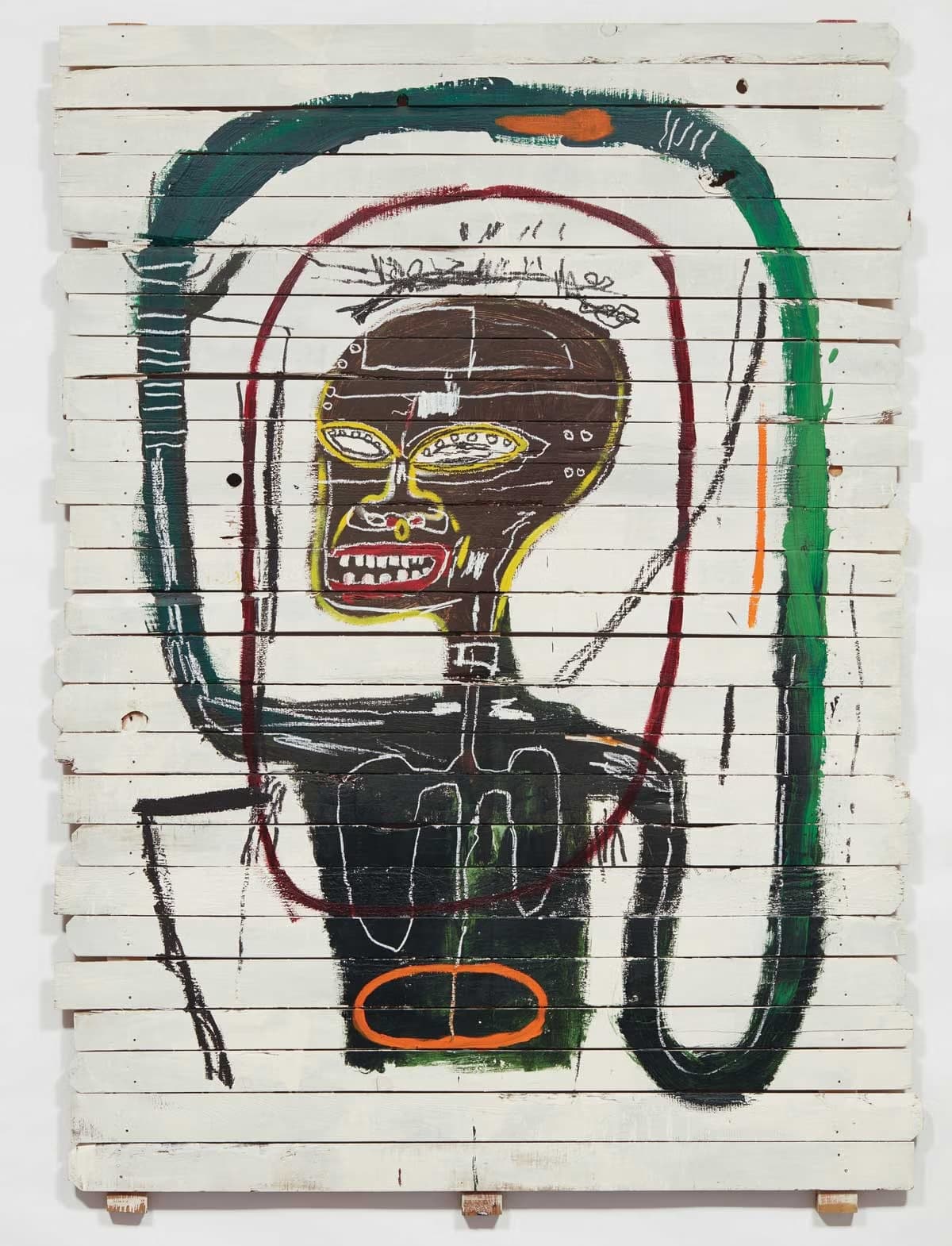
Flexible
Jean-Michel Basquiat, 1984 • Acrylic and oilstick on wooden slats
View more by Jean-Michel Basquiat →Valuation Analysis
Valuation conclusion: I appraise Jean‑Michel Basquiat’s Flexible (1984) at USD 35–55 million, with a working midpoint near USD 45 million. The primary market anchor is the painting’s verified public sale at Phillips, New York, on 17 May 2018 for USD 45,315,000, which establishes a recent, high‑quality realized price for the lot [1].
The estimate is reinforced by a cluster of high‑profile, early‑1980s Basquiat results in recent seasons: Phillips’ mid‑2024 evening‑sale comparable (Untitled/ELMAR, mid‑USD 40M range), Sotheby’s and Christie’s seven‑figure to eight‑figure sales of canonical 1982–83 works, and Christie’s 2023 top‑market outcomes that define the upper ceiling. These comparables show the market supports mid‑double‑digit million outcomes for fresh, well‑provenanced examples while also demonstrating dispersion for 1983–84 works [2].
Work specifics: Flexible’s acrylic and oilstick on wooden slats is a distinctive support that contributes to the work’s individuality and collectible appeal. However, slatted supports introduce conservation and display considerations—possible splits, movement of individual slats, and framing constraints—that prudent buyers explicitly price. A clean, current condition report showing structural stability will be decisive in holding value near the Phillips anchor; evidence of significant conservation interventions would materially depress marketability and realized price.
Provenance and marketability: The Phillips consignment from the Estate of Jean‑Michel Basquiat and the lot’s documented exhibition history are significant pro‑value factors. Estate provenance and cataloguing reduce buyer uncertainty and improve access to evening‑sale bidders and institutional lenders. Conversely, absence of continued public exhibition or gaps in documentation would be a moderating factor.
Market mechanics & timing: Sale method and timing matter. An evening auction during a marquee New York spring season generally maximizes value for works of this profile; private sale timing, day‑sale placement, or sales with limited marketing will likely achieve a lower outcome. Also note that guarantees, third‑party underwriting and private placements can alter signal strength from public hammer prices.
Recommendation: To refine this valuation to a formal insured figure, obtain (a) a written conservator’s condition report focused on the wooden slats, (b) confirmation of Estate authentication/catalogue raisonné entry, and (c) records of any post‑2018 exhibitions or loans. Absent those inputs, USD 35–55 million (midpoint ≈ USD 45 million) is a defensible, market‑facing valuation anchored to the documented 2018 sale and current comparable evidence [1][2].
Key Valuation Factors
Art Historical Significance
High ImpactFlexible is a well‑executed 1984 work by a blue‑chip artist whose market is dominated by early‑1980s masterpieces. While not a canonical 1981–82 “career‑defining” painting, Flexible sits close enough to that period to attract significant collector interest. Its date places it within Basquiat’s mature commercial period when demand was still strong; the work’s aesthetic vocabulary and scale make it desirable to both private collectors and institutions seeking representative post‑1982 material. The historical placement gives it durable market relevance and positions it above typical secondary‑market examples from later years.
Provenance & Exhibition History
High ImpactThe painting’s consignment from the Estate of Jean‑Michel Basquiat is a material value enhancer: Estate provenance reduces questions about ownership history and often implies estate authentication or at least direct provenance tracing. Documented exhibition history (pre‑2018) further strengthens institutional interest and buyer confidence. Works with clear, museum‑level provenance typically attract stronger evening‑sale bidding and are more likely to be acquired by major collections or lent for exhibitions—both value multipliers. Gaps or unresolved provenance issues would be a significant negative.
Condition & Support (wooden slats)
High ImpactThe wooden‑slat support is simultaneously distinctive and technically consequential. Slatted constructions can be vulnerable to movement, warping, splitting or historical repairs; these variables materially affect display and insurance costs. A stable, well‑conserved slat assembly will preserve the painting’s market standing and allow auction houses to market it aggressively. Conversely, evidence of structural compromise or invasive restoration will deter top bidders and reduce liquidity, potentially moving the value to the low end of the estimate band or lower. A conservator’s report is essential.
Authentication & Documentation
High ImpactFormal authentication (Estate confirmation and catalogue raisonné inclusion) and comprehensive documentation—condition reports, invoice history, published references—are critical. Authentication resolves a primary market friction and enables participation by institutional buyers and the most conservative private collectors. Absence of documented authentication increases perceived risk, narrows the bidding pool and can suppress hammer prices. Complete documentation will materially improve the painting’s sale prospects and justify a price at or above the midpoint of the estimated range.
Market Liquidity & Comparables
Medium ImpactBasquiat is a blue‑chip, liquid market at the high end, but liquidity is highly stratified by year, subject and condition. Recent comparables for early‑1980s works cluster in the mid‑tens to high‑seven‑figure band, with occasional outcomes above USD 50M or much lower for less desirable lots. Flexible’s 2018 sale is the best direct anchor; comparable evening‑sale results indicate buyers will pay a premium for fresh, well‑provenanced examples, though 1984 works show greater price dispersion than 1981–82 material.
Sale History
Phillips, New York
Sotheby's, New York
Sotheby's, New York
Phillips, New York
Sotheby's, New York
Jean-Michel Basquiat's Market
Jean‑Michel Basquiat is a top‑tier contemporary artist whose market is anchored by a small number of museum‑quality early‑1980s paintings that set the auction ceiling. Since the 2017 record sale, the market has become more selective: canonical 1981–82 works continue to command the highest prices while 1983–84 works trade across a wider band. Estate provenance, museum loans and fresh‑to‑market consignments remain decisive in extracting premium prices. Basquiat retains blue‑chip status and strong institutional demand, supporting continued high values for the best examples.
Comparable Sales
Untitled (1982)
Jean-Michel Basquiat
Artist auction record and benchmark for top-tier, large early-1980s Basquiat canvases; establishes the market ceiling for canonical 1981–82 works.
$110.5M
2017, Sotheby's New York
~$135.9M adjusted
Versus Medici (1982)
Jean-Michel Basquiat
High-quality 1982 work (peak period) sold in a marquee evening sale; price and date are closely comparable and indicate demand for early-1980s Basquiats above the mid‑tens of millions.
$50.8M
2021, Sotheby's New York
~$59.5M adjusted
Untitled (ELMAR) (1982)
Jean-Michel Basquiat
Recent (2024) evening-sale result at Phillips that sits very close to Flexible's 2018 realized price; strong, fresh-market comparable for mid‑tier masterpieces from the early 1980s.
$46.5M
2024, Phillips New York
~$47.9M adjusted
El Gran Espectaculo (The Nile) (1983)
Jean-Michel Basquiat
Large 1983 painting sold above the $50M band in 2023; a stronger, museum-quality example that defines the upper-middle market for early-1980s works.
$67.1M
2023, Christie's New York
~$71.1M adjusted
Campaign (1984)
Jean-Michel Basquiat
Same-year (1984) example that sold for materially less in 2024, illustrating dispersion for 1984 works and serving as a useful lower-bound comparable.
$10.1M
2024, Sotheby's New York
~$10.4M adjusted
Current Market Trends
The market for Basquiat remains robust but selective: top‑quality, fresh works with tight provenance continue to achieve multi‑million and occasionally eight‑figure results, while mid‑period and later works show greater dispersion. Guarantees and private placements influence public signals; institutional loans and high‑profile exhibitions materially lift demand.