How Much Is Self-Portrait as a Heel (Part Two) Worth?
Last updated: June 1, 2026
Quick Facts
- Last Sale
- $42.0M (2023, Sotheby's New York (Contemporary Evening Auction))
- Methodology
- recent sale
Anchored to the public, arm’s‑length sale at Sotheby’s (Nov 15, 2023) that realized $42,000,000, I place Self‑Portrait as a Heel (Part Two) (1982) in a current market range of $35,000,000–$55,000,000. This band reflects the realized price as the baseline plus a +/- market premium/discount to account for sale channel, timing, condition, and any new documentary evidence.
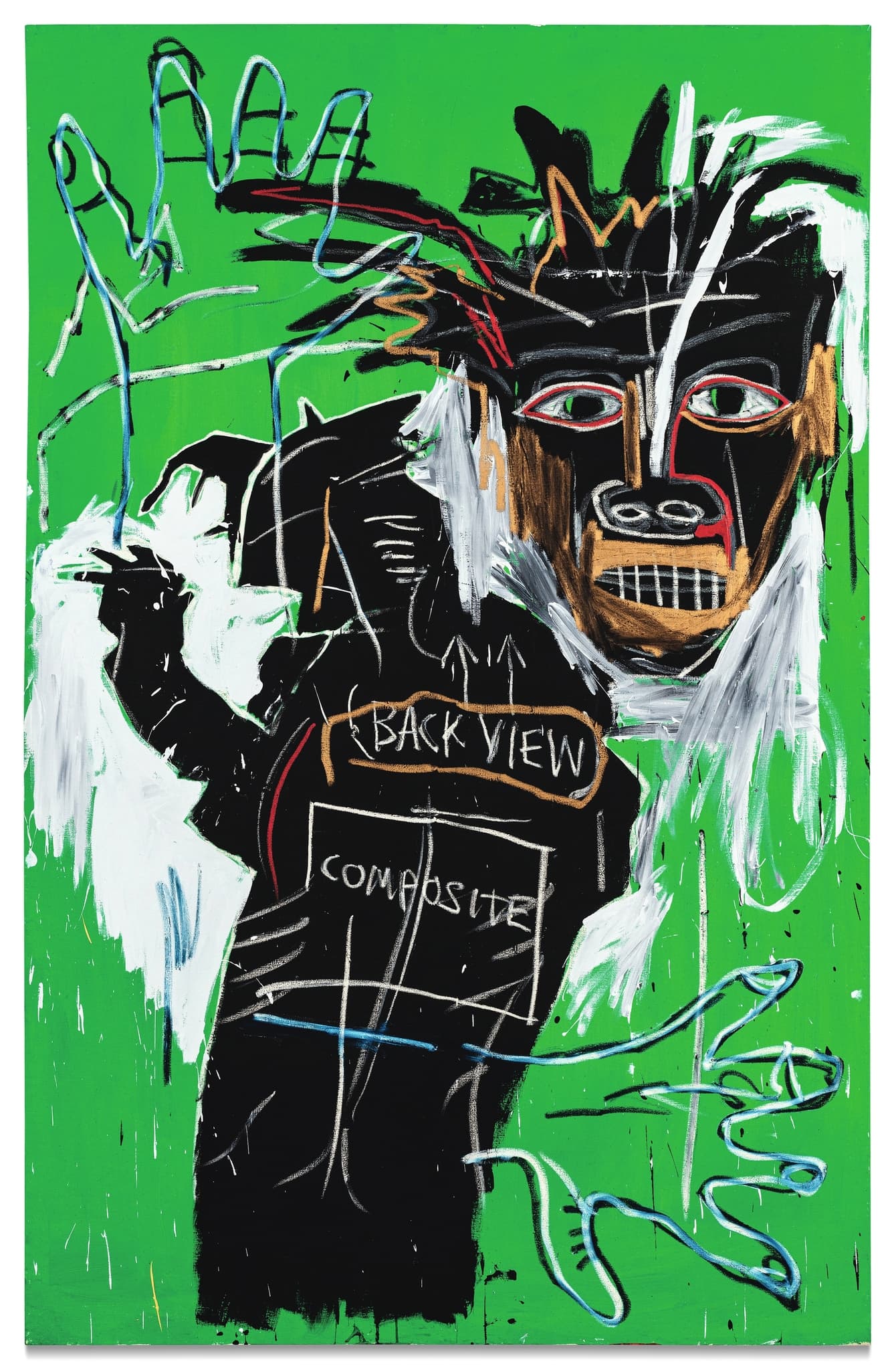
Self-Portrait as a Heel (Part Two)
Jean-Michel Basquiat, 1982 • Acrylic and oilstick on canvas
View more by Jean-Michel Basquiat →Valuation Analysis
Valuation conclusion: This final valuation is anchored to the painting’s documented, arm’s‑length sale. Self‑Portrait as a Heel (Part Two), 1982, realized $42,000,000 (final price with buyer’s premium) at Sotheby’s New York on 15 November 2023; that public sale is the primary market anchor for present value [1]. Accounting for comparable transactions, the painting’s date and scale, and current market conditions, my current market value range for the identical object is $35,000,000 to $55,000,000. This range treats the 2023 sale as the baseline and allows for market movement, sale channel premium/discounts, and any newly surfaced documentation.
The picture’s year (1982) places it in Basquiat’s commercial and critical apex. It is a large‑format, acrylic and oilstick canvas (96 x 61½ in), and the self‑portrait subject carries additional curatorial and collector interest. Works from 1981–83 consistently capture the highest demand within Basquiat’s oeuvre; a large, well‑documented canvas from that period is typically marketable to the blue‑chip collector base that underwrites seven‑figure and multi‑million‑dollar prices. Given those intrinsic attributes, the piece has the formal credentials to trade at the mid‑to‑upper end of the market for Basquiat canvases.
Comparable sales illustrate the valuation bandwidth. The painting’s $42M realization sits close to Phillips’ May 2024 sale of Untitled (ELMAR), 1982 (≈$46.5M), which acts as a practical peer for similarly scaled and dated canvases [2]. Higher marquee results (for example the 1982 skull, In This Case and the Maezawa picture) define the ceiling for the very rare, flagship canvases; more modest 1982 works or those with opaque provenance have historically traded well below the mid‑eight figure threshold. The $35M–$55M band therefore reflects the painting’s 2023 arm’s‑length price, with a ±~25% window to accommodate sale timing, guarantees, and marketing strategy.
Provenance and public exhibition materially support the Sotheby’s outcome and the above range. Sotheby’s lot notes cite early representation by Larry Gagosian, ownership by Stéphane Janssen, a Christie’s 1999 sale, and institutional publication/exhibition history — all factors that reduce buyer risk and increase competitive bidding [1]. If the object being valued exactly matches the images, inscriptions and provenance in Sotheby’s catalogue, the $42M transaction is the most comparable and is the preferred figure for insurance, lending and sale planning.
Risks that would move a fair‑market value materially below this band include undisclosed condition problems, evidence of heavy restoration, gaps or contradictions in provenance, or any contested attribution. Upside to the band would be achieved by fresh high‑profile museum loans, publication in a major catalogue raisonné, or a well‑timed evening sale marketed to deep collectors. Practically, for transaction planning I would treat $42M (the Nov 2023 sale) as the baseline and apply a market premium or discount of up to ~25% depending on timing, sale channel and any new documentary evidence — which yields the $35M–$55M range stated above.
Recommendations: obtain a conservator’s condition report, secure complete provenance documentation tied to the Sotheby’s lot entry, and solicit formal pre‑sale estimates from Sotheby’s/Christie’s/Phillips specialists. If you wish, I can prepare a consignor packet (high‑res images, provenance checklist and suggested auction timeline) keyed to this valuation.
Key Valuation Factors
Art Historical Significance
High ImpactJean‑Michel Basquiat is a defining figure of late 20th‑century American art and 1982 is widely regarded as his artistic apex. A large, dated 1982 self‑portrait carries both curatorial weight and market desirability: it articulates Basquiat’s mature visual language—crown imagery, frontal figuration, text motifs—and resonates with scholarship and exhibition programming. Museums and top collectors prioritize canonical works from this narrow date range, which increases competition and liquidity at auction. In short, the work’s year, subject and scale confer significant art‑historical premium relative to undated or later/earlier studio works, directly supporting multi‑million dollar valuation levels.
Provenance & Exhibition History
High ImpactDocumented early gallery representation (Larry Gagosian), subsequent ownership (Stéphane Janssen), a Christie’s 1999 sale and inclusion in institutional literature/exhibitions materially reduce buyer risk and underpin the Sotheby’s 2023 result. Clean, continuous provenance that ties the canvas to known dealers and institutional displays is a major value multiplier in the Basquiat market because it mitigates forgery/attribution concerns and expands the buyer universe to museums and major private collectors. Conversely, any gaps, disputed ownership or unverified early history would generate substantial discounts and limit marketability.
Condition & Conservation
Medium ImpactCondition is a central commercial factor: original surface integrity, stable stretcher, absence of in‑paintings or heavy lining significantly preserve value for a Basquiat canvas. Any evidence of structural weakness, inpainting, relining, or chemical instability can lower buyer confidence and result in material discounts—often larger than anticipated because conservators’ notes are closely scrutinized by bidders and institutions. For this painting, an up‑to‑date conservator’s report confirming stable condition and conservation history would sustain the mid‑tens of millions valuation; negative findings would push value toward the lower bound or below.
Market Comparables & Liquidity
High ImpactRecent realized prices for 1982–83 Basquiat canvases define a broad but actionable price ladder: marquee 1982 trophies have reached nine figures, several high‑quality 1982 canvases have sold in the $40M–$90M range, and mid‑tier 1982 works settle in the low‑to‑mid‑tens of millions. The subject painting’s $42M Sotheby’s sale places it within the active, liquid tier for such canvases; comparable sales (e.g., Phillips’ $46.5M ELMAR) validate the mid‑to‑high‑tens market. Liquidity remains concentrated at the top end, so marketing strategy (evening sale vs private treaty) materially affects realizations.
Authentication & Catalogue Raisonné
High ImpactEstate/curatorial acceptance and inclusion in authoritative catalogue raisonnés are decisive. A work confirmed by recognized Basquiat scholars or the Estate dramatically reduces buyer risk and raises competitive bidding. Sotheby’s offered this painting as a clearly attributed Basquiat in 2023, which implies accepted attribution at the time of sale; any future contestation of attribution or omission from key catalogues would sharply depress market value. For major consignments, documented expert acceptance is effectively non‑negotiable and can move price by multiples.
Sale History
Sotheby's New York - Contemporary Evening Auction
Christie's New York - Evening Sale (lot cited in provenance)
Jean-Michel Basquiat's Market
Jean‑Michel Basquiat remains a blue‑chip artist in the Post‑War & Contemporary market. His 1981–83 canvases form the most coveted corpus, producing the artist’s highest auction results (record: $110.5M, 2017). Demand is global and deep among private collectors and institutions; however, auction frequency for top‑tier works is irregular and prices are sensitive to provenance, condition and exhibition history. While top results have softened in frequency since 2019–2021, marquee works with clean provenance and museum pedigree continue to command strong multi‑million to multi‑tens‑of‑millions outcomes.
Comparable Sales
Untitled (1982 skull)
Jean‑Michel Basquiat
Iconic, large 1982 Basquiat canvas and the artist's auction record — serves as the upper‑bound for market demand for canonical 1982 canvases with museum quality and flawless provenance.
$110.5M
2017, Sotheby's New York
~$145.7M adjusted
In This Case
Jean‑Michel Basquiat
Major 1983 canvas that realized a top‑tier evening‑sale price in 2021; similar market tier and institutional interest to high‑quality early‑1980s Basquiats — useful for gauging demand for museum‑grade works.
$93.1M
2021, Christie's New York
~$111.0M adjusted
Untitled (Maezawa)
Jean‑Michel Basquiat
Seminal 1982 canvas sold at Phillips — same pivotal year as Self‑Portrait as a Heel (Part Two). Good comparable for high‑quality 1982 works with prominent provenance/collectorship.
$85.0M
2022, Phillips New York
~$93.8M adjusted
El Gran Espectaculo (The Nile)
Jean‑Michel Basquiat
1983 large canvas sold in 2023 for a strong mid‑double‑digit result — a recent mid‑to‑high‑tier auction comparable for large canvases from Basquiat's peak period.
$67.1M
2023, Christie's New York
~$71.0M adjusted
Untitled (ELMAR)
Jean‑Michel Basquiat
1982 canvas sold in 2024 for c.$46.5M — very close in scale and date to Self‑Portrait as a Heel (Part Two) and therefore a highly relevant working comp for valuation.
$46.5M
2024, Phillips New York
~$47.5M adjusted
Current Market Trends
Current market conditions (mid‑2024 to mid‑2026) show selective buying: top‑quality Basquiat canvases continue to perform well, but fewer blockbuster lots appear and buyers apply greater provenance/authentication scrutiny. Works on paper have surged in collector interest, and houses increasingly offer guarantees/private sales for high‑value consignments. Overall, liquidity is concentrated among well‑documented, museum‑quality examples; market cycles and macroeconomic factors introduce a +/- band around realized prices.