How Much Is Benois Madonna (Madonna and Child with Flowers) Worth?
Last updated: May 7, 2026
Quick Facts
- Last Sale
- $80K (1914, Imperial Hermitage (acquisition))
- Methodology
- comparable analysis
Hypothetical market bracket assuming legal sale and unanimous autograph attribution: USD $100–300 million. This reflects the extreme premium for securely attributed Leonardos (ceiling set by Salvator Mundi) tempered by the Benois Madonna’s status as a small, early, and attributionally contested work now held by the State Hermitage.
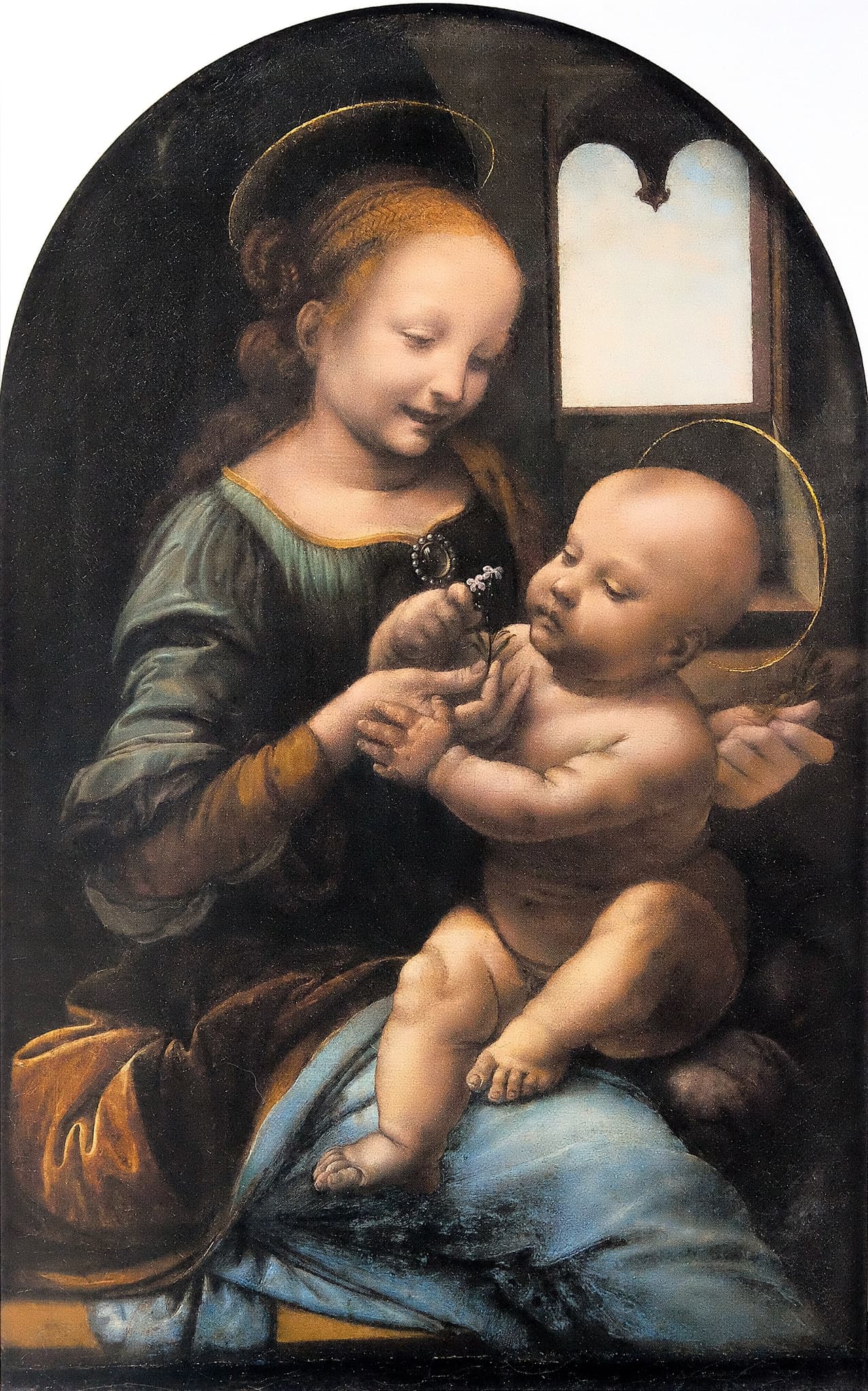
Benois Madonna (Madonna and Child with Flowers)
Leonardo da Vinci • Oil on panel
View more by Leonardo da Vinci →Valuation Analysis
Final valuation bracket: USD $100–300 million. This is a hypothetical market range that assumes the Benois Madonna (Madonna and Child with Flowers) were (a) accepted unanimously as an autograph Leonardo da Vinci and (b) legally transferable into the international marketplace. The work is presently a State Hermitage Museum holding and has not been tested by a modern auction, so any market number is theoretical rather than transactional [1].
Methodology: this estimate is derived by comparative analysis of the high‑end Old Master market, using the 2017 Christie's sale of Salvator Mundi as the practical auction ceiling for works attributed to Leonardo and adjusted downward to reflect the Benois Madonna’s smaller scale, earlier date, and lesser global fame [2]. The lower bound reflects market reality for a securely attributed but small devotional Leonardo; the upper bound reflects strong private‑buyer competition and the precedent that a confirmed Leonardo can enter the hundreds of millions.
Primary value drivers: authorship certainty is by far the single largest determinant — a unanimous attribution to Leonardo would multiply value many times over; a consensus that the painting is largely a workshop production or later copy would collapse value into the low millions. Technical findings (infrared reflectography, x‑radiography, pigment analysis, dendrochronology) and documented conservation history will materially affect the final valuation.
Practical constraints: the painting’s status as a national museum object in Russia creates near‑insurmountable legal and political barriers to export and sale; hence the market value is largely a theoretical exercise unless institutional circumstances change. Historical provenance (reported Duveen interest c.1912 and the Hermitage acquisition in 1914) anchors the picture historically but does not create a modern price test [3][1].
Risk and sensitivity: attribution uncertainty, any substantial overpainting or restoration, panel stability, and gaps in provenance are the principal downside risks; undisputed autograph status, excellent technical findings, and active private‑buyer competition (including state-level or sovereign collectors) are the drivers to the high end. Given current information and constraints, the USD $100–300M bracket is a reasoned market estimate for a saleable, unanimously‑attributed autograph Leonardo; if considered a workshop/follower work, the realistic market would be in the low millions.
Next steps for a narrower appraisal: obtain the Hermitage technical/conservation files, secure authoritative scholarly opinion on attribution, and confirm legal/export status. With on‑site access to technical reports and full provenance documentation I can convert this bracket into a formal insurance or market appraisal.
Key Valuation Factors
Art Historical Significance
High ImpactThe Benois Madonna is important to Leonardo scholarship as an early devotional composition associated with his formative Milanese/Lombard period. While not on the global iconic level of the Mona Lisa or Last Supper, it contributes to our understanding of Leonardo’s early compositional and figural experiments and workshop practice. That scholarly significance translates into collectible and institutional value: works tied credibly to Leonardo carry a disproportionate premium because of rarity, historical interest, and museum demand. For an autograph Leonardo, the painting’s scholarly importance would meaningfully uplift market interest despite its small scale and modest public profile.
Attribution Certainty
High ImpactAuthorship is the dominant determinant of value. Consensus that the Benois Madonna is an autograph Leonardo would move this painting into the small group of market‑defining Old Master masterpieces, commanding prices in the high hundreds of millions in private sale scenarios. Conversely, a consensus that the work is primarily by a studio assistant, follower, or heavily restored copy would reduce value by one or two orders of magnitude. Technical analyses (IR reflectography, pigment and binder studies, dendrochronology) and peer review by leading Leonardo specialists are essential to resolving attribution and therefore to narrowing the valuation range.
Condition & Technical Findings
Medium ImpactThe painting’s physical state—original paint surface, degree of retouching, panel integrity, and previous conservation interventions—affects both aesthetic desirability and market price. Small devotional panels frequently undergo restoration that can obscure original authorship markers; heavy restoration reduces confidence and therefore price. Conversely, demonstrably original paint and favorable technical signatures consistent with Leonardo’s hand would materially increase the value within the autograph bracket. Detailed conservation reports are required to quantify this factor; absent them, condition remains an intermediate but critical uncertainty.
Provenance & Legal Status
High ImpactDocumented ownership back to the Benois family and the reported 1914 Hermitage acquisition provide a clear institutional provenance, but museum ownership by the State Hermitage imposes near‑absolute constraints on sale and export. National cultural property rules and modern geopolitical considerations make a lawful market transfer extremely unlikely. Even if market interest is high, the practical ability to transact the work is the determinative reality: institutional immovability converts market potential into largely theoretical value unless exceptional circumstances enable a sale.
Market Scarcity & Demand
High ImpactLeonardo paintings are among the rarest and most sought‑after assets in the global art market. The small supply of autograph Leonardos and the presence of deep‑pocketed buyers—sovereign museums, foundations, and very affluent private collectors—create the potential for outsized prices when attribution is secure. The 2017 Salvator Mundi sale demonstrated this ceiling. At the same time, demand is highly attribution‑sensitive; buyer confidence in technical and scholarly endorsement is a prerequisite for megasales, meaning scarcity amplifies both upside and downside.
Sale History
Reported dealer offer (Joseph Duveen, appraisal/offer; not completed sale)
Imperial Hermitage (acquisition)
Leonardo da Vinci's Market
Leonardo da Vinci occupies the apex of the Old Master market: securely attributed paintings by Leonardo are exceptionally rare and command a disproportionate share of collector and museum capital. The 2017 sale of Salvator Mundi established the modern price ceiling for a Leonardo at over US$450 million, and most other autograph Leonardos remain in institutional collections and are effectively off‑market. Because the supply of accepted autograph works is effectively fixed, attribution, provenance, and technical certainty drive outsized premiums when a work is judged authentic and saleable.
Comparable Sales
Salvator Mundi
Leonardo da Vinci
Modern auction price ceiling for a work attributed to Leonardo; shows the extreme upper bound if Benois were universally accepted as an autograph and legally saleable.
$450.3M
2017, Christie's New York
~$585.4M adjusted
Copy/variant of Salvator Mundi (damaged, workshop/follower)
Follower of Leonardo da Vinci (attributed)
Recent auction of a damaged workshop/follower copy related to the Salvator Mundi shows the market floor for non-autograph, Leonardo‑related works (low millions or under).
$1.1M
2022, Christie's Paris (Old Masters online sale)
~$1.2M adjusted
Benois Madonna — reported sale into Imperial/Hermitage collection
Leonardo da Vinci (attribution disputed)
The last documented transaction for the actual work; provides a provenance anchor and an early‑20th‑century market benchmark, but is not a modern auction test.
$80K
1914, Sale to Imperial Hermitage (reported payment: 150,000 rubles, 1914)
~$2.5M adjusted
Reported Duveen valuation/offer (for Benois Madonna, c.1912)
N/A (dealer valuation for work attributed to Leonardo)
Contemporary early‑20th‑century dealer valuation by a leading international dealer — useful to show how the work was valued in the cross‑border market at that time.
$100K
1912, Reported Joseph Duveen offer/valuation (not a completed sale)
~$3.3M adjusted
Portraits of Marten Soolmans and Oopjen Coppit (pair)
Rembrandt van Rijn
One of the largest modern museum purchases of Old Masters; relevant as a high‑end museum/Old‑Master benchmark even though by a different artist and subject.
$180.0M
2016, Private sale to the Louvre and the Rijksmuseum (reported)
~$216.0M adjusted
Current Market Trends
The high‑end Old Master market remains concentrated among a narrow set of institutional and private buyers. Demand for securely attributed masterpieces is strong, but buyers are increasingly rigorous about technical scholarship and provenance. Geopolitical and regulatory factors (including national cultural‑property protections) and recent caution around contested attributions temper liquidity. Private sales still occur at the very top end, but unrestricted market access and undisputed attribution are prerequisites for megasales.
Sources
- State Hermitage Museum — Madonna and the Child (The Benois Madonna)
- The Art Newspaper — Leonardo's Salvator Mundi sells for US$450m at Christie's New York (2017)
- ArtDaily / provenance reporting on Benois Madonna (Duveen offer and Hermitage acquisition)
- Artnet News — market commentary on Benois Madonna and Leonardo‑related sales