How Much Is Ginevra de' Benci Worth?
Last updated: May 7, 2026
Quick Facts
- Last Sale
- $5.0M (1967, Private acquisition by the National Gallery of Art from the Princely Family of Liechtenstein)
- Methodology
- comparable analysis
Hypothetically offered on the open market, Ginevra de' Benci would be reasonably valued in the range of $250–600 million, with a central expectation in the low‑to‑mid hundreds of millions (≈$300–$450M). This conclusion rests on Leonardo’s extreme scarcity and high‑end comparable transactions (notably Salvator Mundi) but is tempered by the painting’s museum ownership and likely deaccession/legal constraints.
Valuation Analysis
Valuation conclusion: If Ginevra de' Benci were to be sold on the open market under permissive legal and institutional conditions, a reasoned hypothetical valuation range is $250–600 million, with a central expectation in the low‑to‑mid hundreds of millions (approximately $300–$450M). This view rests on Leonardo’s extreme scarcity, the demonstrated appetite and price ceiling created by Salvator Mundi’s 2017 auction result, and Ginevra’s status as a museum‑quality, early Leonardo portrait held in a major public collection [2][1].
Method and comparables: The primary valuation methodology is comparable analysis. Salvator Mundi’s $450.3M auction result establishes a contemporary trading ceiling for an accepted Leonardo painting and shows that single‑object scarcity can translate into extraordinary prices when attribution and provenance are accepted by the market [2]. Complementary comparables include high‑end Leonardo drawings and recent top Old Master purchases that demonstrate institutional and private willingness to pay mid‑seven to low‑eight figures for securely attributed Renaissance works, supporting a strong scarcity premium for any autograph Leonardo painting.
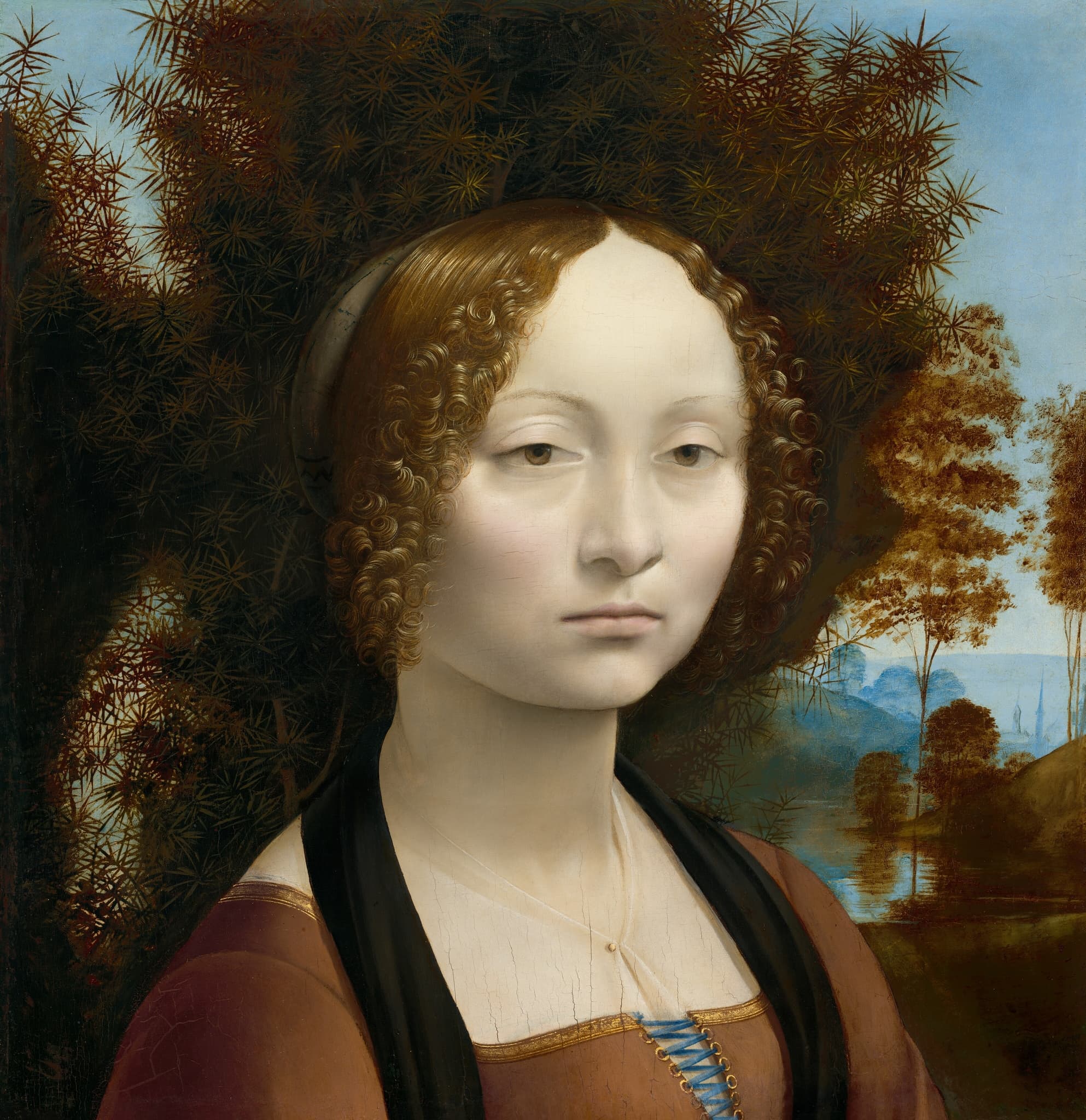
Work‑specific considerations: Ginevra de' Benci is a major early work within Leonardo’s Florentine portraiture, notable for its technical sophistication, the painted reverse (laurel/juniper wreath and motto), and long exhibition/provenance history. It is also the only Leonardo painting in the Americas, which elevates its cultural visibility but does not make it more marketable while in public ownership. The painting’s art‑historical weight supports a premium relative to typical Old Master panels, though its public recognition is below that of the Mona Lisa or Salvator Mundi, placing it below the absolute top tier of cultural iconicity.
Key upside/downside drivers: The most important determinants are (1) attribution confidence and technical condition, (2) provenance and clear legal title, and (3) institutional/legal constraints on sale. If the NGA’s conservation records and technical imaging reaffirm a fully autograph Leonardo in strong condition, private and sovereign buyers would likely bid competitively; conversely, condition issues, extensive restoration, or contested attribution would materially depress value. Most critically, NGA ownership and likely deaccession restrictions make any market sale hypothetical unless formal deaccession were permitted [1][3].
Practical recommendation: To convert this hypothetical range into a firm market estimate, obtain the NGA’s full conservation dossier, technical imagery (infrared, x‑radiography, pigment studies), and accession/deed documentation. With those inputs one can size buyer pools, determine optimal sales mechanism (private treaty vs. auction), and produce a narrower low/central/high valuation scenario tied to evidence. Until such documentation is reviewed, the USD 250–600M band represents a reasoned, evidence‑anchored hypothetical market valuation.
Key Valuation Factors
Art Historical Significance
High ImpactGinevra de' Benci is widely accepted as an autograph, early Leonardo portrait and is central to understanding his development as a portraitist. The painting exhibits early explorations in sfumato, psychological characterization, and compositional restraint that prefigure later masterpieces. Its painted reverse — a laurel/juniper wreath and motto — adds unique documentary and iconographic value that intrigues scholars and curators. While it does not carry the universal cultural recognition of the Mona Lisa, the work’s canonical status within Leonardo’s oeuvre confers a material premium: collectors and institutions prize securely attributed, historically important Leonardo panels, which drives substantial value relative to ordinary Old Master works.
Scarcity / Rarity
High ImpactLeonardo’s corpus of accepted autograph paintings is extremely small (fewer than ~20 agreed panels), which creates an acute scarcity premium for any work that attains consensus attribution. Most major Leonardos are held in museum collections and are effectively off‑market; therefore the appearance of an agreed Leonardo painting generates outsized buyer competition from private collectors, sovereign buyers, and institutions. Salvator Mundi’s extraordinary 2017 price demonstrated empirical willingness to pay in the mid‑hundreds of millions when market confidence exists, and that precedent directly supports a high valuation band for Ginevra if saleability and attribution are clear.
Condition & Conservation
High ImpactCondition is a gating factor for market acceptance and price. Panel integrity, original paint survival, evidence of overpainting, and recent conservation interventions materially influence bidder confidence. For valuations in the hundreds of millions, buyers demand rigorous technical documentation (infrared reflectography, x‑radiography, pigment analysis, microscopic layer studies) demonstrating autograph paint and a coherent conservation history. Any unresolved conservation questions or visible compromises in original materiality would materially reduce the buyer pool and depress price, while clean, independently verified conservation records can unlock the high end of the valuation range.
Provenance & Legal / Deaccession Constraints
High ImpactClear, unencumbered title is essential. Ginevra’s provenance is well documented and the NGA acquired it in 1967, but the museum’s accession terms, donor conditions, and federal/state museum governance commonly create strong barriers to sale. Deaccession policies, donor restrictions, or national heritage statutes can render works inalienable or require lengthy approvals, effectively removing marketability. Any practical valuation therefore needs explicit confirmation that legal and governance pathways exist for transfer; absent that, the valuation remains hypothetical and contingent on a deaccession decision or exceptional political/legal circumstances.
Market Demand & Comparables
High ImpactBuyer concentration and comparables dynamics heavily influence price. The ultra‑high end is populated by a small set of buyers (sovereigns, private collectors, museums) whose competitive behavior can push prices to record levels when attribution and provenance are secured. Salvator Mundi established a ceiling that demonstrates this dynamic; complementary evidence from high‑end drawings and Old Master acquisitions indicates robust demand for academically validated works. However, the market is risk‑averse—attribution debates or provenance gaps rapidly narrow the buyer set and reduce realized prices. Clean scholarship, exhibition history, and technical backing therefore materially increase market appetite.
Sale History
Ginevra de' Benci has never been sold at public auction.
Leonardo da Vinci's Market
Leonardo da Vinci occupies the apex of the Old Master market. Very few autograph paintings survive and most are in public institutions, so the private supply is essentially zero and any sale attracts extreme interest. Salvator Mundi’s 2017 auction showed the upper bound of market willingness for an accepted Leonardo painting, but it also produced intense scholarly scrutiny that has made buyers more cautious. In short, Leonardo is uniquely scarce, commands exceptional prices when attribution and condition are clear, and is subject to unusually rigorous technical and provenance vetting.
Comparable Sales
Salvator Mundi
Leonardo da Vinci
Same artist and same medium (oil painting); the 2017 sale is the empirical auction ceiling for Leonardo works and therefore a primary market benchmark (despite attribution/contestation issues).
$450.3M
2017, Christie's New York
~$518.0M adjusted
Head of a Bear (drawing)
Leonardo da Vinci
Recent record for a Leonardo drawing; demonstrates strong collector/institutional willingness to pay premiums for securely attributed Leonardo material, even when the object is not a painting.
$12.2M
2021, Christie's London
~$13.7M adjusted
Study of a Right Foot (Sistine study)
Michelangelo Buonarroti
High-profile sale of a securely attributed Renaissance drawing by a canonical master; indicates active demand (and willingness to pay tens of millions) for top‑tier, well-documented Old Master works, supporting a scarcity premium for autograph pieces.
$27.2M
2026, Christie's New York
~$26.7M adjusted
Ecce Homo
Antonello da Messina
Institutional purchase of an important early‑Renaissance panel; useful as a period/market comparator showing what museums/sovereigns will pay for major, well-provenanced early-Renaissance works (though Antonello is less globally scarce/market-catalytic than Leonardo).
$14.9M
2026, Sotheby's (sale to Italian Ministry of Culture)
~$14.6M adjusted
Current Market Trends
The Old Masters segment (2024–2026) is quality‑led: top buyers and institutions favor well‑provenanced, technically documented works. Recent record sales for Renaissance drawings and selective institutional purchases indicate renewed appetite at the top end, but contested attributions (as with Salvator Mundi debates) have increased conservatism. Liquidity is thin and buyer concentration high; timing, scholarly consensus, and legal clarity determine whether a given canonical work realizes premium prices.