How Much Is Salvator Mundi Worth?
Last updated: May 6, 2026
Quick Facts
- Last Sale
- $450.3M (2017, Christie's New York (Post‑War & Contemporary Evening Sale))
- Methodology
- comparable analysis
Anchor valuation to the 2017 Christie’s public sale: if broadly accepted as an autograph Leonardo with clear provenance and public exhibition, the realistic market range is $300M–$600M. If the attribution is downgraded or remains contested, value collapses into the low‑tens of millions ($5M–$60M).
Valuation Analysis
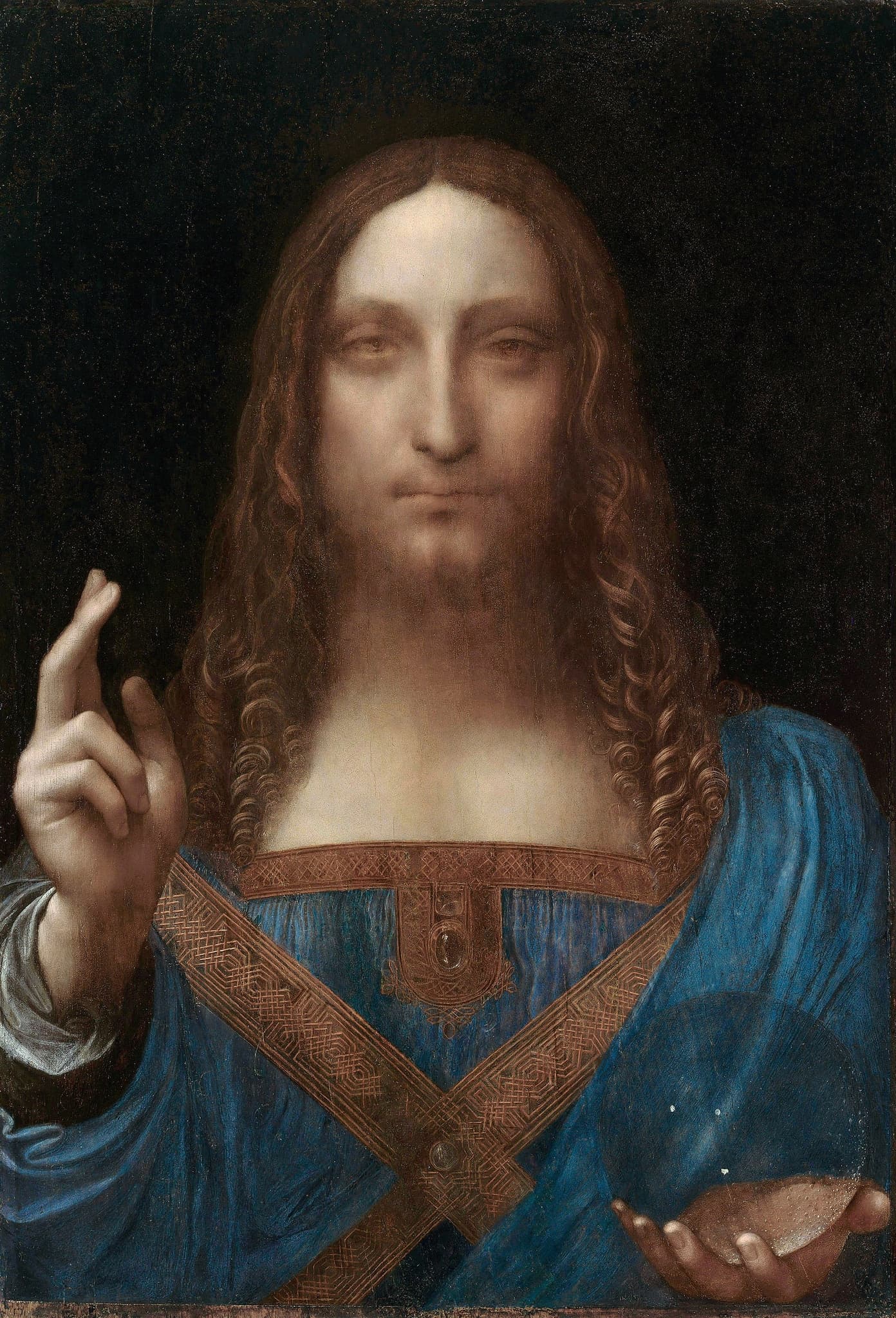
Valuation conclusion: Using the 2017 Christie’s New York sale as the primary market anchor, this analysis produces a working market range of $300,000,000–$600,000,000 if the painting is broadly accepted as an autograph Leonardo and offered with clear provenance and public visibility; if attribution is downgraded to a workshop or remains seriously disputed, the value is more likely in the $5,000,000–$60,000,000 band. The 2017 public sale (hammer c. $400m; total $450,312,500) is the decisive recent price point for market modelling [1].
This valuation uses a comparable‑analysis approach: the Salvator Mundi auction result is unique but can be framed against recent trophy purchases and top public‑auction records for canonical masters to determine realistic ceilings and floors. Private‑sale trophies (major Cézanne, de Kooning and Gauguin examples) and sovereign collecting behaviour demonstrate there is a credible demand segment willing to pay very high prices for one‑off masterpieces; however, differences in medium, historic attribution certainty, and institutional appetite mean each comparable must be weighted conservatively in modelling.
The valuation is extremely sensitive to authorship and condition. The painting was included in the National Gallery’s 2011 research/exhibition cycle and subsequently presented to the market as an autograph Leonardo, but substantial and ongoing scholarly dispute persists about the extent of Leonardo’s hand versus workshop contribution and about the impact of extensive restoration and overpainting [2]. Objective, owner‑authorised technical data (IR reflectography, pigment XRF, cross‑sections, varnish stratigraphy and dendrochronology of the panel) would materially narrow uncertainty and could move a market price point by multiples.
Provenance opacity and current ownership status materially depress liquidity. The modern rediscovery, the 2013 private transaction chain and the 2017 auction have been well reported, but gaps before the 20th century and litigation‑adjacent private transfers (dealer‑to‑dealer) create title and reputational risk that institutional buyers factor heavily into bids [3]. Public reporting linking post‑2017 ownership to Saudi intermediaries and a postponed Louvre Abu Dhabi display mean the work is effectively off‑market and inaccessible to independent scholarship and potential bidders, further reducing realistic price‑realization prospects [4][5].
Practically, if the owner places the work on the market with full technical dossiers, firm provenance, and major‑museum exhibition plans, top competitive bidding from states or ultra‑high‑net‑worth collectors could support prices in the mid‑ to high‑hundreds of millions (hence the $300M–$600M band). If the technical dossier or curatorial consensus instead supports a workshop attribution or shows a majority of visible surface is later restoration, market participants would apply severe discounts, pushing value to the low tens of millions or below (the $5M–$60M scenario).
Recommended next steps: to refine this valuation to a formal appraised figure, obtain owner‑authorized technical conservation records and a current condition report, secure written provenance documentation to 16th–17th century where possible, and seek independent curatorial assessments from leading Leonardo scholars. With those inputs the range can be tightened materially; without them this estimate remains a scenario‑based market appraisal anchored to the 2017 sale datum [1][2].
Key Valuation Factors
Art Historical Significance
High ImpactSalvator Mundi occupies a unique place in the market because, if accepted as an autograph Leonardo, it would be one of only a handful of surviving paintings by the master, conferring near-unique scarcity and institutional demand. Leonardo’s canonical status multiplies prices beyond standard Old Master levels: museums and sovereign collections prize autograph works of this rarity for national prestige and permanent display. That singular significance is a potential multiplier on top of technical and provenance validation. However, the painting’s contested attribution and restoration history mean the significance is conditional — only secure attribution and transparent condition/provenance documents will convert historical importance into top‑end monetary value.
Attribution Certainty
High ImpactAuthorship is the single largest value driver. A clear, widely accepted Leonardo attribution converts the painting into a near-unique trophy masterpiece and commands top-tier pricing; a downgrading to workshop or follower removes most of the scarcity premium and aligns the work with much lower Old Master workshop prices. Given extensive and visible conservation intervention, independent technical and connoisseurial validation is essential. Market participants price attribution risk aggressively: unresolved academic debate or dissent among leading Leonardo scholars will produce large discounts, whereas strong, documented consensus can re‑establish the painting’s ability to attain or exceed its 2017 realisation.
Condition & Restoration
High ImpactExtensive restoration and overpaint materially affect both aesthetic and scientific assessments of authenticity. Later interventions can mask original paint layers, alter brushwork perception, and complicate pigment and stratigraphic analysis crucial for attribution. A full conservation dossier — including cross‑sections, varnish stratigraphy, and documented treatment history — is required to quantify what portion of the visible surface is original and how restoration affects market perception. Without transparent, owner‑authorised technical records conservators and prospective buyers will discount for uncertainty; with a clean, documented condition report, institutional confidence and realized prices can rise substantially.
Provenance & Title
High ImpactClear, continuous provenance is essential at this price scale. Gaps or ambiguities prior to the 20th century introduce legal and reputational risks that deter museums and conservative private buyers. The modern rediscovery (2005), subsequent private dealer chain and intermediate transactions have been scrutinised in litigation and press reporting, increasing buyer caution. Definitive archival evidence extending reliably into early centuries reduces title risk and underpins institutional acquisition. Conversely, unresolved provenance gaps, potential restitution claims, or opaque intermediary transactions materially reduce the pool of credible buyers and lower expected sale proceeds.
Market Liquidity & Ownership/Location
High ImpactCurrent off‑market status and opaque ownership materially lower liquidity. Works held in private or state collections with restricted access attract fewer bidders and present complex transactional, political, and reputational risks. Public exhibition — lending to major museums — is often necessary to mobilize institutional interest and maximize competitive bidding. If ownership remains unwilling to permit study or sale, realistic realization will likely be well below theoretical ceilings. Conversely, a market offering accompanied by exhibition guarantees and full disclosure would increase competition and support the upper end of the valuation range.
Sale History
Sotheby's, London
Regional/estate sale (New Orleans)
Private sale (to Yves Bouvier)
Private sale (resale to Dmitry Rybolovlev)
Christie's New York (Post‑War & Contemporary Evening Sale)
Leonardo da Vinci's Market
Leonardo da Vinci occupies the apex of the Old Master market: securely attributed paintings are extremely rare and almost exclusively held by national museums, making supply effectively fixed. Because of that scarcity and Leonardo’s global cultural cachet, attributions to Leonardo attract intense attention and significant premiums, particularly from sovereign buyers and ultra‑high‑net‑worth collectors seeking trophy acquisitions. Market pricing thus depends disproportionately on scholarly acceptance and transparent technical evidence; a confirmed autograph Leonardo commands multi‑hundred‑million valuations, while any credible doubt dramatically reduces market appetite and price.
Comparable Sales
Salvator Mundi
Leonardo da Vinci
Primary public‑auction benchmark: same work and attribution claim; sets the market anchor for an accepted autograph Leonardo.
$450.3M
2017, Christie's New York (Post‑War & Contemporary Evening Sale)
~$595.0M adjusted
The Card Players
Paul Cézanne
High‑end private sale of a single canonical masterpiece to a sovereign/elite buyer — useful ceiling for trophy‑asset pricing and sovereign demand.
$250.0M
2011, Private sale (reported sale to Qatari royal collection, 2011)
~$360.3M adjusted
Interchange
Willem de Kooning
One of the top private‑sale prices in the market; demonstrates private‑market ceilings for unique, museum‑quality masterpieces (though modern rather than Old Master).
$300.0M
2015, Private sale (reported sale to Kenneth C. Griffin, 2015)
~$410.0M adjusted
Nafea Faa Ipoipo (When Will You Marry?)
Paul Gauguin
Another very large private‑sale trophy purchase of a canonical 19th‑century master; relevant for understanding sovereign/elite buying behaviour and private‑sale pricing.
$300.0M
2014, Private sale (reported sale to private/Qatari buyer, 2014)
~$410.4M adjusted
Les Femmes d'Alger (Version O)
Pablo Picasso
High‑profile auction record for a modern master; demonstrates how competitive bidding in marquee evening auctions produces very large public‑sale prices.
$179.4M
2015, Christie's New York (Evening Sale, 11 May 2015)
~$245.2M adjusted
Portrait of Dr. Gachet
Vincent van Gogh
Former auction record for a single painting (at the time); useful historical precedent showing how canonical‑artist works have set high price points and how long‑term inflation/market growth affects valuation.
$82.5M
1990, Christie's (reported sale, 1990)
~$193.1M adjusted
Current Market Trends
At the top end, the market remains driven by sovereign and UHNW collectors, with private‑sale trophies and marquee auction results setting de facto ceilings. While macroeconomic volatility and regulatory scrutiny can compress liquidity, buyers continue to pay premiums for unique canonical works. For Old Masters, museum budgets are constrained, so private and state buyers remain decisive. Attribution confidence, condition transparency, and exhibition plans are increasingly critical to unlock the highest valuations; without them, even high‑profile works face steep discounts.
Sources
- Christie's press release: Salvator Mundi sold for $450,312,500
- Robert Simon: Leonardo's Salvator Mundi (exhibition/restoration/discussion)
- Legal and reporting summary of 2013 private dealer transactions (Bouvier/Rybolovlev)
- The Guardian: Louvre Abu Dhabi postpones display of Salvator Mundi
- Smithsonian Magazine: reporting on purchaser identity and subsequent ownership reporting