Portrait on a White Cover

by Lucian Freud

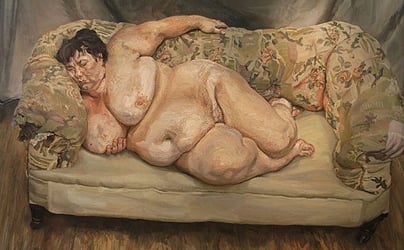
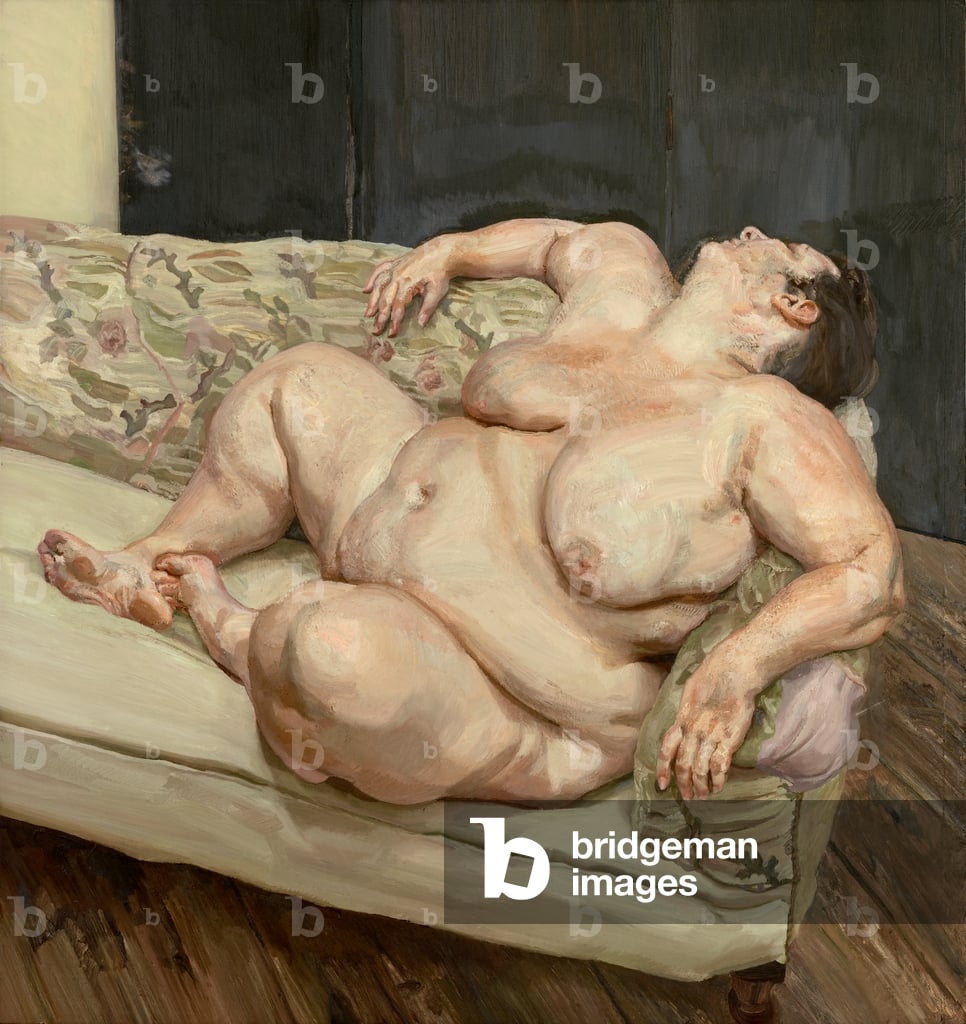
Lucian Freud’s Portrait on a White Cover turns the human body into a field of material truth, setting warm, bruised flesh against a cool, worked cloth that is named in the title. The diagonal sprawl, clenched left hand, and twisted feet make gravity and duration felt as subjects in their own right [1][2].

Study Print Studio

Create a personal study print

Build a companion study sheet around the part of this painting that speaks to you most. Choose a detail, shape an interpretation, and walk away with something personal and display-worthy.

Fast Facts

Year
2002–2003
Medium
Oil on canvas
Dimensions
116.5 × 143 cm (45 7/8 × 56 1/4 in)
Location
Private collection (sold Sotheby’s London, June 26, 2018)
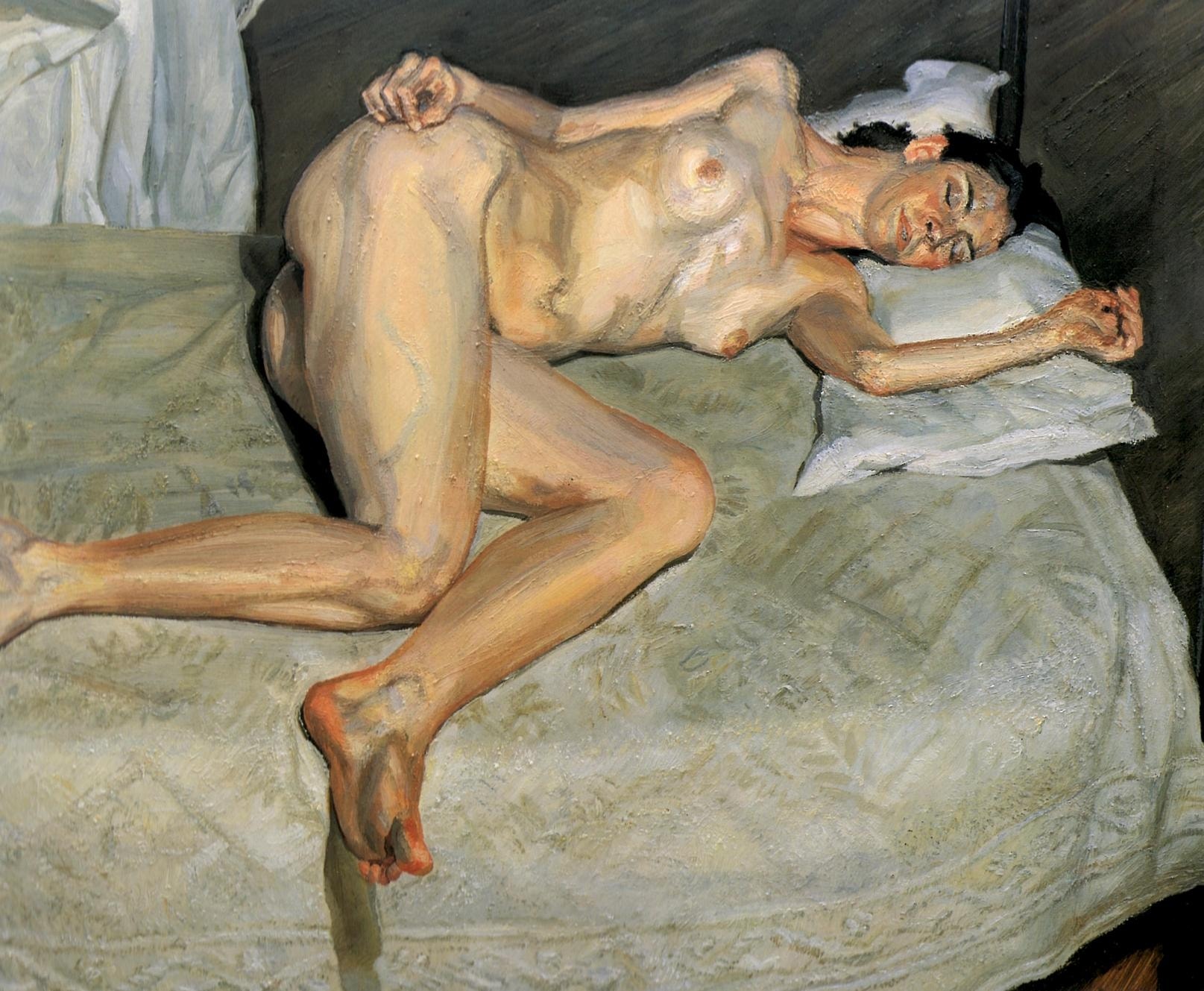
Portrait on a White Cover by Lucian Freud (2002–2003) featuring White cover (bed sheet), Diagonal bed edge, Clenched left hand, Twisted feet and taut tendons

Click on any numbered symbol to learn more about its meaning

Meaning & Symbolism

Freud builds a drama of contact—skin to sheet, weight to ground—by bisecting the bed with a raking diagonal and letting the body cross it like a hinge. The left hand tightens into a knot on the thigh; the feet torque outward with tendons pulled taut; the mouth and eyelids slacken. These contradictions—tension and sleep, exposure and withdrawal—are not psychological metaphors so much as physical facts rendered as form. The light, glancing across hip, rib, knee, and the raised knuckles, prints every plane of the body into visibility, while the granular brushwork turns skin into a topography of ochres, greens, and violets that critics have noted in Freud’s late palette 2. Against this living surface, the white cover is not neutral. Its faint patterning, stains, and chilled greys green the room’s temperature and draw heat from the flesh, so that the bed behaves like a second sitter. By naming the cover in the title, Freud elevates drapery to a structural counterpart of the body, echoing Old Master precedents where cloth clarifies volume and foreshortening; here it frames the splayed legs and foreshortened foot with a clarity that feels almost forensic 1. Freud’s long-declared aim of an “intensification of reality” replaces symbolism with matter: paint is the carrier of truth, not an allegory for it 13. The pillow, roughly indented by the head, records pressure over time; the cover’s scuffed motifs trace daily usage; the edge of the mattress bites into the thigh. Each mark accounts for how bodies actually inhabit rooms. That is the ethical core of Freud’s “naked portrait” ethos—the sitter is not generalized into a type, but encountered as a particular, and yet ultimately unknowable, presence 1. The cool tonality and the studio’s clinical vantage make the viewer a near-intruder, but the work never claims psychological certainty; instead it registers how observation, over many months of sittings, sediments into surface. In this late phase—contemporary with and following his Tate retrospective—Freud consolidated decades of research on the reclining figure, replacing theatrical pose with gravity itself as subject 156. The result is a paradox: intimacy sharpened by scrutiny. The white cover reads at once as bed, shroud, and hospital sheet, yet these associations arise from things themselves—cloth, light, pressure—not from imposed iconography. That is why Portrait on a White Cover stands as a culminating statement of the School of London’s belief that looking, sustained and unsentimental, can still yield a modern image of human presence 4.

Explore Deeper with AI

Ask questions about Portrait on a White Cover

Popular questions:

Powered by AI • Get instant insights about this artwork

💬 Ask questions about this artwork!

Interpretations

Formal Analysis — Drapery as Co-Sitter

The title’s emphasis on the cover signals drapery as a co-equal subject, not mere backdrop. Freud leverages the cloth’s chilled greys and faint motifs to contour hips, knees, and the foreshortened foot with almost forensic clarity. This is a modern reactivation of Old Master strategies—think Ingres, Mantegna, Velázquez—where fabric sharpens perspective and exposes weight. Here, folds aren’t picturesque; they are instruments of volume-clarification, counterpointing the granular flesh and stabilizing the body’s diagonal hinge across the bed. In this sense, the white cover behaves like a second sitter that both cools and calibrates the figure, making contact (sheet-to-skin, weight-to-ground) legible as pictorial structure rather than anecdote 14.

Source: Sotheby’s catalogue essay; National Galleries of Scotland (School of London context)

Historical Context — After the Retrospective: Gravity as Subject

Painted in 2002–03, immediately after Freud’s Tate retrospective, the work belongs to a consolidation phase in which he strips the reclining nude of theatrics and lets gravity do the posing. Contemporary displays (Wallace Collection, then Acquavella) underscored the astonishing late-career output and the studio’s clinical vantage. Across months of sittings, Freud tracks pressure over time—the pillow’s indentation, mattress bite, and splayed feet—as empirical data. The result is an image whose drama is induced not by narrative but by duration: the material record of hours accumulating into surface. In late Freud, the bed and body become a field of forces measured by light and touch, recasting the postwar nude as a problem of weight, balance, and tempo 126.

Source: Wallace Collection Annual Report 2004–05; artcritical review (2004); Sotheby’s catalogue essay

Psychological Interpretation — Unknowability Under Clinical Light

The painting’s cool tonality and high vantage cultivate an intrusive closeness that stops short of psychological claim. As Sebastian Smee argues, Freud’s portraits achieve presence while acknowledging the sitter’s unknowability. The slack mouth and heavy eyelids don’t decode an inner state; they register the body’s expenditure across protracted sittings. The clinical light prints every plane into view, but what it reveals is material contingency—the topography of skin—rather than character. This is the School of London’s wager: sustained looking can thicken reality without promising confession. The effect is a paradoxical intimacy—sharp, bodily, unidealized—held at a measured distance by scrutiny itself, a stance the New Yorker reads as Freud’s “truth of the body,” not its psychology 15.

Source: Sebastian Smee (monograph, quoted in Sotheby’s); The New Yorker (2021)

Technical/Material Reading — Palette as Physiology

Freud’s late palette—ochres, livid greens and yellows, dust blues, chromium whites—operates like physiology in paint. The granular, dragged strokes articulate tendon pull, venous blues, and areas of chilled or heated flesh, so that color functions as a diagnostic rather than decorative device. In raking light, the knuckles, hip, and rib become relief maps whose chromatic modulations imply circulation, pressure, and rest. This is consistent with Freud’s pursuit of an intensified reality, where facture is the truth-condition: the body is not idealized contour but a layered record of time spent, light absorbed, and touch resisted. The portrait’s intimacy thus resides in its corporeal palette, which makes the sitter present as living matter rather than as symbol 37.

Source: The Guardian (2012 review of Freud’s portraits); Getty/Tate (Auping interview reference)

Symbolic Reading — Memento Without Metaphor

The white cover reads, by sheer resemblance and use, as bed, shroud, and hospital sheet. Yet Freud’s anti-symbolist stance keeps these meanings grounded in things themselves: cloth, light, pressure, stain. The hospital inflection comes from the cover’s cooled greys; the shroud from the stilling spread and framing of limbs; mortality from the way gravity flattens and exposes. This is a memento mori achieved through observation, not emblem. By refusing allegorical shortcuts, Freud lets the image accrue existential weight through material facts, fulfilling his idea of an “intensification of reality.” The painting’s ethical charge—neither consoling nor accusatory—arises where empirical seeing brushes against the limits of the body’s time 17.

Source: Sotheby’s catalogue essay; Getty/Tate (Freud’s statements on ‘intensification of reality’)

Related Themes

About Lucian Freud

Lucian Freud (1922–2011) was a Berlin-born, British painter and a leading figure of postwar figurative art associated with the School of London. Across decades, he shifted from linear precision to dense impasto, developing an exacting practice of prolonged sittings that produced psychologically charged “naked portraits” challenging the idealized tradition of the nude [3][4].
View all works by Lucian Freud

More by Lucian Freud