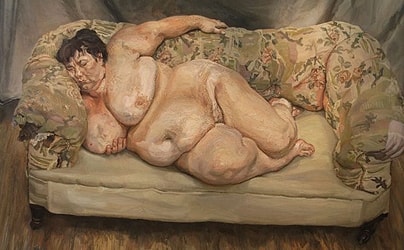
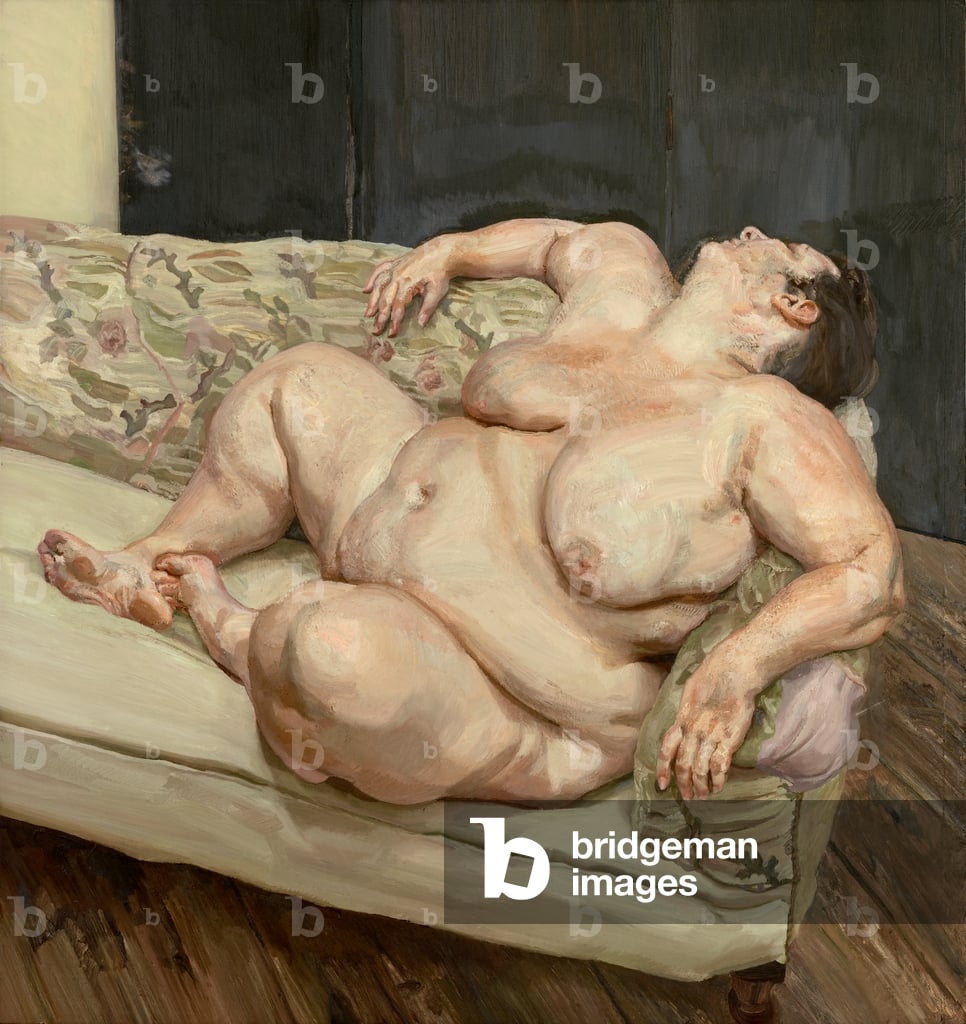
Benefits Supervisor Sleeping

by Lucian Freud

Benefits Supervisor Sleeping is a 1995 oil painting in which Lucian Freud renders a sleeping, unidealized body across a sagging, floral sofa. With dense, tactile brushwork and a close, low vantage, the work asserts monumental presence while confronting viewers with the material truth of flesh and time’s imprint. It is a late‑century landmark of the School of London’s uncompromising figurative art [1][4].

Study Print Studio

Create a personal study print

Build a companion study sheet around the part of this painting that speaks to you most. Choose a detail, shape an interpretation, and walk away with something personal and display-worthy.

Fast Facts

Year
1995
Medium
Oil on canvas
Dimensions
151.3 x 219 cm
Location
Private collection
Benefits Supervisor Sleeping by Lucian Freud (1995) featuring Worn floral sofa, Pressure points/indentations, Sleeping posture, Monumental torso

Click on any numbered symbol to learn more about its meaning

Meaning & Symbolism

Freud constructs meaning here through facture and posture rather than anecdote. The thick, variegated paint turns skin into terrain—veins mapped in ridges, temperatures shifting from warm umbers to cooler grays at the knees and ankles, and those small crimsoned zones where flesh meets upholstery. Light pools across the abdomen and thigh, not to flatter but to register weight and gravity, so that the body reads as both subject and evidence, a record of living rather than a fantasy of it 36. The figure’s sleep—jaw slackened, cheek pressed into the right forearm, the left arm curled defensively—cancels theatrical self-presentation and with it the conventional codes of erotic display; we are placed in a charged interval between intimacy and scrutiny, invited to acknowledge a common, vulnerable corporeality rather than to consume a spectacle 5. Freud’s low, frontal vantage amplifies scale: the torso becomes almost architectural, asserting a monumental presence that rebukes taste-bound hierarchies of beauty while conferring dignity through sheer painterly attention 16. Equally decisive is the sofa: a faded, floral thing with seams abraded, cushions slumped, and pattern worn to patches. Freud famously acquired such a “worn out” couch for this very purpose, and here it acts as a visual ledger of time—the upholstery’s collapse mirrors the body’s relaxation, its frayed blooms a memento of domestic use that counters any myth of timeless ideal form 2. Where the thigh presses into the cushion, the fabric dimples visibly; where the shoulder meets the armrest, the floral arabesques distort, making the furniture a register of contact and duration. In this reciprocity—flesh shaping fabric, fabric receiving flesh—Freud forges an ethic of looking that privileges material encounter over allegory. The painting thus enters the long tradition of the reclining figure only to invert it: not a perfected “nude,” but a specific, sleeping person whose body is rendered with the same unflinching scrutiny Freud accorded all his “naked portraits” 3. That commitment aligns him with the School of London’s postwar insistence on the stubborn facticity of the body—its mass, its time, its mortality—against both abstraction’s purities and the market’s fantasies 4. Finally, the work’s close framing, earthbound palette, and hours-laden surface make time almost audible; each brushmark is a tick. The floorboards tilt forward, the studio cloths sag behind the sofa, and the entire composition settles downward, as if acknowledging gravity as the painting’s real protagonist. Yet what might read as exposure also reads as repose: sleep protects the sitter from our gaze even as it makes the body available to it, converting voyeurism into recognition. That moral pivot—between looking at and looking with—explains why Benefits Supervisor Sleeping endures: it makes a modern monument from the ordinary, compelling us to see in the pressure points, pallor shifts, and worn fabric an image not of spectacle but of shared human endurance 156.

Explore Deeper with AI

Ask questions about Benefits Supervisor Sleeping

Popular questions:

Powered by AI • Get instant insights about this artwork

💬 Ask questions about this artwork!

Interpretations

Art-Historical Genealogy (Reclining Figure Inverted)

Freud’s recumbent body engages the long history of the reclining nude—from Titian and Rubens to Velázquez—only to reverse its premise. Instead of an allegorical Venus, we meet a sleeping civil servant on a sagging floral sofa, her presence asserted by scale, gravity, and facture rather than by ideal form. Scholarship on the Tilley cycle notes Freud’s conscious dialogue with Old Masters even as he substitutes the naked portrait for the idealized nude, and a low, frontal vantage that reads as architectural mass rather than erotic invitation 93. The result is a secular, postwar counterpart to the classical nude: a picture that maintains the format’s monumentality while stripping away its mythology—beauty is not a style but the intensity of attention paid to a particular life.

Source: Christie’s (Benefits Supervisor Resting essay)

Theory: Naked vs. Nude (Ethics of Depiction)

Freud’s insistence on the term “naked portrait” reframes the genre ethically. As MoMA observes, he repudiates the “nude” as an objectifying ideal, insisting on a person seen over time, with circulation, pallor, and pressure made visible in paint 3. Read through Kenneth Clark’s classic polarity, Freud deliberately aligns with the vulnerable, time-bound naked, not the timeless nude—yet he does so at monumental scale, collapsing Clark’s hierarchy from within 10. The thick, incremental facture is not garnish but evidence, a record of sittings that renders the body neither emblem nor type but a singular presence. In this sense, the painting is a study in truth over artifice, where beauty inheres in the work of looking, not in conforming to an inherited ideal.

Source: MoMA (press text on Naked Portraits)

Material Time and Object Biography (The Sofa as Witness)

Freud bought the “worn out” sofa specifically for Tilley after an earlier, uncomfortable pose, integrating a humble studio object into the work’s temporal engine 2. Its frayed blooms, collapsed cushions, and distortions where flesh meets fabric function as a ledger of contact: the upholstery records duration as surely as the layered brushstrokes do. In tandem, surface and support convert the picture into an index of hours—“each brushmark is a tick”—so that domestic material becomes a chronicle of attention 12. This object-biographical reading sidesteps symbol-hunting: the sofa is neither prop nor allegory but a participant in the painting’s ethics, receiving and reflecting the body’s weight while insisting on the ordinary infrastructures that sustain looking.

Source: Christie’s (pre-sale release and lot entry)

School of London Lens: Facticity Against Fantasy

Situated within the School of London, Freud’s method insists on the stubborn materiality of the human figure against both abstraction’s purities and the market’s fantasies 4. Sleep here is not an alibi for voyeurism but a way to neutralize self-presentation, compelling a mode of attention closer to recognition than consumption 5. The painterly “topography” of skin—veins, warmth shifts, pressure flush—enacts a phenomenology of flesh rather than a spectacle of display. This is a postwar ethos: to render the facticity of the body—its mass, time, and vulnerability—without consoling myths. Freud’s low, frontal vantage augments this ethic, making the torso read as almost architectural, a secular monument to corporeal endurance rather than to ideal beauty 45.

Source: National Galleries of Scotland (School of London) / The New Yorker

Social Portraiture: Work, Class, and the Ordinary

Sue Tilley was a Jobcentre benefits supervisor, introduced to Freud by Leigh Bowery; the painting’s very title announces labor and class rather than mythic identity 7. Paired with the frayed domestic sofa, the image refuses the patrician staging of the classical nude, locating monumentality in the ordinary—street-level Britain in the 1990s rather than Arcadia 26. Critics have noted how Freud’s late portraits dignify bodies outside normative ideals, conferring presence without flattery 6. In this light, the work operates as social portraiture: it names the sitter’s role in public service even as it grants her the kind of sustained, painterly attention historically reserved for elites. The result is a class-conscious recalibration of who merits the grand scale of history painting.

Source: National Portrait Gallery (Lucian Freud Portraits)

Reception & Value: The Market and the Monument

When the painting sold for $33.6 million in 2008—a record then for a living artist—it crystallized a debate: does the market’s spectacle of value distort or confirm Freud’s secular monumentality? 8 The sale amplified public awareness of a body far from idealized norms, aligning critical claims of dignity without flattery with institutional and collector validation 68. Yet the work’s power does not derive from price; it arises from duration made visible—the hours-laden surface, the sofa’s collapse, the sitter’s repose—which the market can only measure, not make. In this reception lens, the record becomes a historical footnote to the painting’s core achievement: to convert ordinary corporeality into a lasting form without recourse to allegory.

Source: Christie’s (post-sale press release)

Related Themes

About Lucian Freud

Lucian Freud (1922–2011) was a Berlin-born, British painter and a leading figure of postwar figurative art associated with the School of London. Across decades, he shifted from linear precision to dense impasto, developing an exacting practice of prolonged sittings that produced psychologically charged “naked portraits” challenging the idealized tradition of the nude [3][4].
View all works by Lucian Freud

More by Lucian Freud