Guernica Auction History
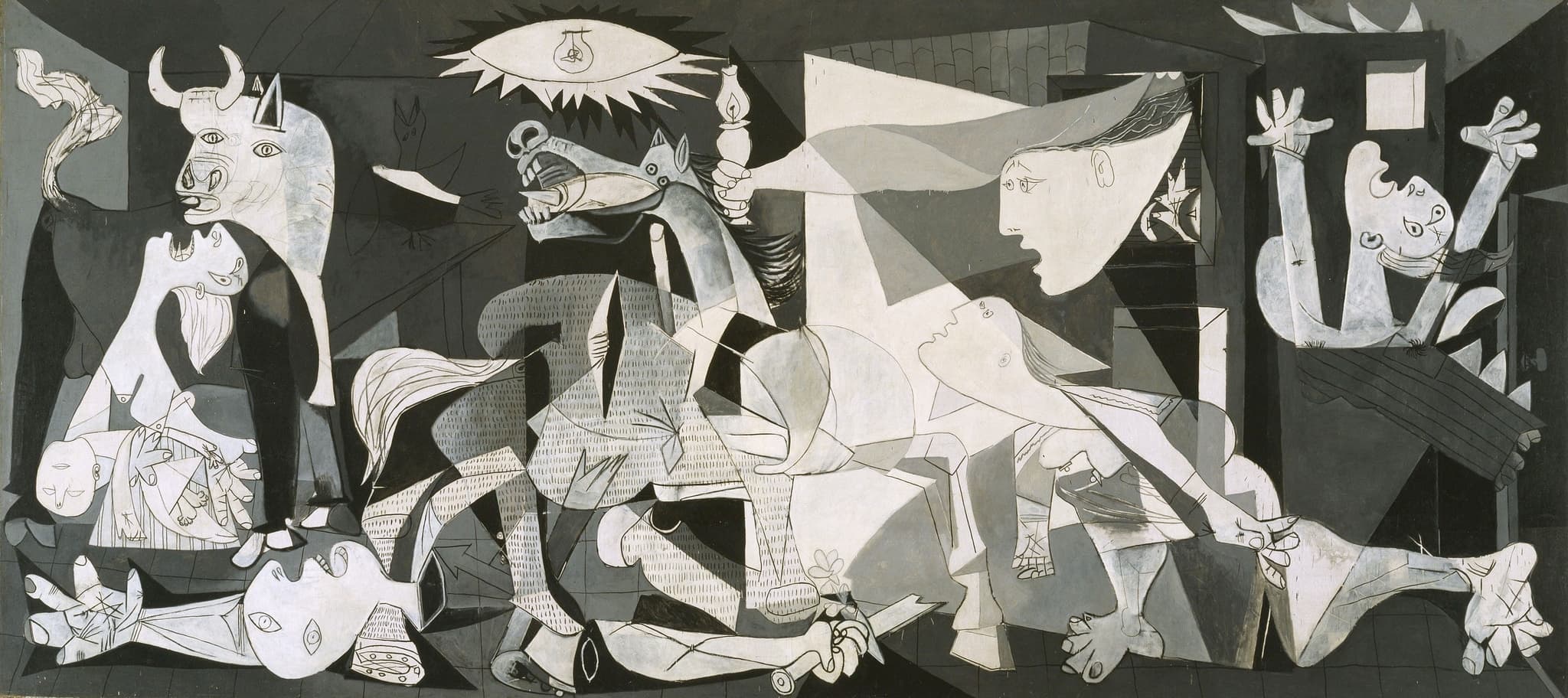
There are no public auction or conventional private sale records for Picasso’s Guernica. Commissioned for the 1937 Spanish Pavilion, it was on long-term loan to MoMA before returning to Spain in 1981 and entering the Reina Sofía collection in 1992. It is Spanish State property, protected by heritage law, and does not travel or come to market.
- Artwork
- Guernica
- Artist
- Pablo Picasso
- Sale type
- No known public sale
- Current location / owner
- Museo Nacional Centro de Arte Reina Sofía, Madrid
Auction and Ownership Timeline
Painted for the Spanish Pavilion
Paris
Picasso completed Guernica in Paris for the Spanish Pavilion at the 1937 Paris International Exposition [1].
Commission financing and post‑Pavilion custody
Paris
The Spanish Republican government financed the commission and the Reina Sofía record notes the work was “acquired” in 1937; research indicates Picasso retrieved the canvas after the Pavilion closed when no authority claimed it, leaving title ambiguous [1][2].
Scandinavian exhibitions
Oslo; Copenhagen; Stockholm
Shown in Oslo, Copenhagen, and Stockholm during 1938 as part of touring exhibitions [3].
Whitechapel display for Spanish relief
Whitechapel Art Gallery, London
Displayed at the Whitechapel Art Gallery, London, in January 1939 to raise funds for Spanish relief [3].
Loan to MoMA, New York
The Museum of Modern Art, New York
Shipped to New York for MoMA’s Picasso: Forty Years of His Art and kept there on Picasso’s loan for safekeeping during and after WWII [4].
Postwar retrospectives
Milan; São Paulo
Temporarily returned to Europe for major retrospectives (Milan) and to the São Paulo Bienal before returning to MoMA [5].
Major European tour
Munich; Cologne; Hamburg; Brussels; Stockholm
Shown in Munich, Cologne, Hamburg, Brussels, and Stockholm, then returned to MoMA [3].
Loan extended indefinitely
MoMA, New York
Picasso extended MoMA’s loan “for an indefinite period” until democracy was restored in Spain [2].
Picasso’s instructions for return
Mougins / New York
From Mougins, Picasso authorized lawyer Roland Dumas to judge when Spain’s public liberties were restored and to oversee Guernica’s transfer [6].
MoMA confirms return to Spain
MoMA, New York
MoMA communicated that Guernica would be sent to Spain in 1981; terms included no travel after installation in Madrid [7].
Arrives in Madrid; installed at the Casón
Madrid (Casón del Buen Retiro)
Packed at MoMA on September 8 and flown to Madrid; installed at the Prado’s Casón del Buen Retiro and opened to the public on October 25, 1981 [8][9].
Enters the Reina Sofía collection
Museo Reina Sofía, Madrid
Transferred from the Prado to the Museo Nacional Centro de Arte Reina Sofía, entering Spain’s national contemporary art collection [10].
No‑loan policy reaffirmed
Madrid
The museum publicly reaffirmed that Guernica would not travel on conservation grounds, cementing its non‑loan status [11].
Provenance and Ownership
1937: Painted in Paris for the Spanish Pavilion at the International Exposition. The Spanish Republican government financed the commission and the Reina Sofía’s record notes the work was “acquired” that year; research on the Pavilion’s close shows Picasso retrieved the canvas when no authority claimed it, leaving title questions unresolved for decades [1][2].
1938–1939: Exhibited across Scandinavia and in London (Whitechapel) to aid Spanish relief; then shipped to New York for MoMA’s Picasso exhibition, remaining there on Picasso’s loan for safekeeping [3][4]. In 1958 Picasso extended MoMA’s loan indefinitely pending a democratic Spain [2].
1970–1981: Picasso authorized lawyer Roland Dumas to determine when Spain’s public liberties were restored and to arrange the transfer; MoMA confirmed plans in 1979. Packed at MoMA on September 8, 1981, the work arrived in Madrid and was installed at the Prado’s Casón del Buen Retiro, opening to the public on October 25, 1981 [6][7][8][9].
1992–present: Transferred to and entered the collection of the Museo Nacional Centro de Arte Reina Sofía (Spanish State). The museum maintains a no‑loan policy; under Spain’s Historical Heritage Law, state cultural property of this kind is inalienable and non‑exportable [10][11][12].
Quick Facts
- Last known sale
- Not publicly reported
- Known sale price
- Not publicly reported
- Sale type
- No known public sale
- Venue / institution
- Not publicly reported
- Current owner or location
- Museo Nacional Centro de Arte Reina Sofía, Madrid (Spanish State)
- Publicly viewable?
- Yes
Why This Sale Matters
Guernica has never been publicly sold, and there is no reliable sale price for the work. Commissioned for Spain’s 1937 Pavilion, it spent decades at MoMA on Picasso’s loan before returning to Spain in 1981 and entering the Reina Sofía’s collection in 1992; today it is Spanish State property, protected by heritage law and a strict no‑loan policy, effectively removing it from the market [1][2][8][10][11][12].
This absence itself shapes Picasso’s market: the artist’s most iconic political mural is not tradable, so no auction benchmark exists for works of comparable scale or historical charge. Market discussion therefore turns to other categories—especially major 1930s and early 1930s canvases—which set the public records. Picasso’s current auction record is held by Les femmes d’Alger (Version O), which realized $179,365,000 at Christie’s New York in 2015, underscoring the extraordinary demand for trophy‑level paintings even when the artist’s most famous work is off‑market [13].
Because Guernica is inalienable state property under Spanish law, any modern valuation is speculative and not tied to transactable supply [12]. Its significance is primarily cultural and political—symbolizing the tragedy of war—rather than financial. For collectors and institutions, this means Guernica functions as a ceiling of cultural importance rather than price, while the top of Picasso’s price curve is established by masterworks that can actually be sold. Understanding this distinction helps explain why Picasso’s market remains deep and resilient without any prospect that Guernica will ever enter it [1][2][11][12].
Related Pages
Other auction histories by Pablo Picasso
Sources
- Museo Reina Sofía – Guernica (collection record) — Museo Reina Sofía
- Rethinking Guernica – Legitimacy and property — Museo Reina Sofía
- Musée Picasso Paris – Chronology — Musée national Picasso–Paris
- Original stretcher for Picasso’s Guernica rediscovered in MoMA storage — The Museum of Modern Art
- MoMA press release (1953) – Major Picasso retrospectives — The Museum of Modern Art
- Pablo Picasso’s letter to MoMA (1970) — Museo Reina Sofía
- MoMA communiqué on the transfer of Guernica (1979) — Museo Reina Sofía
- MoMA – Adiós, Guernica! (1981 transfer) — The Museum of Modern Art
- MoMA press release (Sept 10, 1981) – Transfer to Spain — The Museum of Modern Art
- Museo Reina Sofía – Collections history (year of entry 1992) — Museo Reina Sofía
- Washington Post – Guernica to stay in Madrid (1997) — The Washington Post
- Ley 16/1985 del Patrimonio Histórico Español — Boletín Oficial del Estado
- Christie’s – Les femmes d’Alger (Version O) achieves $179,365,000 (2015) — Christie’s