The Weeping Woman Auction History
Picasso’s The Weeping Woman (1937) has no public auction record. It was acquired for the National Gallery of Victoria in 1986 via donors, with a widely reported price of about A$1.6 million. The painting was stolen and recovered in August 1986 and remains at the NGV. Its market significance is institutional and art-historical rather than price-based.
- Artwork
- The Weeping Woman
- Artist
- Pablo Picasso
- Best-known sale or transfer
- Reported NGV acquisition c. A$1.6m (1986)
- Sale type
- Museum acquisition
- Current location / owner
- National Gallery of Victoria, Melbourne
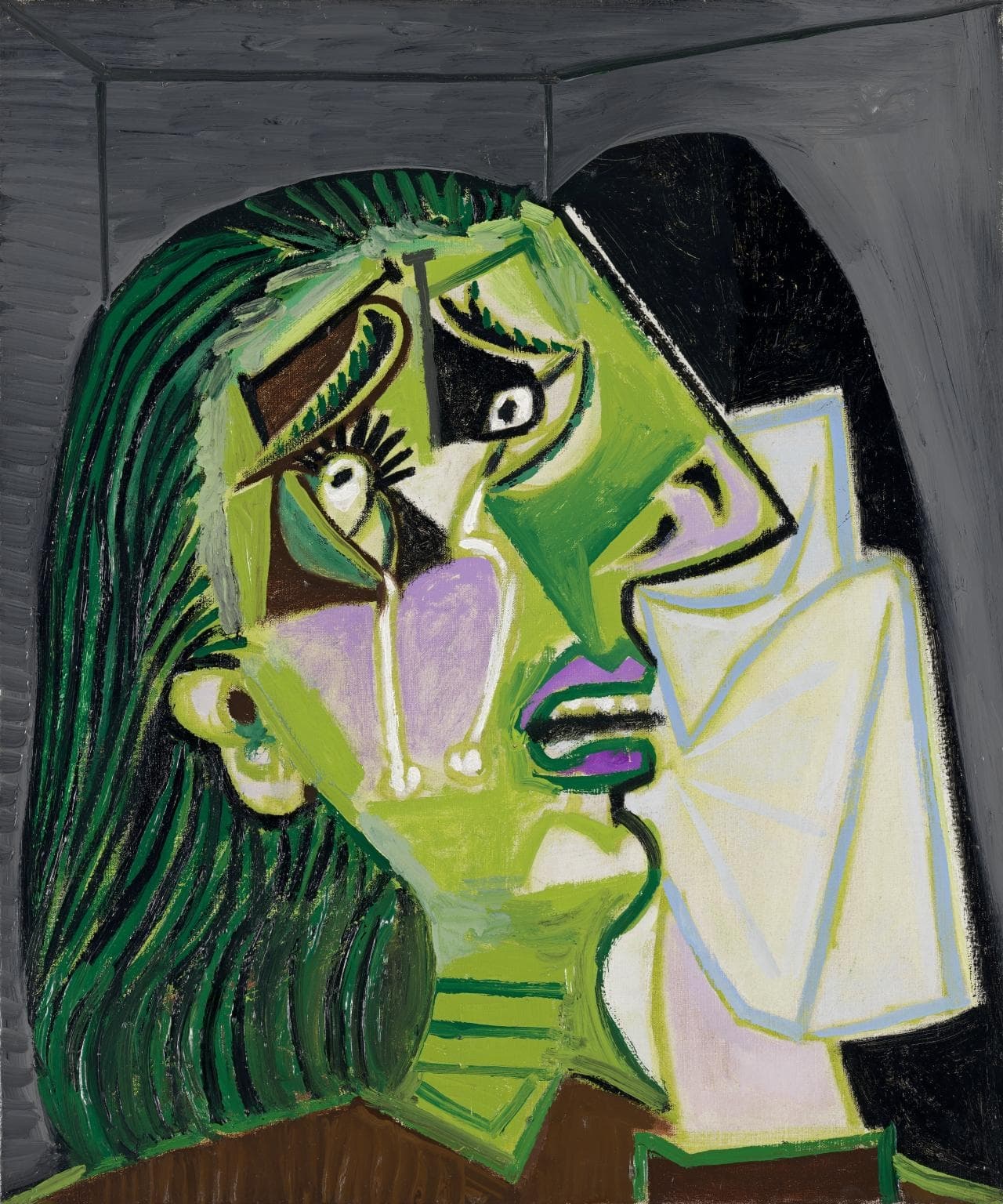
Auction and Ownership Timeline
Painted in Paris
Paris
Picasso completed The Weeping Woman on 18 October 1937 in Paris as a postscript to Guernica, one of three oil versions made that October [2].
Acquired by the National Gallery of Victoria
A$1.6 million (reported) · National Gallery of Victoria, Melbourne
Purchased for the NGV by donors of The Art Foundation of Victoria, with assistance from the Jack and Genia Liberman family; accession no. IC1-1986 [1]. Contemporary reporting cited a price around A$1.6 million [3].
Stolen from the NGV
National Gallery of Victoria, Melbourne
A group calling itself the “Australian Cultural Terrorists” removed the painting from display; press reports valued it at more than $1 million [4].
Recovered in a railway-station locker
Spencer Street railway station, Melbourne
Recovered intact from locker 227 at Melbourne’s Spencer Street railway station (now Southern Cross Station) after a phone tip to an Age journalist [5].
Provenance and Ownership
1937: Painted in Paris on 18 October 1937, as part of Picasso’s post-Guernica explorations of the weeping woman motif [2].
1986: Purchased for the National Gallery of Victoria by donors of The Art Foundation of Victoria, with assistance from the Jack and Genia Liberman family; accessioned as IC1-1986. The NGV record confirms the acquisition but does not publish earlier ownership details [1]. Contemporary reports cited a price of about A$1.6 million for the acquisition [3].
August 1986: The work was stolen from the NGV by a group calling itself the “Australian Cultural Terrorists” and was recovered 17 days later in a railway-station locker; it returned to the NGV collection, where it remains [4][5][1].
Quick Facts
- Last known sale
- 1986
- Known sale price
- A$1.6 million (reported)
- Sale type
- Museum acquisition
- Venue / institution
- National Gallery of Victoria (via donors to The Art Foundation of Victoria)
- Current owner or location
- National Gallery of Victoria, Melbourne
- Publicly viewable?
- Yes
Why This Sale Matters
There is no public auction history for the National Gallery of Victoria’s The Weeping Woman. The painting entered the NGV in 1986 via a donor-supported purchase and has remained in the museum’s collection since then, which removes it from price-based market dynamics [1]. While Australian media widely reported an acquisition price of around A$1.6 million at the time, that figure reflects contemporary press reporting rather than a public auction result [3].
Art-historically, this canvas is significant as one of three oil versions Picasso painted in October 1937 as a postscript to Guernica, crystallizing the weeping woman motif associated with Dora Maar [2]. Its prominence in Australia was further amplified by the high-profile 1986 theft and rapid recovery, events that cemented its cultural notoriety but did not create a market benchmark for the work itself [4][5].
In the broader Picasso market, public auction records continue to be set by large-scale, museum-quality works from highly coveted periods. Christie’s sold Les femmes d’Alger (Version “O”) for $179,365,000 in 2015, and Sotheby’s sold Femme à la montre (1932) for $139.4 million in 2023 [6][7]. Compared with these trophy-market benchmarks, the NGV Weeping Woman’s importance is principally scholarly and institutional: it is a key Guernica-related image, held by a public museum, with no public sale history. For collectors, this means the work itself provides market context through its art-historical standing rather than through transactional comparables; for institutions, it exemplifies how donor-backed acquisitions can secure canonical works that subsequently remain off the market [1][2][3].
Related Pages
Other auction histories by Pablo Picasso
Sources
- NGV Collection: The Weeping Woman (IC1-1986) — National Gallery of Victoria
- A witness to Guernica: Picasso’s Weeping Woman — National Gallery of Victoria
- RetroFocus: Picasso's The Weeping Woman and Australia's famous unsolved art heist — ABC News
- Picasso Painting Stolen in Australia — Los Angeles Times
- The story behind Australia’s most famous and unsolved art heist — Art Guide Australia
- Post-Sale: ‘Looking Forward to the Past’ achieves $705,858,000; Les femmes d’Alger (Version "O") sets record — Christie’s
- Historic auctions: Emily Fisher Landau Collection; Picasso’s Femme à la montre achieves $139.4m — Sotheby’s