How Much Is Les Demoiselles d'Avignon Worth?
Last updated: February 9, 2026
Quick Facts
- Current Location
- The Museum of Modern Art (MoMA)
- Methodology
- extrapolation
Les Demoiselles d’Avignon is a uniquely important, proto‑Cubist masterpiece at the core of MoMA’s identity. If hypothetically offered today, it would likely command $800 million–$1.2 billion, with upside potential beyond that under intense global competition. In practice, it is effectively priceless and extraordinarily unlikely to be sold.
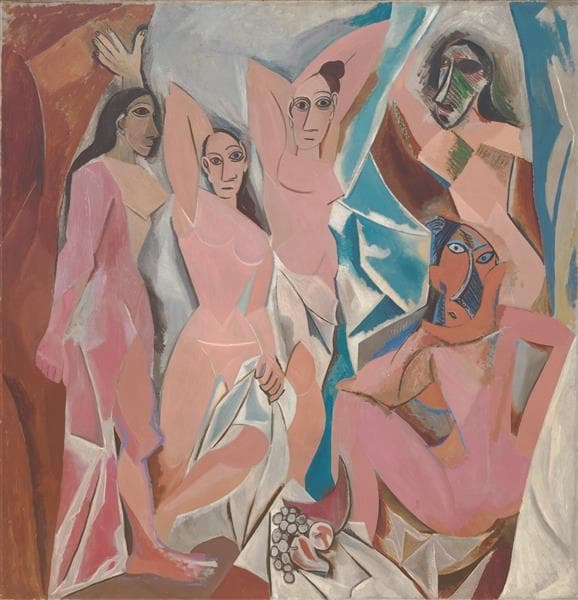
Les Demoiselles d'Avignon
Pablo Picasso, 1907 • Oil on canvas
Read full analysis of Les Demoiselles d'Avignon →Valuation Analysis
Conclusion: If freely offered in today’s market, Pablo Picasso’s Les Demoiselles d’Avignon (1907) would command roughly $800 million–$1.2 billion. This extrapolated range reflects its singular art‑historical primacy, irreplaceable status, and a market that has repeatedly paid nine figures for far less pivotal Picassos. The painting is owned by The Museum of Modern Art, New York (accession 333.1939) and is, for all practical purposes, not for sale [1].
Why the estimate sits well above any realized Picasso: Public benchmarks demonstrate very deep demand for blue‑chip Picassos: the standing auction record is $179.4 million for Les Femmes d’Alger (Version O) (2015) [2], and the $139.4 million result for Femme à la montre (2023) reconfirmed appetite at the high end [3]. The broader market ceiling is Leonardo’s Salvator Mundi at $450.3 million (2017) [4]. Les Demoiselles—an epoch‑making work that catalyzed Cubism and rewired modern art—ranks materially higher in consensus importance than any Picasso that has ever come to market. A substantial premium over Picasso’s record and even over the cross‑artist high watermark is therefore defensible.
Scarcity and irreplaceability: There is no true substitute for Les Demoiselles. Peer canonical touchstones (e.g., Guernica) are state‑held or otherwise immovable. Early transactional history underscores how rarely the work has changed hands: sold by Picasso to Jacques Doucet in 1924 (c. 25,000–30,000 francs), then to Jacques Seligmann & Co. in 1937 (150,000 francs), and acquired by MoMA in 1939 through the Lillie P. Bliss Bequest [1][5]. Works of this singular historical gravity and near‑mythic status can elicit sovereign and institutional interest, pushing outcomes well beyond standard private‑collector competition.
Ownership context and marketability: As a cornerstone of MoMA’s collection, any sale is extraordinarily unlikely. U.S. museum ethics (AAMD) restrict the use of deaccession proceeds and strongly discourage monetizing icons to fund operations, effectively removing such masterpieces from normal circulation [6]. The valuation presented here is a hypothetical replacement/market value, not an indication of impending deaccession.
Positioning of the range: The $800 million–$1.2 billion band brackets (i) a conservative step‑up from the current market apex for any artwork [4], (ii) the clear premium warranted by Les Demoiselles’ unmatched significance within 20th‑century art [1], and (iii) demonstrated nine‑figure depth for top Picassos [2][3]. Upside beyond $1.2 billion is plausible in a trophy‑driven, globally competitive scenario; a lower‑bound execution case could still clear many hundreds of millions depending on market tenor, venue, and sale design.
What could move the needle: Confirmed, current condition reports; visibility into any institutional insurance benchmarks; and real‑time intelligence on private‑treaty prices above $300 million would refine this range. None of these, however, alters the core thesis: Les Demoiselles is a once‑per‑generation cultural asset whose market value would almost certainly reset the record books if it were ever obtainable.
Key Valuation Factors
Art Historical Significance
High ImpactLes Demoiselles d’Avignon is widely regarded as the foundational pivot to Cubism and a seismic rupture in Western painting. Executed in 1907, it synthesizes multiple viewpoints, radicalizes form, and engages with Iberian and African sources to an extent that redefined the trajectory of 20th‑century art. Its canonical status is not simply within Picasso’s oeuvre but across modernism, where it anchors museum narratives and survey texts. This level of consensus, coupled with its visibility and scholarship, creates a structural premium over even record‑setting Picassos. For valuation, the work’s status as an origin‑point of Cubism supports a price well above typical artist‑record multiples when extrapolating potential market outcomes [1].
Scarcity and Irreplaceability
High ImpactThere is no true substitute for Les Demoiselles. Comparable touchstones (for example, Guernica) are state‑held and effectively unsellable; other proto‑Cubist breakthroughs reside with museums. The painting’s early private transactions and MoMA’s 1939 acquisition remove it from normal market circulation, creating near‑absolute scarcity. In that context, any hypothetical availability would concentrate global demand from mega‑collectors, foundations, and potentially sovereign entities. Such scarcity dynamics are known to unlock step‑change pricing for cultural trophies, justifying a valuation multiple far above conventional comparables and beyond typical Picasso market peaks.
Market Benchmarks and Demand Depth
High ImpactPicasso’s auction record stands at $179.4 million (Les Femmes d’Alger, 2015), and the 2023 $139.4 million sale of Femme à la montre showed fresh depth for highest‑caliber works. The cross‑artist public ceiling is Leonardo’s Salvator Mundi at $450.3 million (2017). Relative to these anchors, Les Demoiselles sits in a league of its own in terms of consensus art‑historical weight. Extrapolating from these data points supports an $800 million–$1.2 billion range, with plausible upside if multiple sovereign or institutional buyers compete. The comparables validate the market’s capacity; the unique significance explains the premium [2][3][4].
Provenance and Institutional Prestige
High ImpactThe painting’s provenance—from Picasso to Jacques Doucet, to Jacques Seligmann, to MoMA via the Lillie P. Bliss Bequest—confers exceptional credibility and scholarship. MoMA’s custodianship has cemented the work’s global recognition and aura, amplifying its brand value beyond intrinsic art‑historical importance. While museum ownership also makes a sale extraordinarily unlikely due to sector ethics and policy constraints, the MoMA association itself would command a premium were the work ever hypothetically transferable. Together, provenance and institutional stature bolster both perceived value and potential bidding intensity [1][5][6].
Scale and Presentation
Medium ImpactLes Demoiselles is a monumental canvas (approximately 8 × 7.5 feet), a physical scale that enhances its visual impact and exhibition presence. Monumentality is a recognized value driver for trophy collectors and institutions because it signals ambition, anchors gallery installations, and photographs iconically for global media. While condition specifics would refine pricing in any real transaction, long‑term institutional stewardship and ongoing conservation research at MoMA mitigate typical concerns and support confidence at the ultra‑high end. The work’s commanding size and stage‑defining composition are additive to the valuation thesis [1].
Sale History
Private sale (Picasso to Jacques Doucet)
Sold by the artist to couturier/collector Jacques Doucet for c. 25,000–30,000 FRF (≈$1,200 at the time).
Private sale (Mme Doucet to Jacques Seligmann & Co.)
After Doucet’s death, sold to Seligmann for c. 150,000 FRF (≈$6,000).
Museum of Modern Art, New York (acquisition)
Acquired through the Lillie P. Bliss Bequest (by exchange); $24,000 is a commonly cited secondary figure.
Pablo Picasso's Market
Pablo Picasso remains one of the most liquid and valuable names in the auction market, consistently ranking among the top artists by volume and value. His all‑time auction record is $179.4 million for Les Femmes d’Alger (Version O) in 2015, and his second‑highest public result is $139.4 million for Femme à la montre in 2023. Multiple Picassos have surpassed $100 million, evidencing deep global demand for prime periods and iconic subjects. While 2024 saw softer totals due to fewer trophy consignments and broader caution at the very top, late‑2025 results indicated renewed depth and disciplined bidding for blue‑chip works. In private sales, Picasso also performs strongly, with museum‑quality pieces often placed quietly with major collectors or institutions.
Comparable Sales
Les Femmes d’Alger (Version O)
Pablo Picasso
Same artist; landmark, multi-figure painting that set Picasso’s auction record. While from 1955 (later period), it is the clearest public price anchor for top-tier Picasso masterworks.
$179.4M
2015, Christie's New York
~$242.2M adjusted
Femme à la montre
Pablo Picasso
Same artist; trophy-level 1932 Marie-Thérèse portrait, a core blue-chip segment of Picasso’s market demonstrating current depth at the high end.
$139.4M
2023, Sotheby's New York
~$150.5M adjusted
Femme assise près d’une fenêtre (Marie‑Thérèse)
Pablo Picasso
Same artist; prime 1932 portrait with museum-level quality. Useful for gauging sustained demand for top Picassos in recent seasons.
$103.4M
2021, Christie's New York
~$124.1M adjusted
Femme nue couchée
Pablo Picasso
Same artist; 1932 reclining nude, an iconic subject in Picasso’s market. Demonstrates pricing for first‑tier but non‑record 1932 works.
$67.5M
2022, Sotheby's New York
~$77.0M adjusted
La Lecture (Marie‑Thérèse)
Pablo Picasso
Same artist; recent marquee 1932 result indicating late‑2025 demand and price discipline for blue‑chip but smaller-scale works.
$45.5M
2025, Christie's New York
Salvator Mundi
Leonardo da Vinci
Cross‑artist market ceiling for a singular, globally recognized masterpiece; useful to bracket potential for an irreplaceable icon like Demoiselles.
$450.3M
2017, Christie's New York
~$562.9M adjusted
Current Market Trends
The Modern category has faced a multi‑year recalibration, with 2024 marked by fewer $50m+ trophies at auction and more selective bidding. Supply, not demand, has been the primary constraint, particularly for canonical works in top condition. As a result, averages declined even as transaction counts held or rose, and private sales absorbed significant A+ material. Despite the cooler backdrop, apex masterpieces continued to command dominant prices when available, reaffirming the market’s capacity for nine‑figure outcomes. Against this context, a singular, museum‑defining icon like Les Demoiselles would transcend cyclical softness and likely reset records through globally competitive, trophy‑driven demand.
Study print
Study this painting as a print
Pair the full artwork with a museum-style study sheet focused on one meaningful detail.
Sources
- The Museum of Modern Art (MoMA), Les Demoiselles d’Avignon – Collection Page
- Christie’s, Post‑Sale Release: Looking Forward to the Past (Picasso record $179.4m)
- Sotheby’s, Emily Fisher Landau Collection reaches $425m (Femme à la montre $139.36m)
- Christie’s, Press Release: Leonardo da Vinci’s Salvator Mundi sells for $450,312,500
- The New Yorker, Modern Art and the Esteem Machine (Doucet/Seligmann pricing context)
- Association of Art Museum Directors (AAMD), Deaccessioning Rule – Press Release