How Much Is The Course of Empire: Desolation Worth?
Last updated: April 27, 2026
Quick Facts
- Methodology
- comparable analysis
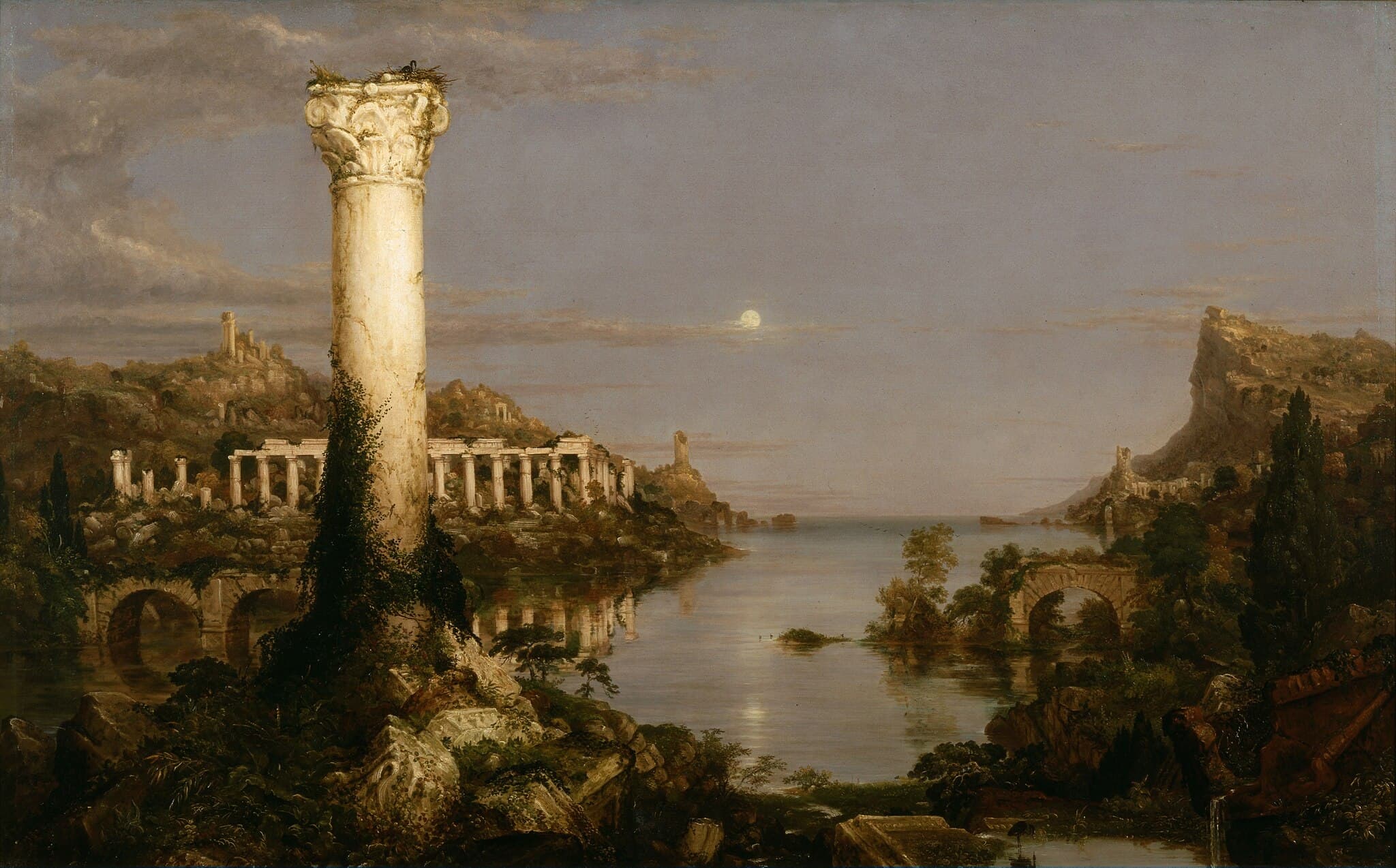
I estimate The Course of Empire: Desolation (original 1836 oil, museum quality) would likely realize between $2,000,000 and $6,000,000 in today’s market. This range is based on the work’s canonical status within Cole’s oeuvre, its long museum provenance, and recent auction comparables for major Thomas Cole landscapes.
Valuation Analysis
Valuation conclusion: Based on available evidence, I place an indicative market band of $2,000,000–$6,000,000 for the original oil painting The Course of Empire: Desolation (1836). This figure assumes an original, authenticated canvas in good-to-excellent condition with complete provenance and a standard museum frame and dimensions as recorded in institutional records [1].
Why this band: The painting is the culminating panel in Thomas Cole’s major five-part series The Course of Empire, one of the artist’s most important and widely studied works — a quality that materially increases institutional demand and collector interest. The canonical nature of the series and Desolation’s narrative power make it a top-tier example within Cole’s oeuvre and within 19th-century American landscape painting more broadly [1].
Market comparables and precedent: Public-auction evidence for Cole’s large oils clusters in the low single millions: Christie’s recent result for Mount Chocorua (Jan 23, 2025) set a new public-auction benchmark at $1,623,000, demonstrating that high-quality Cole landscapes reach the mid-to-high single‑million range in a competitive sale environment [2]. Institutional private purchases historically have exceeded headline auction results (for example, reported museum acquisitions in prior decades), which supports a higher ceiling for a fresh-to-market canonical panel offered by or to a museum [3]. Because the original Desolation has remained in institutional care (New-York Historical Society custody as recorded), it has not been regularly market-tested; that provenance both underpins authenticity and removes the painting from routine price discovery [1].
Key contingencies: Final value would pivot on several determinative variables: in-hand condition and conservation history (structural issues or heavy overpainting will reduce value substantially), completeness and continuity of provenance (continuous museum ownership versus gaps), exhibition and publication record (major loans and catalogue inclusion elevate demand), and the sale channel (a museum-to-museum private acquisition generally commands a premium over an open auction sale). In an active buyer environment with institutional bidders or a high-profile auction placement, the painting could exceed the stated band; conversely, significant condition problems or provenance doubts could push value below it.
Recommended next steps: Obtain a full condition/conservation report, the complete provenance and exhibition bibliography from the New-York Historical Society and the Thomas Cole National Historic Site, and high-resolution recto/verso imagery. After that, solicit formal pre-sale opinions from Christie’s and Sotheby’s American Art specialists; they will provide a refined estimate once they have examined the work in hand. These steps will materially tighten the range and establish a working reserve or insurance benchmark.
Sources underpinning this appraisal include the New-York Historical Society/Thomas Cole project documentation and recent auction results reported by major houses and market press [1][2].
Key Valuation Factors
Art Historical Significance
High ImpactThe Course of Empire is one of Thomas Cole’s signature multi-panel projects; Desolation is the series’ concluding, allegorically potent image. As an integral panel in a canonical narrative suite, it occupies an outsized position in Cole scholarship and public imagination. Works that are both narrative keystones and visually striking in Cole’s output typically attract museum interest internationally, which raises theoretical buyer competition and supports a premium relative to ordinary landscape views. The series’ didactic, cultural resonance also increases the painting’s attraction for institutional collections focused on American art history and nineteenth-century narrative painting.
Provenance & Museum Ownership
High ImpactContinuous museum provenance (the original Desolation is recorded in New-York Historical Society holdings from the mid-19th century onward) strongly reinforces attribution and authenticity. Institutional custody reduces provenance risk and normally supports a higher valuation because museum-quality pieces are scarce on the market. At the same time, long-term museum ownership means the object is not market-tested: there is no recent open-market comparable for this exact panel, which increases valuation uncertainty and makes the sale channel (private museum purchase versus public auction) a decisive variable in final price realization.
Condition & Technical State
High ImpactFinal market value is highly sensitive to the painting’s condition and conservation history. A canvas with original paint layers intact, minimal invasive restoration, and sound structural support will command the top of the estimated band. Major issues—significant craquelure, extensive relining or overpainting, or structural damage to stretcher and tacking margins—can depress value sharply, potentially into mid-six-figure territory. A technical report (X-radiography, paint cross-sections) and documented conservation interventions are therefore essential to firm up value.
Market Comparables & Scarcity
High ImpactPublic-auction comparables for Cole’s large landscapes generally sit in the low single millions, with Christie’s 2025 result for Mount Chocorua at roughly $1.62M as the recent public benchmark. Historic private museum acquisitions (reported instances in prior decades) demonstrate that institutions have been willing to pay premiums above auction records for major works. Because canonical Course of Empire panels rarely come to market, scarcity supports valuation above typical open-market lots, but the realized price will depend on buyer competition and timing relative to institutional demand cycles.
Exhibition & Publication History
Medium ImpactInclusion in major exhibitions, catalogue raisonnés, and high-profile publications measurably increases desirability and the perceived market value. A panel with an established exhibition history and citations in academic literature or museum catalogues becomes more attractive to institutional buyers and high-end private collectors. If Desolation has been prominently exhibited or extensively published, expect upward pressure within the stated band; absence of such history will modestly reduce competitive institutional interest.
Sale History
The Course of Empire: Desolation has never been sold at public auction.
Thomas Cole's Market
Thomas Cole is the acknowledged founder of the Hudson River School and commands enduring scholarly and institutional interest. His market is characterized by selective strength: top-quality, well-provenanced works attract institutions and collectors and have sold in the low single‑millions at auction, while museum acquisitions in private sales have historically achieved higher sums. Activity is episodic—important works are rare to market and therefore can reset benchmarks when they appear. The buyer base is largely U.S.-centered, with primary demand from museums, major private collectors, and a handful of specialist dealers.
Comparable Sales
Mount Chocorua, New Hampshire
Thomas Cole
Recent public auction high for Cole; same artist and Hudson River School landscape subject — sets the current public-market benchmark for quality Cole paintings.
$1.6M
2025, Christie's New York
The Hunter's Return
Thomas Cole
Major private/museum acquisition of a Cole work (reported 'just under $2.75M' in 1983); shows institutions will pay substantial premiums in private sales — useful ceiling indicator for museum-quality examples.
$2.8M
1983, Private sale (reported to Amon Carter Museum)
~$8.8M adjusted
Catskill Mountain House
Thomas Cole
Same artist and region (Catskills); mid-2000s Christie’s result for a quality Cole landscape — helpful for mid-market, auction-based range-setting.
$1.5M
2003, Christie's New York
~$2.6M adjusted
View in Kaaterskill Clove
Thomas Cole
Lower‑tier Cole landscape sale (realized ~ $1.02M nominal) — useful lower-anchor for auction pricing of period Cole landscapes (size/subject differences apply).
$1.0M
2003, Christie's New York
~$1.8M adjusted
Current Market Trends
The current market for Hudson River School and nineteenth-century American landscape painting is selective and driven by a flight-to-quality dynamic: museum-quality examples with strong provenance and exhibition histories are outperforming lesser works. Institutional programming and anniversary-driven interest (recent and forthcoming Cole initiatives) have supported demand for top examples, but overall activity remains episodic and sensitive to supply of fresh, museum-grade works.
Sources
- Explore Thomas Cole / The Course of Empire: Desolation (collection record)
- Christie’s press release — American Sublime sale (Mount Chocorua realized price, 2025)
- Artnet News — Coverage and market commentary on Thomas Cole and recent auction results
- Washington Post — Reporting on historic private museum acquisitions of Thomas Cole works (1983)