How Much Is The Oxbow (View from Mount Holyoke) Worth?
Last updated: April 26, 2026
Quick Facts
- Insurance Value
- $180.0M (Analyst estimate)
- Methodology
- comparable analysis
Thomas Cole’s The Oxbow is a canonical American masterpiece in The Met’s collection that has never traded in the modern market. Based on trophy-level comparables and demonstrated institutional demand for top-tier Hudson River School works, a current fair‑market value is estimated at $100–150 million, with a higher replacement/insurance figure warranted by its singular cultural importance.
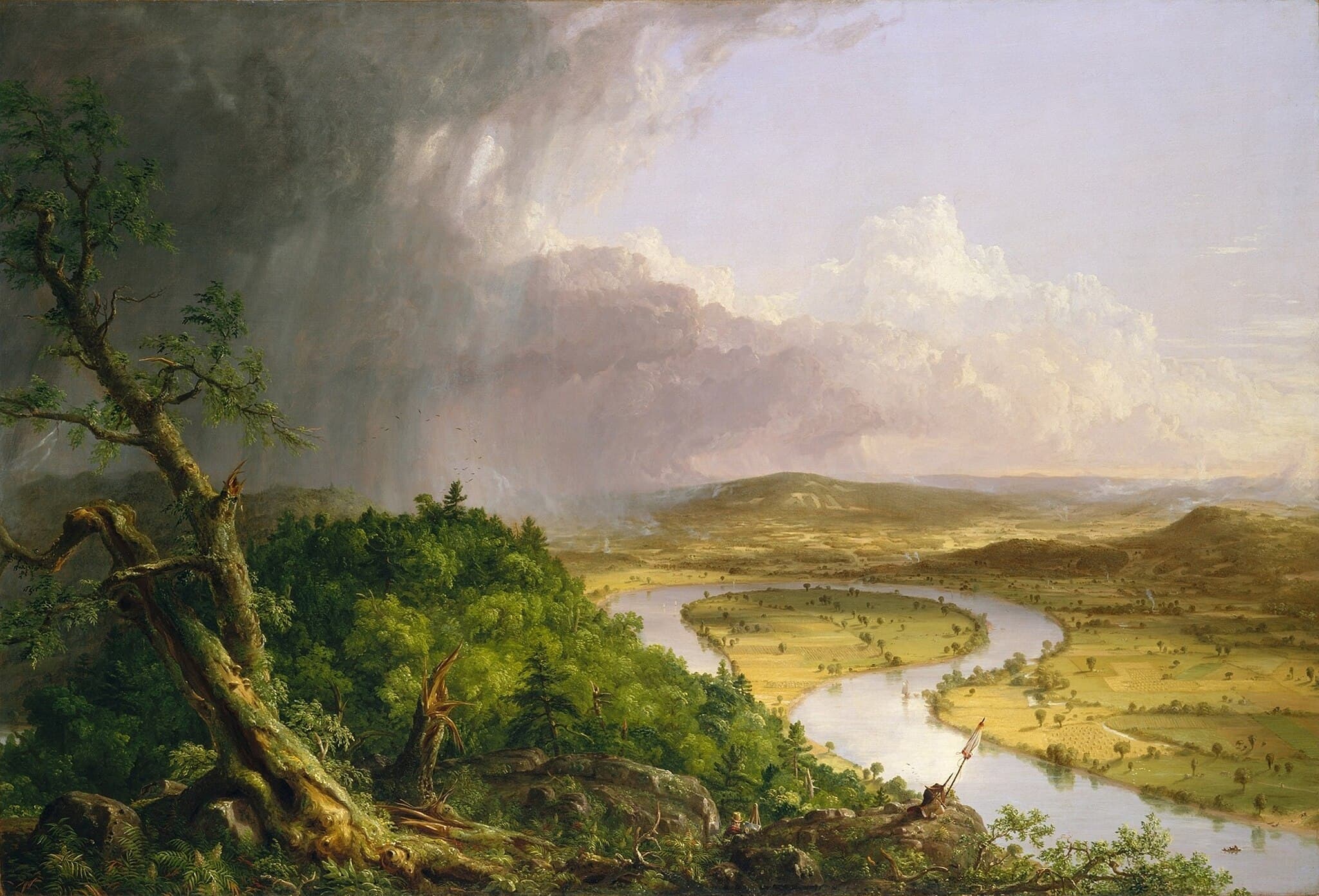
The Oxbow (View from Mount Holyoke)
Thomas Cole, 1836 • Oil on canvas
Read full analysis of The Oxbow (View from Mount Holyoke) →Valuation Analysis
Conclusion: Thomas Cole’s The Oxbow (1836) is a museum‑defining icon of American art, held by The Metropolitan Museum of Art since 1908 and never tested at modern auction. If hypothetically offered today, a fair‑market value of $100–150 million is justified by its unmatched art‑historical stature, extreme scarcity, and the price behavior of closely analogous American trophies [1].
Comparables and category benchmarks: The closest Hudson River School proxy is Asher B. Durand’s Kindred Spirits, sold via a sealed‑bid private process in 2005 for a reported sum above $35 million—roughly $55–60 million in today’s dollars—demonstrating this category’s capacity to command a substantial trophy premium when an icon with ironclad provenance becomes available [2]. At public auction, Thomas Moran’s Green River of Wyoming realized $17.74 million in 2008, a long‑standing benchmark for grand 19th‑century American landscapes [3]. Outside landscape but within the 19th‑century American canon, Emanuel Leutze’s Washington Crossing the Delaware achieved $45.0 million in 2022, underscoring top‑tier willingness to pay for nationally emblematic images [4]. Within Cole’s own market, The Huntington’s acquisition of Portage Falls on the Genesee at a publicly disclosed $12 million in 2021 confirms eight‑figure institutional demand for major works substantially below The Oxbow’s level of fame and significance [5].
Why The Oxbow sits above these markers: The Oxbow is arguably Cole’s single most famous painting and the signature image of the Hudson River School. Its large scale, self‑referential narrative, and crystallization of the American landscape ideal elevate it beyond the artist’s typical market to the realm of national icons [1]. Public auction records for Cole remain modest—his current record stands at $1.623 million (Christie’s, January 2025) because truly great, large‑scale works almost never appear publicly; the constraint is supply, not demand [6]. For a once‑in‑a‑generation masterpiece with broad institutional and mission‑aligned private appeal, the appropriate valuation is determined by cross‑category trophy pricing rather than by the artist’s routine auction track.
Market setting: The historical American segment is selectively strong when quality is exceptional and provenance is clean. Recent cycles show renewed institutional and private engagement, with commentators anticipating additional tailwinds into the U.S. Semiquincentennial in 2026 that could further spotlight foundational American images [7]. In such an environment, a canonical, museum‑grade Cole would likely reset the category ceiling for 19th‑century American landscape painting, well above prior landscape benchmarks and competitive with the most celebrated American historical works at auction [3][4].
Valuation synthesis: Anchoring to Durand’s Kindred Spirits (inflation‑adjusted ~$55–60m), stepping up for The Oxbow’s superior fame and art‑historical primacy, acknowledging Moran’s and Leutze’s public markers, and recognizing recent eight‑figure museum acquisition prices for major Coles, a hypothetical open‑market fair‑market value of $100–150 million is supported. Given its irreplaceability and scarcity, an insurance/replacement value would reasonably sit higher.
Key Valuation Factors
Art Historical Significance
High ImpactThe Oxbow is widely regarded as Thomas Cole’s definitive statement and a cornerstone of the Hudson River School, synthesizing sublime wilderness with cultivated landscape in a single, self-aware composition. It appears in virtually every survey of American art, functions as a visual shorthand for the 19th‑century American landscape ideal, and is among the most reproduced images in U.S. art history. Works that define an artist’s oeuvre and crystallize a movement’s ethos command outsized premiums. This level of cultural penetration and scholarly consensus places The Oxbow in the small cohort of American icons for which market pricing is set by cross-category trophy demand rather than by routine artist comparables.
Rarity and Supply Constraints
High ImpactLarge, fully realized Cole masterpieces are exceptionally scarce in private hands; most are in museums. The Oxbow has been in The Met since 1908, and its peers—e.g., the Course of Empire and Voyage of Life cycles—are institutional. Scarcity drives a structural gap between the artist’s modest auction record (reflecting smaller, less iconic works) and the potential price for a museum‑caliber canvas. When a truly comparable Hudson River School trophy has surfaced—such as Durand’s Kindred Spirits—it has traded far above typical category levels, indicating that buyer capacity exists when supply aligns with significance.
Scale, Subject, and Iconography
High ImpactThe Oxbow’s commanding size and panoramic view from Mount Holyoke encapsulate the movement’s central themes, while the inclusion of the artist within the landscape enriches its narrative and didactic power. The duality of wilderness and cultivation reads as a national allegory, broadening its relevance beyond connoisseurship to civic identity and institutional missions. Scale and subject coherence are prime price drivers in this category; here, both are at their apex, supporting a trophy-level valuation above other Cole landscapes and in line with the most coveted 19th‑century American images.
Comparative Market Benchmarks
High ImpactDurand’s Kindred Spirits achieved a reported >$35m in 2005 (≈$55–60m today), Moran’s Green River of Wyoming brought $17.74m at auction in 2008, and Leutze’s Washington Crossing the Delaware realized $45.0m in 2022. These datapoints bracket pricing for American art icons and grand-format landscapes. The Oxbow’s higher art-historical ranking and visibility reasonably command a step above these marks. Additionally, The Huntington’s $12m acquisition of a major Cole in 2021 evidences robust museum demand for important, but less canonical, Coles—supporting a materially higher value for The Oxbow.
Sale History
The Oxbow (View from Mount Holyoke) has never been sold at public auction.
Thomas Cole's Market
Thomas Cole is the acknowledged founder of the Hudson River School, with an auction market constrained by supply rather than demand. Public auction records have historically been modest because the best large-scale works reside in institutions; his current auction record stands at $1.623 million (Christie’s, Jan 2025). Private and institutional acquisitions for significant Coles reach into eight figures, exemplified by The Huntington’s $12 million purchase of Portage Falls on the Genesee in 2021. When top-tier 19th‑century American landscapes surface, they can surpass individual artist records by wide margins, as seen with Durand and Moran. Consequently, valuation for a canonical Cole masterpiece is set by trophy comparables and institutional appetite, not by routine public records.
Comparable Sales
Kindred Spirits
Asher B. Durand
Hudson River School trophy of canonical status; closest market proxy for an American landscape icon changing hands privately. Reported at ‘over $35m’ in 2005; demonstrates the category’s capacity to trade far above typical HRS auction records.
$35.0M
2005, Sotheby's (sealed-bid private sale for the New York Public Library)
~$57.4M adjusted
Green River of Wyoming
Thomas Moran
Record-setting public auction for a 19th‑century American landscape (Western School) and long-standing benchmark for grand-format American landscapes at auction; useful for calibrating top public-market appetite.
$17.7M
2008, Christie's New York
~$26.1M adjusted
Washington Crossing the Delaware
Emanuel Leutze
Category-level ceiling for 19th‑century American painting at public auction in recent years; while figural/history rather than landscape, it indicates what the market will pay for an American art icon.
$45.0M
2022, Christie's New York
~$49.4M adjusted
Portage Falls on the Genesee
Thomas Cole
Direct Thomas Cole comparable: major, large-scale American landscape acquired by a leading museum at a disclosed ~$12m price; evidences eight-figure private demand for significant Cole canvases.
$12.0M
2021, Private sale (museum acquisition by The Huntington; Ahmanson Foundation grant)
~$14.2M adjusted
Mount Chocorua, New Hampshire
Thomas Cole
Current public auction record for Thomas Cole; early subject and strong quality, but much smaller and less iconic than The Oxbow; shows the gap between routine Cole auction supply and true trophies.
$1.6M
2025, Christie's New York
Catskill Mountain House
Thomas Cole
Longstanding Cole auction benchmark prior to 2025; quintessential Hudson River subject but smaller/less canonical than The Oxbow; underscores how few major Coles reach auction.
$1.5M
2003, Christie's New York
~$2.5M adjusted
Current Market Trends
The historical American segment remains highly selective but rewards exceptional quality, fresh-to-market works, and museum-grade provenance. Recent seasons showed renewed activity, with Christie’s reporting strong American art totals and market observers anticipating further attention around the U.S. Semiquincentennial in 2026. Category benchmarks—from Leutze’s $45m history painting to Moran’s $17.74m landscape—indicate buyers will pay for icons. Given that most Hudson River School masterworks are museum-held, pricing for a truly canonical image is determined by trophy dynamics and cross-institutional competition rather than by an artist’s routine auction track.
Study print
Study this painting as a print
Pair the full artwork with a museum-style study sheet focused on one meaningful detail.
Sources
- The Metropolitan Museum of Art — The Oxbow object page
- Los Angeles Times — ‘Kindred Spirits’ sale coverage
- Christie’s Press Release (May 22, 2008) — Moran record
- Christie’s — American Art department (Leutze sale reference, 2022)
- The Huntington — Ahmanson Foundation acquisitions partnership (Portage Falls at $12m)
- Christie’s Press — American Sublime (Jan 23, 2025) including Cole record
- Artnet News — Historical American art market outlook (Mar 2025)