How Much Is The Course of Empire: Destruction Worth?
Last updated: April 26, 2026
Quick Facts
- Methodology
- comparable analysis
Thomas Cole’s The Course of Empire: Destruction (1836) is a canonical American masterpiece held by the New-York Historical Society and effectively off-market. Based on top-tier private benchmarks for Cole and Hudson River School trophies, scarcity of first-rank material, and the work’s central place in the artist’s oeuvre, we estimate a hypothetical open-market value of $60–100 million.
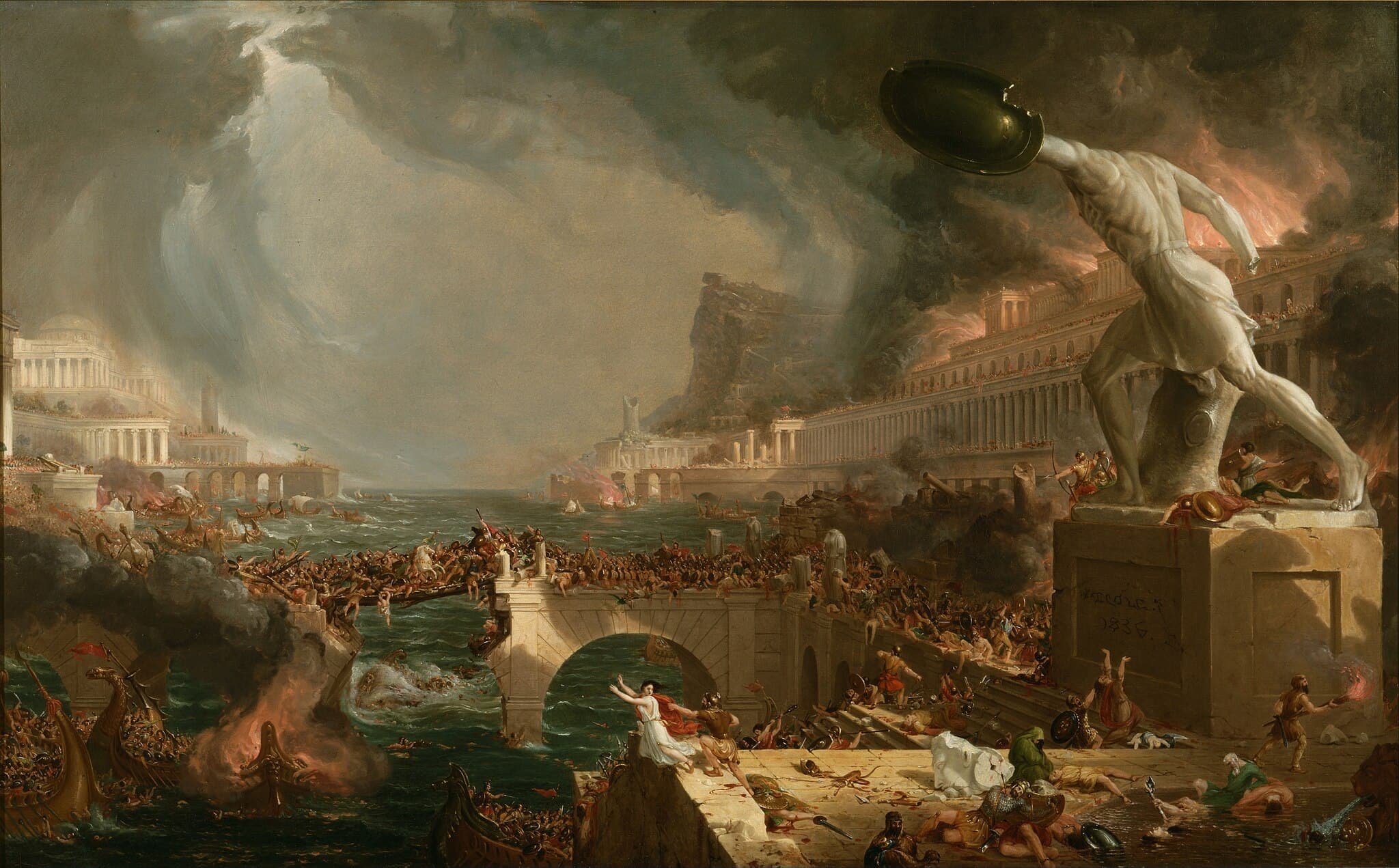
The Course of Empire: Destruction
Thomas Cole, 1836 • Oil on canvas
Read full analysis of The Course of Empire: Destruction →Valuation Analysis
Estimated value (hypothetical): $60–100 million. Thomas Cole’s The Course of Empire: Destruction is among the most iconic images in 19th‑century American art—a centerpiece of the five‑painting narrative cycle and a touchstone of the Hudson River School. The work has no public sale history and is owned by the New‑York Historical Society, rendering it effectively off‑market; any sale would be extraordinary and subject to institutional constraints [1].
Methodology. We extrapolate from a tight set of same‑artist and closely related category benchmarks. Public auction prices understate the ceiling for Cole: the artist’s current auction record is $1.623 million (Christie’s, January 23, 2025) for Mount Chocorua, New Hampshire, a strong but non‑trophy panel [2]. Private and appraisal data show far higher pricing when masterpieces surface: The Falls of the Kaaterskill reportedly sold privately for upward of $35 million in 2011 [3]; Gurr Johns appraised the monumental Portage Falls on the Genesee at roughly $18–20 million in 2008 [4]; Newark’s deaccession of The Arch of Nero in 2021 achieved $988,000 at Sotheby’s, underscoring how subject, scale, and status drive wide dispersion in outcomes [5]. In 2021, The Huntington acquired Portage Falls (widely reported around $12 million), confirming robust institutional appetite for major Cole [6].
Why Destruction commands a premium. Within Cole’s oeuvre, Destruction is a signature, widely reproduced image with exceptional narrative power, on par with his most famous works and arguably the most dramatic scene in the Course of Empire cycle. Works of this stature seldom, if ever, reach market; that scarcity, plus the cultural centrality of the painting, supports a meaningful “trophy premium” over prior Cole comparables and category peers.
Positioning of the estimate. The $60–100 million band sits above known private Cole prices and well above the public record, reflecting Destruction’s canonical status, museum‑grade provenance, and the global trophy market’s willingness to transcend artist records for singular masterpieces. The top of the range presumes competitive interest from U.S. institutions and a handful of cross‑category collectors; the lower bound reflects thinner liquidity in 19th‑century American art relative to modern/contemporary, even for icons.
Notes. This estimate assumes stable, museum‑standard condition and that the work is offered singly. If the entire five‑painting Course of Empire cycle were marketed intact, a substantial unity premium could push aggregate value materially higher.
Key Valuation Factors
Art Historical Significance
High ImpactDestruction is a centerpiece of Cole’s five-part The Course of Empire, one of the most influential cycles in American art. It encapsulates the artist’s moralizing vision of rise and fall and is among the most reproduced, taught, and exhibited images in the Hudson River School canon. Within Cole’s oeuvre, only a handful of works (e.g., The Oxbow, The Voyage of Life) rival its cultural imprint. That centrality drives demand from both institutions and cross-category trophy collectors seeking emblematic works that signify beyond the artist’s market. When such a definitive, narrative work surfaces—especially from a landmark series—buyers typically pay substantial premiums over standard landscape subjects.
Rarity and Market Supply
High ImpactFirst-rank Cole paintings are extremely scarce on the open market; the most important examples have long been in museum collections. The Course of Empire cycle has resided with the New-York Historical Society since the 19th century, meaning Destruction has never established a modern auction price. In recent years, auction offerings by Cole have skewed to smaller or less iconic works, keeping the public record artificially low. This structural scarcity intensifies competition for any masterpiece‑grade Cole that might appear and supports significant extrapolation beyond public comps. At this level, rarity is a chief price determinant, especially when paired with the painting’s canonical status.
Provenance and Institutional Stewardship
High ImpactThe painting’s blue‑chip provenance—commissioned in the 1830s and held by the New‑York Historical Society since 1858—confers exceptional credibility. Continuous institutional care typically ensures rigorous conservation, exhaustive scholarship, and an unimpeachable exhibition and literature history. Such factors reduce transactional risk, bolster buyer confidence, and justify premium pricing. While any deaccession would involve ethical and practical complexities, the quality of title and depth of documentation associated with long‑term museum ownership meaningfully enhance perceived value, particularly at the upper end where trophies are increasingly judged on cultural stature and provenance prestige as much as on formal attributes.
Market Benchmarks and Trophy Premium
High ImpactCole’s public auction record is $1.623 million (2025), but private and appraisal indicators for top material are an order of magnitude higher. A celebrated Cole, The Falls of the Kaaterskill, was reported to have sold privately for $35+ million in 2011; Portage Falls on the Genesee drew an $18–20 million appraisal (2008) and was acquired by The Huntington in 2021, widely reported around $12 million. These datapoints establish that true masterpieces command far more than auction comps suggest. Destruction’s status as a canonical, narrative‑cycle apex justifies an additional trophy premium, placing it comfortably in the $60–100 million range under competitive conditions.
Sale History
The Course of Empire: Destruction has never been sold at public auction.
Thomas Cole's Market
Thomas Cole (1801–1848), founder of the Hudson River School, occupies a foundational position in American art history. Supply of major works is exceptionally tight due to early patronage and long-term institutional holdings. Public auction prices for Cole have historically been modest relative to his stature, with a new auction record of $1.623 million set in January 2025. However, private transactions and appraisals for masterpiece-grade Coles demonstrate substantially higher valuations, often in the eight figures. Demand concentrates on autograph, large-scale oils with emblematic subjects (Catskills, White Mountains, or signature narrative themes), fresh market status, and distinguished provenance. Private-treaty channels dominate at the top end of the market.
Comparable Sales
Mount Chocorua, New Hampshire
Thomas Cole
Same artist; prime early subject and strong mid-size panel; set the current public auction record for Cole and establishes the recent public ceiling for the artist.
$1.6M
2025, Christie's New York
View Near Catskill
Thomas Cole
Same artist; late‑1820s Catskills subject on panel—quintessential Cole territory; indicates recent public pricing for solid but non‑trophy material.
$504K
2024, Christie's New York
~$519K adjusted
The Arch of Nero
Thomas Cole
Same artist; mid‑1840s canvas with classical‑ruin subject that thematically echoes empire/decay—concepts central to The Course of Empire.
$988K
2021, Sotheby's New York
~$1.2M adjusted
The Falls of the Kaaterskill
Thomas Cole
Same artist; widely celebrated early masterwork of monumental scale and signature subject; reported to have sold for upward of $35m, showing private-market appetite for top-tier Coles.
$35.0M
2011, Private sale
~$50.8M adjusted
Portage Falls on the Genesee
Thomas Cole
Same artist; monumental 1830s canvas long viewed as a major Cole; institutional acquisition reported at ~$12m provides a recent private benchmark for museum‑caliber Cole.
$12.0M
2021, Private sale to The Huntington (via Ahmanson Foundation)
~$14.4M adjusted
Kindred Spirits
Asher B. Durand
Cross‑artist Hudson River School trophy closely linked to Cole (a memorial to him); its ~$35m private price shows the field’s top tier can command mid‑eight figures.
$35.0M
2005, Private sale
~$58.1M adjusted
Current Market Trends
The broader 19th‑century American and Hudson River School category has firmed over the past three years, with Christie’s Americana Week totals strengthening and a new Cole auction record set in 2025. Specialists cite renewed curatorial focus and America 250 programming as tailwinds, while acknowledging that top‑tier activity remains concentrated among a small pool of determined buyers. Within this context, marquee historical American works continue to transact privately at levels well above public comps. Trophy‑grade material—especially canonical images with museum provenance—can attract cross‑category collectors, enabling step‑change pricing when competition materializes, even as overall market liquidity remains thinner than in modern and contemporary segments.
Study print
Study this painting as a print
Pair the full artwork with a museum-style study sheet focused on one meaningful detail.
Sources
- Wikipedia: The Course of Empire (paintings) — ownership and series context
- Christie’s press release — Jan 23, 2025 sale totals and Cole auction record
- Artnet News — Cole’s new auction record and reported $35m private price for The Falls of the Kaaterskill
- ArtfixDaily — Gurr Johns appraisal of Cole’s Portage Falls on the Genesee at $18–20m (reported 2013)
- The Art Newspaper — Newark Museum of Art’s sale of Cole’s The Arch of Nero ($988,000 with fees, 2021)
- The Huntington — 2021 announcement of Cole’s Portage Falls on the Genesee acquisition (institutional benchmark)